Visit Worldwide Topsites
Showing posts with label Craters-Gassendi. Show all posts

Friday, 19 February 2016

West of the Moon images by astronomical telescope.

Throughout its history, the Moon has undergone many and varied attempts to reach the form that we see today through a telescope. These steps were somewhat like a puzzle arranged by astronomers to understand exactly how and when the successive periods was reached forming seas, mountains, craters and other lunar features.

Also successive periods can be found in any available object for observation, if we have enough data for analysis. Even Earth has such successive periods of forming but many have been erased by erosion, the atmosphere. But the Moon has no atmosphere and all stages of its formation are more easily understood by scientists.

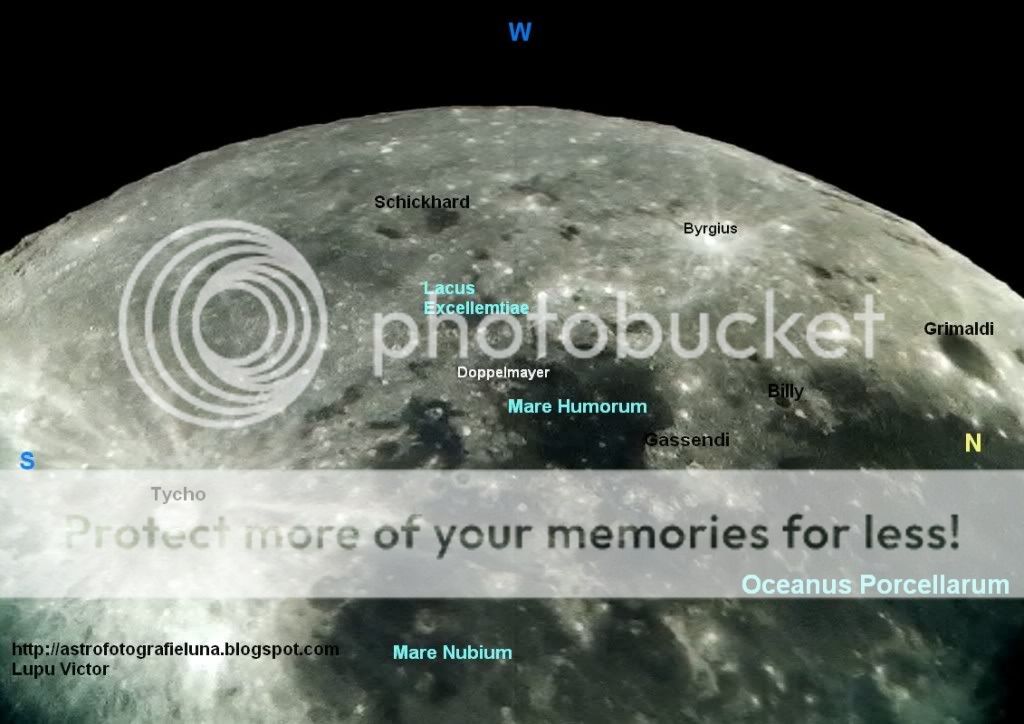
I believe that parts of southeast and south of the Moon, are the most ancient lands because they were not affected by the seas that covered much of the surface. Also in these images crater walls were untouched by floods of Mare Humorum. Examples are Gassendi (110 km) Mersenius (84 km) Liebig (37 km), Gasparis (30 km), Cavendish (56 km), Freres (42 km), Byrgius (87 km) - in the shade.


Magnitude: -12.11
Phase: 0.96
Distance: 401.329 km
Illuminated: 96.2% (0% = New, 100% = Full)


Astronomical instrument: Celestron C8-Newtonian telescope,
Eyepiece: Plossl 20mm, 2x Barlow
Mount: CG5 (EQ5)
Apparatus: Sony CX130
Filter: no
Date: 08.11.2011
Location: Baia Mare, Romania
Processing: FastStone Image Viewer


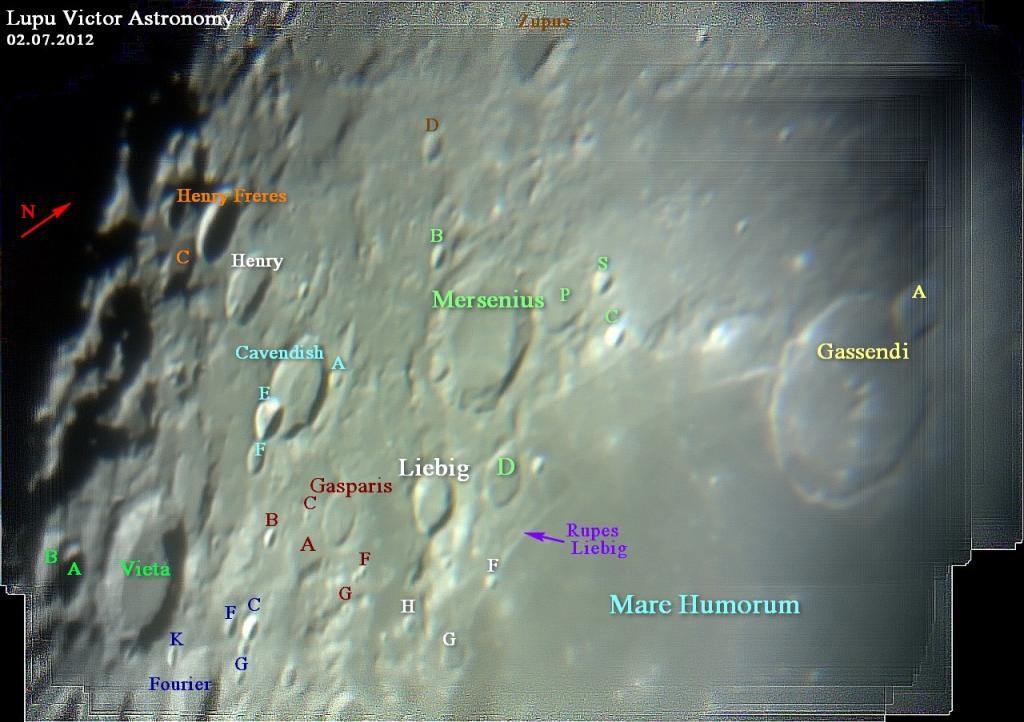
In the picture below are labeled craters and other lunar features in the region. To better understand this photo, you should note that the label with the name or the letter of larger craters could be found at their center, and on the small craters, you should find them around them, usually above.


Saturday, 11 July 2015

Distances between craters. South-west Moon through astronomical telescope.

The whole surface of the Moon is interesting, especially observed through a telescope. It is true, here on Earth, we can't enjoy all of its surface, but only 59% of it, because it keeps the same face toward us without enjoying the "unseen face", or the "dark side" of it.

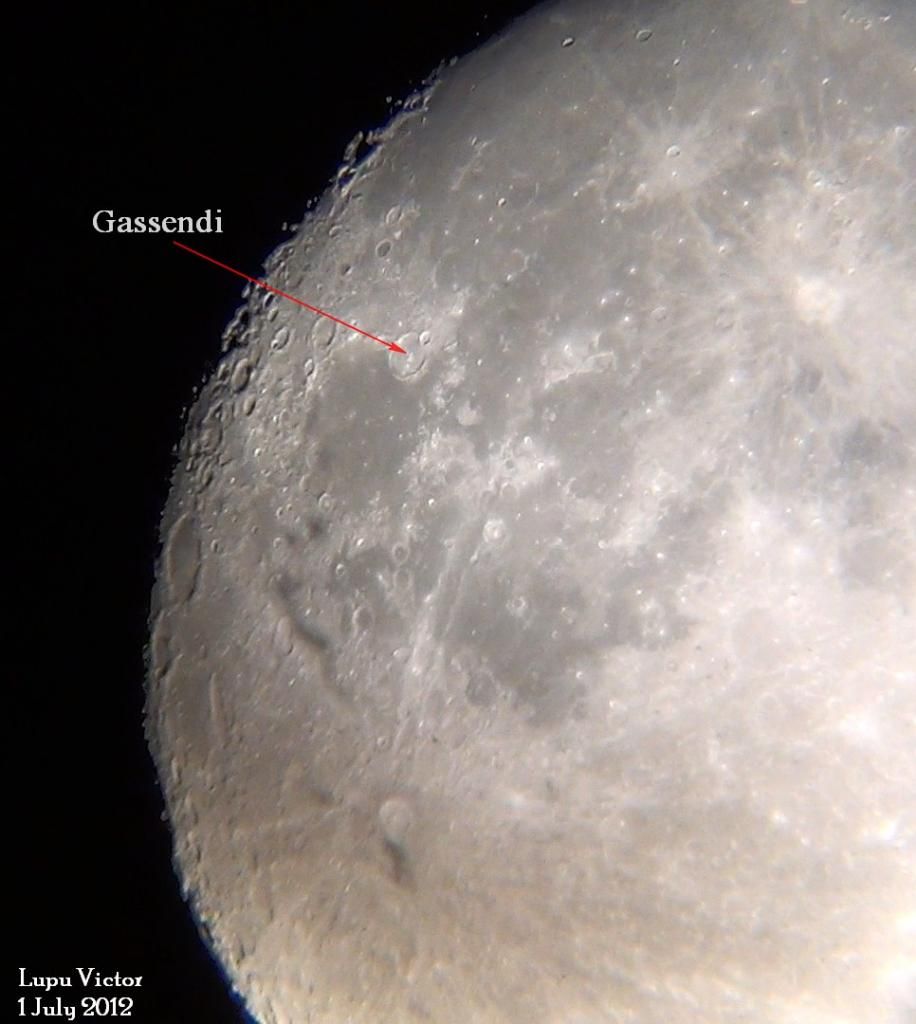
The images in this article, shows the south-west of the Moon. What we can see here, there are many interesting features, with craters of various shapes, some very interesting as Tycho's rays, or Gassendi (110 km) resembling a stone diamond ring and this time is at the terminator where light meets darkness.

Also identified here are other special craters as Clavius (225 km), south of Tycho (85 km). Both can be observed through binoculars, but differently: Clavius, for its large size but on Tycho we can not observe the crater itself through binoculars, but only the intense rays of the albedo which starts from it, thus being able to figure out where it is located. However, Tycho crater rays are not visible in any lighting conditions. To be observed, sunlight must shine from a high angle, such as when lunar phase is almost full.

We meet here only a basin on this side of the Moon, namely Mare Humorum.

In the last image are labeled a few craters and the distance between them to estimate how big the size of the Moon is. We can thus see that between Gassendi located on Moon's West and Langrenus (132 km) located on the Moon's east are 2,959 Km


Magnitude: -11.90
Phase: 0.86
Distance: 400.253 km
Illuminated: 85.8% (0% = new, 100% = full)


Astronomical Instrument: Celestron C8-Newtonian telescope
Eyepiece: Plossl 20mm, 2x Barlow
Mount: CG5 (EQ5)
Camera: Sony CX105
Filter: no
Date: 06.11.2011
Location: Baia Mare, Romania
Processing: FastStone Image Viewer

Thursday, 26 June 2014

Lunar craters filmed through a telescope: Gassendi Letronne Billy. 3 craters.


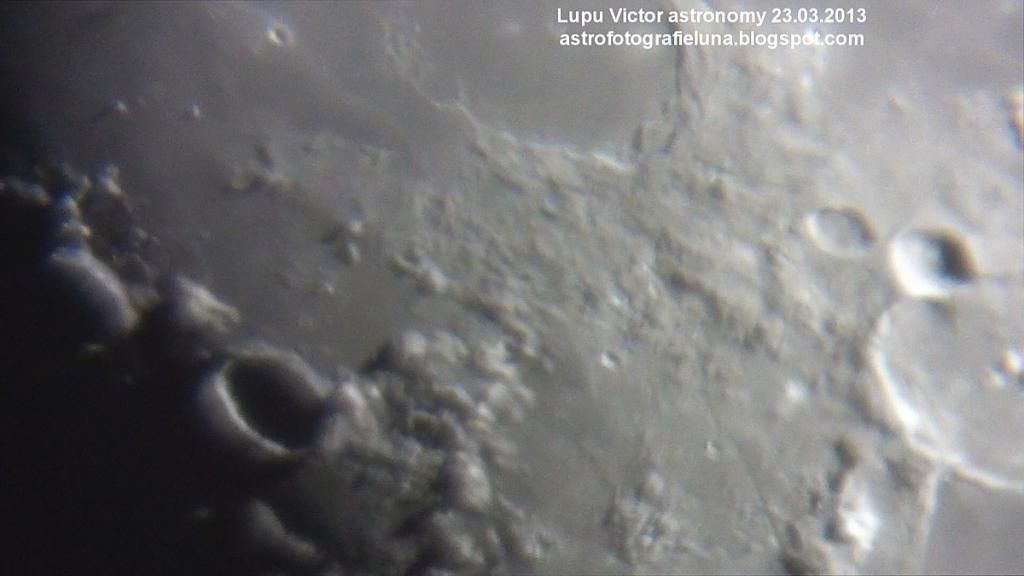
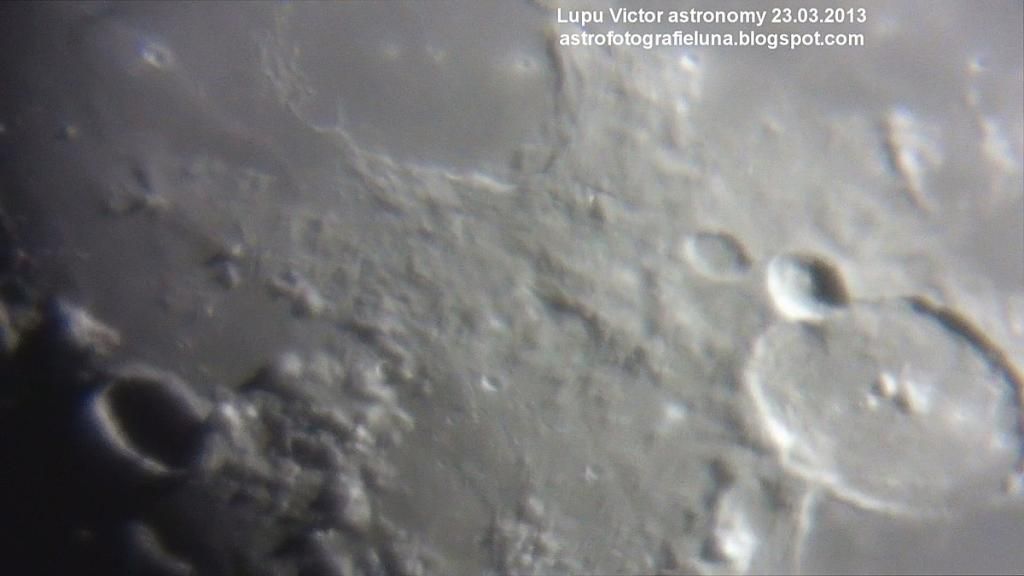
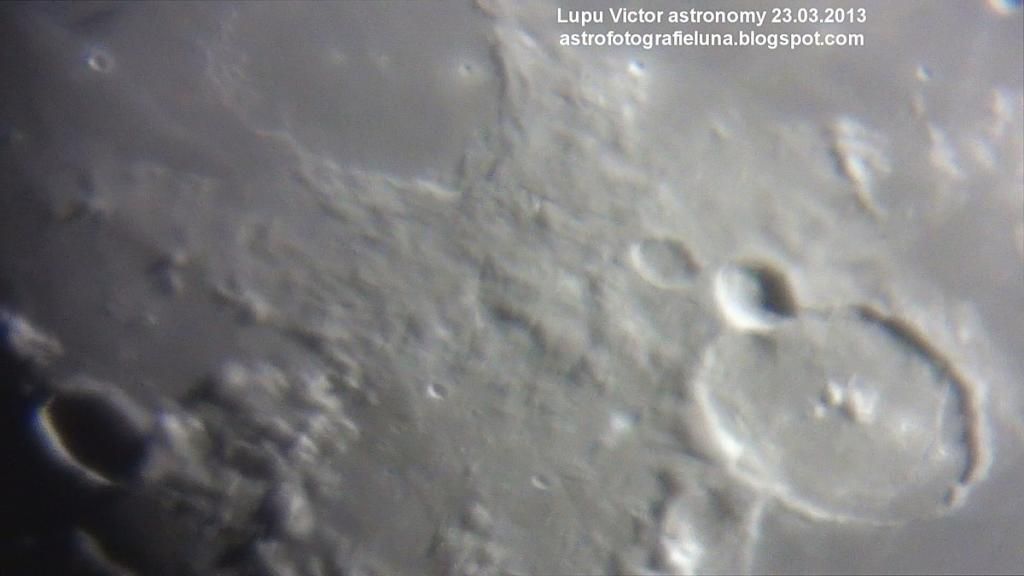
These images taken by the astronomical telescope, we observe three distinct craters in a single frame: Gassendi (110 km) with the shape of the diamond ring, Letronne (119 km) because it resembles a horseshoe, and Billy (46 km ), which has dark floor at this stage, and so it is highlighted.

Craters mentioned here are located on the west side of the Moon, in a region of the northwestern Mare Humorum Basin.

These are frames from a video made off HD camcorder attached to the telescope.


Age of Moon: 11 days
Distance: 386 658
Phase: 85% (0% = New, 100% = Full)


Optical Telescope Celestron C8 "Newtonian, 20mm Plossl, 2x Barlow
Mount: CG5 (EQ5)
Device: Sony CX-130
Video Mode: Full HD 1920x1080 progressive
Filter: no
Date: 23/03/2013
Location: Baia Mare, Romania
Processing and editing: Sony Vegas 10 FastStone.


Tuesday, 1 April 2014

Gassendi crater snapshots.


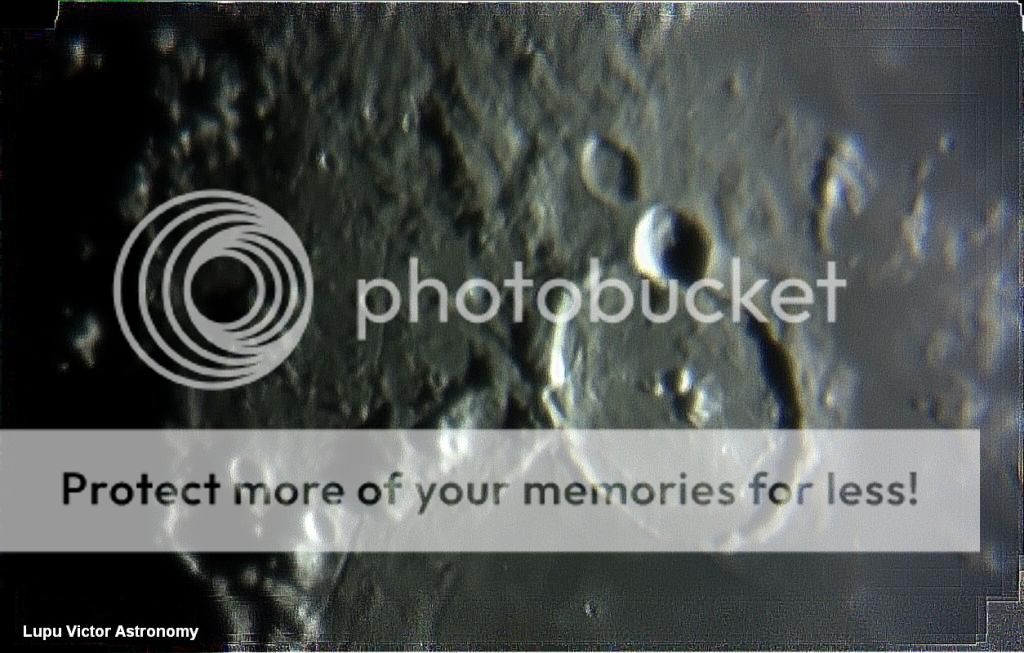
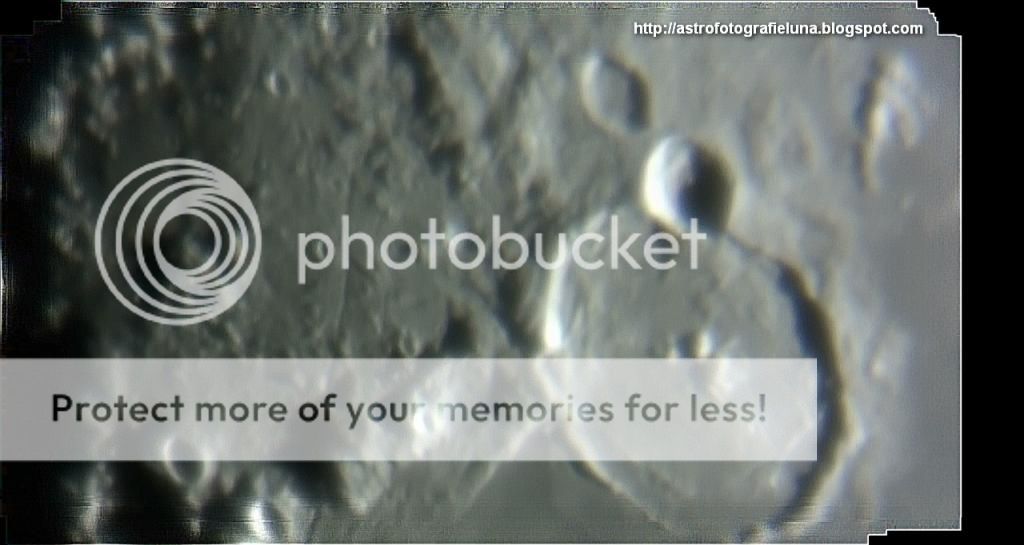
The largest crater that captivates you in these pictures, is Gassendi (110 km). It is easily observed through binoculars not only through a telescope. This area is magnified by the camcorder's lens, it is not a digital zoom. Every day craters looks different as the Moon phases are constantly changing.

Many of the craters present here were presented in other articles where I presented images of the same evening, but processed in Registax 5. These are only video captures.


Distance: 361125 km
Phase: 98.8% (0% = New, 100% = Full)


Optical Telescope CelestronC8 "Newtonian, plossl20mm, 2x Barlow
Mount: CG5 (EQ5)
Device: Sony CX-130
Video Mode: Full HD 1920x1080 progressive
Filter: no
Date: 02/07/2012
Location: Baia Mare, Romania
Processing and editing: Sony Vegas 10 video captures


Saturday, 11 January 2014

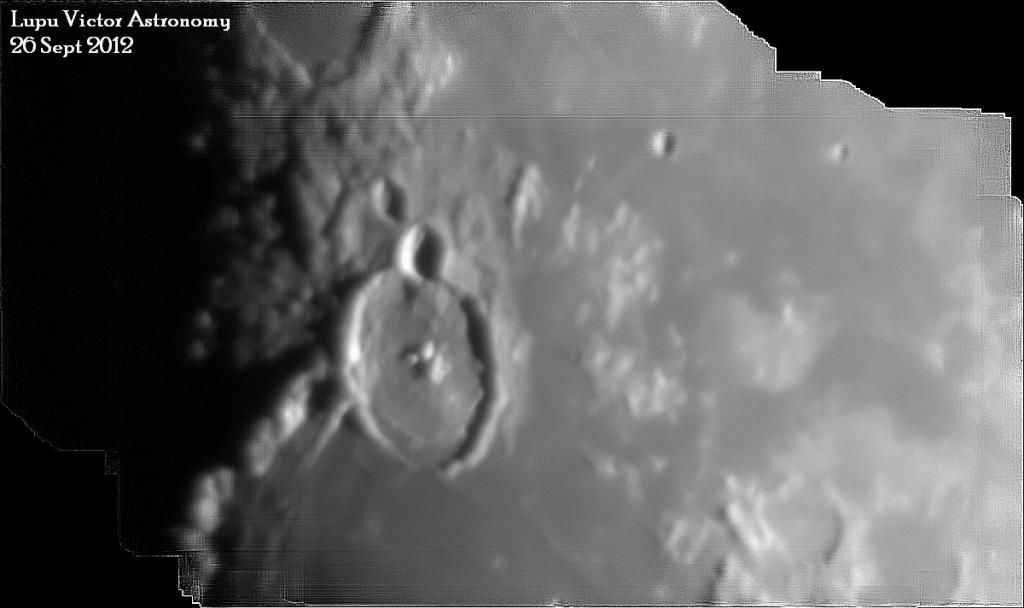
Lunar Photo - Gassendi crater.

466 frames at 85% best quality in Registax.


This image depicts the west of the Moon.
At center in image is the crater Gassendi (110 km). To the south is the Mare Humorum and to the north is Oceanus Procellarum

In the west is the terminal due to the phase of the Moon at the time. Because of this, craters west of Gassendi, are not visible, as is the crater Mersenius.
This image is a video processing in Registax.
I like the features observed in the crater Gassendi. We can see the mountains at the center of its floor, and the surrounding terrain.


Age ofthe Moon: 27.32 days
Distance: 381.700 km
Phase: 88.8% (0% = New, 100% = Full)


Optics: Celestron C8-Newtonian telescope, Plossl 20 mm, 2x Barlow
Mount: CG5 (EQ5)
Camera: Sony CX130
Filter: no
Date: 26/09/2012
Location: Baia Mare, Romania
Processing: Registax, FastStone Image Viewer


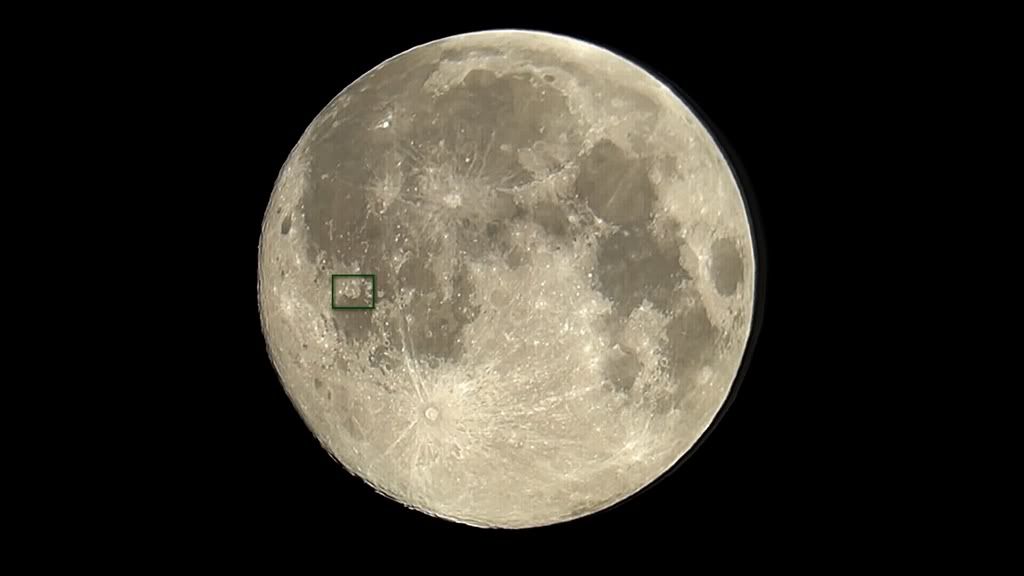
Image for guidance, from 04 March 2012.


Thursday, 21 November 2013

Craters North-West Mare Humorum. Telescope Images.

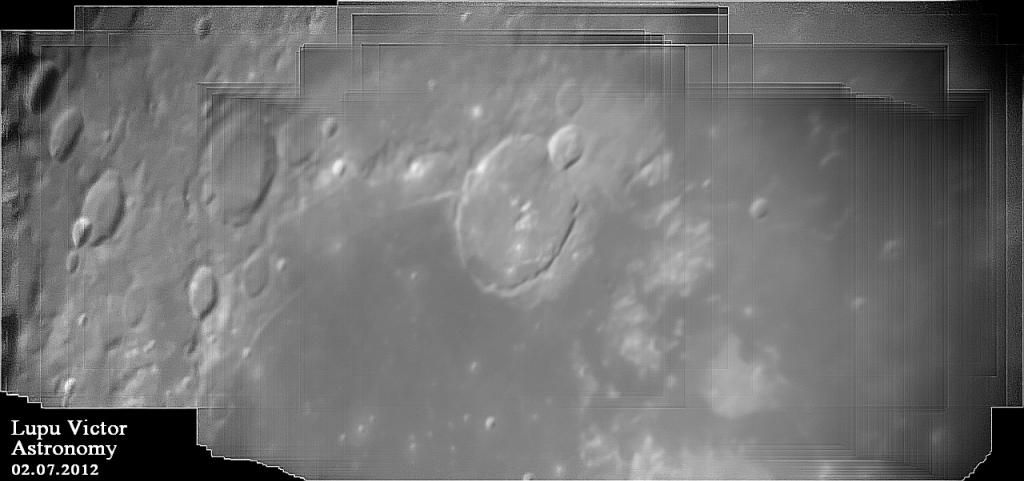
121 frames, at 79% in Registax.
165 frames, at 84% in Registax.

In the images in this article are a few nice features observed on northwestern Basin Mare Humorum, craters, which are located on the west side of the Moon. Where dark meets light left in the images, is called  the terminal.

I list here craters which in turn have smaller satellite craters or on the floor or around them, namely Cavendish (56 km) Vieta (87 km), Liebig (37 km), Mersenius (84 km), Gasparis (30 km) Henry (41 km), Freres (42 km), but not least, Gassendi (110 km).

Age of the Moon: 27 days
Distance: 361.204 km
Phase: 98.8% (0% = New, 100% = complete)


Optics: Celestron C8-Newtonian telescope, Plossl 20 mm, 2x Barlow
Mount: CG5 (EQ5)
Camera: Sony CX130
Filter: no
Date: 02.07.2012
Location: Baia Mare, Romania
Processing: Registax, FastStone Image Viewer


Image for guidance, from 04 March 2012.


Wednesday, 23 October 2013

Video by astronomical telescope Crater Gassendi

The first thing that crosses my mind when I think of Mare Humorum basin, is Gassendi crater (110 km) (minute 1:31), a diamond ring-shaped crater, located north-west of the circular basin west of the Moon.

Although this video is short, there is much to see in this region from the west of the Moon.

We note here Bullialdus crater (61 km) (0:13 min), Gassendi (0:18 min) and last, beautifully surrounded by shade, located west of Mare Humorum, is Mersenius (84 km) (shown at the beginning of the clip) .

Age of the Moon: 11 days
Distance: 386 658
Phase: 85% (0% = New, 100% = full)


Optical Telescope Celestron C8 "-Newtonian plossl 20mm, 2x Barlow
Mount: CG5 (EQ5)
Device: Sony CX-130
Video Mode: Full HD 1920x1080 progressive
Filter: no
Date: 23/03/2013
Location: Baia Mare, Romania
Processing and editing: Sony Vegas 10


Wednesday, 16 October 2013

Visual astronomy Mare Humorum Video.

The first thing that crosses my mind when I think of Mare Humorum, is crater Gassendi (110 km) (minute 1:31), a crater shaped as a diamond ring, north west of this circular basin on thr Moon.

Not much to see on Mare Humorum but only many small craters which are spread on the smooth plateau with the exception of Puiseux (25 km), but on the edges we see features that can not be overlooked.

On the edge of east, west and south of the basin are large craters as Doppelmayer (64 km), Hippalus (58 km) south and east, both having similar shapes because they were partially flooded and a part of their edges disappeared under lava basin, leaving them with a semicircle form.

Age of the Moon: 11 days
Distance: 386 658 km
Phase: 85% (0% = New, 100% = full)


Optical Telescope Celestron C8 "-Newtonian plossl 20mm, 2x Barlow
Mount: CG5 (EQ5)
Device: Sony CX-130
Video Mode: Full HD 1920x1080 progressive
Filter: no
Date: 23/03/2013
Location: Baia Mare, Romania
Processing and editing: Sony Vegas 10


Mare Humorum. Image from 2010.


Thursday, 5 September 2013

Crater Gassendi and former Clarkson.

25 frames, 95% best quality in Registax.
70 frames, 90% best quality in Registax.
28 frames, 90% best quality in Registax.


Beautiful ring-shaped crater in these pictures is called Gassendi (110 km), and is situated on the northern  Mare Humorum basin. "Jewel" of the ring is Gassendi A (33 km), a satellite crater that can be found in some older maps as Clarkson, named after the selenographer Roland Clarkson, but this name was not accepted.

Most interesting on Gassendi, inside it is full of rilles that stretch across the entire floor in several directions. Also on the floor, we see another circular inner wall.

Although this is a huge crater 110 km in diameter, it has a depth of only 1.9 km.

Age of the Moon: 11 days
Distance: 377.436 km
Phase: 44% (0% = New, 100% = Full)


Optics: Celestron C8-Newtonian telescope, 20mm Plossl, 2x Barlow
Mount: CG5 (EQ5)
Camera: Sony CX130
Filter: no
Date: 04.03.2012
Location: Baia Mare, Romania
Processing: Registax, FastStone Image Viewer


Thursday, 21 June 2012

Most beautiful crater on the Moon Gassendi telescope images


Above are video captures made ​​in Sony Vegas. Below are video captures made ​​in Splash Player.


     Gassendi (110 km.), is probably the most ancient crater on the Moon. It is a magnificent crater, which dominates the north of Mare Humorum. Much of the crater overlaps the north of  Mare Humorum, where it narrows and Gassendi's south wall is almost submerged.

     Gassendi's floor is a complex of mountains, hills and ditches. The group of three large central mountains, is surrounded by Rima Gassendi, who cut most of the crater floor, especially at east of the central peaks. The most important Rilles (ditches), is starting from the east of the highest central peak, and tilts toward the eastern crater wall. Between these grooves are seen two small but notable craters that go along them. United, the largest of Rima Gassendi grooves, are spanning for more than 300 km.

Gassendi A (33 km), a crater with sharp edges, is superimposed on the northern edge of Gassendi. A south ridge of this crater, lies on the floor of Gassendi, causing a prominent triangular shadow.
      The video of these great images, can be found here: Video by telescope Gassendi crater in March 2012 .


Photographer: Victor Lupu
Optics: Celestron C8-Newtonian telescope, plossl 20mm, 2x Barlow
Mount: CG5 (EQ5) 
Device: Sony CX130
Filter: no
Date: 04/03/2012
Location: Baia Mare, Romania
Processing: Sony Vegas 10 video captures

 
All images are © Copyright 2010-2015 Lupu Victor. All rights reserved.Images may not be reproduced, published, or copied in any form without written permission of the author. Thank you for respecting the intellectual property rights. ASTROFOTOGRAFIA | Lupu Victor Astronomy - Contact - About
Design by Free WordPress Themes | Bloggerized by Lasantha - Premium Blogger Themes | Online Project management