Visit Worldwide Topsites
Showing posts with label Planets. Show all posts

Wednesday, 10 April 2013

Photos of Mars through a telescope


Mars, is the fourth planet from the Sun, and the last terrestrial planet in the Solar System. Beyond Mars, are only gas or icy planets. Those are called extra planets.


It is believed that Mars is made of a single plate, unlike the Earth, which is composed of several tectonic moving plates. Perhaps the Red Planet, with no volcanic activity, does not allow exposure to light of some plates , while being covered by dust storms that can last for weeks, and covering the entire planet. These storms occur especially when Mars gets closer to the sun.

Mars is at the closest distance to Earth, 54.7 million kilometers. However, when the two are separated by the Sun (the Sun in the middle), they can be separated by 400 million kilometers.

In the future, I think that people will look for precious metals on Mars. If their existence proves to be true, imagine how much a gram of martian gold would be. But so far we did not tried any recovery mission ever for a rover or any module way back to Earth from Mars. Perhaps this requires manual handling of a human.

Mars (Ares: God of War), has 2 moons, called Phobos (phobia, fear) and Deimos (panic). These names were given for the god twins with the same names, companions of Ares in wars. Phobos orbits very close to the planet, with assumption of it to crash on Mars in about 500 million years.

Optics: Celestron C8-Newtonian telescope, 20mm Plossl, 2x Barlow
Mount: CG5 (EQ5)
Camera: Sony CX130
Filter: no
Date: 29.04.2012
Location: Baia Mare, Romania
Processing: video captures, FastStone Image Viewer
Sunday, 7 April 2013

Video by astronomical telescope Jupiter filmed in December 31, 2012

Jupiter, is the largest planet in the Solar System where we live, a systemwhich counts eight planets. Jupiter is 318 times greater than the mass of our planet. This beautiful planet is not like Earth. It consists of clouds of poisonous gas and the colored bands surrounding the planet are mixed gases due to its rapid rotation around its axis. The planet with have the fastest speed of rotation of all the planets in the system. Due to the high speed (one day is approximately 10 hours), Jupiter is slightly flattened, and this is seen on its equator.

Many do not know, but with a modest 7x40 binoculars, you can see 4 of Jupiter's largest moons: Io, Europa, Ganymede and Callisto, of the 63 known moons to date.

Below I've put a 10 minute long video in which we see Jupiter far, and near, filmed with a HD camera of which I gradually increased the zoom.


Optics: CelestronC8 "-Newtonian telescope, plossl20mm, 2x Barlow
Mount: CG5 (EQ5) motorized
Device: Sony CX-130
Video mode: Full HD progressive 1920x1080
Filter: no
Date: 31/12/2012
Location: Baia Mare, Romania
Processing and editing: Sony Vegas 10

Friday, 29 March 2013

Beautiful images of Venus planet through amatorial telescope


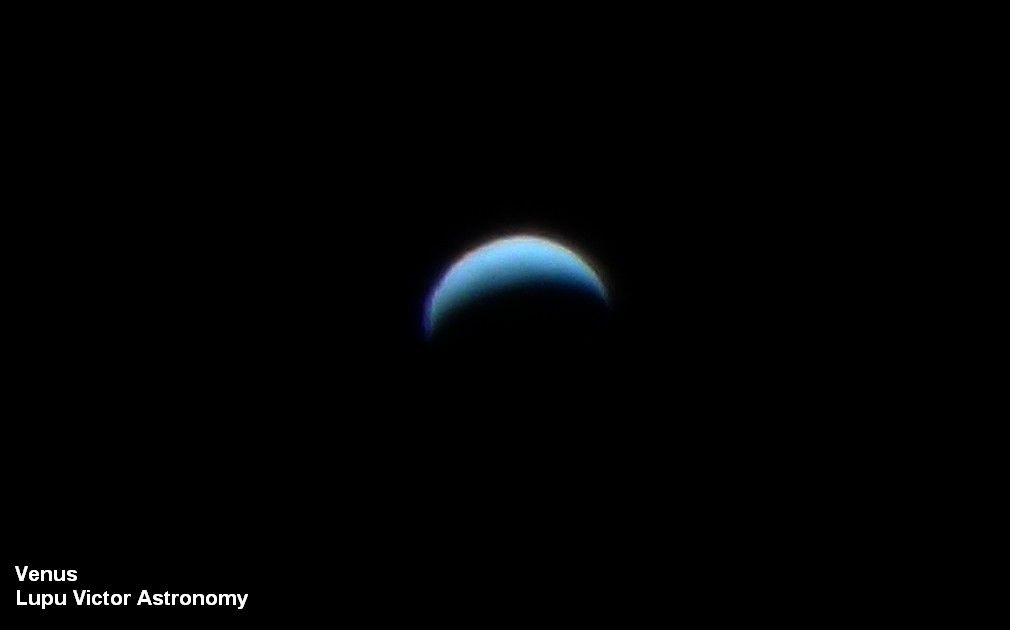
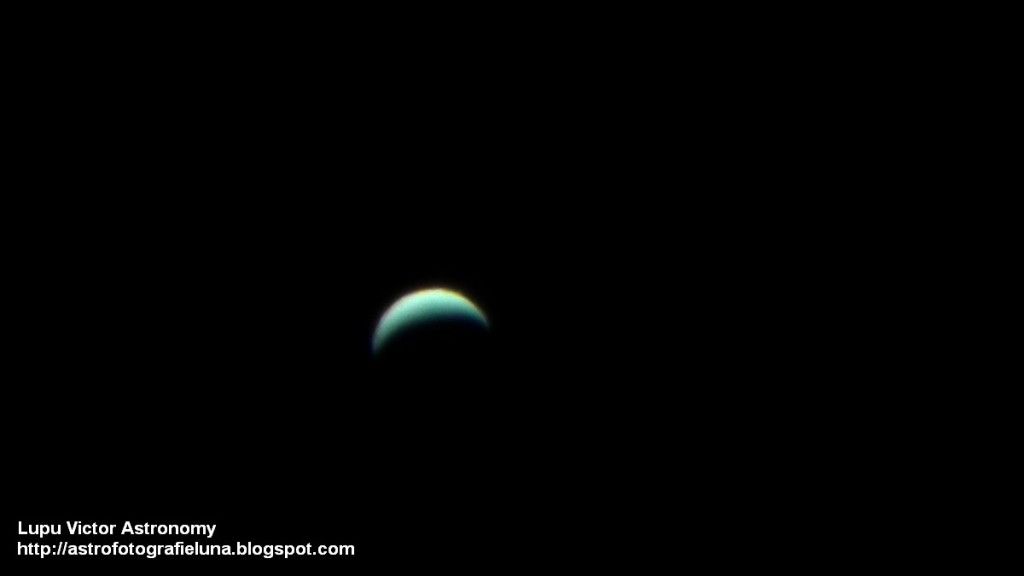
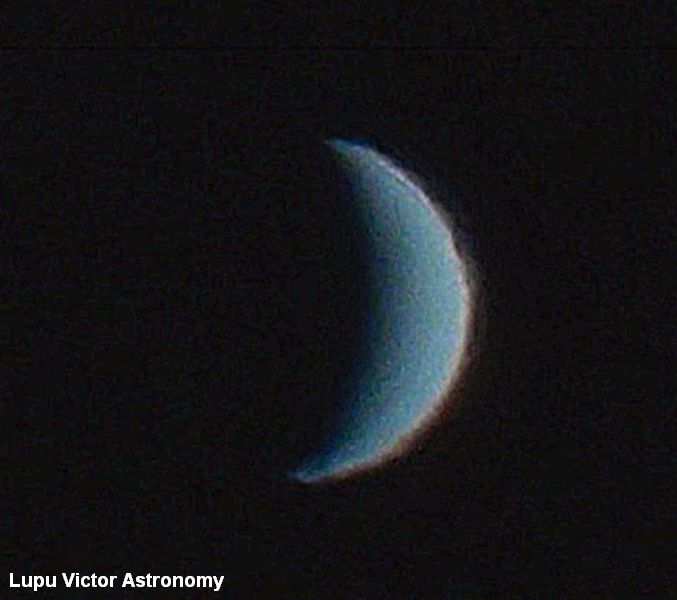
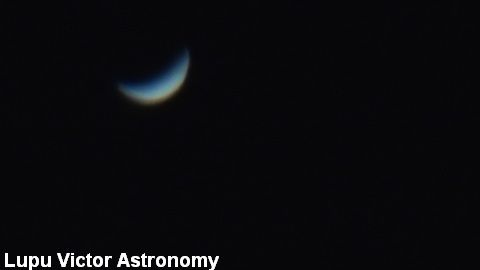
These sharp images with Venus are so amazing to me, because we have a planet so beautiful neighbor of ours, which we can see with a telescope so well and we can notice it's form. The sun illuminates only one side, giving the impression that you look at a crescent Moon. The color of the planet it's blue, but that is the eyepiece lenses fault. One might say it's Neptune, if it were not so far from Earth.
 The surface of Venus can not be seen because it is always covered in clouds. Many times I was disappointed when I made images of the planet through the telescope, but now, being in opposition, I caught it in her moments of extreme closeness to us, Venus being on opposition at the time.

Optics: Celestron C8-Newtonian telescope, 20mm Plössl, 2x barlow
Mount: CG5 (EQ5)
Camera: Sony CX130
Filter: no
Date: 29/04/2012
Location: Baia Mare, Romania
Processing: video captures, FastStone Image Viewer

Monday, 25 March 2013

Saturn images through 8 inch Celestron


Ask some of the amateur astronomer which are using a telescope what he considered his the most beautiful thing in the sky, and many of them will tell you it is Saturn. In fact, many say that their first glimpse of this planet, was what made ​​them focus on astronomy. A view of Saturn in a good telescope, often attract sighs of the visitors, who, after a lifetime of seeing the planet rings in cartoonsare "terrified" at the sight of the original.

Saturn's rings should be visible even through the smallest telescope at 25x. A 3-inch telescope at 50x can show you the ring as a detached structure on both sides of the planet.

8-inch telescopes are excellent for observing Saturn. With this size of telescope, you can have a magnification of up to 300x or more. Most will offer the best observation of 350x or less, some can go up to 450x before the image to degrade, or you can not see too much Saturn, because it will take a little tracking engine on the telescope to follow the sky, due to Earth's rotation.


Optics: Celestron C8-Newtonian telescope, 20mm Plössl, 2x barlow
Mount: CG5 (EQ5)
Camera: Sony CX130
Filter: no
Date: 29/04/2012
Location: Baia Mare, Romania
Processing: video captures, FastStone Image Viewer


Evening sky map of 29 April 2012, captured image with Stellarium program.

Thursday, 28 February 2013

Jupiter last night with DSLR and HDR


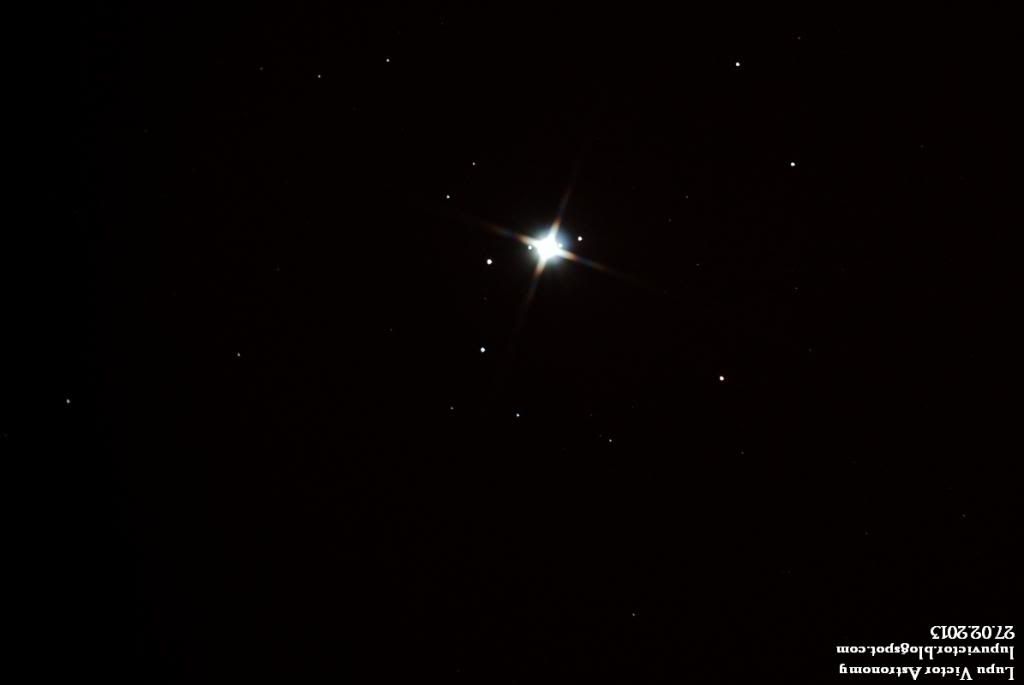
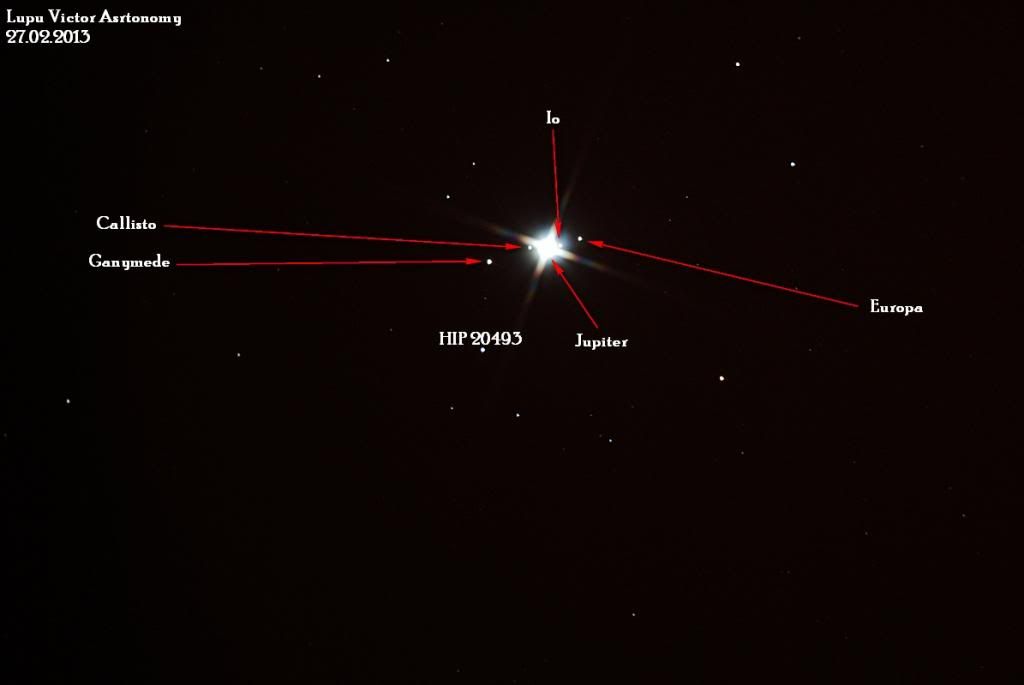
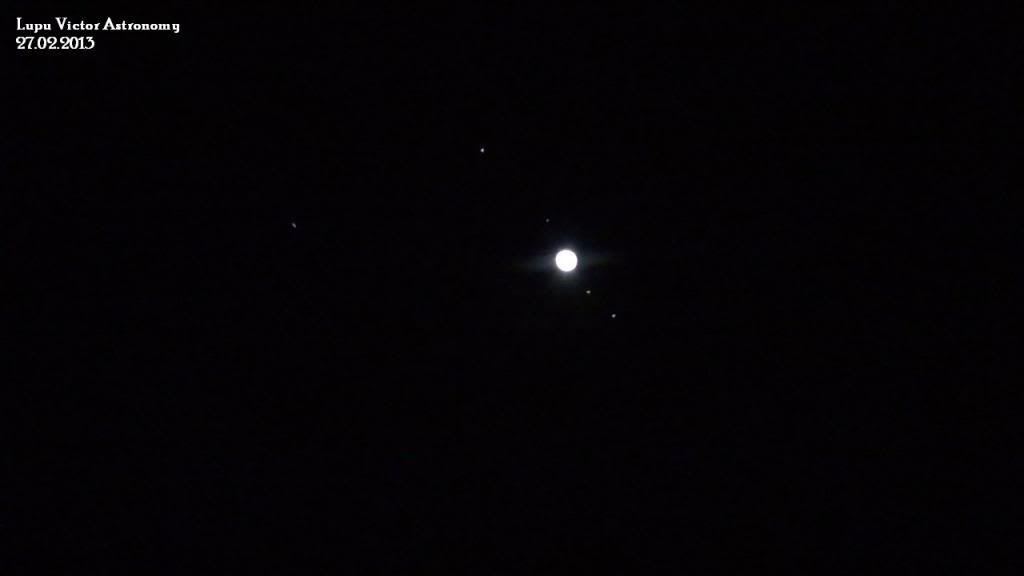
These are pictures of Jupiter last night at around 10:00 p.m. taken by DSLR camera Nikon D80 (top) and Sony HDR CX130 camcorder (below).

Last night it was warm, unusual for this time of the year.

These are quick processing photos. Video processing will be posted later.


Sunday, 11 November 2012

Mercury The courageous planet to stand before the Sun

Photo: Mercury taken by Messenger probe (NASA / JHU Applied Physics Laboratory / Carnegie Institution)

First planet near the Sun is Mercury, a small size planet, which orbits the sun in 88 days, and 59 days to rotate once on its axis. Earth need only 24 hours. It is similar in appearance to Earth's moon. Actually now still are doubts about how our moon got in our orbit, because it could have been a planet like Mercury, but trapped by Earth's gravity.

If this little planet is at the smallest distance from the Sun, it is not difficult to understand that on the Earth, Mercury can not be seen but only shortly after setting, or rising of the Sun. However, even through a telescope can not be seen clearly because its diameter. Imagine that you want to see the Moon, not 385,000 miles away from Earth, but at 77 million km, because the diameters of the two are quite similar. Mercury has a diameter of 4.878 km and the  Moon 3.474 km.
Mercury was photographed and studied closer by the probes Mariner 10 and Messenger.


Mercury has it's name from the Roman god Mercury, messenger to the gods.
Being very close to the Sun, is the hottest planetit's temperature reaching from -173 to 426 degrees Celsius.
It does not have an atmosphere like it's neighbor planet (and ours), Venus, and so is naked in front of the sun without being protected against solar radiation. Craters on this planet are very much like that of our moon. I even wrote an article about the similarity of Schickard crater on the Moon with a crater on Mercury.


The planet Mercury resembles the Moon, and the other satellites of other planets. We find nothing original about it's appearance.
It is the first body that has the courage to stand before the Sun. We do not know yet if it is the courage, or whether it was forced due to some circumstances, to be the planet closest to the Sun, but definitely the hard conditions of this planet makes it a heroine. Between the two bodies is a distance of only 70 million km (at aphelion), compared to the distance between Earth and the Sun, which is 150 million km.


We don't know much about the planets in the Solar System, if formed where they are, or have changed their position relative to the Sun, but to know thatwe need landing space missions that give us information about soil composition of each body in the system, to compare them. These data could be surprising. Mercury could be for example one of the moons of planets like Jupiter etc. ..

If you would stay on Mercury, actually on any planet in the Solar System, the night sky would be the same as we see it from Earth. Constellations would have the same form in the same order. The only changes the sky would be some 'stars', which are the planets. Mercury's closest planet is Venus, which ould look on Mercury's sky about the same in brightness as we see it on Earth. Of course all the planets would be in a different arrangement seen on Mercury. Among them is our planet, which I guess would be seen less luminous as Venus, and maybe with a blue tint.
In Mercury's daytime, the Sun is seen very large and very bright. Because it has the lacks of the atmosphere, it does not have colors of the sky, like our case, which we have blue skies, or the planet Venus, which is always covered with clouds .. No climate change there, because the planet is not alive. It is something like what you would find on the Moon.


Tuesday, 30 October 2012

Splendid planet Venus video through telescope

Two planets are closer to the Sun than Earth and they are Mercury and Venus. This means that we can not see them very far from the Sun in the sky. All other planets glow in the midnight sky, but these two "inferior planets" (planets which have a closer distance from the Sun than the Earth) are never seen more than a few hours after sunset or before sunrise .

The inner planet, Mercury, it can be no more than 28 ° from the Sun, and Venus at about 47 ° . These moments when Mercury and Venus reach maximum angular separation from the Sun, are the most precious for seeing these planets better. When they get to this position, we say that they are at greatest elongation.


Video: Victor Lupu
Optics: CelestronC8 "-Newtonian telescope, plossl20mm, 2x Barlow
Mount: CG5 (EQ5)
Device: Sony CX-130
Video mode: Full HD progressive 1920x1080
Filter: no
Date: 29/04/2012
Location: Baia Mare, Romania
Processing and editing: Sony Vegas 10

Sunday, 21 October 2012

Jupiter 21 october 2012 DSLR and telescope.


This is Jupiter, and 4 of its moons with Nikon D80 camera through a telescope. I've used different exposures of 4, 13 and 20 seconds. I have a secret about these pictures, namely that were made with a little motor guide that had run wild. It functioned alone without pressing any buttons. So it turned out that the way it moved matched the rotation of the earth. Actually all the pictures taken that day were made in the same manner.

Telescope: Celestron 8 inch Newtonian
C5/EQ5 motorized mount
Camera: Nikon D80 ring T
Eyepiece: not (focal)
Filter: no
Date: October 21, 2012
Time: 04:51
Mode: manual
ISO: 640
Exposure time: 20 sec
Location: Baia Mare, Romania

Sunday, 16 September 2012

[FullHD] Saturn planet video by telescope

A 9-minute video of gaseous planet Saturn seen through my telescope in April 2012. A gas giant planet refers to planets such as Jupiter, Saturn, Uranus, Neptune. These planets
are gaseous, without any solid surface, on which could not land anything.


It is very likely that all giant planets, gas and ice alike, to have come from the same region of the protoplanetary disc of the solar system formation, ~ 5.10 AU, ie today's region of Jupiter and Saturn. Uranus and Neptune are likely to be only "failed" versions of Saturn and Jupiter.

The four outer planets, gas giants, are much more massive than Earth. Two large, Jupiter and Saturn, are composed primarily of hydrogen and helium, and the two outermost planets, Uranus and Neptune, are composed largely of ice, such as water, ammonia and methane, and are often referred to separately as "ice giants".

Related article: Planets in our Solar System. Astronomy lecture.


Optics: CelestronC8 "-Newtonian telescope, plossl20mm, 2x Barlow
Mount: CG5 (EQ5)
Device: Sony CX-130
Video mode: Full HD progressive 1920x1080
Filter: no
Date: 29/04/2012
Location: Baia Mare, Romania
Processing and editing: Sony Vegas 10

Monday, 4 June 2012

3 amazing Venus videos by telescope The second planet from the Sun.

      Venus continues to amaze me. At first time I noticed this planet through a telescope, I saw it small and difficult to distinguish, because of the atmosphere and distance from the Earth. I believed then that my telescope will never see it well, but apparently I was wrong. Now I see it clear as a crescent, big and beautiful.
      Venus has a diameter of 12,100 km, with about 1040 km in smaller than the diameter of Earth (95%). If it would be someone on Venus with a telescope, would see the Earth at about the same size as we see Venus from here.

     Average surface temperature of Venus is 462 ° C, about 9 times higher than on Earth. The surface pressure is 92 times higher than here, and the atmosphere contains 96% carbon dioxide.

     The clips below are organized in chronological order. On April 27th I had the sharpest images with Venus, in my opinion. I hope to have luck on June 6 transition to film the planet across the Sun, because clouds in this area are announced.


Video: Victor Lupu
Optics: CelestronC8 "-Newtonian telescope, plossl 20mm, 2x Barlow
Mount: CG5 (EQ5)
Device: SonyCX130
Full HD 1080p (1920x1080)
Filter: no
Date: 27./04/2012, 07/04/2012, 24/03/2012

Location: Baia Mare, Romania
Processing and editing: stabilized in Sony Vegas 10

Tuesday, 22 May 2012

Saturn through telescope filmed in March 2012

Saturn filmed through the telescope. Catches of this video camera can be found here: Saturn Lord of the Rings Pictures by telescope in March 2012 .


Saturn's composition is similar to that of Jupiter, but has a much smaller mass and therefore an inner core much smaller. In the same way as Jupiter, Saturn's interior cooling produces condensation of liquid helium to hydrogen-helium. This process releases heat due to phase change.


Video: Victor Lupu
Optics: CelestronC8 "-Newtonian telescope, plossl20mm, 2x Barlow
Mount: CG5 (EQ5)
Device: SonyCX130
Full HD 1080p (1920x1080)
Filter: no
Date: 24/03/2011
Location: Baia Mare, Romania
Processing and editing: Sony Vegas 10

Saturday, 19 May 2012

Pictures of Jupiter through telescope Registax Most massive planet.


Jupiter's atmospheric composition is similar to Sun is mostly made ​​of hydrogen and helium.
 Images are processed in Registax.


 Most massive planet in our solar system, has four moons and other smaller moons, Jupiter forms a kind of a solar system in miniature, because it resembles a star in composition.
In fact, if it was about 80 times more massive, would have been a sun rather than a planet.

Images of Jupiter are processed in Registax .
The first two images are made up of 226 images, the third 219 images, the fourth of 533 images, all at 90% Lowest quality.

Photographer: Victor Lupu
Optical Reflector Telescope Celestron C8-Newtonian inch, 20mm Plössl, 2x Barlow
Mount: CG5 (EQ5)
Camera: Sony HDR CX 105
Filter: No
Date: 14/08/2011
Location: Baia Mare, Romania
Processing: Registax 5

Tuesday, 1 May 2012

Venus big magnitude April 2012 Pictures by telescope


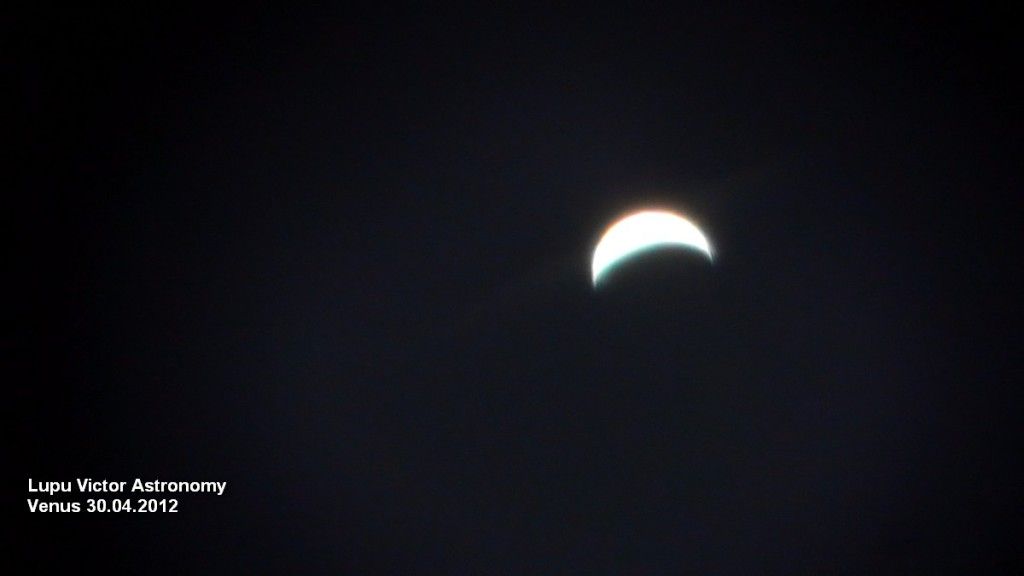
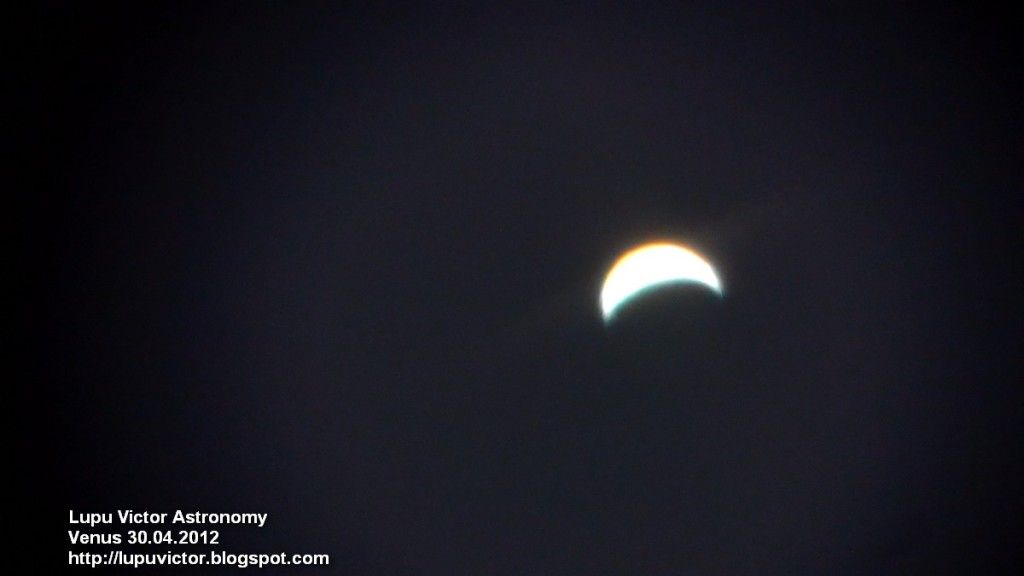
This is the planet Venus filmed on April 30, 2012, when the planet was at -4.5 magnitude, enough to be visible in daylight. This date is recorded in the table of special positions of the planet as very bright.


Venus will shine in our sky early, in the first part of May 2012 because is close to Earth. Watch it at sunset just to the west.
Although Venus is already a bright planet, it will be very bright while is approaching our planet the next few days, and in May 2012 which makes it look much bigger and brighter for us.

Venus also makes the transition from the other side of the Sun, close to our planet. This provides more sunlight reflected from the planet, making it shine.

On June 6, 2012, depending on where you are in the world, Venus will transit the Sun, and moves in front of the Sun as seen from our perspective here on Earth.

The pictures above are qick captures of the video I made ​​last night by telescope at 20:00 to 22:00.

Photographer: Victor Lupu
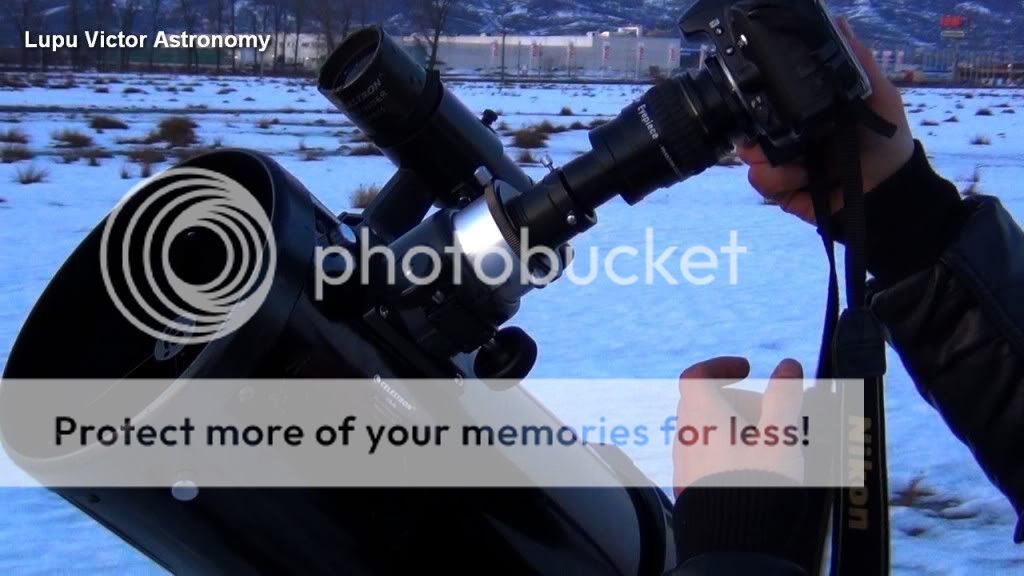
Optics: Celestron C8-Newtonian telescope, plossl 20mm, 2x Barlow
Mount: CG5 (EQ5)
Device: Sony CX130
Filter: no
Date: 30/04/2012
Location: Baia Mare, Romania
Processing: video capture Splash Player, FastStone Image Viewer


Astro calendar 2012: Astronomical calendar-astronomy events in 2012 .
Next astronomical event in 2012: May 6, 2012 - Full Moon. - Moon at the perigee

 
All images are © Copyright 2010-2015 Lupu Victor. All rights reserved.Images may not be reproduced, published, or copied in any form without written permission of the author. Thank you for respecting the intellectual property rights. ASTROFOTOGRAFIA | Lupu Victor Astronomy - Contact - About
Design by Free WordPress Themes | Bloggerized by Lasantha - Premium Blogger Themes | Online Project management