Visit Worldwide Topsites
Showing posts with label Planets-Venus. Show all posts

Friday, 5 February 2016

Venus observed through telescope.

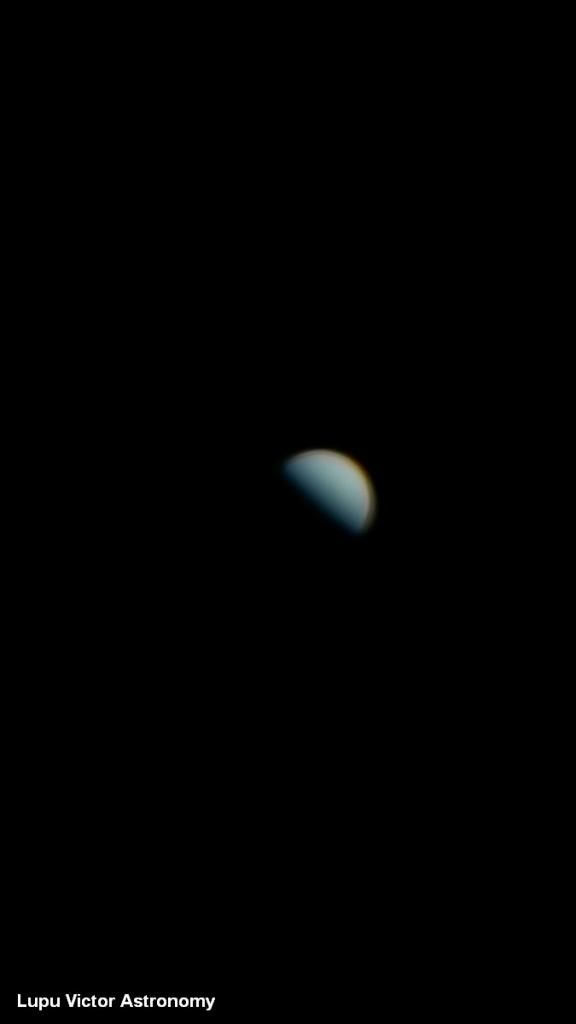
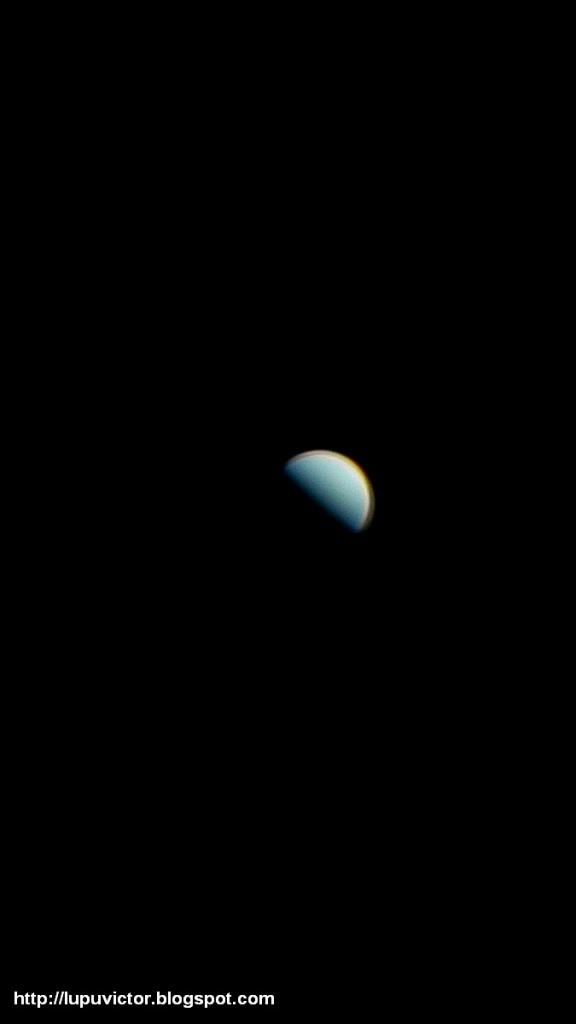
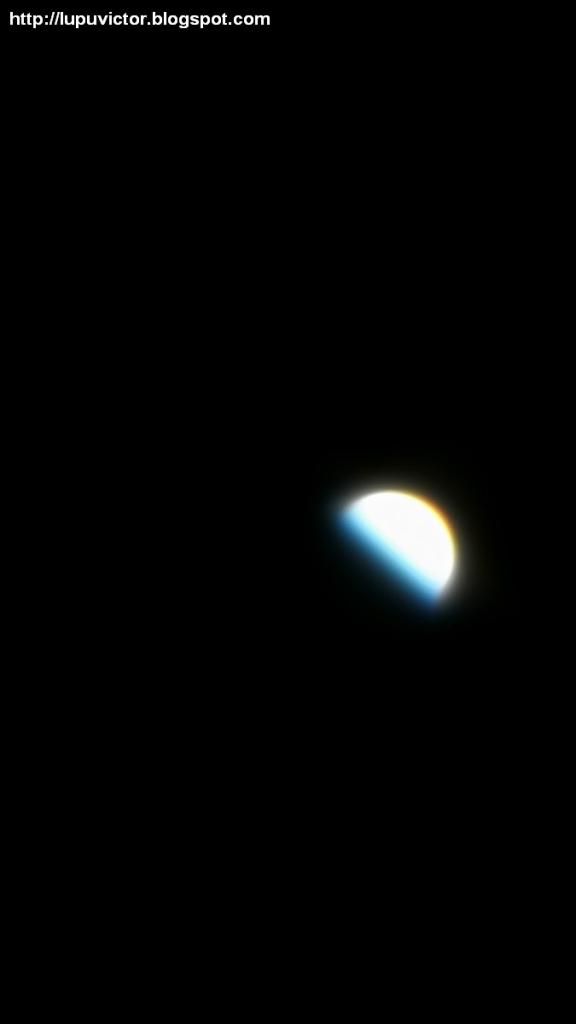
Observing Venus by astronomical telescope has been very difficult due to atmospheric turbulence, but also because of the long distance to our planet at the time. I've never had the intention to post these images but I changed my mind after a careful analysis and I thought it worthwhile.

Weather conditions were not good enough, so it was harder to look for the clearest video frames and undistorted.


Planet: Venus
Distance: 168, 638 mil. Km. (1127 continental United States)
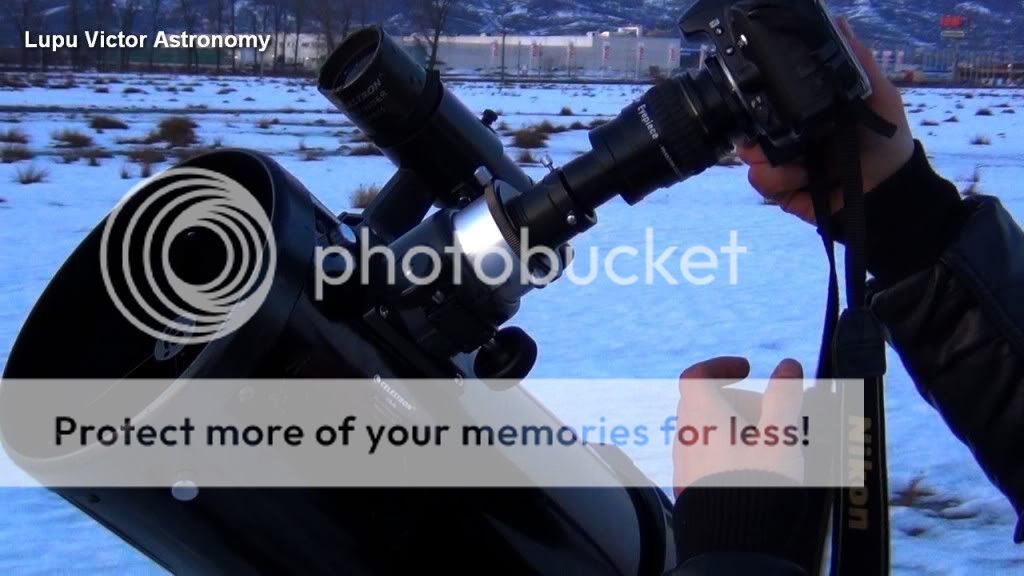
Optics: Celestron C8-Newtonian telescope, Plossl 20mm, 2x Barlow
Mount: CG5 (EQ5)
Camera: Sony CX130
Filter: no
Date: 28.01.2012
Location: Baia Mare, Romania
Processing: FastStone Image Viewer


Monday, 21 October 2013

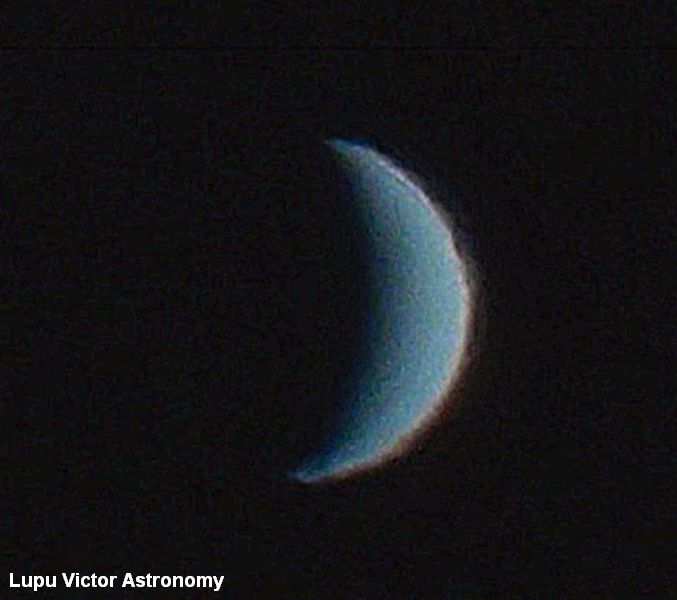
Observation of Venus through the telescope.

36 frames to 95% best quality, Gaussian in Registax.
18 frames to 97% best quality, in Registax.


Venus, is magnificent in these images. I have never seen it in such a size through the telescope ever. So big and clear to see through the 8 " telescope, that even passersby who were curious about what I'm watching did not believe it was a planet, but they said it's the Moon. It's true that during that period Venus was at the perfect distance for observation.

But I still don't know why it blue because this color is not true. What intrigues me is that other planets like Jupiter, Saturn and Mars, have their real colors filmed through the telescope. A hunch would be that being so close to the Sun, is too bright and the colors of the camera are probably getting wrong.

 Although you may believe that the pictures are old, from March 2012, only now they were processed, so for me these images are in premiere. In fact all images in new articles are made in the same manner, later, because the amount of videos and the time does not allow me an image processing in the same day, week or even year.

Planet: Venus
Distance: 67, 319, 041,8 km.
Optics: Celestron C8-Newtonian telescope, 20mm Plossl, 2x Barlow
Mount: CG5 (EQ5)
Camera: Sony CX130
Filter: no
Date: 29.04.2012
Location: Baia Mare, Romania
Processing: Images in Registax, FastStone Image Viewer


Video capture of same day.

Thursday, 26 September 2013

More Imaging Fun with Venus through telescope

Venus. 506 frames in Registax.
Venus. 261 frames in Registax.
Venus. 118 frames in Registax.


Planet Venus.
Illumination: 53%
Distance: 0.73 AU = 109,206,446 km
Magnitude: -3.96

One important thing should be known by Venus observers through a telescope. This planet, our Earth's sister only because of similar sizes, can not be seen fully lit as a "full moon", from Earth. Being closer to the Sun than Earth, Venus can be seen almost as a "full moon" but this is hampered by two factors: on that time Venus is too close to the Sun, at a very small angle, and thus the observation must be made only by day, and a second factor is the great distance from us at the time when the two planets are opposite one to another, with the sun in the middle.

It is not hard to imagine what I wrote above. It's easier if you look at a simulation program like Celestia, to see what it looks like when the planets are at different points in its orbit to the Sun.

Also, when Venus is seen as a "New Moon" through a telescope, it means it is closer to Earth in its orbit, on the same side, but even then can hardly be seen sometimes, if it is at a small angle to the Sun.

The best time to observe Venus is when in our sky is as far as possible from the Sun, and usually in those moments is seen as a "crescent", as shown above, the end of March 2012 being the best time for the observation and photograph of this beautiful planet.

 Images are processed in Registax.

Optics: Celestron C8-Newtonian telescope, 20mm Plossl, 2x Barlow
Mount: CG5 (EQ5)
Camera: Sony CX130
Filter: no
Date: 24.03.2012
Location: Baia Mare, Romania
Processing: Images in Registax, FastStone Image Viewer


Wednesday, 12 June 2013

Venus by amatorial telescope Images processed in Registax


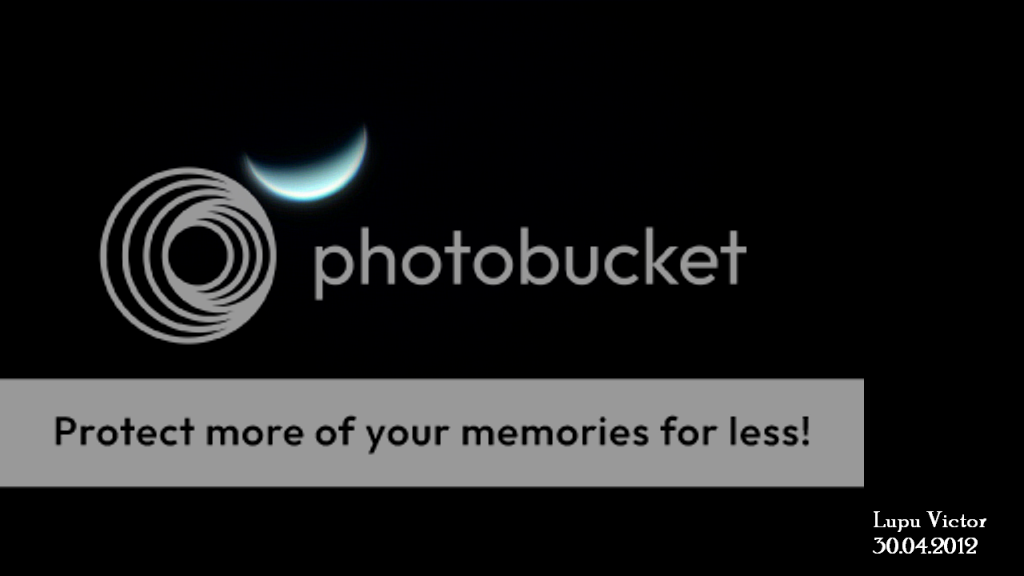
Venus, 38 frames at 95% best quality
Venus, 74 frames at 95% best quality


Images are Registax processings of a video from which were taken frames, merged to form a single image.

Venus, it is called "the morning star" or "the evening star" in the sky, being very bright, and always close to the Sun, at sunset or sunrise. In the images I made, with the telescope and camera attached, is the bright star (here, of the evening) I've talked about above, but close enough to see the shape of the surface, without features, being permanently covered with a thick cloud.

Our knowledge about the surface of Venus, comes from a limited amount of information obtained by the Russian Venera series, and the first radar images of the planet that have been made both by instruments on Earth and by space probes . Largest radar image was obtained by Magellan Orbiter, in a period of 4 years, in the early 90s. As a result, we now have a detailed radar image of the surface of Venus.

   Space missions, have shown that the surface is covered with craters, volcanoes, mountains and high plains of lava. Venus's surface is not where you would like to be, with temperatures that can melt lead, an atmosphere so thick that it would crush you, and clouds of sulfuric acid, having a smell of rotten eggs.

Venera 13 and 14 were the only probes that on which both cameras have functioned properly. Unfortunately, surface conditions on Venus are extreme, which meant that the probes on the surface only survived for a period of 23 minutes (initial probes) until about two hours (final probes).

Above is a color image on the surface of Venus. Picture taken by Venera 13 on March 3, 1982.

Optics: Celestron C8-Newtonian telescope, 20mm Plossl, 2x Barlow
Mount: CG5 (EQ5)
Camera: Sony CX130
Filter: no
Date: 30/04/2012
Location: Baia Mare, Romania
Processing: Registax, FastStone Image Viewer

Friday, 29 March 2013

Beautiful images of Venus planet through amatorial telescope


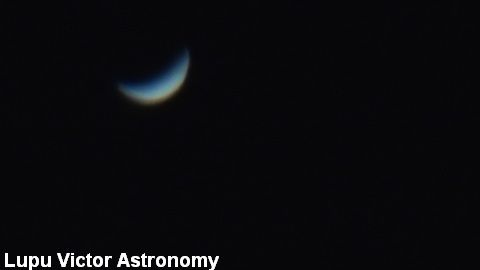
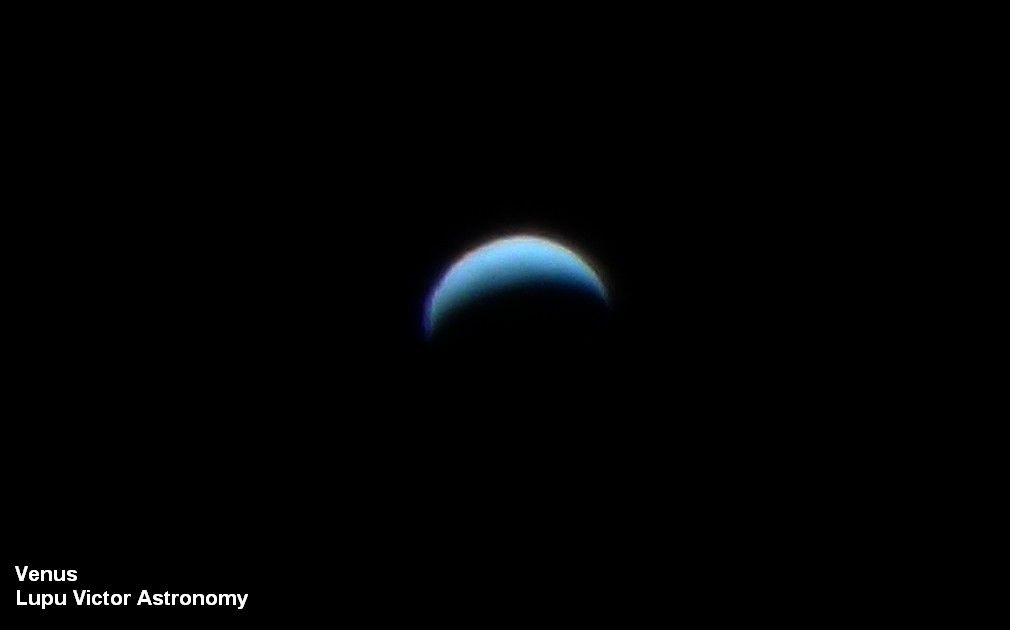
These sharp images with Venus are so amazing to me, because we have a planet so beautiful neighbor of ours, which we can see with a telescope so well and we can notice it's form. The sun illuminates only one side, giving the impression that you look at a crescent Moon. The color of the planet it's blue, but that is the eyepiece lenses fault. One might say it's Neptune, if it were not so far from Earth.
 The surface of Venus can not be seen because it is always covered in clouds. Many times I was disappointed when I made images of the planet through the telescope, but now, being in opposition, I caught it in her moments of extreme closeness to us, Venus being on opposition at the time.

Optics: Celestron C8-Newtonian telescope, 20mm Plössl, 2x barlow
Mount: CG5 (EQ5)
Camera: Sony CX130
Filter: no
Date: 29/04/2012
Location: Baia Mare, Romania
Processing: video captures, FastStone Image Viewer

Tuesday, 30 October 2012

Splendid planet Venus video through telescope

Two planets are closer to the Sun than Earth and they are Mercury and Venus. This means that we can not see them very far from the Sun in the sky. All other planets glow in the midnight sky, but these two "inferior planets" (planets which have a closer distance from the Sun than the Earth) are never seen more than a few hours after sunset or before sunrise .

The inner planet, Mercury, it can be no more than 28 ° from the Sun, and Venus at about 47 ° . These moments when Mercury and Venus reach maximum angular separation from the Sun, are the most precious for seeing these planets better. When they get to this position, we say that they are at greatest elongation.


Video: Victor Lupu
Optics: CelestronC8 "-Newtonian telescope, plossl20mm, 2x Barlow
Mount: CG5 (EQ5)
Device: Sony CX-130
Video mode: Full HD progressive 1920x1080
Filter: no
Date: 29/04/2012
Location: Baia Mare, Romania
Processing and editing: Sony Vegas 10

Monday, 3 September 2012

Venus this morning 3 august 2012 by telescope


Planet Venus video this morning 3 august 2012 by astronomical telescope.
On the first part of the video, the camera was set on auto mode. The planet is seen on the last part of the video.


Optics: CelestronC8 "-Newtonian telescope, plossl 20mm, 2x Barlow
Mount: CG5 (EQ5)
Device: Sony CX-130
Video mode: Full HD progressive 1920x1080
Filter: no
Date: 03/09/2012
Location: Baia Mare, Romania
Processing and editing: Sony Vegas 10

Saturday, 11 August 2012

Perseids when the planets align. Venus Jupiter and Moon aligns this weekend. About Venus mission

Moon, Venus and Jupiter align in the sky to the east this weekend, when will be the Perseids meteor shower on 12 and August 13, when Earth passes through the heart of debris with rates of more than 100 meteors per hour. It is a good time for amateur astronomers to photograph or film the two events the same night.

Venus, the Earth's twin sister, was the best seen, this year (for me at least). There are a few things on the internet on this planet about space missions or new photos, not the same as we hear about Mars, to whom everyone turned its attention especially in this period with Curiosity MSL mission.

                                             Venus Express (VEX).


Few people know that there is currently ongoing a mission to explore Venus, launched by ESA (European Space Agency) since 2005 and will end in 2014 until it received the funds, called Venus Express (VEX ).
 Module performs a detailed study of the venusian atmosphere and clouds, maps the planet and its surface environment, while also, this mission will contribute to an understanding of climate change on Earth.
Also, Venus Express is used, to see signs of life on Earth from the orbit of Venus. In images, the Earth is less than one pixel in size, which mimics the observations that we also do here to discover planets in other solar systems. These observations are then used to develop methods for detecting extra-solar planets.

Below is a short video made ​​by me through the telescope, of the planet Venus.


Video: Victor Lupu
Optics: CelestronC8 "-Newtonian telescope, plossl20mm, 2x Barlow
Mount: CG5 (EQ5)
Device: Sony CX-130
Video mode: Full HD progressive 1920x1080
Filter: no
Date: 29/04/2012
Location: Baia Mare, Romania
Processing and editing: Sony Vegas 10

Monday, 4 June 2012

3 amazing Venus videos by telescope The second planet from the Sun.

      Venus continues to amaze me. At first time I noticed this planet through a telescope, I saw it small and difficult to distinguish, because of the atmosphere and distance from the Earth. I believed then that my telescope will never see it well, but apparently I was wrong. Now I see it clear as a crescent, big and beautiful.
      Venus has a diameter of 12,100 km, with about 1040 km in smaller than the diameter of Earth (95%). If it would be someone on Venus with a telescope, would see the Earth at about the same size as we see Venus from here.

     Average surface temperature of Venus is 462 ° C, about 9 times higher than on Earth. The surface pressure is 92 times higher than here, and the atmosphere contains 96% carbon dioxide.

     The clips below are organized in chronological order. On April 27th I had the sharpest images with Venus, in my opinion. I hope to have luck on June 6 transition to film the planet across the Sun, because clouds in this area are announced.


Video: Victor Lupu
Optics: CelestronC8 "-Newtonian telescope, plossl 20mm, 2x Barlow
Mount: CG5 (EQ5)
Device: SonyCX130
Full HD 1080p (1920x1080)
Filter: no
Date: 27./04/2012, 07/04/2012, 24/03/2012

Location: Baia Mare, Romania
Processing and editing: stabilized in Sony Vegas 10

Tuesday, 1 May 2012

Venus big magnitude April 2012 Pictures by telescope


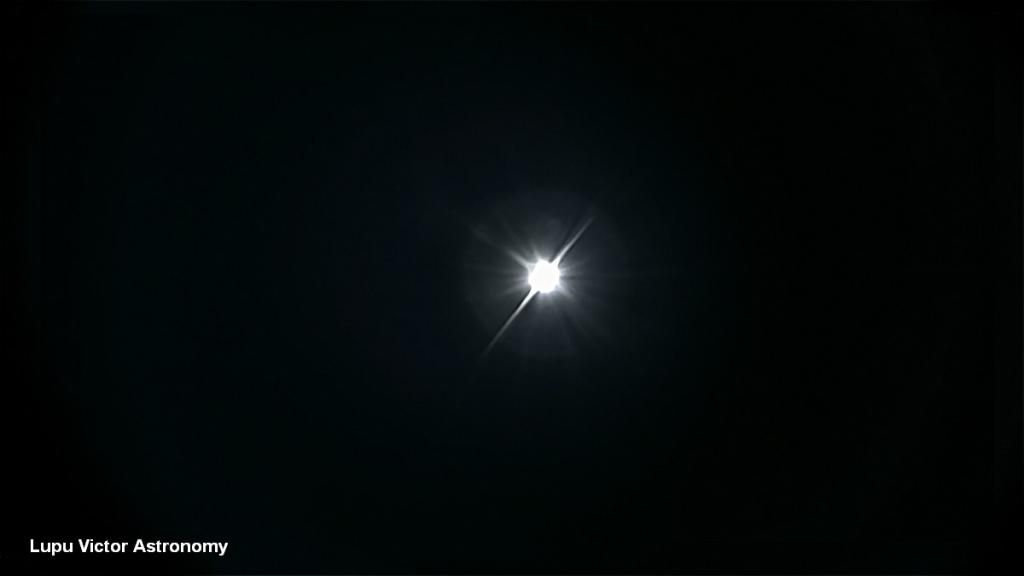
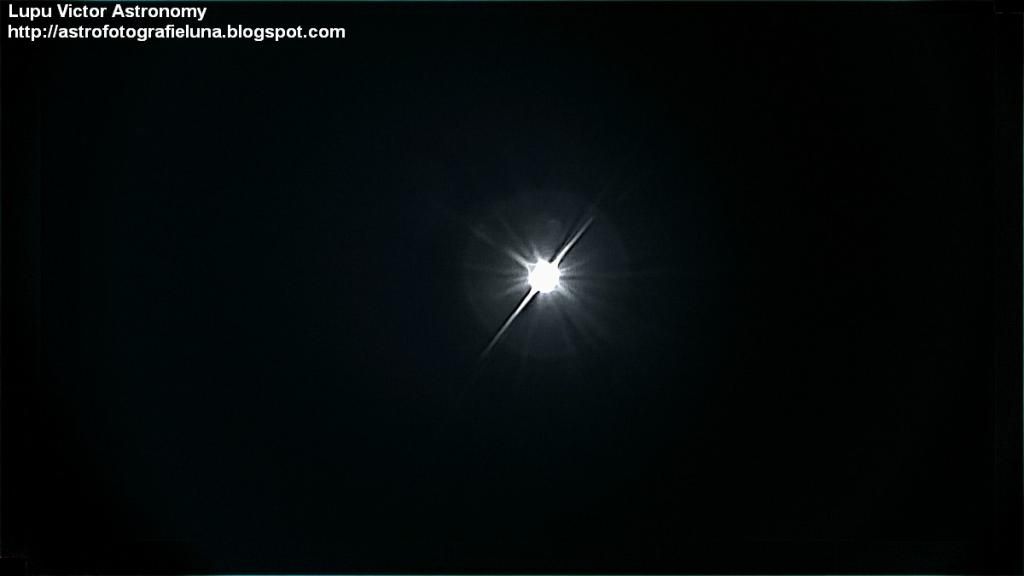
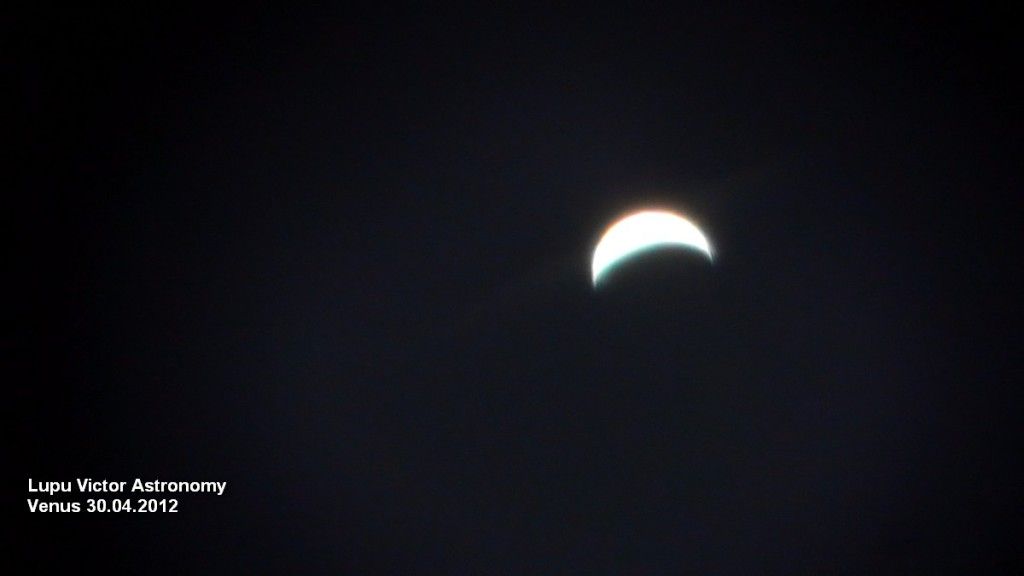
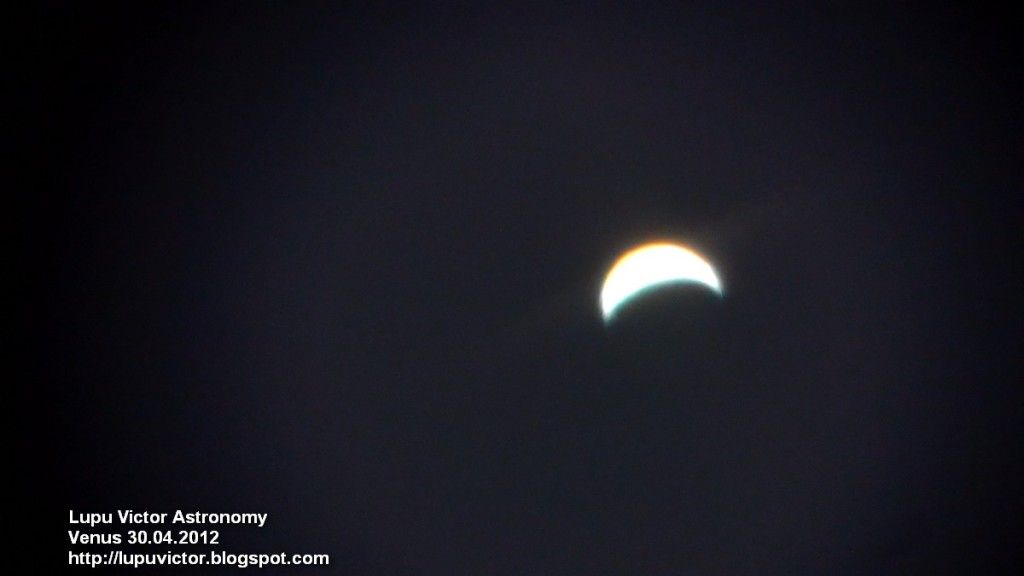
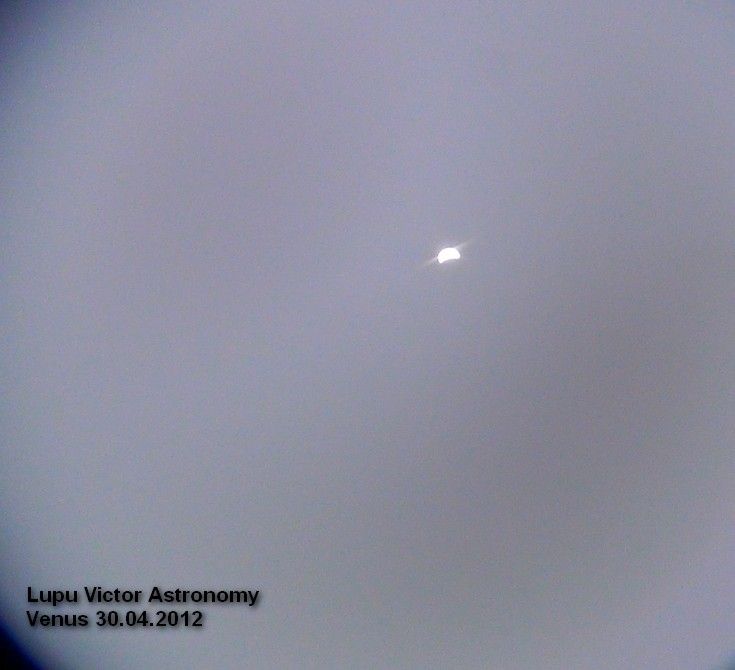
This is the planet Venus filmed on April 30, 2012, when the planet was at -4.5 magnitude, enough to be visible in daylight. This date is recorded in the table of special positions of the planet as very bright.


Venus will shine in our sky early, in the first part of May 2012 because is close to Earth. Watch it at sunset just to the west.
Although Venus is already a bright planet, it will be very bright while is approaching our planet the next few days, and in May 2012 which makes it look much bigger and brighter for us.

Venus also makes the transition from the other side of the Sun, close to our planet. This provides more sunlight reflected from the planet, making it shine.

On June 6, 2012, depending on where you are in the world, Venus will transit the Sun, and moves in front of the Sun as seen from our perspective here on Earth.

The pictures above are qick captures of the video I made ​​last night by telescope at 20:00 to 22:00.

Photographer: Victor Lupu
Optics: Celestron C8-Newtonian telescope, plossl 20mm, 2x Barlow
Mount: CG5 (EQ5)
Device: Sony CX130
Filter: no
Date: 30/04/2012
Location: Baia Mare, Romania
Processing: video capture Splash Player, FastStone Image Viewer


Astro calendar 2012: Astronomical calendar-astronomy events in 2012 .
Next astronomical event in 2012: May 6, 2012 - Full Moon. - Moon at the perigee

Saturday, 21 April 2012

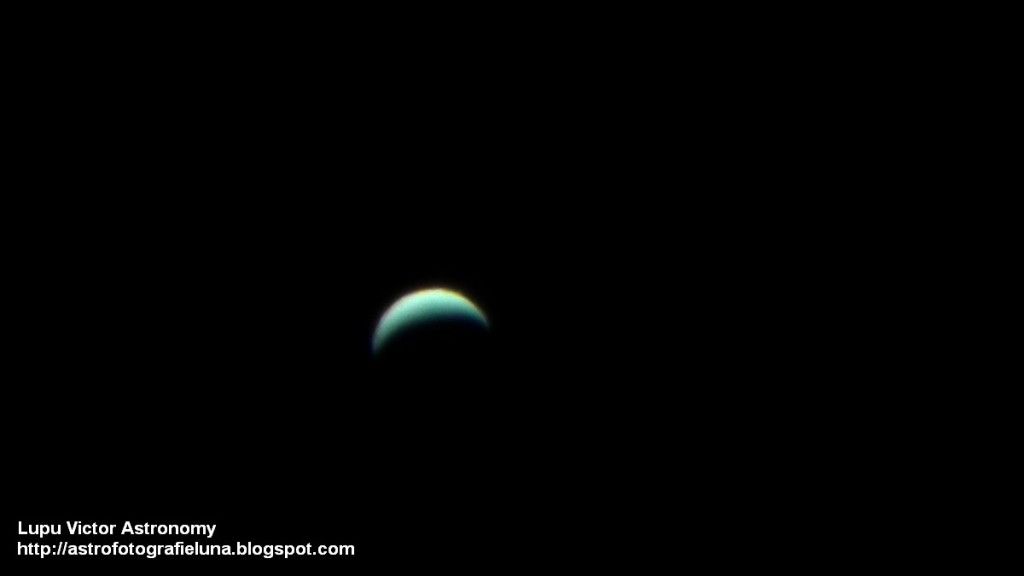
Venus pictures telescope in March 2012.


It appears that observing and photographing the planet Venus, I had results getting better.

The pictures above are made ​​with Splash player, and those below, are captures made ​​in Sony Vegas 10. Images will be processed in Registax and will have a higher quality of course.


You do not need a big telescope to see Venus, because even such a telescope can not reveal more details on this planet. The reason might be that Venus is always at a low angle in the sky and another is that the planet itself shows little: it is always covered by clouds on its entire surface.


Below are video captures images of Venus taken with automatic exposure on camera.


Photographer: Victor Lupu
Optics: Celestron C8-Newtonian telescope, plossl 20mm, 2x Barlow
Mount: CG5 (EQ5)
Device: Sony CX130
Filter: no
Date: 03/24/2012
Location: Baia Mare, Romania
Processing: video captures in Splash Player, Sony Vegas, FastStone Image Viewer

 
All images are © Copyright 2010-2015 Lupu Victor. All rights reserved.Images may not be reproduced, published, or copied in any form without written permission of the author. Thank you for respecting the intellectual property rights. ASTROFOTOGRAFIA | Lupu Victor Astronomy - Contact - About
Design by Free WordPress Themes | Bloggerized by Lasantha - Premium Blogger Themes | Online Project management