Visit Worldwide Topsites
Showing posts with label Craters-Santbech. Show all posts

Monday, 2 June 2014

Santbech crater pictured from Earth


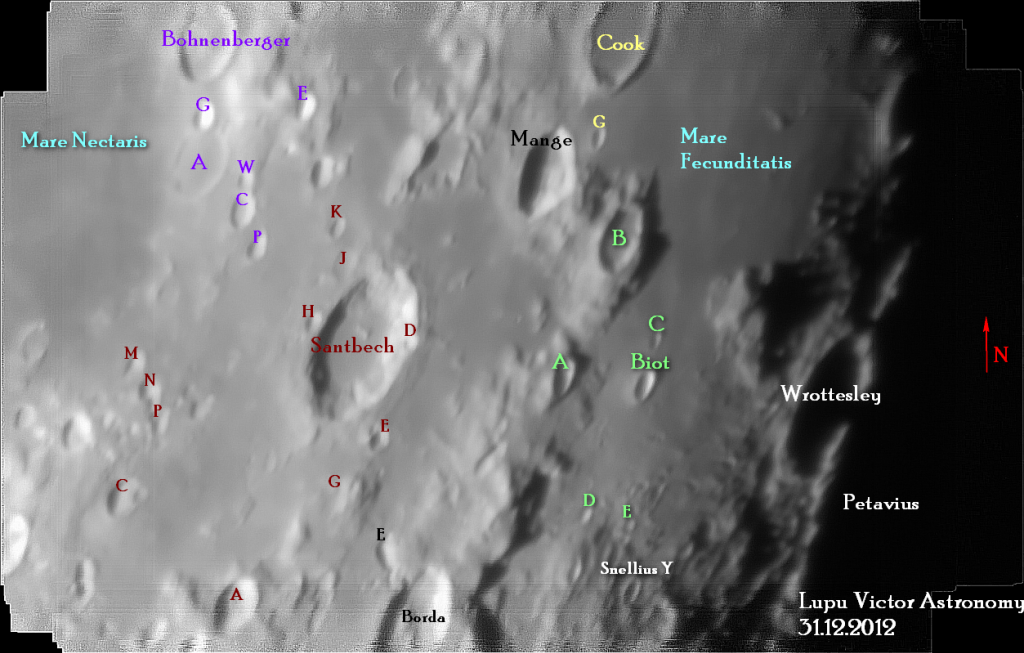
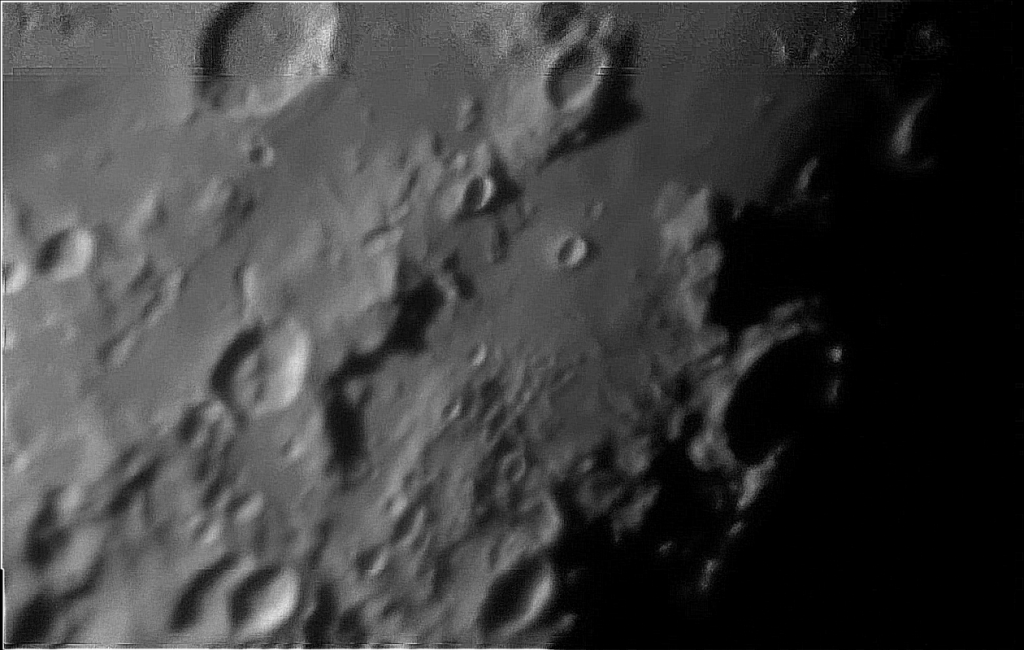
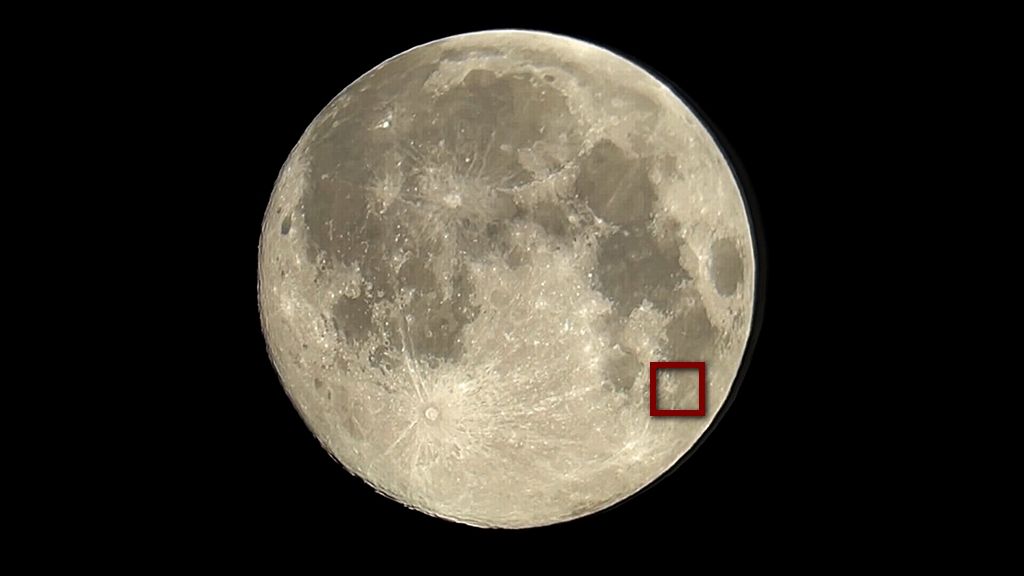
This article presents images of Moon craters, on the east side, as Santbech (64 km), Monge (37 km), Cook (47 km), Wrottesley (57 km).

These are video captures. To view images processed in Registax 5, click here. To watch the video of which I have extracted the images, please click here.

By astronomical telescope, the image is projected upside down, therefore, the last 2 pictures are so, and the first two are reversed.


Age of the Moon: 17 days
Phase: 93% (0% = New, 100% = full)

Distance: 394.960 km

Optics: Celestron C8-Newtonian telescope, 20mm Plossl, 2x Barlow
Mount: CG5 (EQ5) motorized
Camera: Sony CX130
Filter: no
Date: 31/12/2012
Location: Baia Mare, Romania
Processing: FastStone Image Viewer


178 frames at 90% best quality in Registax.

Sunday, 2 March 2014

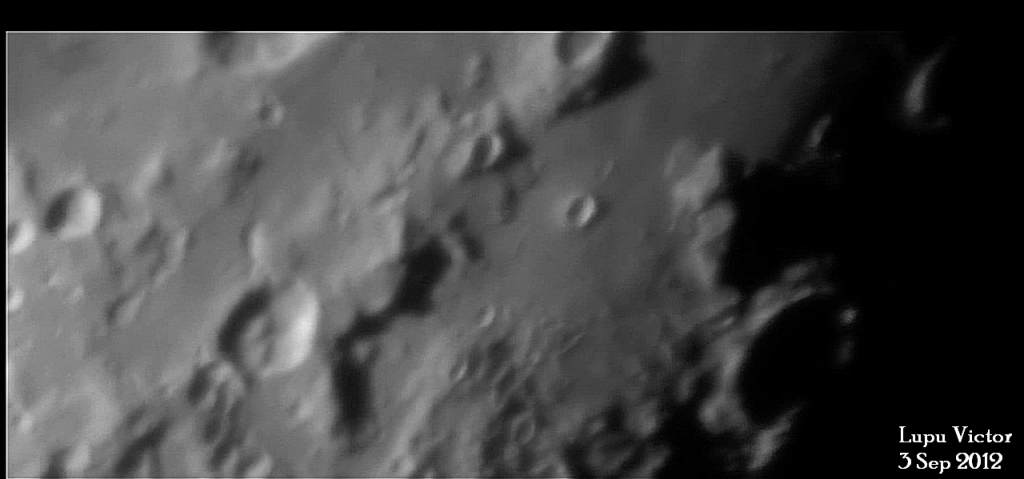
Night falls on Santbech and Wrottesley craters on the Moon. HD Video by telescope.

In this video, we find Moon at a stage where the east craters are near the terminal of the Moon's shaded area. Here you see the crater Wrottesley (57 km) northwest Petavius​​ (177 km). It is enveloped by darkness inside, leaving it to be seen only the outer edge.

We see here also a mountain chain that starts from the crater to the north-west.


Another interesting crater with a pie shape, is Santbech (64 km). Between Wrottesley and Santbech, we see a higher region on which small satellite craters of Snellius (83 km), Biot (13 km) and Borda (44 km) are scattered.

Earth's atmosphere was not very favorable, so visibility was at an average level.


Age of the Moon: 17 days
Phase: 90% (0% = New, 100% = full)
Distance: 399796 km


Optics: Celestron C8-Newtonian telescope, 20mm Plossl, 2x barlow
Mount: CG5 (EQ5)
Camera: Sony CX130
Filter: no
Date: 03/09/2012
Location: Baia Mare, Romania
Processing: FastStone Image Viewer


The image below was made in December 31, 2012.


Monday, 8 July 2013

Beautiful Santbech lunar crater by astronomical telescope


178 frames 90% best quality in Registax


We talked about this area on other occasion, three months before, when the Moon was at a very small phase difference to this.

   Santbech (64 km) has many satellite craters around it, having almost all letters of the alphabet, from Santbech A to Santbech Z, missing only I and O. Notice the area around the crater, which was inundated in the past by lava . On the floor, near the center, is a mountain peak. The crater is surrounded by a beautiful collar, this being due to the impact that created the crater, heavy material being ejected outside.

   Santbech, takes its name from the the German mathematician and astronomer, Daniel Santbech Noviomagus, who lived in the 16th century.


Image processing in Registax of a video that have taken 178 shots, merged to form a single image.
To see the video from which I extracted these photos, see Santbech Crater on the Moon. Video by astronomical telescope.

Age of the Moon: 17 days
Phase: 93% (0% = New, 100% = full)
Distance: 394.960 km


Optics: Celestron C8-Newtonian telescope, 20mm Plossl, 2x Barlow
Mount: CG5 (EQ5) motorized
Camera: Sony CX130
Filter: no
Date: 31/12/2012
Location: Baia Mare, Romania
Processing: Registax, FastStone Image Viewer


Friday, 17 May 2013

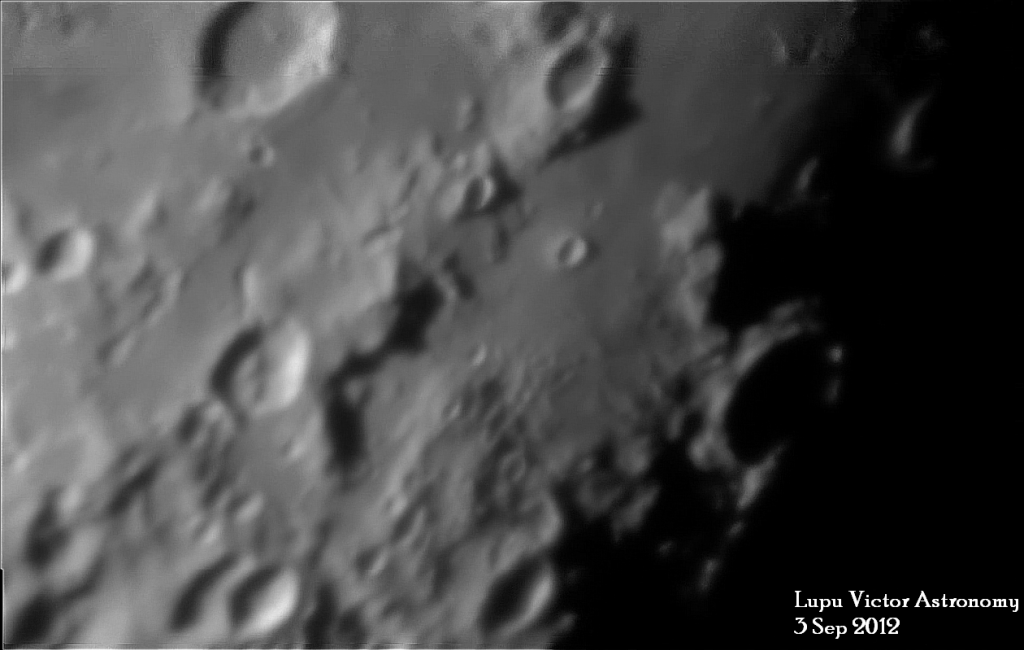
Pictures by astronomical telescope. Santbech crater in light and Wrottesley in darkness

9 frames at 100% best quality


5 frames at 100% best quality


2 frames at 100% best quality

5 frames at 95% best quality

9 frames at 95% best quality


We've talked about these craters in other article: Santbech Crater on the Moon. Video by astronomical telescope.., where I presented the video shot in the night of 30 December 2012, when the Moon was at a similar stage (96%), with most of these images (90%).

   Do not think that where we see that it is dark in the image, there would be the edge of the Moon. In fact, there is the Moon terminal, the line between shadow and light, due to the Moon phase at that time, when it was lit 90%. Where it's dark, there are the 10% of the shaded Moon.

Notice the beautiful mountain range that starts from the crater Wrottesley (57 km) northwest. This crater is glued to the northwest edge of the crater Petavius (177 km), which can not be seen here as it is in shadow, but we can see the circular edge in the sunlight.

Borda (44 km), an irregular crater, lies south of Santbech. Note the peaks in the center of its floor. To the east of it, observe a mountain chain, interrupted here and there, stretching until Biot B craters (28 km) and Monge (37 km). Angle of the sunlight, beautiful designs a shadow of these mountains on the Mare Fecunditatis plateau.

 A few frames were used to achieve these images in Registax, but they came out great in my opinion. Image are from a video from which were taken some frame, joined to form a single image.


Age of the Moon: 17 days
Phase: 90% (0% = New, 100% = Full)
Distance: 399796 km


Optics: Celestron C8-Newtonian telescope, 20mm Plossl, 2x Barlow
Mount: CG5 (EQ5)
Camera: Sony CX130
Filter: no
Date: 03/09/2012
Location: Baia Mare, Romania
Processing: Registax, FastStone Image Viewer


The picture below was made on 31 December 2012.


Wednesday, 24 April 2013

Santbech Crater on the Moon. Video by astronomical telescope.

Although you would not say, Santbech crater (64 km), has striking resemblance to the bigger Copernicus crater (93 km), but because of his position, it appears oval, seen from Earth, because there is more closer to the edge of the Moon. But if they were swich their places, you would not realize that Copernicus had been replaced.

The two craters. looks exactly the same, on the shape, the beautiful terraced inner walls, and the central peaks, but less in size.
 Outside area of Santbech, is smooth all around it, until begin an uneven and hilly areas.

Notice Monge crater (37 km) below in video images and Biot B (28 km),  flooded crater, surrounded by mountains. The small crater Biot (13 km) is in the middle of a flat area, in the eastern part of Santbech (Note that the image is inverted). I would say that this crater belongs to Fecunditatis Basin, to its extreme southern area.

On the terminal, the edge of shadow and light on the left, notice a dark crater with the edge lit by the Sun. This is the crater Wrottesley (57 km).


Optics: CelestronC8 "-Newtonian telescope, plossl20mm, 2x Barlow
Mount: CG5 (EQ5) motorized
Device: Sony CX-130
Video mode: Full HD progressive 1920x1080
Filter: no
Date: 31/12/2012
Location: Baia Mare, Romania
Processing and editing: Sony Vegas 10


Registax Santbech crater from the same video above.


All images are © Copyright 2010-2015 Lupu Victor. All rights reserved.Images may not be reproduced, published, or copied in any form without written permission of the author. Thank you for respecting the intellectual property rights. ASTROFOTOGRAFIA | Lupu Victor Astronomy - Contact - About
Design by Free WordPress Themes | Bloggerized by Lasantha - Premium Blogger Themes | Online Project management