Visit Worldwide Topsites
Showing posts with label DSLR telescope pictures. Show all posts

Saturday, 29 August 2015

The Moon through C10 telescope / Nikon D80 DSLR.


This is Moon photographed through an 10 inch telescope and a NIKON D80 DSLR camera on the morning of August 8th, 2015.

The clarity of the images are really much greater than those made by my 8 inch telescope, and this made me finally realize that I underestimated imaging the Moon through DSLR's, because I did not understand why the various forums praise imagery of this kind, and I praised HDR video cameras filming the Moon. So I was more excited about the results of the videos I processed, and continue to process the Registax.

My disappointment actually had a cause, namely the 8-inch telescope does not magnifies the Moon as the 10 inch one, as presented in this article. For this reason I was not fully satisfied, because I have not had extraordinary detail of the Moon and therefore not worthwhile to approach this method with DSLR on the Moon.

My opinion therefore is not worth it shooting the Moon through an 8-inch telescope with a DSLR and have big expectations. From 10 inches up, with a DSLR the results are seen really amazing. But also, with an 8-inch telescope mirror, deepsky images can be achieved like with any other telescope, and also the Moon and planets filmed through an HD camcorder is effective. Of course, with a 10 inch telescope you can do all of these.

I congratulate my friend Sandu Val-Cosmin for purchasing this telescope, and wait for the results of that certainly will exceed mine in deepsky, but also in shooting of objects in our Solar System if he will decide to like this method is that I like more.

Although I used my camera on the telescope, he deserves credit for his powerful telescope which I hope it will be in perfect condition for decades to come.

Astronomical instrument: Skywatcher Newtonian telescope 10 inches (Val-Cosmin Sandu)
Mount C6 / EQ6 motorized GoTo
Camera: Nikon D80 ring T
Ocular: No (focal)
Filter: no
Date: August 8th, 2015
Time: 4:10
Mode: Manual
ISO 250
Shutter: 1/250, 1/400
Location: Dridu, Ilfov, Romania

Thursday, 20 March 2014

March 12, 2014 Jupiter DSLR Nikon images.

This is Jupiter on the night of March 12, 2014. The wind knocked pretty hard and the telescope was somewhat unstable because of this. I went down my block that kept as a protection for the city lights. Worst moment was when everyone seemed suddenly to have started heating their apartments and heat waves were high above the block. From that moment the image began to boil especially in video.


 Telescope: Celestron 8 inch Newtonian
mount C5/EQ5
Camera: Nikon D80 DSLR ring T
Ocular: no
Filter: no
Date: March 12, 2014
Time: 20:30
Exposure: 30 sec, ISO 400
Location: Baia Mare, Romania

Monday, 17 March 2014

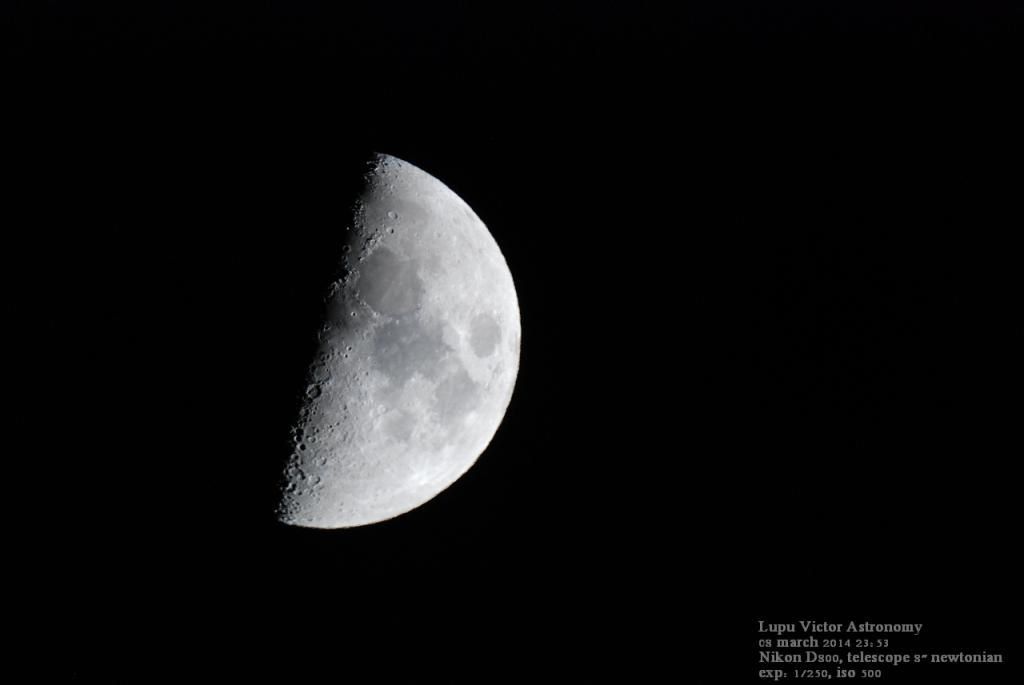
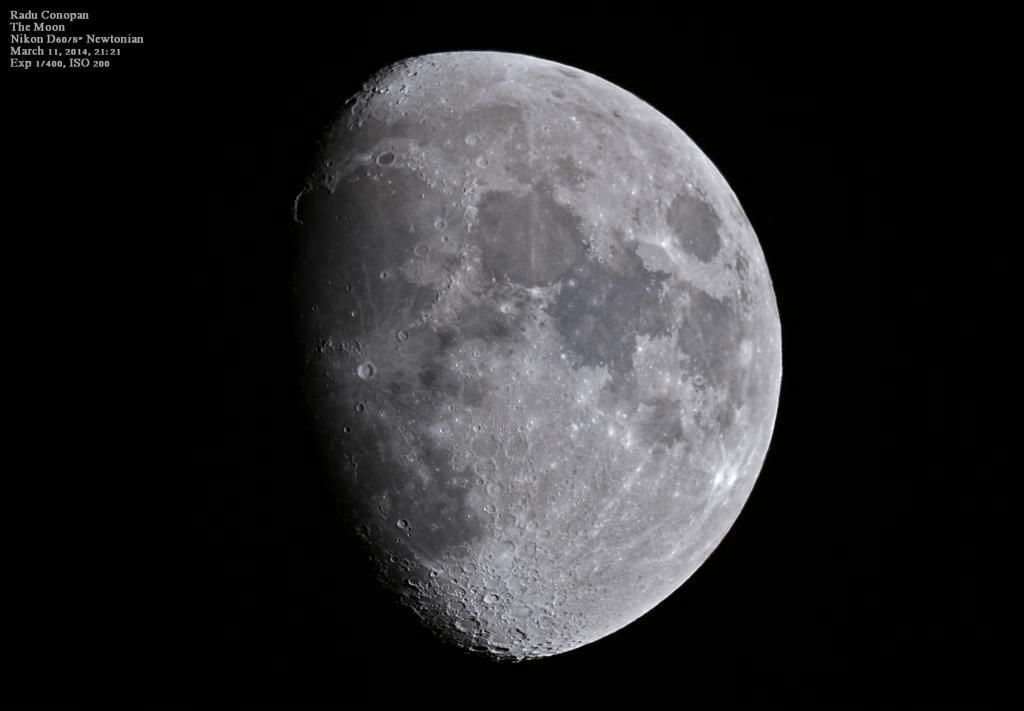
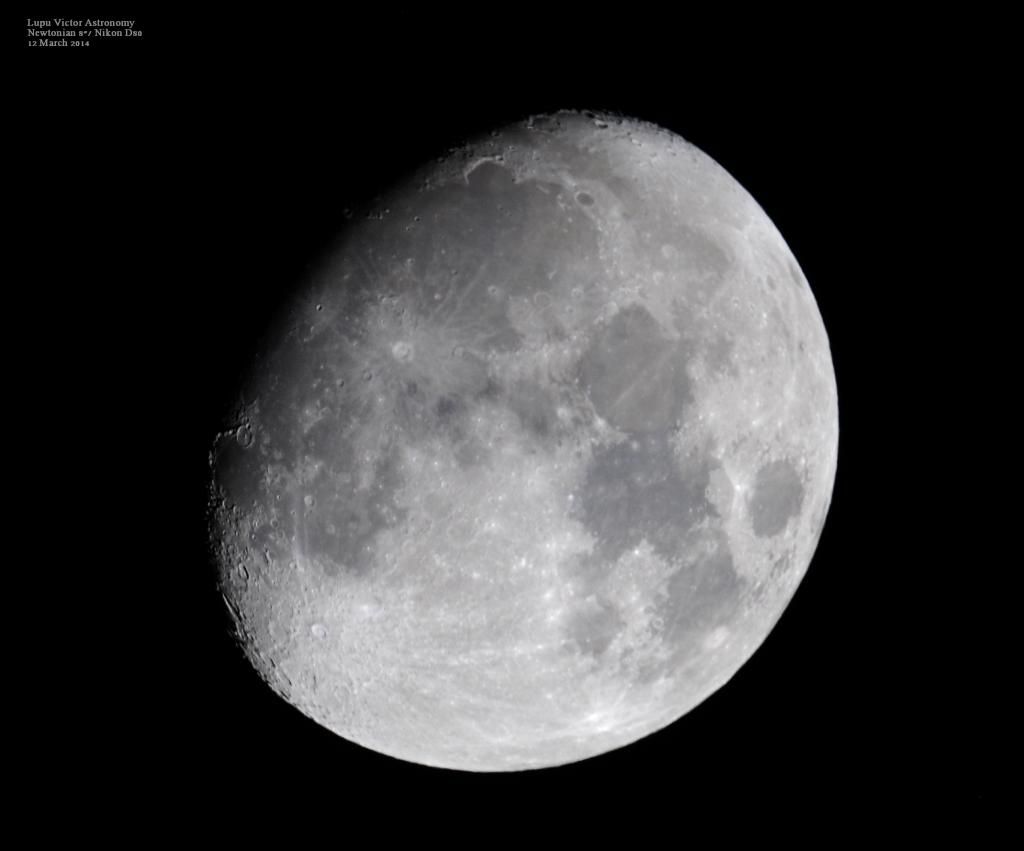
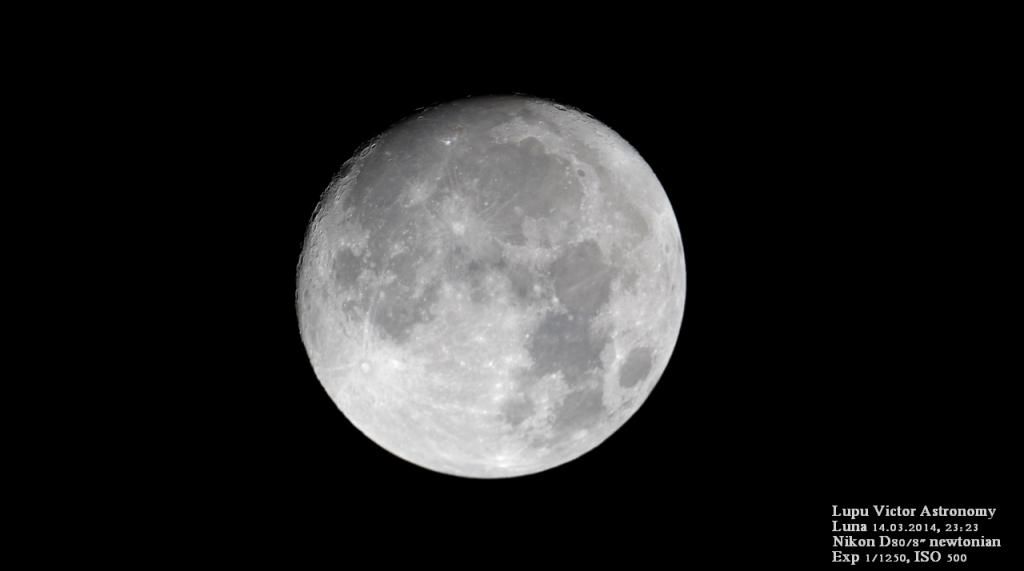
6 days Moon phase in action between 8 and 14 March 2014 (video).

This is a changing of the lunar illumination within 6 days beginning March 9 and ending on March 14, 2014. In that period the sky was mostly clear, and so I decided to go for observations through the telescope, almost every night at my block.


The devices used were two DSLR cameras: Nikon D80 (mine) and D60 (Radu Conopan) as follows:

9,10,12 and March 14, 2014 photos are made with Nikon D80, and on March 11, 2014, with Nikon D60.


I wanted to get to complete the cycle with the full Moon, but I did not because it had started a rainy weather.


In the video below, are the same pictures edited in Sony Vegas 10. Images were positioned so as to match one another.


Moon on March 9, 2014 (Nikon D80/telescope 8 ")
Moon on March 10, 2014 (Nikon D80/telescope 8 ")
Moon on March 11, 2014 (Nikon D60/telescope 8 ")
Moon on March 12, 2014 (Nikon D80/telescope 8 ")
Moon on March 14, 2014 (Nikon D80/telescope 8 ")


Age of the Moon: 7 to 13.2 days
Distance: 398.283 to 396,318 km
Phase: 53% -96.6% (0% = new = 100% full)


Photographer: Victor Lupu / Conopan Radu
Telescope: Celestron 8 inch Newtonian 

Mount C5/EQ5
Camera: Nikon D80/D60 DSLR with T ring 

Ocular: no
Filter: no
Date: March 9 to 14, 2014
Exposure: 1/1250, ISO 200-500
Location: Baia Mare, Romania

Saturday, 15 March 2014

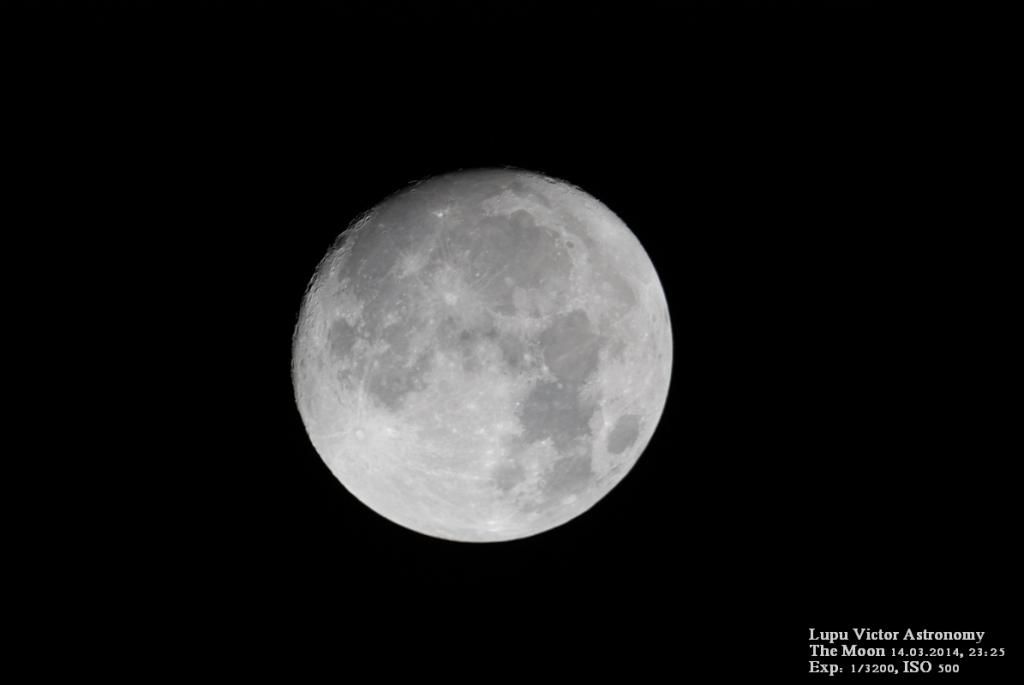
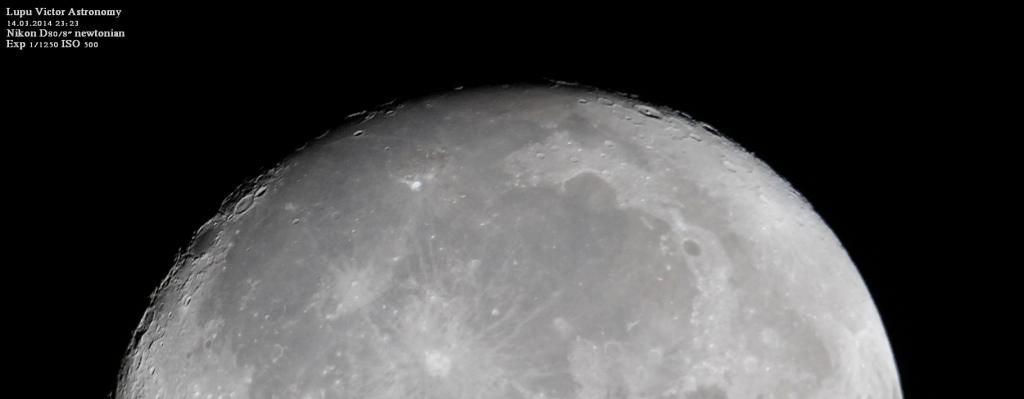
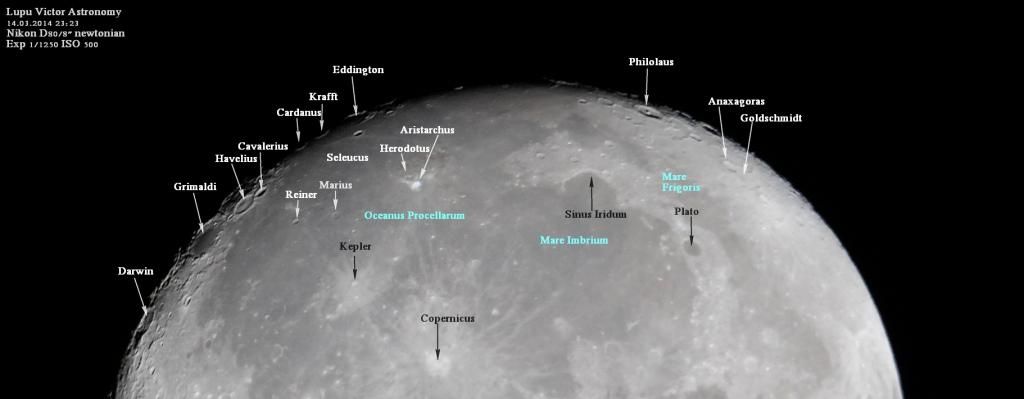
Moon through telescope last night March 14, 2014.


I went with my telescope consecutive on evenings because the sky was perfect for observation. I went last night to photograph and film the Moon and its craters. These are just images with DSLR Nikon D80. Video processings will come later. The sky was very good, cloudless, and the atmosphere at a very good level.
The camera filmed lunar craters much closer.
Age of the Moon: 13.2 days
Distance: 396.318 km
Phase: 96.6% (0% = new = 100% full)


Telescope: Celestron 8 inch NewtonianMount C5/EQ5
Camera: Nikon D80 DSLR ring T
Eyepiece: no
Filter: no
Date: March 14, 2014
Time: 23:23
Exposure: 1/1250, ISO 500
Location: Baia Mare, Romania

Wednesday, 12 March 2014

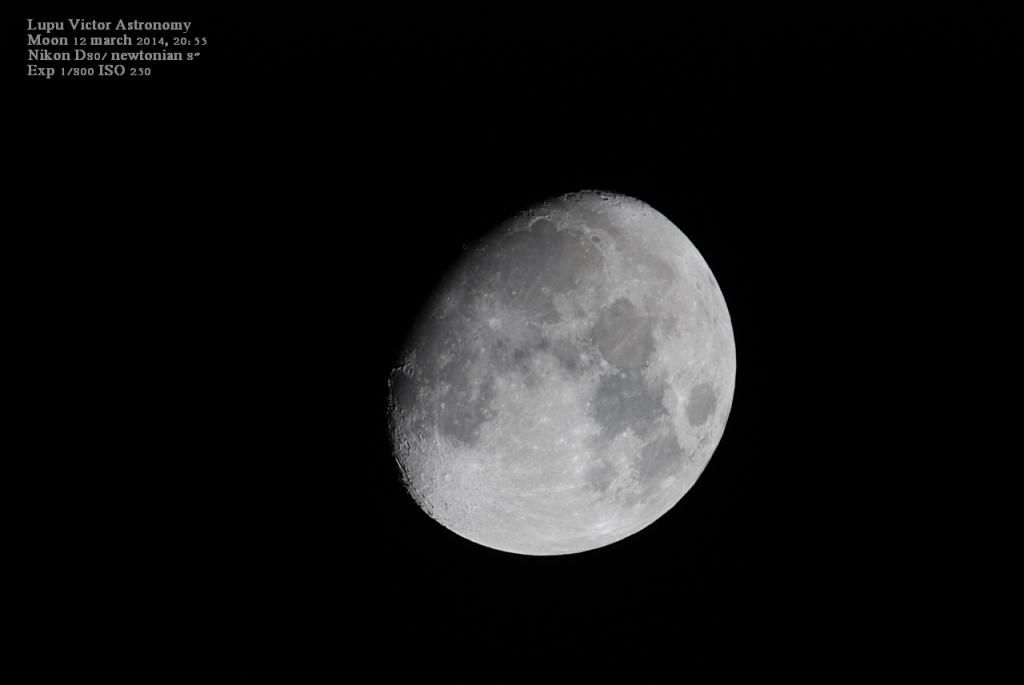
The Moon Now March 12, 2014 telescope images.


This is the Moon on the night of March 12, 2014. The wind knocked pretty hard and the telescope was somewhat unstable because of this. I went down my block that kept as a protection for the city lights. Worst moment was when everyone seemed suddenly to have started heating their apartments and heat waves were high above the block. From that moment the image began to boil especially in video.


Age of the Moon: 11,2 days
Distance: 399.599
Phase: 86% (0% = New, 100% = Full)


Telescope: 8 inch Celestron Newtonian
mount C5/EQ5
Camera: DSLR Nikon D80, T ring
Eyepiece: no
Filter: no
Date: March 12, 2014
Time: 20:55
 
Exposure: 1/800, ISO 250
Location: Baia Mare, Romania


Monday, 10 March 2014

The Moon right now March 10, 2014.


This is a quick Moon from tonight seen from Romania. Say "Cheese"
All the informations are below.


Age of the Moon: 9 days
Distance: 399.785
Phase: 71% (0% = New, 100% = Full)


Telescope: 8 inch Celestron Newtonian
mount C5/EQ5
Camera: Nikon D80, T ring
Eyepiece: no
Filter: no
Date: March 10, 2014
Time: 09:00 p.m. to 10:00
p.m. 
Exposure: 1/640, ISO 400
Location: Baia Mare, Romania


Sunday, 9 March 2014

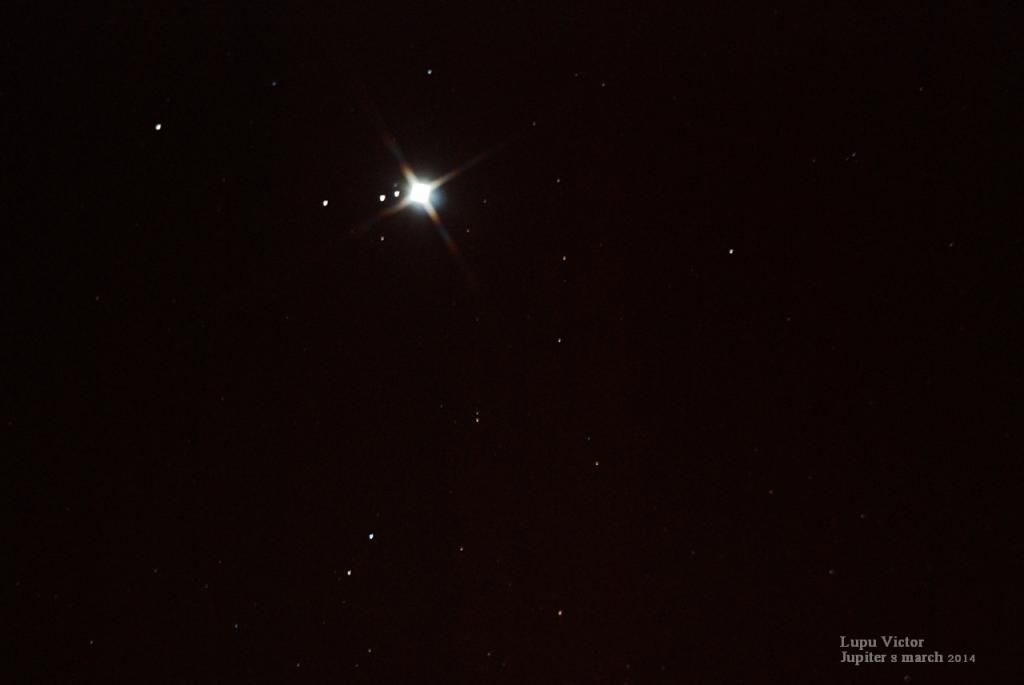
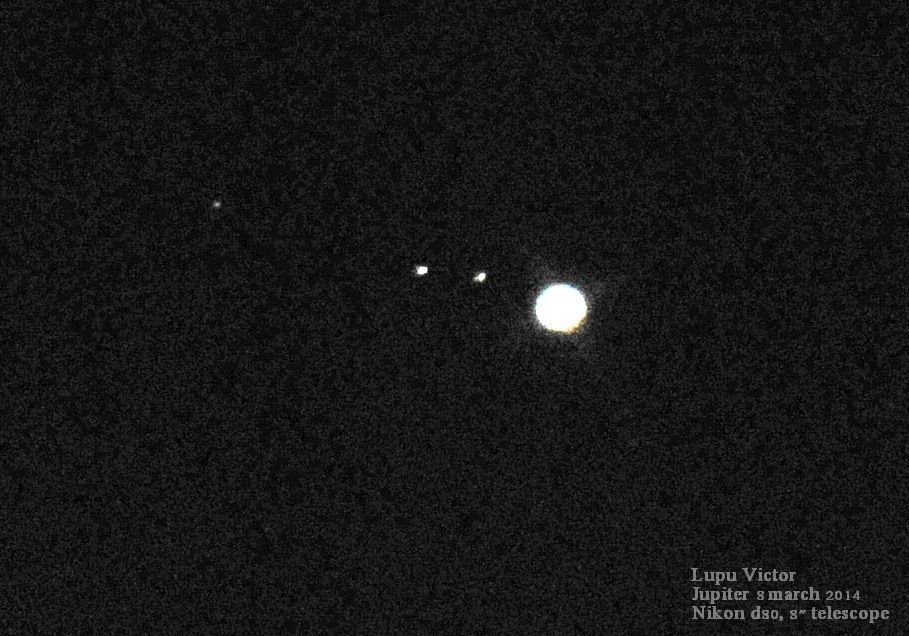
Quick report from Romania. Last night Moon/Jupiter snap with Nikon and telescope.


Last night I went out with the telescope on my block. The temperature was good enough to not freeze my hands. The wind beat slightly in short series. This was the first time I went out with the telescope in 2014.
The atmosphere was bad for a success shooting, but I'll see what I have to choose from what was have recorded.
I filmed and photographed the Moon and Jupiter. Photos, you can see them above.

Age of the Moon: 7 days
Distance: 398.283
Phase: 53% (0% = New, 100% = Full)


Telescope: 8 inch Celestron Newtonian
mount C5/EQ5
Camera: Nikon D80, T ring
Eyepiece: no
Filter: no
Date: March 8, 2014
Time: 11:00 p.m. to 0:00
Location: Baia Mare, Romania


Sunday, 29 December 2013

Astronomy Now: Orion Constellation/Nebula by DSLR/telescope

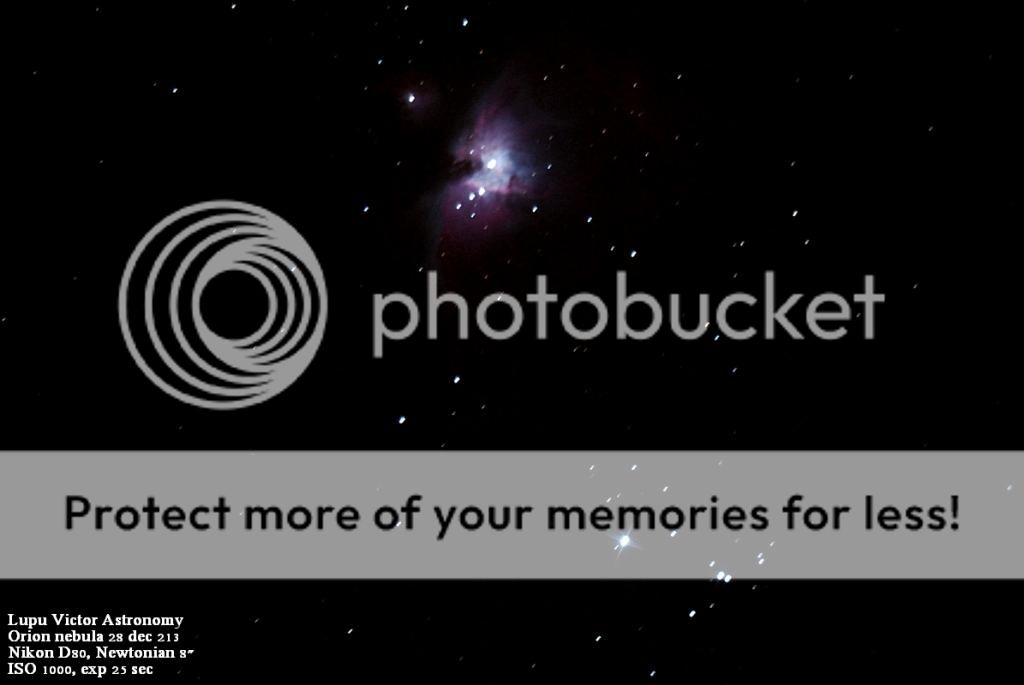
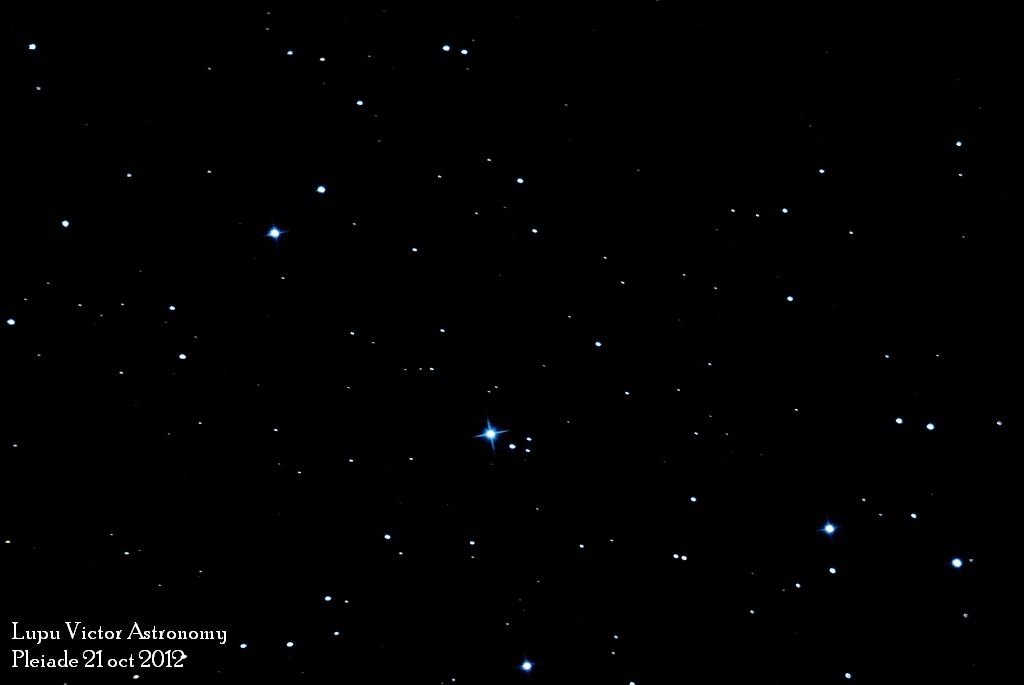
Below, I used the telescope to photograph the Orion Nebula. Stars have some tails. A more success image is the one shot on October 21, 2012.


Above:
Name: Orion Nebula
Location: Baia Mare, Romania
Date: 28/12/2013
Time: 00:28:46
Telescope: Newtonian 8 "Celestron
Ocular: No
Camera: Nikon D80 body
Exposure: 25 sec
Aperture: F1
ISO 1000
Edit: FastStone


Edited: exposures of 20, 25 and 30 seconds.

Above are edited images.
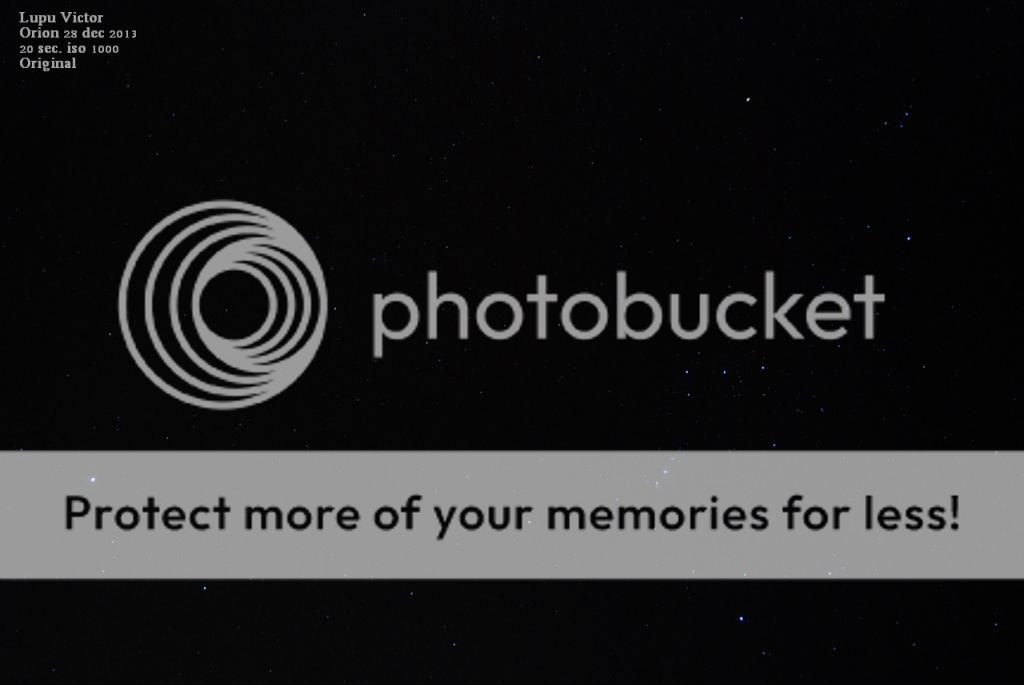
Below are the original photos.

Originals: exposures of 20, 25 and 30 seconds.

Last night, I went out with the telescope on the outskirts of Baia Mare city. It was an acceptable temperature for this period of 5 degrees. The sky was completely clear. I can not say that this night was successful, but is my duty to post here what I have achieved with and without telescope.
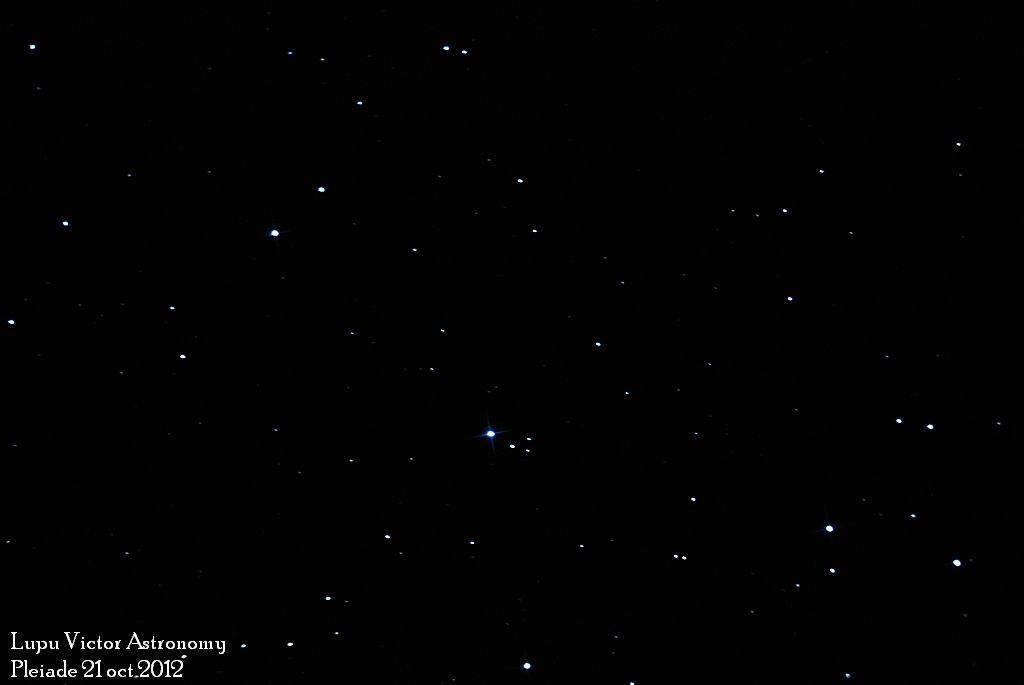
Above are images of Orion constellation photographed without telescope. I've posted here the original images to see the difference for every more 5 seconds exposure in each image. Notice the light pollution in each of the three pictures. The level rises as the exposure is longer. At 30 seconds, the picture is already orange.


Above:
Name: Orion
Location: Baia Mare, Romania
Date: 28/12/2013
Time: 12:00 to 1:30
Telescope: No
Ocular: No
Camera: Nikon D80, 18-55mm
Exposures: 20, 25 and 30 sec
Aperture: F5.1
ISO 1000
Edit: FastStone


Wednesday, 13 November 2013

Red star Betelgeuse this Morning (DSLR and telescope images)

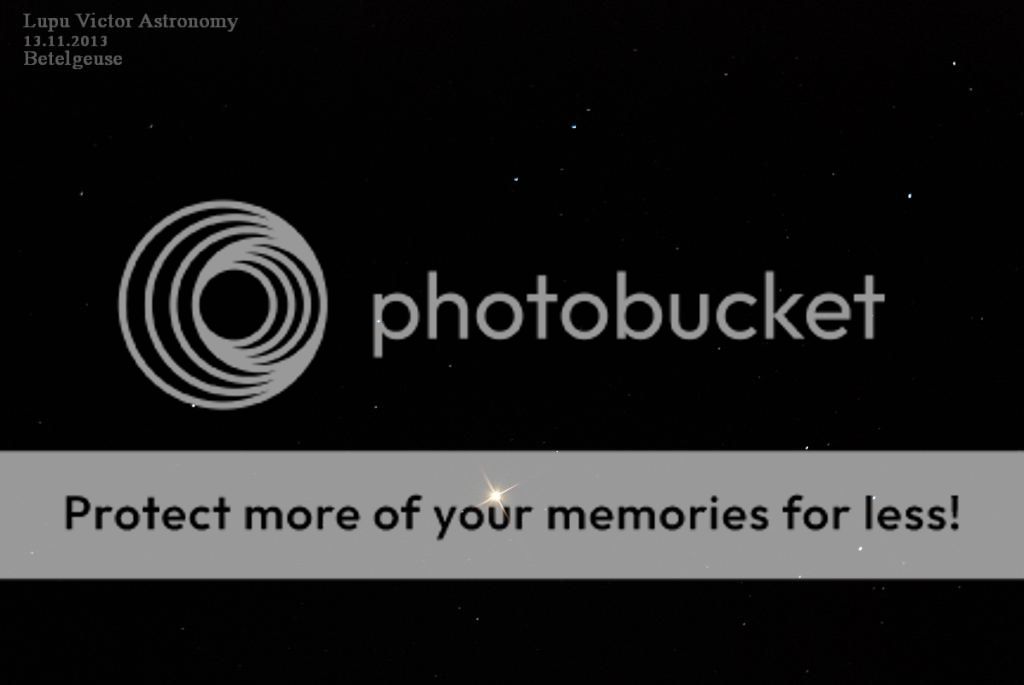
This is the star Betelgeuse in the constellation Orion seen in the morning of November 13, 2013 through a telescope and Nikon D80 DSLR camera.

It was a pretty cold tonight but not cold as in winter. The temperature was 4 degrees. I had my thermos with hot tea so I only had a few chills and cold hands.
In the night sky, Betelgeuse is easy to find with the naked eye because of its proximity to Orion's belt and is distinct like a red-orange color star. In the northern hemisphere in January of each year, we can see it rising in the east just after sunset. By mid-March, is visible to almost every inhabited region of the world except Antarctica. In May, the red giant can be seen for a short time on the western horizon, after sunset, but reappears again a few months later, on the eastern horizon before sunrise.


Telescope: 8 inch Celestron Newtonian
C5/EQ5 motorized mount
Camera: Nikon D80 with ring T
Eyepiece: no (focal)
Filter: no
Date: November 13, 2013
Time: 5:33
Mode: Manual
ISO: 1000
Exposure time: 8 sec
Location: Baia Mare, Romania


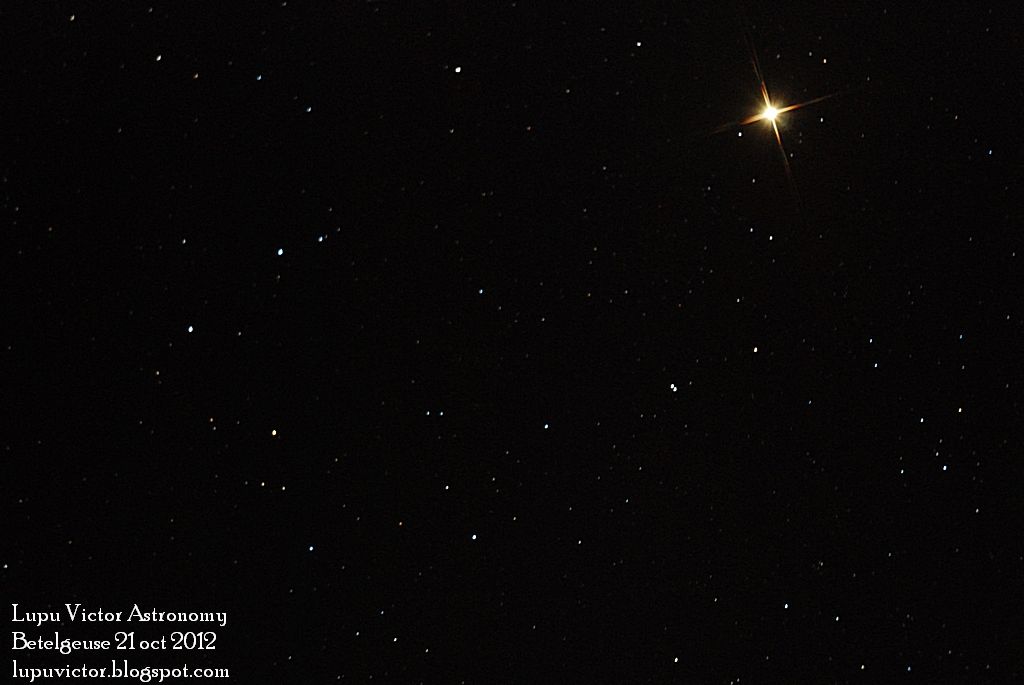
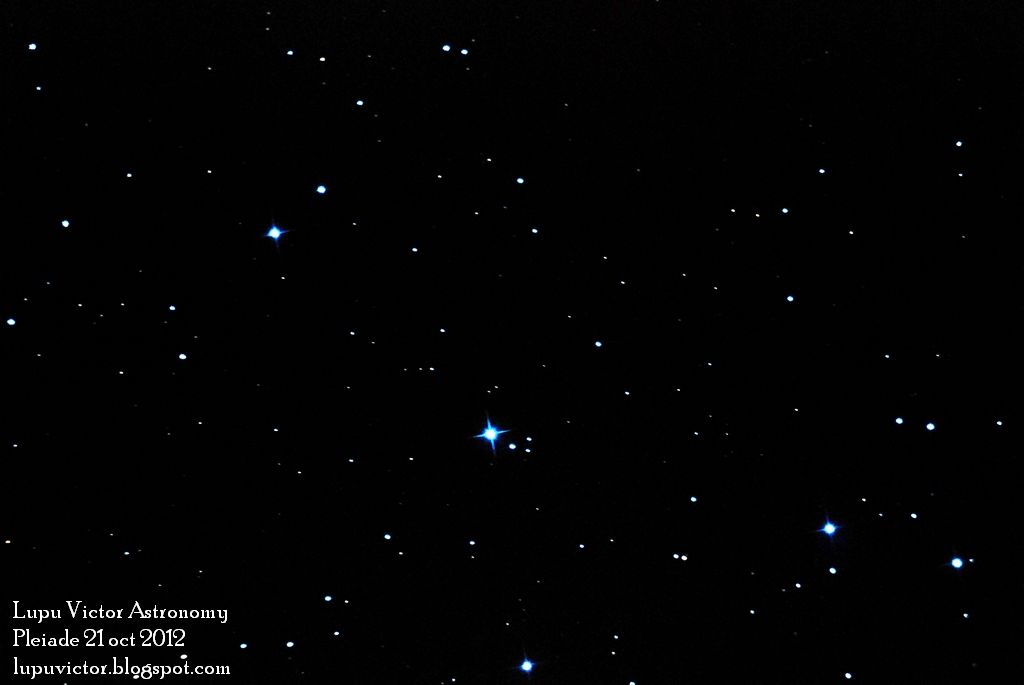
Image for guidance, taken on 21 October 2012.


Saturday, 19 October 2013

Yellow Full Moon through telescope.

Full Moon tonight, a day after partial eclipse.

Age of the Moon: 1 day
Phase: 99.3% (0% = New, 100% = full)
Distance: 386,300 km


Telescope: 8 inch Celestron Newtonian
Mount C5/EQ5
Camera: Nikon D80 ring T
Ocular: no
Filter: no
Date: October 19, 2013
Time: 21:05
1/4000 sec
ISO 250
Location: Baia Mare, Romania

Sunday, 19 May 2013

The Sun Today Astronomical telescope pictures May 19, 2013

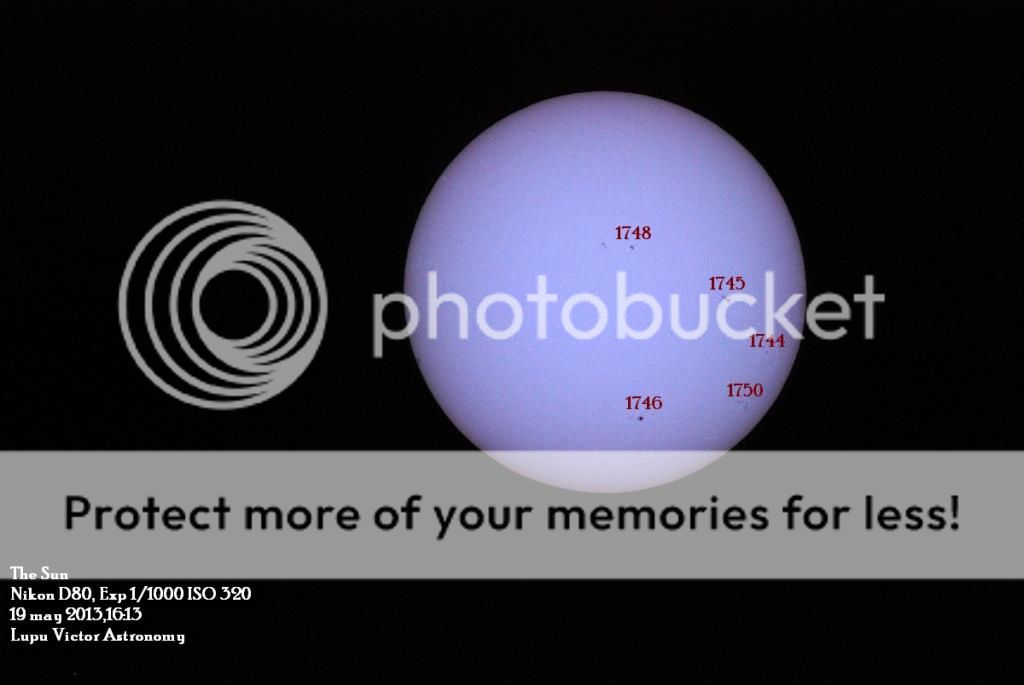
These are the Sun's spots by astronomical telescope as it looks today, May 19, 2013.

I have used the Nikon D80 DSLR camera, without eyepiece.

The biggest spot, 1745, is situated on the eastern sun disc now. Next in size, is 1746, located at South. Other spots are smaller and called 1744, 1748 and 1750.


Telescope: 8 inch Celestron Newtonian
Mount C5/EQ5
Camera: Nikon D80 ring T
Eyepiece: no
Filter: solar
Date: May 19, 2013
Time: 4:00 p.m.
Location: Baia Mare, Romania


Thursday, 28 February 2013

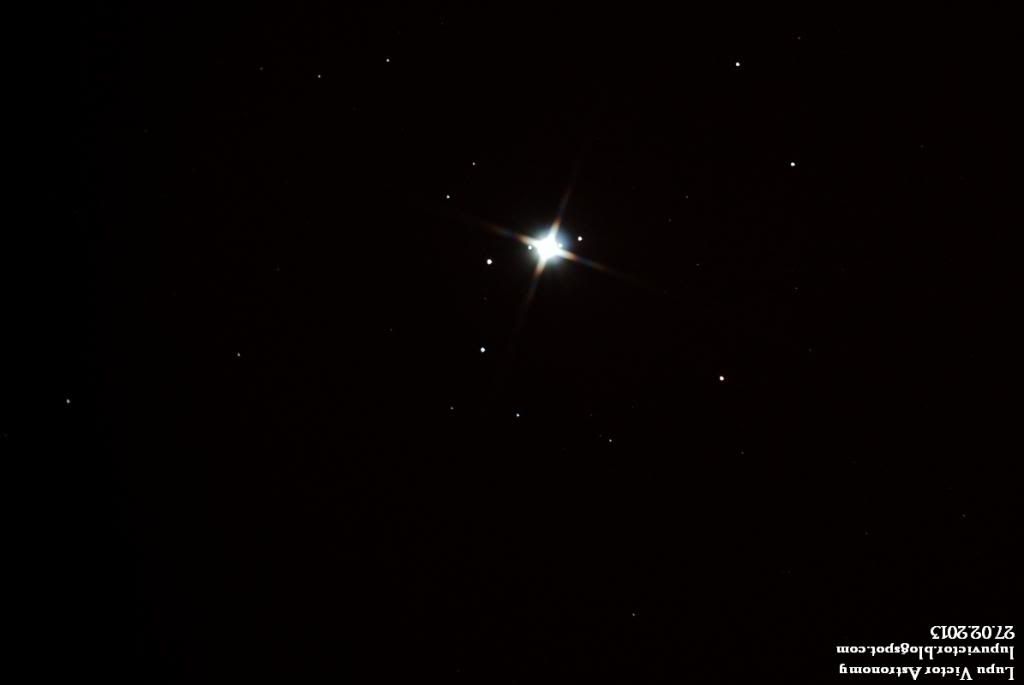
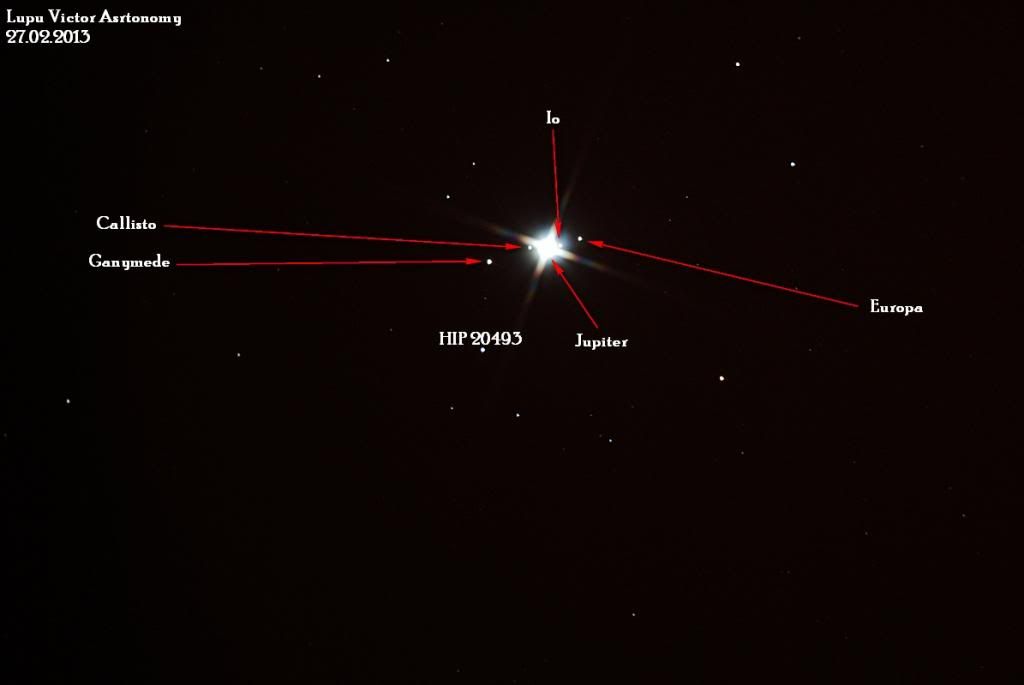
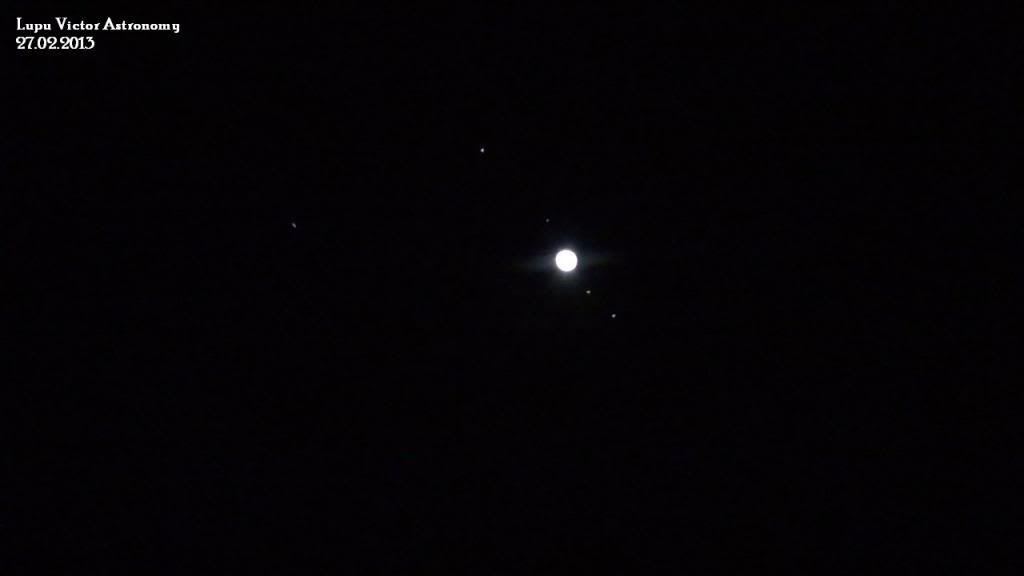
Jupiter last night with DSLR and HDR


These are pictures of Jupiter last night at around 10:00 p.m. taken by DSLR camera Nikon D80 (top) and Sony HDR CX130 camcorder (below).

Last night it was warm, unusual for this time of the year.

These are quick processing photos. Video processing will be posted later.


Saturday, 10 November 2012

Pleiades Seven Sisters or Hen with Chicks pictures by astronomical telescope


If there is a beautiful view seen by the naked eye in astronomy, the Pleiades are certainly the ones, located approximately 400 light-years from us.

Pleiades is one of the most beautiful scenery in astronomy: the dispersion stars of Pleiades or Seven Sisters. In Romania (my country), is known as Hen with chicks. The main stars of the Pleiades form a small dipper that is much richer than the Hyades, and are most easily recognized of all the stars in the heaven.
Almost every culture throughout history, imagined this cluster as something delicate, like a group of virgins, a flock of doves, or a hen and chicks. This swarm is best known in Greek as the Seven Sisters.

The Pleiades were important in legends, poetry, and even as a timekeeping throughout history.
Pleiades are located on the shoulder of the imaginary Taurus constellation.

Anyone can look at the Pleiades with binoculars or a small telescope under dark skies. It is important, however, to look through a wide field telescope to fit the entire stellar group in the image.


Telescope: Celestron 8 inch Newtonian
C5/EQ5 motorized mount
Camera: Nikon D80 ring T
Eyepiece: no (focal)
Filter: no
Date: October 21, 2012
Time: 05:00
Mode: manual
ISO: 640
Exposure time: 10 sec
Location: Baia Mare, Romania


Articles about Pleiades:
Pleiades star group arrangement. Images through the telescope.
Video Pleiades (Messier 45 or M45), by astronomical telescope
The Pleiades astronomical images
My first Pleiades

Sunday, 28 October 2012

Betelgeuse a supernova in the near future


For a long time, observers noted that the brightest stars in the constellation Orion forms a nearly symmetrical model together. This huge geometric group is sometimes called Winter Hexagon composed of straight lines from Sirius to Procyon to Pollux, Capella, Aldebaran and Rigel, and within the geometric model, is Betelgeuse.
The most famous star of the constellation Orion is not Rigel, but Betelgeuse for its strange name and its orange color. It is a red giant . This star is compared with the color of Mars and its brightness varies because some years it shines much more than others. From this fact we are assuming for this star to become a supernova soon.


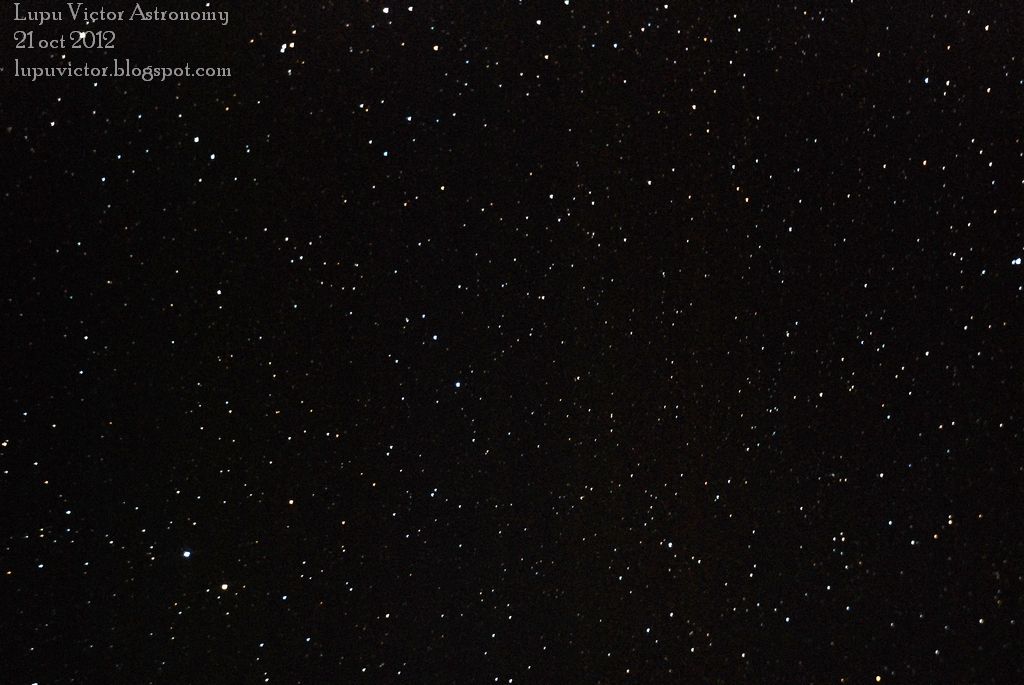
A region of the sky that I do not recognize because I pointed the telescope at random in the sky, but in the galactic plane.

Telescope: Celestron 8 inch Newtonian
C5/EQ5 motorized mount
Camera: Nikon D80 ring T
Eye: not (focal)
Filter: no
Date: October 21, 2012
Time: 06:26
Mode: manual
ISO: 1250
Exposure time: 30 sec
Location: Baia Mare, Romania


LinkedIn comments to this post:

Sharon Xuesong Wang •Hi Lupu,
Pretty plots! Would you mind sharing about how you've become an astronomy photographer with the group? Please forgive my ignorance, but I'm wondering if how one can become an professional astronomy photographer for a living... Are you currently doing that?
I think that would be of more interest to the group. ;)
Thanks!
Sharon


Lupu Victor •I work in military. I like astronomy and this is my second job in my life. And this second job takes all of my free time, but I like that. Thanks for your question.


Megan Donahue •Interesting fact : when Betelgeuse has its supernova, it will be visible to us on Earth night ...or day (as long as it is above the horizon). The supernova will not give much warning, though. Once it has an iron core (invisible to us) it will only have a few short hours of life left.
Sharon - professional astrophotographers' best bets are to take large-angle images of the sky and request royalties for their use or sell as posters. With targeted images of small things, they are in competition with free images available from the Hubble Space Telescope or others. For most, it has to be a labor of love at least at first.


Harold Henderson •For a Red Supergiant like Betelguese 100 milion years is a "lifetime". But still, an imminent supernova might be thousands of years (plus 1500 years for light to travel here) away. Keep watching and good luck!

David Windschitl •If it should happen in our lifetimes, I will mourn my red winter 'friend' - both the color and the name made it one of my favorites when I started out stargazing.

Leela Kalyanaraman •But Richard, I thought a fair estimate would be from yesterday to 10,000 years? And Harold, Betelgeuse isn't that many light years away, is it?
David, Orion would be himself without a shoulder, would he??:-(

Gregory Roberts •direct parallax measurements put Betelgeuse as close as 495 ly, others at about 640 ly - but the accepted average is about 570 ly

Personally I think it would be pretty cool to see it nova, I look at it every clear night when its up wondering if the flash is just a few hours away

 
All images are © Copyright 2010-2015 Lupu Victor. All rights reserved.Images may not be reproduced, published, or copied in any form without written permission of the author. Thank you for respecting the intellectual property rights. ASTROFOTOGRAFIA | Lupu Victor Astronomy - Contact - About
Design by Free WordPress Themes | Bloggerized by Lasantha - Premium Blogger Themes | Online Project management