Visit Worldwide Topsites
Showing posts with label Wich camera is good for astrophotography?. Show all posts

Thursday, 10 February 2011

Nikon D80 DSLR vs. video camera Sony CX105

With Sony CX105 HD  capture                                                              -click to enlarge
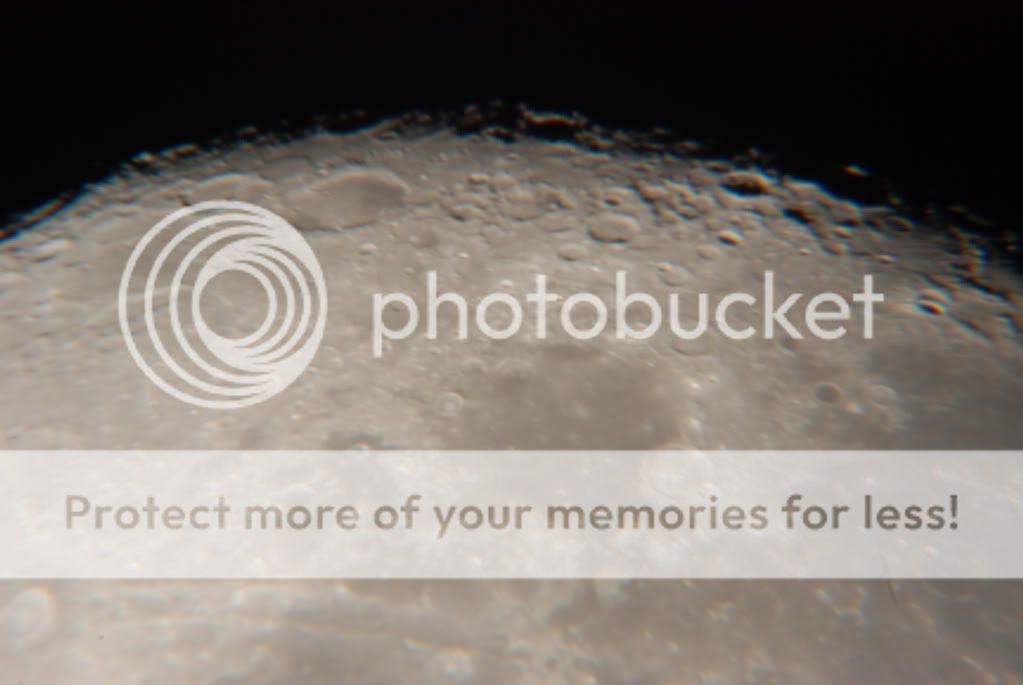
With Nikon D80 1/100,iso 1250 9.02.2011 19:53 cu telescope 8",hyperyon 10mm-click to enlarge


With Sony CX105 09.02.2011 18:00 cu telescope 8" newtonian   -click to enlarge

Cu Nikon D80 1/50,iso 320 09.02.2011 19:58 cu telescop 8",hyperyon 10mm-click to enlarge


With Sony CX105 09.02.2011  18:00  telescope 8" newtonian   -click to enlarge

With Nikon D80 1/100,iso 1250 09.02.2011 19:53 telescope 8",hyperyon 10mm-click to enlarge
The difference between a video capture made with a camera that shoots HD and a photograph taken with Nikon D80 DSLR is quite big.How I said in other articles, video camera I have, is much better than DSLR Why I came to this conclusion?
      With Nikon as photos made when shutter is open, so remains.On video, you can choose the frame for a snapshot, or you can process a large number of frames for processing in registax.
       In processing with registax, the photos taken with DSLR , must be made in such a way that craters must be all in the same position when you make pictures, because if you don't do so, in the alignment in registax , the square (the area chosen for alignment) is lost among other craters, running everywhere; alignment is impossible. Of course those who have a motorized telescope does not have such problems, the photos are made the same point, one after another.
      I do not know if you agree with mine.Anyway, starting last night I advanced in astrohotography problem with Nikon, but many gaps still remain,and questions.

     For those who have the passion astrophotography:
It is easier with a video camera or a DSLR?
With that camera you like the results?
Which kind of photos are more convenient for you to process in registax for example?
Registax photo processing with a DSLR is only possible if the pictures were done on a motorized telescope?
Details:-
Sony CX105
Photographer: Victor Lupu
Optics: Celestron C8-N telescope, plossl 20mm, 2x Barlow
Mount: C5
Filter: No
Date: 09/02/2011
Location: Baia Mare, Romania
Exposure Details: -
Processing: 10 Sony Vegas, video snapshots

-with Nikon D80
Photographer: Victor Lupu
Telescope: Celestron C8-N (CELESTRON Newtonian)
Mount: C5
Ocular: Hyperion 10mm, 2x Barlow
Camera: Nikon D80, Hyperion adapter, Nikon T Ring
Filter: No
Date: 09/02/2011
Location: Baia Mare, Romania

   Next post will be about the star Rigel with pictures made last night
Sunday, 6 February 2011

DSLR Nikon D80 vs. HDR Sony CX105

Photographer: Victor Lupu
Telescope: Celestron C8-N (CELESTRON Newtonian)
Mount: C5
Ocular: Hyperion 10mm, 2x Barlow
Camera: Nikon D80, Hyperion adapter, Nikon T Ring
Filter: No
Date: 17/01/2011
Time: 21:59
Location: Baia Mare, Romania
Exposure Details: - 1 / 25 ISO 400

Optics: Celestron C8-N telescope, plossl 20mm, 2x Barlow
Mount: C5
Device: Sony HDR CX105
Filter: No
Date: 17/01/2011
Location: Baia Mare, Romania
Processing: Sony Vegas 10 Registax

   The photos above were made in the same night two above are made with DSLR Nikon D80, and next two are the result of video files processed in Registax.
      I talked on the forums about the difference between the DSLR and HDR.It seems I always managed to achieve more quality pictures with the Sony CX 105 and Registax than a DSLR

Sunday, 26 December 2010

How to take pictures of the Moon

Focal image - celestron 8" and nikon D80 with T ring                                            

Afocal image - celestron 8" and HDR sony CX105                     
It depends on what kind of device you have.And if you have a telescope, it's better.Without telescop.This simple metod is to straighten the camera to the Moon and hit the buton.But matters what settings you gave to the camera.With the mobile phone cameras would come out of the question to make something nice.They don't have an optical zoom, but digital.The difference between the two of them is that with the optical zoom lens, is the same as you would move to the object and take a picture.Instead, the digital zoom, increases your digital pixels, instead of approaching to the object, with the effect of "collapse" of the picture.The pixels are seen increasingly bigger as you zoom and the photo will not be so clear.
     
So it's very important to have an optical device that approach, not digital.The only way to take beautiful pictures is to not zoom, and the Moon to be already close, so it is recommended to be used only by the eyepiece of the telescope through which the image is already good in the front of your camera.And if the device (even as mobile phone), has some more megapixels, the picture can get really incredible.
    
With an optical zoom camera, the pictures come out more better(not always).The moon is clear.Fixed on the tripod to be stable, and the settings you need, you would like what that camera will do.Of course, digital cameras are now in vogue.Do not confuse digital zoom,with  digital camera.The digital camera has optical zoom lens (attached or not), these two things are different.
    The best to take in consideration in s
ettings of a digital cameras with optical zoom DSLR (digital single-lens reflex), is in my opinion ISO light sensitivity that is entering into the camera, and the exposure time.Who has a camera or a phone camera, can see ISO in options menu .
     
If the ISO is set lower, when it is dark, the resulting image will be the same as darker.but when is set bigger,the picture will be brighter, even if it's dark.
   
Exposure time.In photography, shutter speed is a common term used to discuss the exposure, that is the actual length of time of exposure to light on the sensor.More the CCD is open to light ,The more the picture is even brighter when is dark, releasing details that not even your eyes can see at that moment.
    
The telescope images can be made focal and afocal.Focal means to mount the camera without any objective, directly to the telescope,and take pictures through the ocular.Afocal pictures are achieved when you mount your video or photo camera in front of the telescope's eyepiece.


Monday, 13 December 2010

Astrophotography : HD vs. DSLR vs. VGA through telescope

 
The passion for astrophotography is made with different devices using different methods to capture what is observed through the telescope. I use  two methods for astrophotography : CX105 Sony HD camera (with registax Processing) and Nikon D80 camera, for which I have a T ring  for my C8-N telescope. The difference you see between the two methods is very big. With DSLR camera I can not see the Moon close, like with the HD Sony camera . But how do you approach the Moon with DSLR camera? I am much more interested in videos, but I want to make some progress with the Nikon, with some good results, but i guess i have a lot to study.

 
Moon with C8-N telescope,20mmplossl,2x barlow,sony cx105,registax


All images are © Copyright 2010-2015 Lupu Victor. All rights reserved.Images may not be reproduced, published, or copied in any form without written permission of the author. Thank you for respecting the intellectual property rights. ASTROFOTOGRAFIA | Lupu Victor Astronomy - Contact - About
Design by Free WordPress Themes | Bloggerized by Lasantha - Premium Blogger Themes | Online Project management