
 Wednesday, March 30, 2016
 Unknown

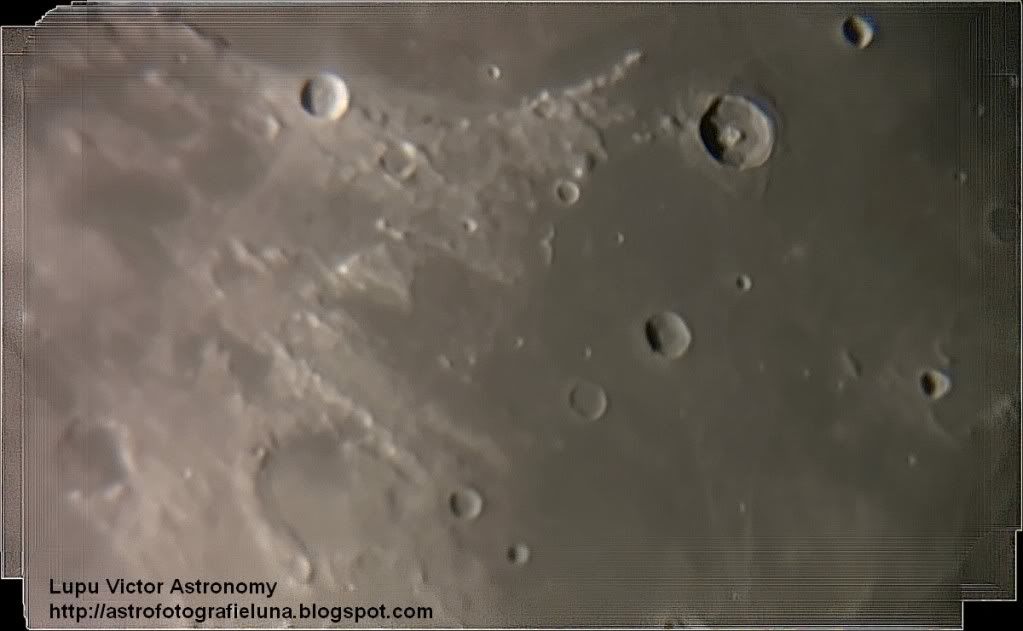
In these images we see lakes, mountains, craters and seas located on the central-east of the Moon.
We mention Menelaus crater (27 km), Manilius (39 km) and Boscovich (46 km), the 3 lakes Gaudii, Lenitatis and Hiemalis, Montes Haemus, Mare Serenitatis and Mare Vaporum.
These snapshots were chosen as the clearest made of a video camera attached to the telescope.
Menelaus crater is small but visually easy to locate thanks to the layout of the south shore of Mare Serenitatis and the foothills Montes Haemus.
Manilius is larger but with a well defined edge, south of Lacus Doloris. It has a depth of 3.1 km, and to this phase is almost totally in shadow.
Boscovich (46 km), is located southeast of Manilius. It is almost entirely eroded by impacts, and therefore its shape is not circular. Its floor is cut by a system of Rille called Rima Boscovich. Interesting is the satellite crater Boscovich P (67 km), which is elongated in the direction of the crater Manilius.
Mare Vaporum is at the terminator, and therefore there is less light present.
As a conclusion, these pictures are very beautiful and interesting at the this phase of the moon. The features that you are glaring from the first moment, are crater Manilius and Montes Haemus.


Magnitude: -10.82
Phase: 0.46
Distance: 399.283 km
Illuminated: 45.6% (0% = New, 100% = Full)
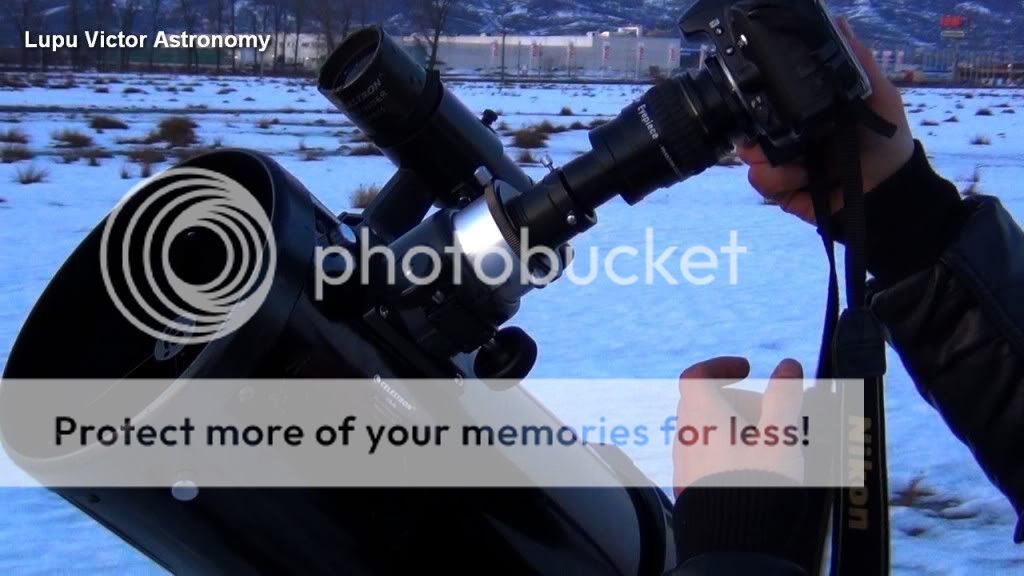
Astronomical instrument: Celestron C8-Newtonian telescope,
Eyepiece: Plossl 20mm, 2x Barlow
Mount: CG5 (EQ5)
Camera: Sony CX130
Filter: no
Date: 30.01.2012
Location: Baia Mare, Romania
Processing: FastStone Image Viewer
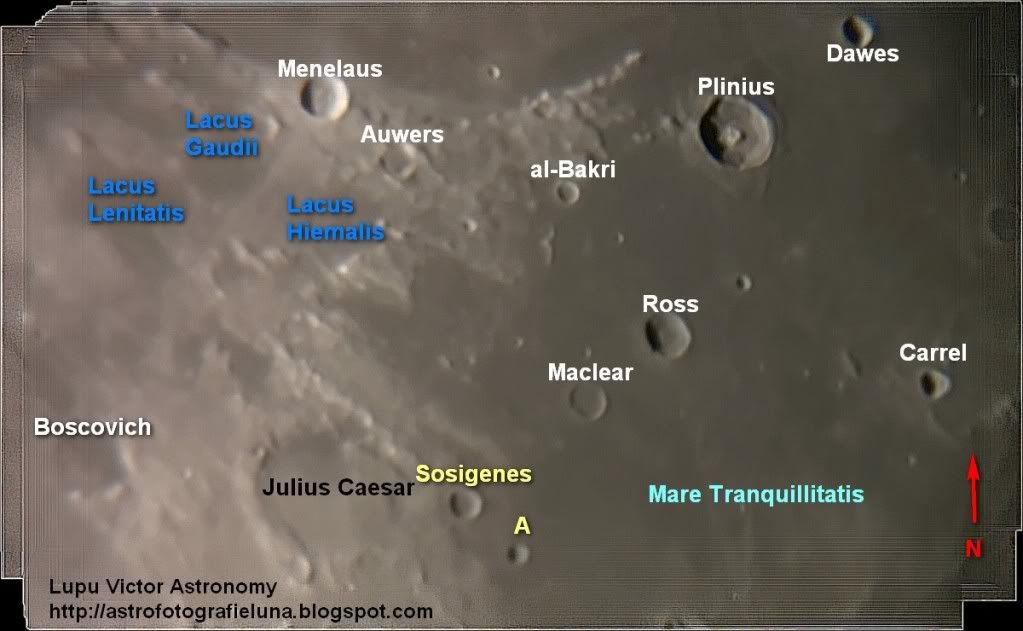
In the picture below are labeled craters and other lunar features in the region. To better understand this photo, you should note that the label with the name or the letter of larger craters could be found at their center, and on the small craters, you should find them around them, usually above.


We mention Menelaus crater (27 km), Manilius (39 km) and Boscovich (46 km), the 3 lakes Gaudii, Lenitatis and Hiemalis, Montes Haemus, Mare Serenitatis and Mare Vaporum.
These snapshots were chosen as the clearest made of a video camera attached to the telescope.
Menelaus crater is small but visually easy to locate thanks to the layout of the south shore of Mare Serenitatis and the foothills Montes Haemus.
Manilius is larger but with a well defined edge, south of Lacus Doloris. It has a depth of 3.1 km, and to this phase is almost totally in shadow.
Boscovich (46 km), is located southeast of Manilius. It is almost entirely eroded by impacts, and therefore its shape is not circular. Its floor is cut by a system of Rille called Rima Boscovich. Interesting is the satellite crater Boscovich P (67 km), which is elongated in the direction of the crater Manilius.
Mare Vaporum is at the terminator, and therefore there is less light present.
As a conclusion, these pictures are very beautiful and interesting at the this phase of the moon. The features that you are glaring from the first moment, are crater Manilius and Montes Haemus.
Magnitude: -10.82
Phase: 0.46
Distance: 399.283 km
Illuminated: 45.6% (0% = New, 100% = Full)
Astronomical instrument: Celestron C8-Newtonian telescope,
Eyepiece: Plossl 20mm, 2x Barlow
Mount: CG5 (EQ5)
Camera: Sony CX130
Filter: no
Date: 30.01.2012
Location: Baia Mare, Romania
Processing: FastStone Image Viewer
In the picture below are labeled craters and other lunar features in the region. To better understand this photo, you should note that the label with the name or the letter of larger craters could be found at their center, and on the small craters, you should find them around them, usually above.