Visit Worldwide Topsites
Showing posts with label Vallis Schröteri. Show all posts

Monday, 14 September 2015

Pictures by telescope. Aristarchus crater on the Moon in Registax 5.

Aristarchus (40 km) is one of the most distinct craters on the lunar surface though it is small in size. That's because its brightness when in contact with sunlight. It makes a great pair with Herodotus (35 km), which is about the same size Aristarchus, but very different from it, since Herodotus is flooded.
We can easily see debris thrown around Oceanus Procellarum from Aristarchus, ending up at Kepler (32 km), another crater to the southeast of it.

Herodotus appears as a bright ring near Aristarchus and between the two we distinguish a curved westward channel called Vallis Schröteri. In the area of this channel, the terrain color is darker.

Towards the west of two, it is an isolated crater called Schiaparelli (24 km), and further, the terminator is a large crater which it is lit on the outer edge, called Seleucus (43 km).


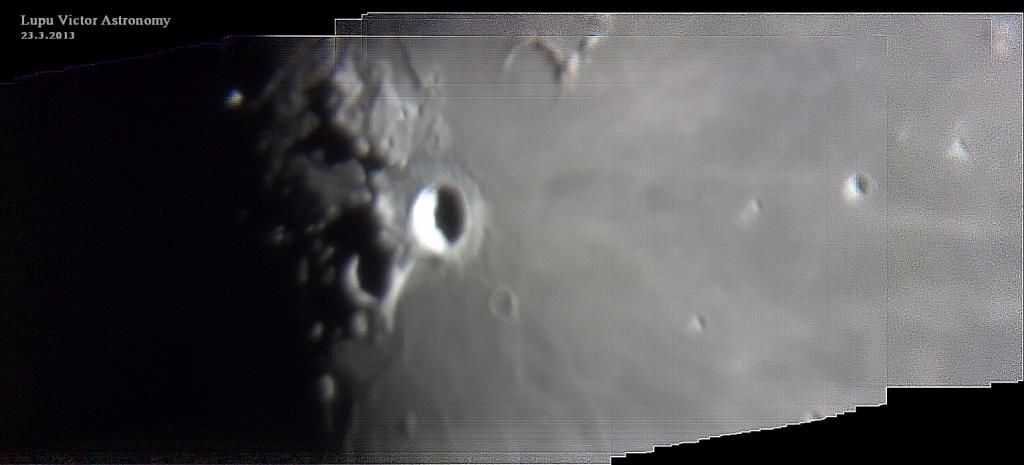
335 video frames in Registax.
276 video frames in Registax.
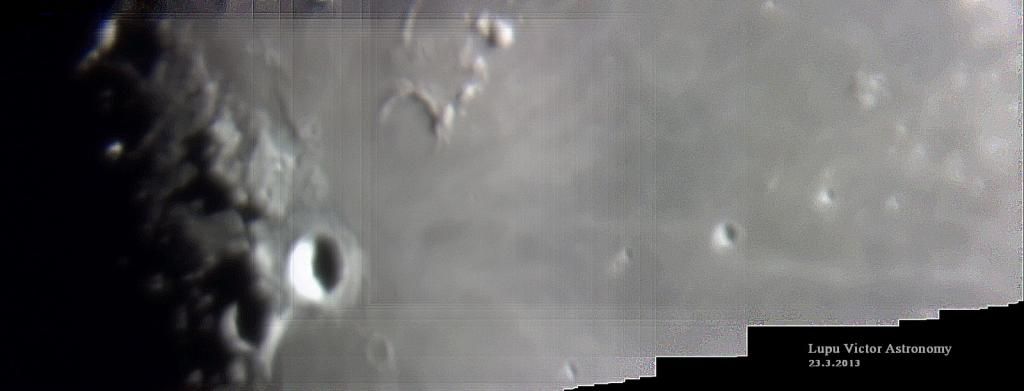
224 video frames in Registax.

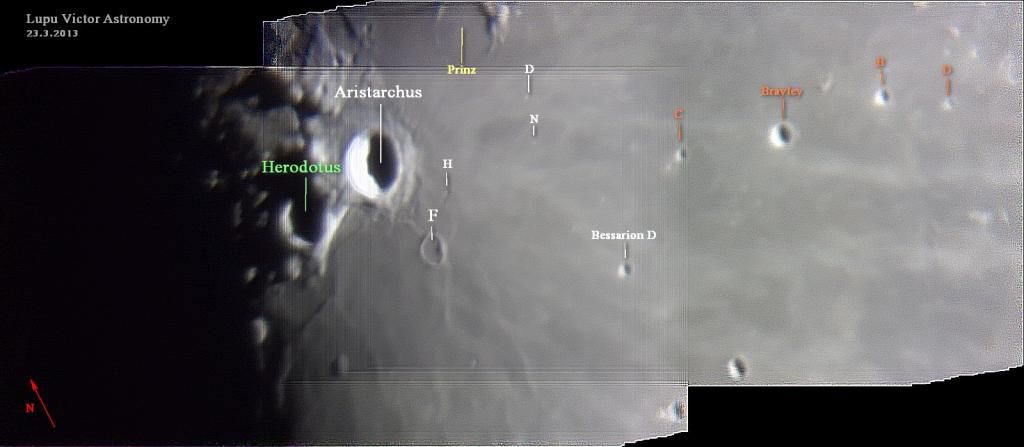
In the picture below are labeled craters and other lunar features in the region. To better understand this photo, you should note that the label with the name or the letter of larger craters could be found at their center, and on the small craters, you should find them around them, usually above.


Magnitude: -12.10
Phase: 0.96%
Distance: 402.464 km
Illuminated: 96% (0% = new, 100% = full)

Astronomical Instrument: Celestron C8-Newtonian telescope
Eyepiece: plossl 20mm, 2x Barlow
Mount: CG5 (EQ5)
Camera: Sony CX105
Filter: no
Date: 08.11.2011
Location: Baia Mare, Romania
Processing: Registax 5 FastStone Image Viewer


Sunday, 31 May 2015

Aristarchus Herodotus Moon craters by telescope. Astronomy science.


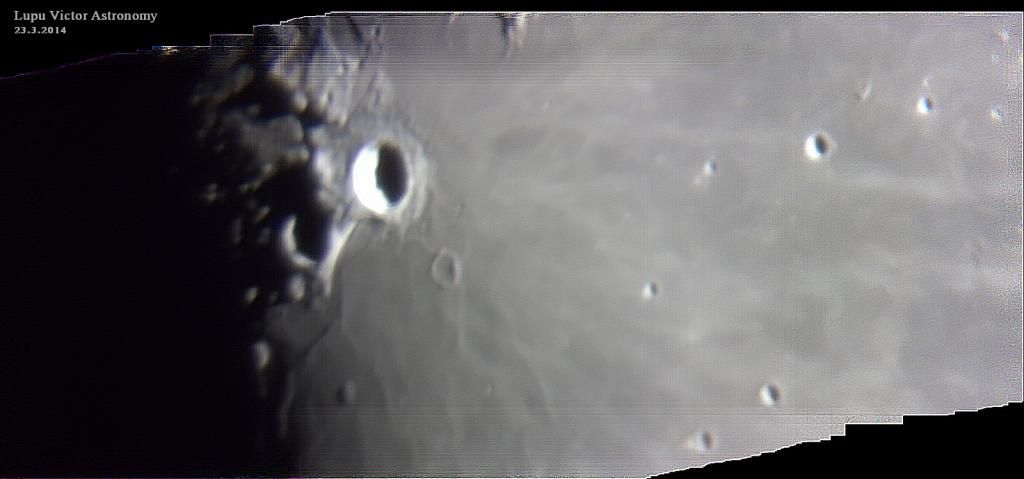
The glowing Aristarchus crater (40 km) is what captures your attention at first view of these images with the lunar surface. Adjacent to the west, is another crater opposite to Aristarchus's glow, flooded by lava by Oceanus Procellarum basin, which is called Herodotus (35 km).

We can see different shades of color on the Oceanus Procellarum. To the north of Herodotus begins Vallis Schröteri, a valley with a length of 160 km and a depth of about 1 km, which can be better seen in these images.

The mess left behind after the Aristarchus's impact crater that formed it, is seen around it, by the reflected rays which starts from it.

Magnitude: -12.03
Phase: 70.5% (0% = new, 100% = full)
Distance: 398.311 km
Sidereal Period: 27.32 days
Illuminated: 92.2%


Optics: Celestron C8-Newtonian astronomical telescope 
Eyepiece: Plossl 20mm, 2x Barlow
Mount: CG5 (EQ5)
Camera: Sony CX130
Filter: no
Date: 14/03/2014
Location: Baia Mare, Romania
Processing: FastStone Image Viewer


Craters were filmed with a video camera attached to an astronomical 203 mm Newtonian telescope.

In the picture below are labeled craters and other lunar features in the region. To better understand this photo, you should note that the label with the name or the letter of larger craters could be found at their center, and on the small craters, you should find them around them, usually above.

Image from 2010.


Tuesday, 28 January 2014

Been Busy! Aristarchus Region Telescope Images.

61 frames, 80% best quality in Registax.
72 frames, 90% best quality in Registax.
122 frames, 80% best quality in Registax.
68 frames, 85% best quality in Registax.
39 frames, 85% best quality in Registax.
87 frames, 70% best quality in Registax.


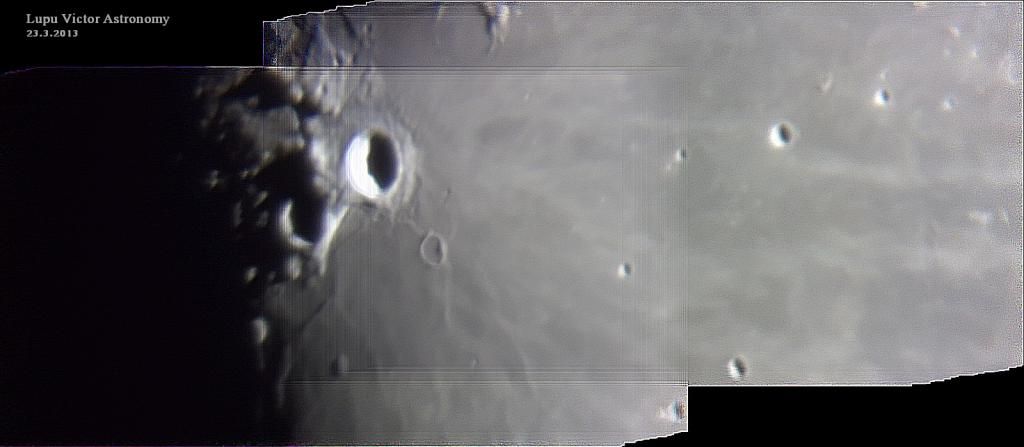
Aristarchus (40 km), is one of the hunted craters by telescope observers although is small in size .
(40 km)
Because of the Moon phase, it can be observed more clearly the terrain elevation surrounding the two craters : Aristarchus and Herodotus . Although they are similar in size , they are different in appearance. One is 3.7 km deep and the other, Herodotus (35 km), is flooded by lava with a depth of 1.5 km.

Among them , we can observe a crack heading north. This is called Vallis Schröteri , and starts from the crater Herodotus . This valley is close to a tall wall that stretches north of the crater Herodotus , giving the illusion that the valley splits at one point , but it is not like that. Vallis Schröteri continues on to North , and it curves West.

Notice south of Aristarchus a crater which seems rather like a drawing because it was flooded in the past by lava , leaving only to see the top end edge . This is Aristarchus F (18 km).

To the east of these craters , starts Oceanus Procellarum basin. Here, we see small craters like Brayley (15 km) and satellite craters of Bessarion. To the west , there are many features to be seen as we get to the edge of the Moon , but all are in the dark here.

Video can be seen here: Aristarchus crater on the Moon on HD video.


Age of the Moon: 11 days
Distance: 386 658
Phase: 85% (0% = New, 100% = complete)

Optical Telescope Celestron C8 "Newtonian, plossl 20mm, 2x Barlow
Mount: CG5 (EQ5)
Device: Sony CX-130
Video Mode: Full HD 1920x1080 progressive
Filter: no
Date: 23/03/2013
Location: Baia Mare, Romania
Processing and editing: Sony Vegas 10

Image from 2010 with the same telescope.


All images are © Copyright 2010-2015 Lupu Victor. All rights reserved.Images may not be reproduced, published, or copied in any form without written permission of the author. Thank you for respecting the intellectual property rights. ASTROFOTOGRAFIA | Lupu Victor Astronomy - Contact - About
Design by Free WordPress Themes | Bloggerized by Lasantha - Premium Blogger Themes | Online Project management