Visit Worldwide Topsites
Showing posts sorted by date for query Alpetragius. Sort by relevance Show all posts

Wednesday, 17 April 2013

List of Moon's center features. Astronomy lecture

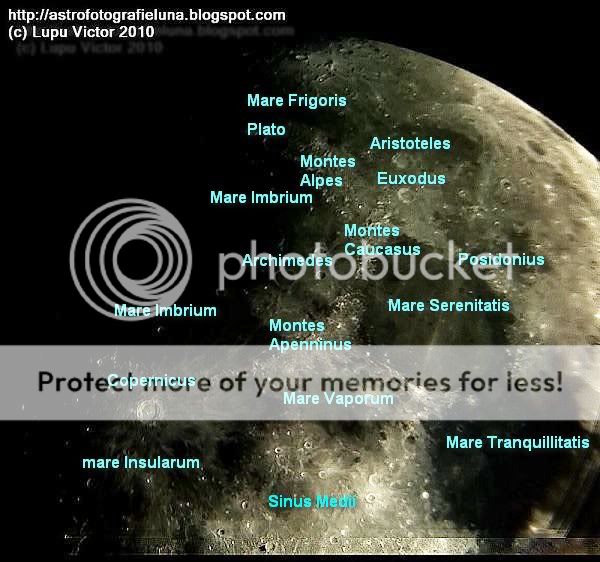
Craters at the center of the lunar disk, as seen from the Earth, are the most visible because their entire structure is facing us, revealing the floors and their perfect detail, even with a modest telescope. On the center, there are many features, such as mountains, seas (mare) and large craters. Apenninus Mountains are easily spotted, and craters as Eratosthenes, Copernicus, the great crater Ptolemaeus but others that can be found in the lists below.

The craters on the Moon are named after great personalities of the branch of science such as astronomers, mathematicians, inventors and not only.

The results of the links may not have as title the craters, mountains or other features you are looking for, but in the content of the articles, those features are presented.


Craters of the Moon's center area.


Abulfeda
Agrippa
Almanon
Andel
Aratus
Albategnius
Alpetragius
Alphonsus
Argelander
Arzachel
Airy
Blagg
Bode
Bonpland
Bowen
Bruce
Bumham
 
Cone
Conon
Copernicus
Davy
Delambre
Dembowsky
Dollond
Eratosthenes
Flammarion
Fra Mauro
Gambart
Gay Lussac
Godin
Gylden
Halley
Herschel
Hind
Hipparchus
Horrocks
Hyginus
Klein
Lade
Lalande
Lassell
Lindsay
Marco Polo
Mosting
Muller
Murchison
Oppilzer Pallas
Pallas
Palissa
Parrot
Pickering
Playfair
Ptolemaeus
Reamur
Reinhold
Rhaeticus
Ritchey
Saunder
Schroter
Seeliger
Sommering
Sporer
Stadius
Sulpicius Gallus
Taylor
Thebit
Triesnecker
Turner
Ukert
Vogel
Wallace


Seas of the Moon's center area.

Mare Vaporum
Mare Nubium
Mare Cognitum
Mare Insularum
Mare Imbrium


Mountains of the Moon's center area

Montes Apenninus
Montes Carpatus
Montes Riphaeus


Other forms of relief on the center area of the Moon.

Sinus Aestuum
Sinus Fidei
Sinus Medii
Lacus Felicitatis
Lacus Odii
Lacus Doloris
Promotorium Taenarium
Rupes Recta
Rimae Alphonsus
Rimae Ariadaeus
Rimae Bode
Rimae Vladimir
Rimae Bradley
Rimae Flammarion
Rimae Gay Lussac
Rimae Hadley
Rimae Hyginus
Rimae Oppolzer
Rimae Yangel
Rimae Parry
Rimae Reamur
Rimae Schroter
Rimae Sulpicius Gallus
Rimae Triesnecker


Space missions on the center area of the Moon.

Apollo 11
Apollo 12
Apollo 14
Apollo 15
Apollo 16
Apollo 17

Luna 5 (1965) USSR due to a malfunction, it crashed on the lunar surface.

Ranger 7 (1964) USA- intentionally crashed, and successfully sent 4308 images with a resolution of up to 0.5m.

Surveyor 3 (1967) USA has landed successfully transmitted images to Earth 6326.

Apollo 14 USA-Extravehicular Activity (EVA). On February 5, 1971, the crew of Apollo 14 landed on the lunar surface in the Fra Mauro formation near Cone crater.


To see the photographic map of the center area of the Moon, view: Photographic map of the Moon: Center Zone. Lunar Atlas.


For those who like my astro pictures or my articles, it woul be great if you could pay attention on advertising that appear in the blog by a click and maybe one day I could buya better telescope.

Saturday, 1 December 2012

Video Alphonsus crater on the Moon through telescope

Prominent and easily visible craters, older Ptolemaeus and younger Alphonsus, are visible through binoculars.

In this video, Alphonsus's east wall shadow, nearly covers a quarter of it's floor. From this, we can figure out the shapes of the peaks and their height.

Central peak of Alphonsus is lit by the sun, shining strong. Alpetragius crater is in total darkness.

Video is upside down as seen through the telescope.


Optics: CelestronC8 "-Newtonian telescope, plossl20mm, 2x Barlow
Mount: CG5 (EQ5)
Device: Sony CX-130
Video mode: Full HD progressive 1920x1080
Filter: no
Date: 30/03/2012
Location: Baia Mare, Romania
Processing and editing: Sony Vegas 10


Thursday, 23 August 2012

[FullHD] Video by astronomical telescope crater Arzachel on the Moon

In the video below, is observed Arzachel crater, an impressive crater from Imbrian Era, with well defined and deep walled terraces. It makes a nice trio with craters Alphonsus and Ptolemaeus, on north.

Notice the crater, and see the large interior wallsthe peak in the center, and the depression valleys of the walls southeast and southwest. East the center of the crater, is another smaller crater called Arzachel A.

Alpetragius crater nearby (40km), shows a central peak, which is a large rounded mountain, occupying most of the floor. This massive is measuring 15 km from north to south, and rises to a height of about 3500 m above the crater floor.

Under a bright sun, the craters are difficult to see with binoculars and small telescopes.


Video: Victor Lupu
Optics: CelestronC8 "-Newtonian telescope, plossl20mm, 2x Barlow
Mount: CG5 (EQ5)
Device: Sony CX-130
Video mode: Full HD progressive 1920x1080
Filter: no
Date: 29/04/2012
Location: Baia Mare, Romania
Processing and editing: Sony Vegas 10


Wednesday, 4 July 2012

All astronomy labels Images Videos News

These are all astronomy labels in one page. If they are too many and did not fit on the main page of the site.You can choose to press 'Ctrl-F' to find what you are interested in.


3D Moon in 3Dfication program(2)About me(6)Accessories(3)Astronomical calendar 2012(1)Astronomical Observatories(1)Astronomical Phylosophy(1)Astronomy news(13)Astronomy Questions and Answers(1)Astronomy terms(2)Astrophotography cameras(2)Astrophotography without telescope(4)Conjunctions(2)Contact me(1)Craters(162)Craters of the center(35)Craters of the east(25)Craters of the north pole(32)Craters of the south pole(50)Craters of the west(29)Craters-Abulfeda and Almanon(4)Craters-Albategnius(4)Craters-Alexander(1)Craters-Apianus(5)Craters-Archimedes(6)Craters-Archytas and Timaeus(2)Craters-Aristarchus and Herodotus(2)Craters-Aristillus and Autolycus(4)Craters-Aristoteles and Eudoxus(8)Craters-Arzachel Thebit and Rupes Recta(5)Craters-Bailly(2)Craters-Balmer and Vendelinus(4)Craters-Biela(2)Craters-Boussingault(9)Craters-Bullialdus(2)Craters-Burg(1)Craters-Byrgius(2)Craters-Capuanus and Palus Epidemiarum(4)Craters-Casatus and Klaproth(2)Craters-Cassini and Vallis Alpes(5)Craters-Catharina(4)Craters-Clavius(7)Craters-Cleomedes(4)Craters-Condorcet(5)Craters-Copernicus(7)Craters-Crüger(1)Craters-Dalambre Taylor and Dolland(1)Craters-Deslandres and Lexell(3)Craters-Endymion(4)Craters-Eratosthenes and Sinus Aestuum(4)Craters-Firmicus and Apollonius(3)Craters-Flammarion Mösting Gyldén and Réaumur(1)Craters-Fracastorius(1)Craters-Furnerius(2)Craters-Gassendi(7)Craters-Geber Abenezra and Azophi(1)Craters-Goldschmidt and Anaxagoras(8)Craters-Grimaldi(6)Craters-Guericke and Parry(1)Craters-Gutenberg(1)Craters-Gärtner and Democritus(1)Craters-Hainzel(3)Craters-Heraclitus and Licetus(6)Craters-Hercules and Atlas(7)Craters-Hommel and Pitiscus(1)Craters-J. Herschel(1)Craters-Janssen(3)Craters-Julius Caesar(4)Craters-Kepler(4)Craters-Langrenus(3)Craters-Letrone(1)Craters-Lilius(1)Craters-Macrobius(4)Craters-Manilius(3)Craters-Manzinus and Curtius(2)Craters-Maurolycus and Barocius(6)Craters-Menelaus(5)Craters-Messala and Geminus(1)Craters-Moretus(9)Craters-Nearch Jacobi and Boguslawsky(3)Craters-Oenopides(1)Craters-Orontius(4)Craters-Pallas and Murchison(3)Craters-Pentland Scott and Demonax(3)Craters-Petavius(7)Craters-Philolaus(2)Craters-Phocylides and Nasmyth(5)Craters-Piccolomini(5)Craters-Plato(7)Craters-Plinius(4)Craters-Pontecoulant(2)Craters-Posidonius(5)Craters-Proclus(6)Craters-Ptolemaeus Alphonsus and Alpetragius(5)Craters-Reinshold and Lansberg(1)Craters-Rhaeticus(1)Craters-Rheita and Metius(5)Craters-Sasserides and Gauricus(1)Craters-Scheiner(4)Craters-Schickard(10)Craters-Schiller(6)Craters-Scoresby(1)Craters-Steinheil and Watt(2)Craters-Stevinus and Snellius(3)Craters-Strabo and Thales(1)Craters-Stöfler and Maurolycus(2)Craters-Theaetatus and Calippus(3)Craters-Theophilus and Cyrillus(4)Craters-Triesnecker(4)Craters-Tycho Longomontanus and Maginus(12)Craters-Vega(3)Craters-Vieta Mersenius and Cavendish(2)Craters-Vlacq and Rosenberger(2)Craters-W.Bond and Meton(6)Craters-Walther Purbach and Regiomontanus(6)Craters-Wilhelm and Pitatus(2)Craters-Wolf(1)Craters-Zucchius Bettinus Kircher(2)Download astronomy softwares(3)DSLR astronomy pictures(10)Eclipses(6)Eclipses-Lunar(4)Eclipses-Solar(1)Equipment(5)Eyepieces(1)Gallery(12)Gallery- Mosaics(2)Gallery-DSLR(17)Gallery-Registax(21)Gallery-Snapshots(12)How to(7)How to edit a picture(2)How to know names of Moon craters(1)How to maintain Newtonian telescope's mirror(1)How to mount DSLR to the telescope(1)How to take pictures of the Moon(1)How to work astrophotography(1)Lacus Excellentiae(1)Lacus Mortis(1)Lacus Somniorum(2)Lacus Timoris(1)Lakes on the Moon(1)Lunar atlas Center maps(1)Lunar atlas East maps(1)Lunar atlas North maps(1)Lunar atlas South maps(1)Lunar atlas West maps(1)Map of the Moon craters(1)Mare Australe(1)Mare Crisium(7)Mare Fecunditatis(1)Mare Frigoris(3)Mare Humorum(4)Mare Imbrium(1)Mare Marginis(1)Mare Nectaris(2)Mare Nubium(1)Mare Oceanus Procellarum(3)Mare on the Moon Lunar Seas(2)Mare Serenitatis and Mare Tranquillitatis(6)Mare Smythii(1)Mare Spumans(4)Mare Undarum(4)Mare Vaporum(1)Montes Alpes(3)Montes Apenninus(6)Montes Carpatus(1)Montes Caucasus(3)Montes Haemus(2)Montes Jura(3)Montes Riphaeus(1)Montes Spitzbergen(2)Montes Taurus(1)Moon Art(13)Moon Perigee(1)Moon Sun Halo(1)Mosaics(6)Mountains of the Moon(14)My way of editing Moon photos(4)Occultations(1)Palus Somni(3)Planets(16)Planets-Jupiter(9)Planets-Mars(3)Planets-Saturn(8)Planets-Venus(8)Rupes Altai(4)Sinus Iridium(7)Sinus Lunicus(2)Sinus Medii(1)Sinus Succesus(1)Stars(9)Stars-Aldebaran(1)Stars-Arcturus(2)Stars-Betelgeuse(2)Stars-Casiopeia(1)Stars-Orion(4)Stars-Pleiades(4)Stars-Rigel(1)Stars-Sirius(2)Sunspots(6)Telescopes(1)The colours of the Moon(4)The Moon(9)The Sun(9)Things about the Moon(5)Venus transition 2012(2)Videos of the Moon(120)Weird sightings(3)Wich camera is good for astrophotography?(4)


Friday, 2 March 2012

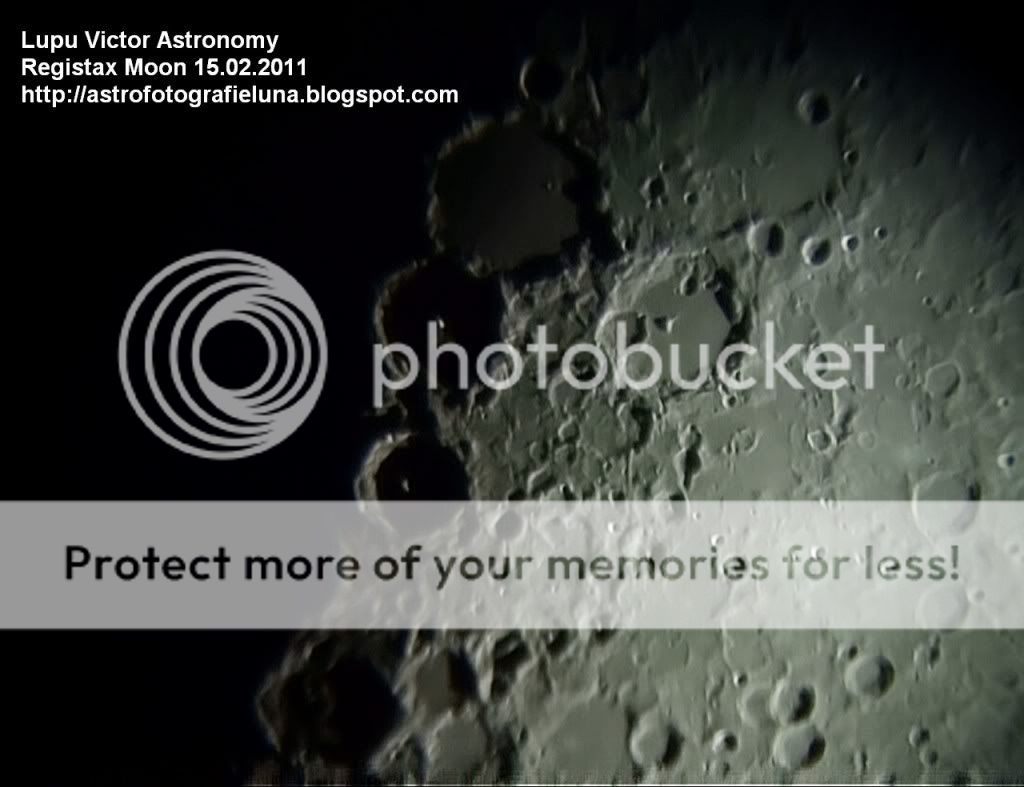
Registax-Craters of the Moon on the edge between light and darkness.


Date: February 15, 2011, Registax 67 frames to 90% Lowest quality.
In these pictures that I have not posted here before, although the video was shot in 2011 (last year), only now I processed the video in Registax.

Craters Alphonsus and Arzachel in the pictures above, are flooded by darkness. Only the central peaks are lit. Ptolemaeus's floor is in semi-darkness. All craters found on line if the three craters, are at the edge of darkness and sunlight.

Coordinates 9.2°S 1.8°W
Diameter 153 km
Depth 2.4 km
Colongitude 3° at sunrise
Eponym Claudius Ptolemaeus

Photographer: Victor Lupu
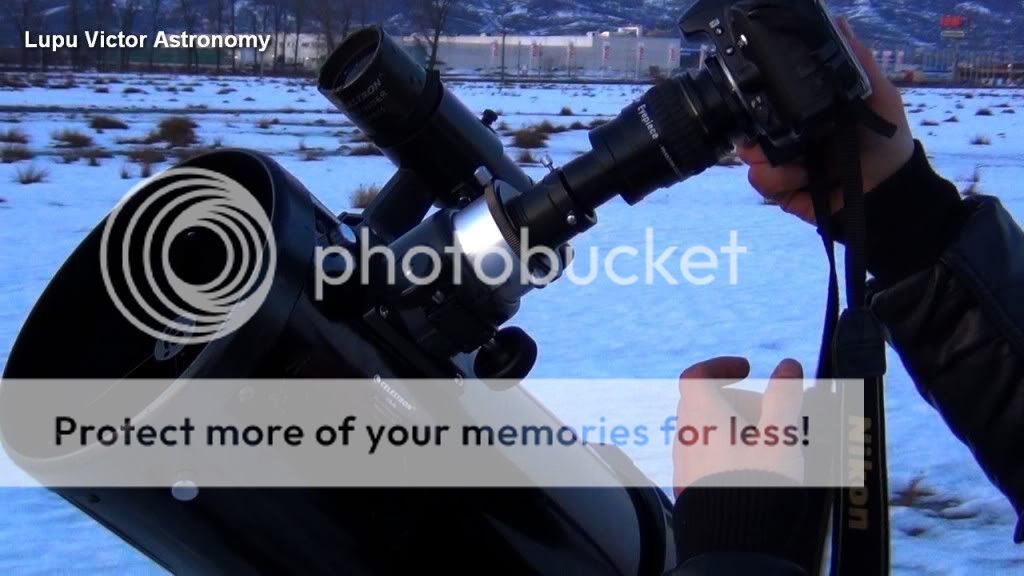
Optics: Celestron C8 inch-Newtonian reflector telescope, plossl 20mm, 2x Barlow
Mount: CG5 (EQ5)
Camera: Sony HDR CX105
Filter: No
Date: 15/02/2011
Location: Baia Mare, Romania
Processing: Registax


The video from wich I processed the images can be found here: Video - Ptolemaeus Alphonsus and Alpetragius craters .

Friday, 16 September 2011

Video Arzachel lunar crater through my telescope

Clip with stabilized images that presents Arzachel crater (97 km). The processed images of it are HERE.
Alpetragius smaller crater (40 km), is near left of Arzachel, and is mexican hat shaped (my opinion).
Right in the video, Delaunay crater (47 km), is a form of two nostrils of a nose as I see. I might say the crater that is the "nose of the Moon".
 These craters are in the full light of the Sun, making it appear that the image is not too clear, but begining with the second 30, we see that is clear.


Video: Victor Lupu
Optics: Celestron C8 "-Newtonian telescope, plossl 20mm, 2x Barlow
Mount: CG5 (EQ5)
Eyepiece Adapter: 1.25 "
Device: Sony CX105 in 7x optical zoom
Total Magnification: 700x
Resolution: 1920x1080
Fps: 25
Bitrate: 16000
Filter: No
Date: 12/05/2011
Location: Baia Mare, Romania
Edit: Sony Vegas 10 stabilized video

Monday, 12 September 2011

Ages of Ptolemaeus Alphonsus and Arzachel craters

Photographer: Victor Lupu
Optics: Celestron C8-Newtonian telescope, plossl 20mm, 2x Barlow
Mount: CG5 (EQ5)
Device: Sony CX105 at 8x optical zoom
Total Magnification: 800x
Eyepiece Adapter: 1.25 "
Filter: No
Date: 12/05/2011
Location: Baia Mare, Romania
Processing: video capture, FastStone Image Viewer


          Alpetragius and Arzachel are on the center of the Moon. In captures above, these two craters are the ones that are in the foreground.
The photo below is an image of the area where this craters are located.


          Arzachel is one of the three craters that form a chain of craters: Ptolemaeus, Alphonsus, Arzachel. On Earth, a technique used to realize the age of geological formations is by seeing the effects of erosion of structures.Even if the force of erosion on Earth and the Moon are different, this technique can be used to know the age of geological formations on the Moon too.
One of the best places to see different craters on the Moon to see craters located next to each other, is Ptolemaeus Alphonsus and Arzachel.
         Looking at the photo below, the differences between the three craters are very obvious. Ptolemaeus has a large flat floor with no central peak , and the edge is almost nonexistent in some places. Alphonsus, has also a flat floor, but shows a central peak and crater walls are more robust. Then there is Arzachel , a good example of a complex crater, with terraced walls, and a distinct central peak.

         
It is evident so far in terms of age of craters, that Ptolemaeus is the oldest, Alphonsus is the middle brother and the youngest is Arzachel.
Why Ptolemaeus do not have a central  peak? After the impact, crater Ptolemaeus formed, magma beneath the crust of the Moon rose through the cracks. Magma, joined and then hardened in the crater forming a flat floor. It was gathered enough lava to completely flood the crater's central peak, but not enough to cover the walls of the crater.


Alphonus crater floor is also flooded with lava, but it was not enough to flood and central peak.
Beautiful terrace walls inside Arzachel crater have remained almost untouched, because of its young age.

Wednesday, 24 August 2011

Alpetragius lunar crater images


Photographer: Victor Lupu
Optics: Celestron C8-Newtonian telescope, plossl 20mm, 2x Barlow
Mount: CG5 (EQ5)
Device: Sony CX105 to 10x, 8x and 5x optical zoom
Total magnitude: 1000x, 800x and 500x (last photo)
Focal diameter: 1 "25
Filter: No
Date: 11/05/2011
Location: Baia Mare, Romania
Processing: Sony Vegas 10 video captures


These materials are craters from the center of the Moon seen from Earth. Ptolemaeus crater (153 km) unlike the others has no central peak, but is an extensive plateau of lava. Arzachel (97 km) has the highest peak in comparison with Alphonsus (108 km). These craters are located at the eastern edge of the Mare Nubium.

 About Alpetragius crater (40 km), I have not talked about at all.It lies near the crater Alphonsus and is notable in this huge central peak compared to the size of the crater. The peak is rounded and occupies almost the entire crater floor (a third of the crater floor), and rises
at a height of 2.0 km. There is evidence that this peak was extended through volcanic eruptions, and seems to provide an eroded vent. Alpetragius's depth is 3.9 km.

Crater name comes from Nur ad-Din al-Bitruji (also written Nur al-Din Ibn Ishaq Al-Betrugi and Abu Ishâk ibn al-Bitrogi , who was an astronomer of Andalusia.

 
All images are © Copyright 2010-2015 Lupu Victor. All rights reserved.Images may not be reproduced, published, or copied in any form without written permission of the author. Thank you for respecting the intellectual property rights. ASTROFOTOGRAFIA | Lupu Victor Astronomy - Contact - About
Design by Free WordPress Themes | Bloggerized by Lasantha - Premium Blogger Themes | Online Project management