Photographer: Victor Lupu
Optics: Celestron C8-Newtonian telescope, plossl 20mm, 2x Barlow
Mount: CG5 (EQ5)
Device: Sony CX105
Filter: No
Date: 10/02/2011
Location: Baia Mare, Romania
Processing: 10 Sony Vegas, video captures
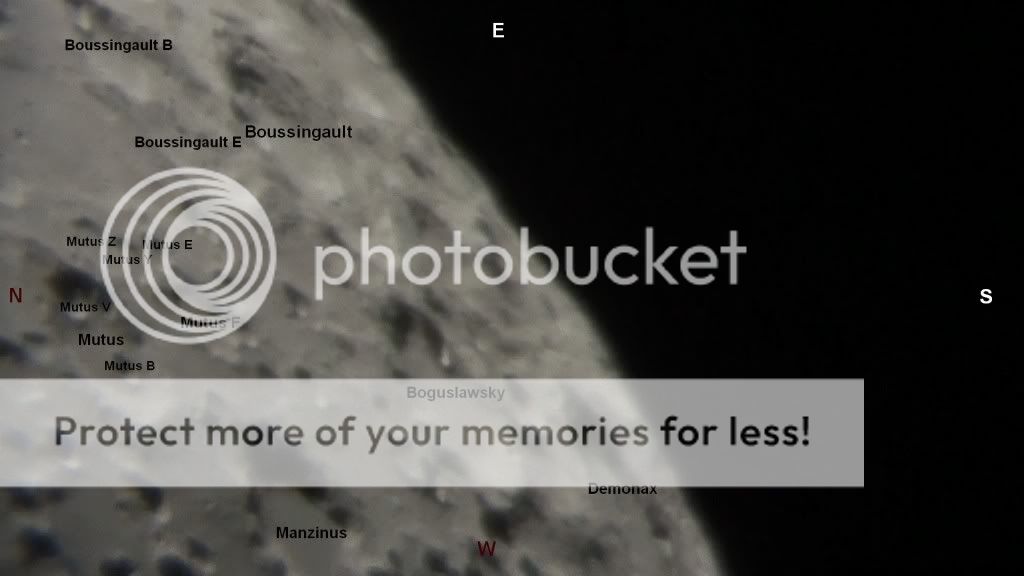
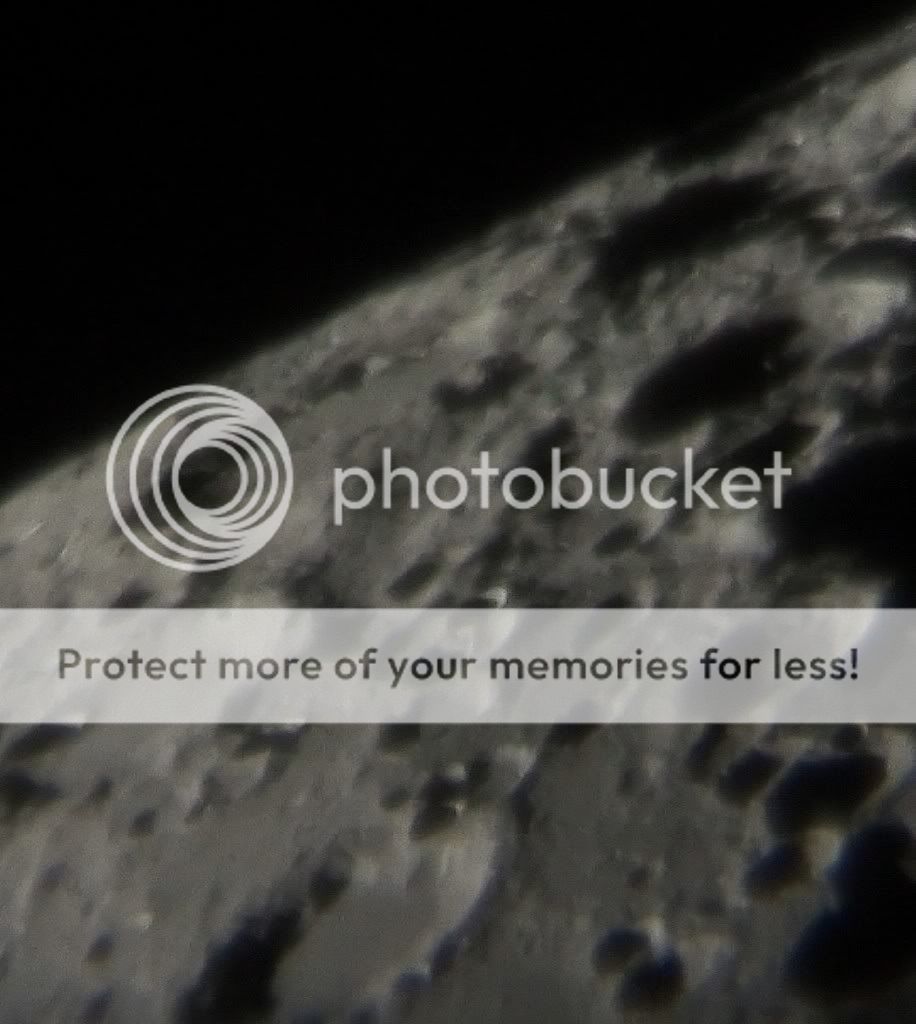
In both top and bottom photos are craters
Boguslawsky,
Manzinus and
Mutus, in the first photo are
Pentland (56 km),
Sempilius A,
Scott (108 km) and
Demonax (114 km) ,
Schomberger (85 km) and
Boussingault (131 km) .
Pentland (56 km), is a Moon impact crater on the south regions, and it appears distorted when viewed from Earth.
Sempilius A is neighbor to the south, and Manzinus at east. On the rim of this crater is a depression along the southern edge,on which is attached a small crater on the outside. The inner wall keeps some untouched structures. The interior shows an elongated central increase in the midpoint. The floor is almost with no features, except for some small craters.
Crater name comes from
Joseph Barclay Pentland (1797 - 12th July 1873) which was an Irish geographer and natural scientist. Born in Ireland, was educated at Pentland. He also studied in Paris and worked with Georges Cuvier.
Scott (108 km) is a crater near the south pole of the Moon. The northern side of the crater is in continuous darkness, and has not been mapped in detail. Scott is between similar-sized crater
Amundsen in the southeast and
Schomberger northwest . In the northeast is
Demonax.The placement of Scott and Amundsen crater on the south pole , refers to two antarctic explorers,
Roald Amundsen and
Robert Falcon Scott, in their race to be the first people to reach the south pole of the Earth.
Demonax (114 km) is in a difficult location to be watched.Demonax crater lies north of
Scott. To the northwest is the crater
Boguslawsky.The floor was renewed, leaving it flat. However, there is a group of central peaks near the middle.
The name comes from
Demonax (Greek: Δημώναξ, Dēmōnax, 70-170) who was a philosopher born in Cyprus. He moved to Athens, known for his wisdom and talent for resolving disputes.This brought him the admiration of the citizens.
Schomberger (85 km)
is located near the southern edge of the Moon. T
he younger satellite Schomberger A (31 km) is attached to the southern rim and Schomberger C (43 km), much older, just outside western edge. Crater is a relatively well defined, with sharp features and was not significantly affected by impacts. Edge is approximately circular with an
inner wall complex marked by increased peaks and several terraces. Interior floor is relatively flat. At the midpoint of the interior is a complex of central peaks.
Boussingault (131 km).
The most notable aspect of this crater is the large crater that is entirely within its outer walls, so that it resembles a double-wall formation. Outer edge is affected by other impacts and Boussingault K (29 km), is located in north-western edge. To the northwest there is also a
formation of craters superposed: Boussingault E (98 km), B (54 km) and C (24 km).
Crater name comes from Jean-Baptiste Joseph Dieudonné Boussingault (February 2 1802- 11 May, 1887) which was a f
rench chemist who has made a significant contribution to the science of agriculture, oil and metallurgical science.




 Monday, December 19, 2011
 Unknown