Visit Worldwide Topsites

Monday, 16 January 2017

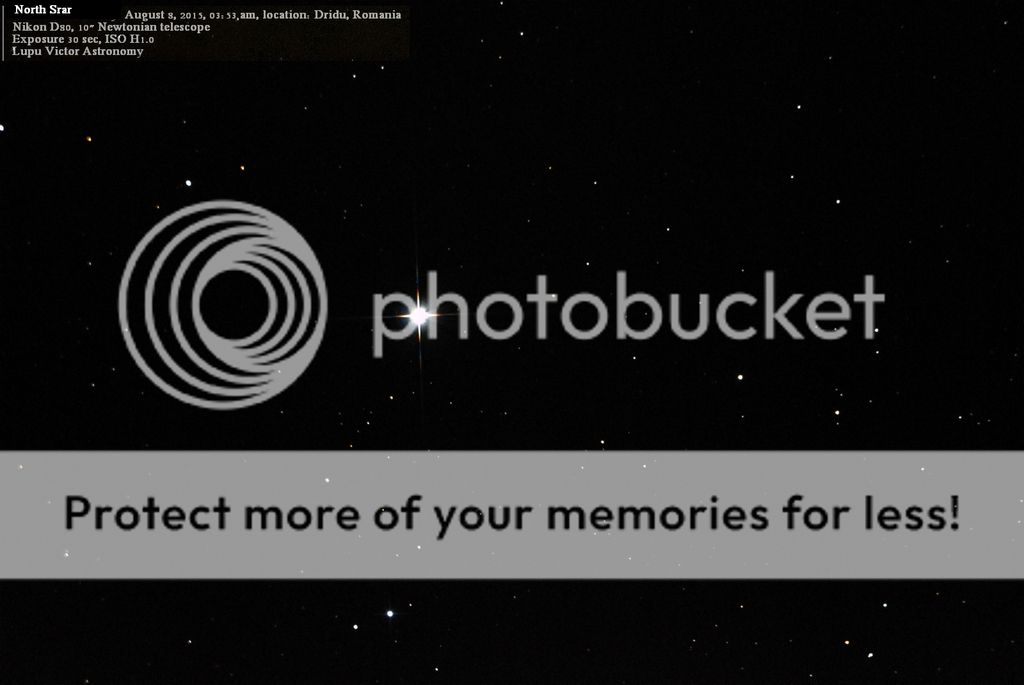
Polaris (the North Star), through astronomical telescope.

Polaris is a star that does not bear this name by accident. It is the brightest star located above the north pole of our planet. For this reason, when observed from Earth, it is in the same place in the sky (whether day or night).
This is the brightest star in the constellation Ursa Minoris (Ursa Minor) and is 4,5x larger than our sun. As an interesting point about Polaris, it is part of a triple star system, Polaris A, B and AB (a dwarf star). Between A (the North Star) and AB is the distance from the Sun as Uranus.


Astronomical instrument: Skywatcher Newtonian telescope 10 inches (Val-Cosmin Sandu)
Mount C6 / EQ6 motorized GoTo
Camera: Nikon D80 T-ring

Eyepiece: Yes (focal)
Filter: no
Date: August 8, 2015
Time: 1:21
Mode: Manual
ISO: 1.0 H
Exposure time: 30 sec
Location: Dridu, Ilfov, Romania


Monday, 19 September 2016

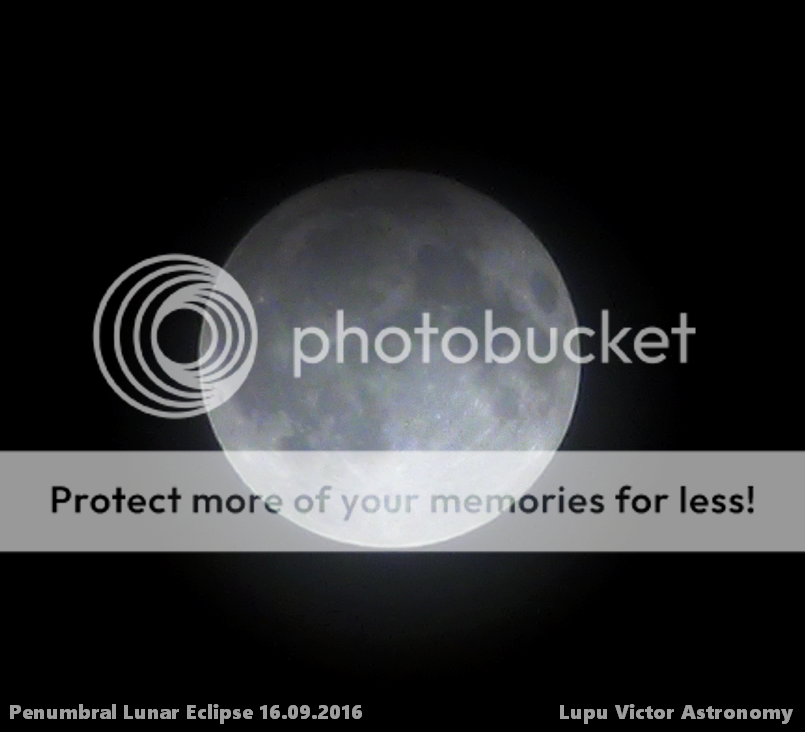
September 2016 Lunar Eclipse Pictures.

Yesterday in the evening sky took place an eclipse of the Moon in the penumbra of the Earth under a pretty good observation condition, considering the fact that before the start of the eclipse were many clouds that made me pessimistic trying to see the event, but the skies cleared immediately after the moon rose above the horizon by 9 °.

The effects of the eclipse are visible on the north-west of the moon.
I did not have access to my 8-inch telescope, but I had CX 130 Sony video camera and tripod to me to immortalize the event.
Below are video captures images of the eclipse.

The beginning of the eclipse: September 16, 19:54:42
Maximum eclipse: September 16, 21:54:20
The end of the eclipse: September 16, 23:53:59


The images below are captures of the partial eclipse of the Moon of 16 September 2016 made with no astronomical telescope, but with a video camera with the zoom at maximum 32x. 


Device: Sony CX-130
Video Mode: Full HD 1920x1080 progressive
Zoom: 32x
Filter: no
Date: 16/09/2016
Location: Baia Mare, Romania
Edit: FastStone

Wednesday, 14 September 2016

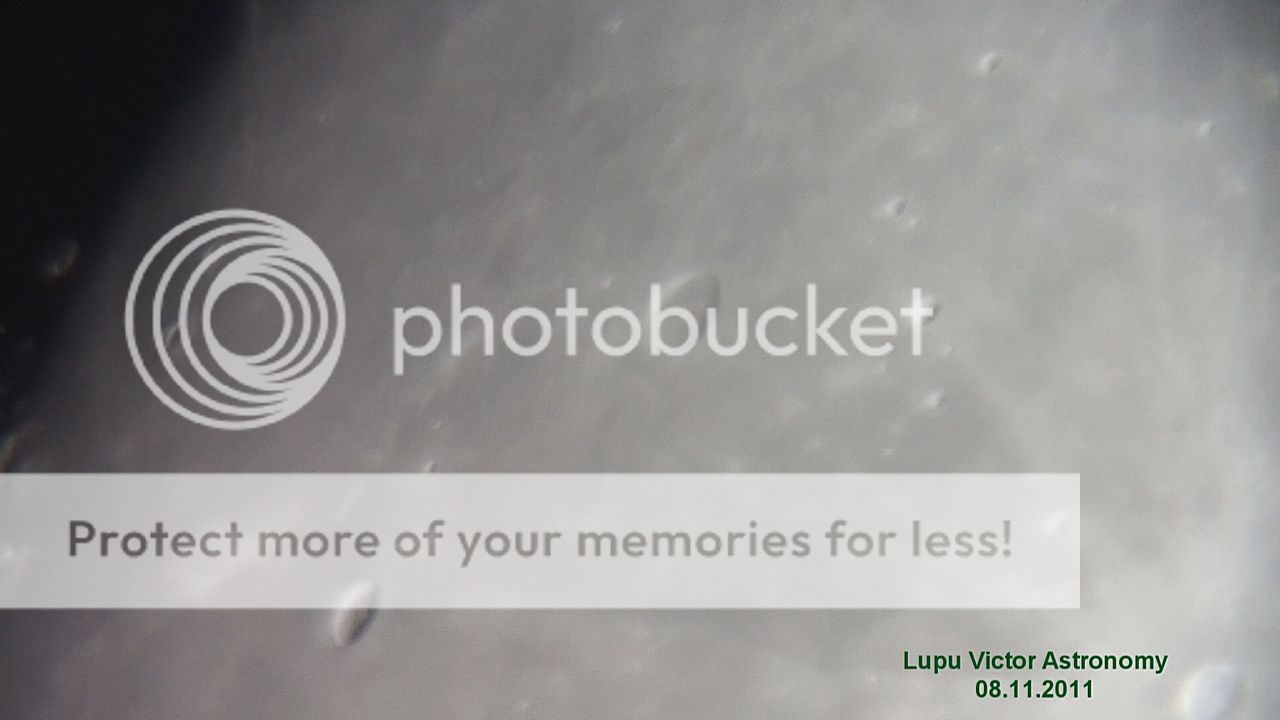
Schickard through a telescope November 8, 2011.

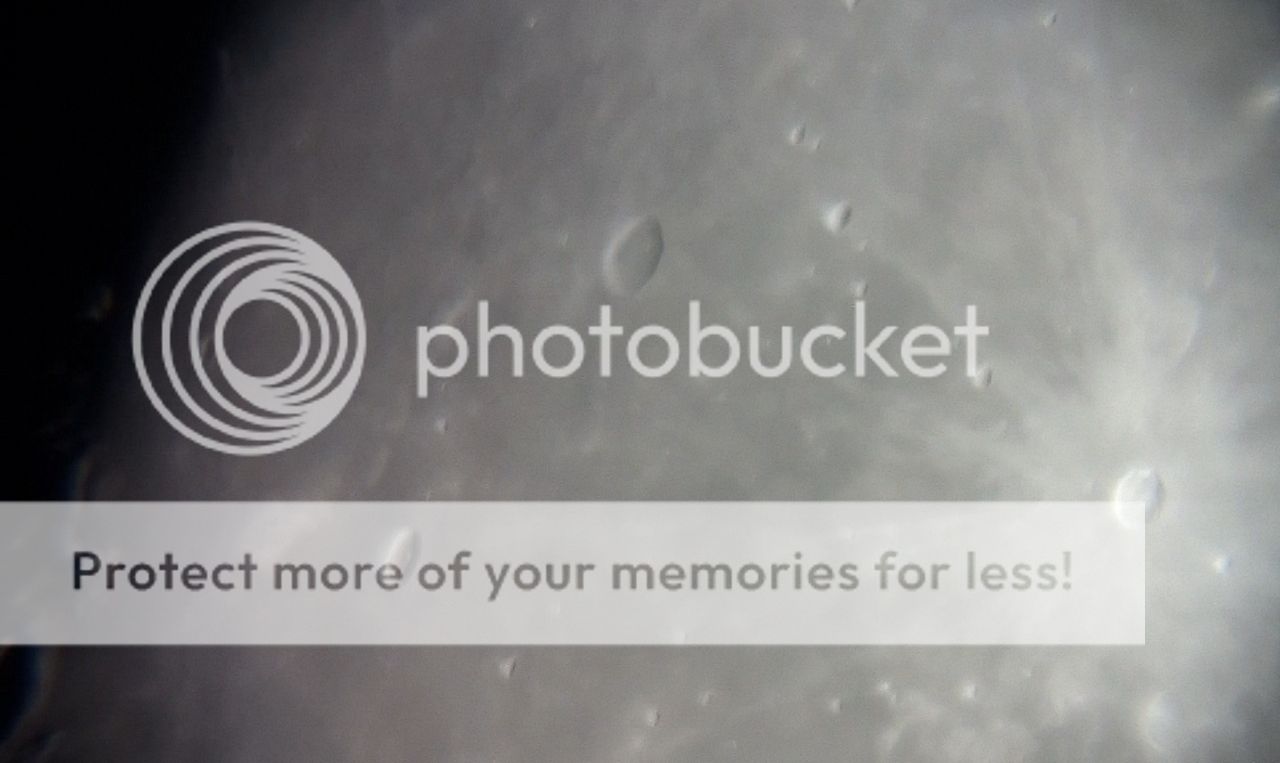
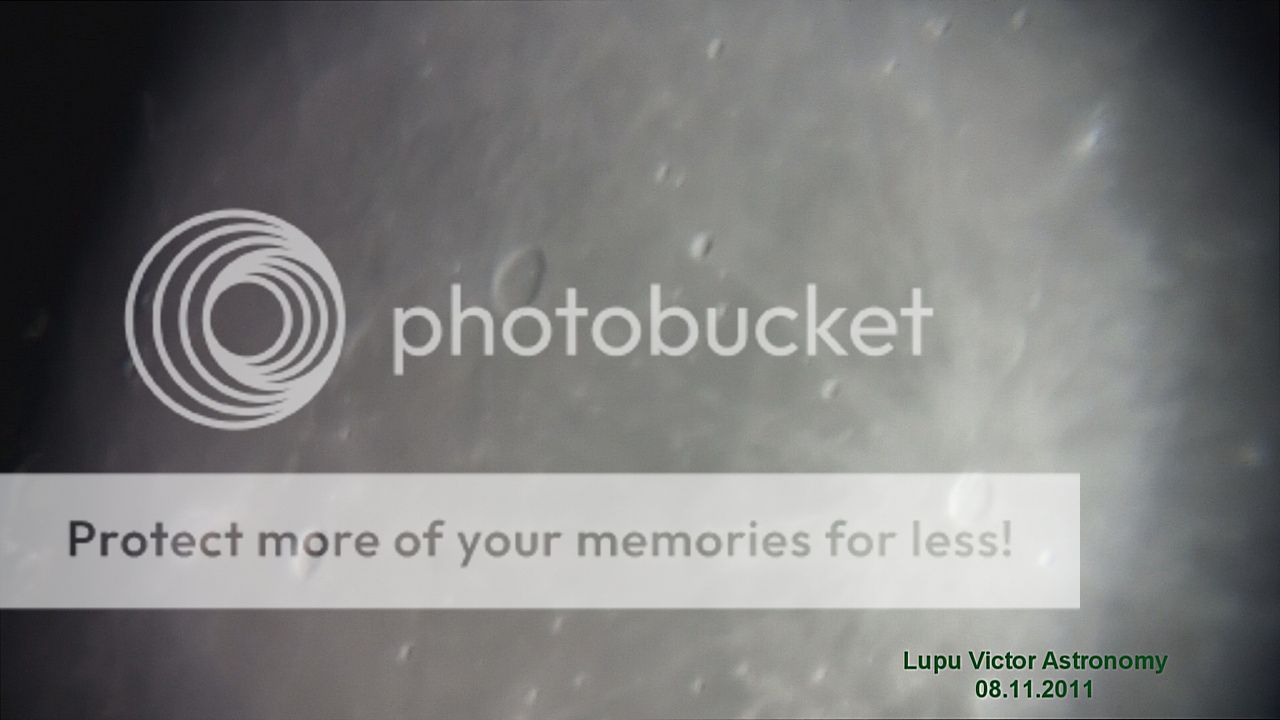
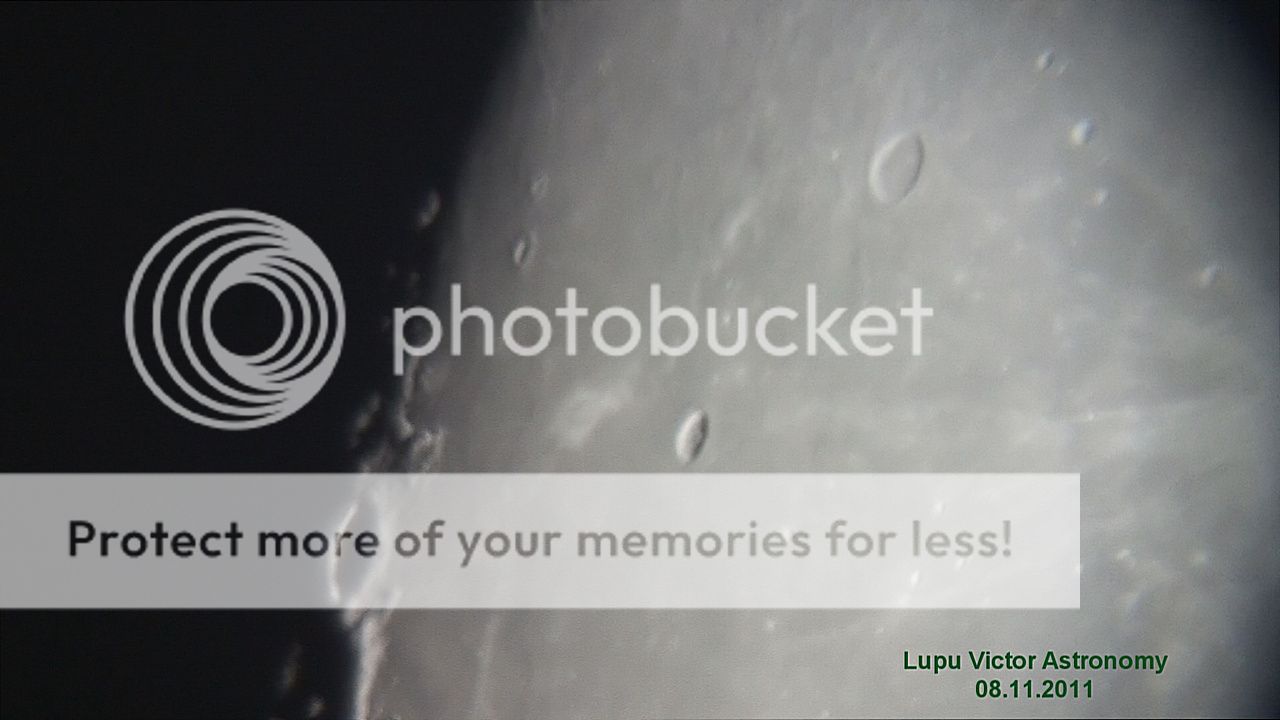
In these stabilized video images with Sony Vegas 10, we see many craters on the moon's south-west. Most evidenced by its size is Schickard (227 km), followed by Schiller crater (180 km), Phocylides and Nasmith (114/77 km) and Wargentin.
By the end of the clip is filmed Hainzel (70 km) also.

These craters can not be detected visually with the naked eye but through an astronomical telescope, or even with binoculars if it comes to Schickard which is quite large, but binoculars will be mounted on a tripod so that the image is fixed.


Magnitude: -12.11
Phase: 0.96
Distance: 401.329 km
Illuminated: 96.2% (0% = New, 100% = Full)


Astronomical instrument: Celestron C8-Newtonian telescope,
Eyepiece: Plossl 20mm, 2x Barlow
Mount: CG5 (EQ5)
Apparatus: Sony CX130
Filter: no
Date: 08.11.2011
Location: Baia Mare, Romania
Processing: Sony Vegas 10


Images were acquired by attaching a video camera directly to an Newtonian astronomical 8 inches (203 mm) telescope's eyepiece; For this reason the eyepiece visual field was increased.
In the picture below are labeled craters and other lunar features in the region. To better understand this photo, you should note that the label with the name or the letter of larger craters could be found at their center, and on the small craters, you should find them around them, usually above.


Tuesday, 26 July 2016

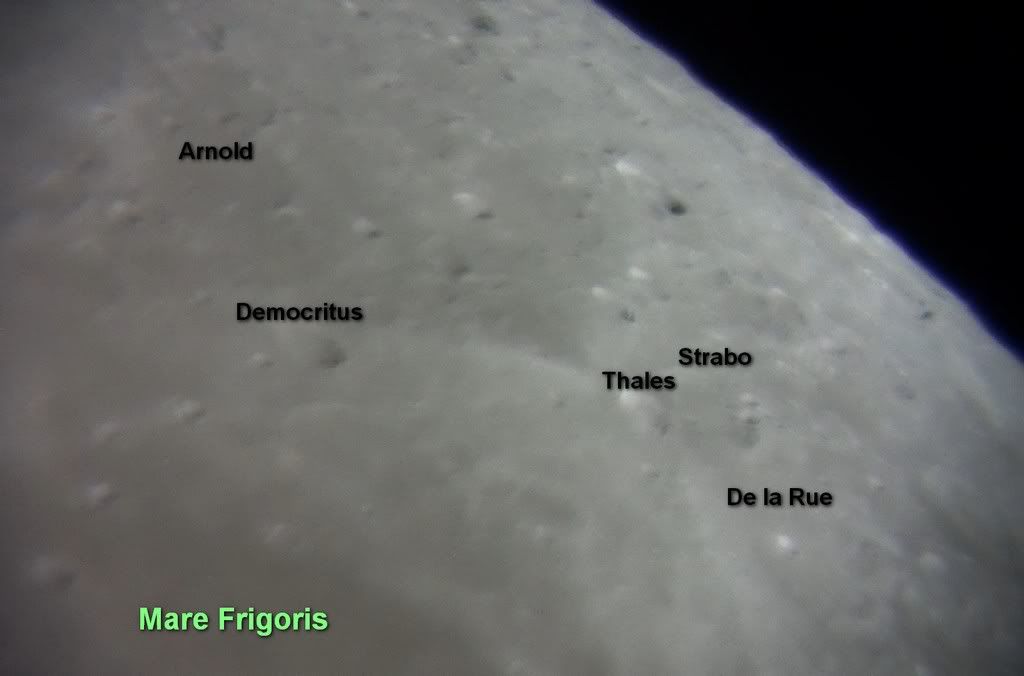
Thales and Strabo lunar craters

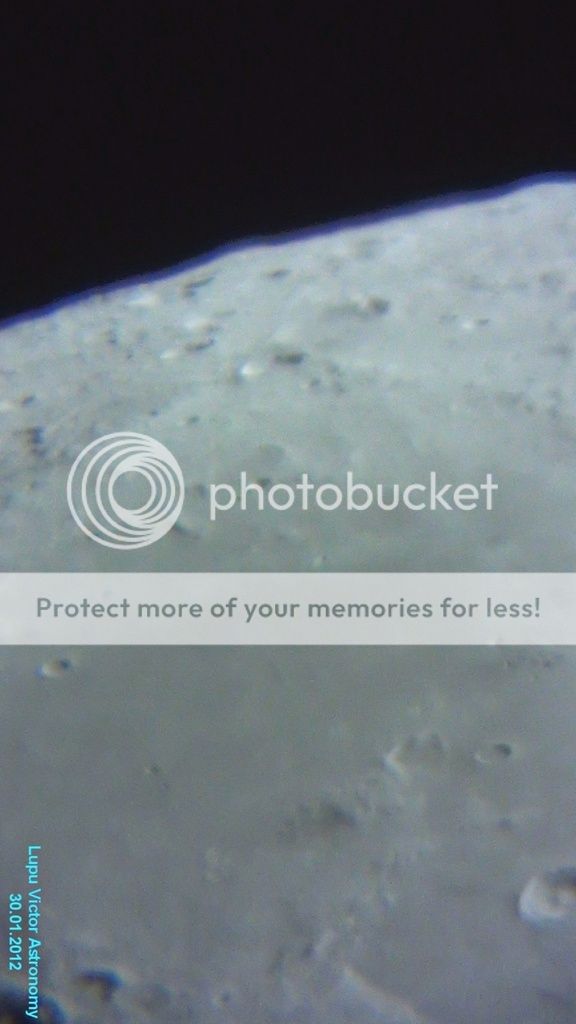
The largest part of this image occupies the eastern Mare Frigoris embodied in darker stain in the lower half of it. The edge of the moon begins higher ground and we distinguish some craters such as Thales (32 km) and Strabo (55 km).

Magnitude: -10.82
Phase: 0.46
Distance: 399.283 km
Illuminated: 45.6% (0% = New, 100% = Full)


Astronomical instrument: Celestron C8-Newtonian telescope,
Eyepiece: Plossl 20mm, 2x Barlow
Mount: CG5 (EQ5)
Camera: Sony CX130
Filter: no
Date: 30.01.2012
Location: Baia Mare, Romania
Processing: FastStone Image Viewer


In the picture below are labeled craters and other lunar features in the region. To better understand this photo, you should note that the label with the name or the letter of larger craters could be found at their center, and on the small craters, you should find them around them, usually above.

Date: 12.05.2011

Sunday, 3 July 2016

Piccolomini. Craters on the Moon through a telescope.

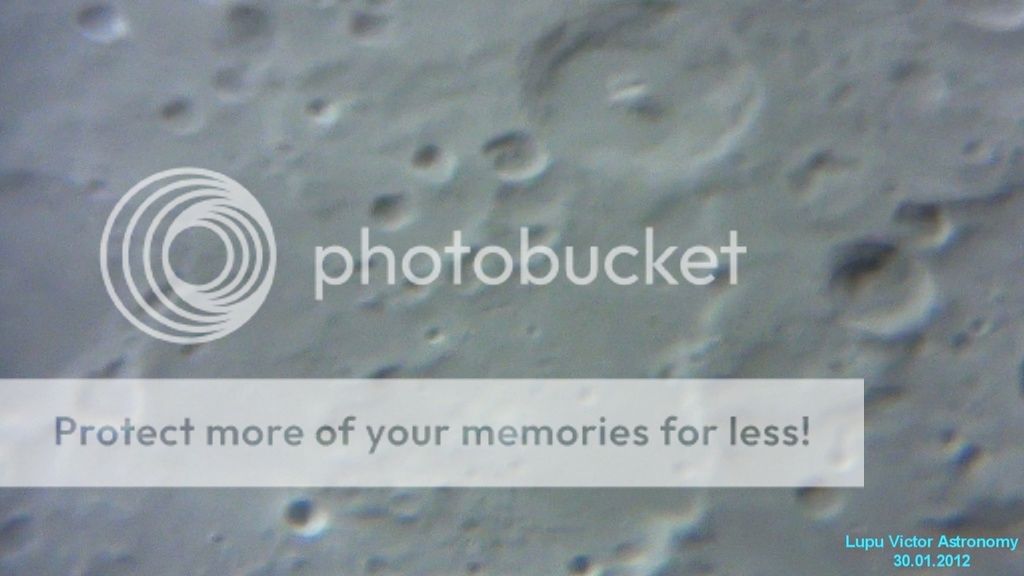
Piccolomini (88 km) crater is interesting because it is overlapped on Rupes Altai wall, which is the second belt formed by the impact that resulted Mare Nectaris basin. This wall is more pronounced from the western edge of Piccolomini. North of the crater, are starting several small ones: Piccolomini M (23 km), D (17 km), E (18 km) and C (26 km) and on south west is adjacent to the crater Rothmann.

Piccolomini has multiple central peaks on its floor which is smooth. The inner wall extends south to the center of the crater due to the angle that hit the object which formed it.


Magnitude: -10.82
Phase: 0.46
Distance: 399.283 km
Illuminated: 45.6% (0% = New, 100% = Full)


Astronomical instrument: Celestron C8-Newtonian telescope,
Eyepiece: Plossl 20mm, 2x Barlow
Mount: CG5 (EQ5)
Camera: Sony CX130
Filter: no
Date: 30.01.2012
Location: Baia Mare, Romania
Processing: FastStone Image Viewer


In the picture below are labeled craters and other lunar features in the region. To better understand this photo, you should note that the label with the name or the letter of larger craters could be found at their center, and on the small craters, you should find them around them, usually above.


Monday, 20 June 2016

Marius crater on the Moon.

Marius (41 km), is an isolated crater on Oceanus Procelarum. A "ray" ejected from the impact that formed the crater Kepler reach it as we see in these pictures. It has the same color as the floor of Procellarum basin, a sign that it was flooded by lava.

Marius is isolated, but at great distances is bordered by Reiner crater (30 km) to the southwest, Kepler (32 km) to the southeast and Aristarchus (40 km) to the northeast.


Magnitude: -12.10
Phase: 0.96
Distance: 401.445 km
Illuminated: 96,2% (0% = New, 100% = Full)


Astronomical instrument: Celestron C8-Newtonian telescope,
Eyepiece: Plossl 20mm, 2x Barlow
Mount: CG5 (EQ5)
Camera: Sony CX105
Filter: no
Date: 08.11.2011
Location: Baia Mare, Romania
Processing: FastStone Image Viewer


In the picture below are labeled craters and other lunar features in the region. To better understand this photo, you should note that the label with the name or the letter of larger craters could be found at their center, and on the small craters, you should find them around them, usually above.

Image of 2 July 2012.


Thursday, 9 June 2016

From where the Sun gets its oxygen to support the burning?

 
Picture dated November 16, 2011.


The Sun burns, yes it is. For example burning of wood needs oxygen to ignite. The chemical components that make up that tree, such as carbon and hydrogen, in combination with oxygen in the atmosphere. So it is what we call combustion.

Sun, however, has a different burning. This is called nuclear fusion, which is very different from a combustion process. It seems that the Sun converts hydrogen to helium, and so there is an energy called gamma rays that do not need oxygen, but it requires extremely high temperatures and pressures. No need for any other element to create this fusion. So far our star has consumed half the reserves of hydrogen, since it exists, of 4.6 billion years.

So when we say that the sun is burning, we do not mean burning fire. The sun burns due to nuclear reactions, namely the collision of two hydrogen nuclei from which arises one of helium. This reactor strong as the sun or any other star, is not ceases its activity, due to enormous gravitational pressure in its core.

Saturday, 4 June 2016

Essay about terrestrial planets in the Solar System.

Terrestrial planets in our Solar System are four in number: the largest is the Earth, then Venus, Mars and Mercury. All this has important similarities because they have rocks, iron cores, have mantles inside and crust on the outside. What we learn about these planets will teach us more about our own.


Mercury Credit: NASA/Messenger

We start with the closest planet from the Sun and the smallest of the terrestrial planets: Mercury. Because it is so small, telescope observers are often disappointed with the results, not only for its size but also because it is very close to the Sun and from the Earth is seen always on the horizon in the evening or morning, so this is a challenge for relief view of the planet.

Being so small and so close to the Sun, Mercury's atmosphere is very thin and it results from the atoms from the sun hitting the ground of the planet, and this in turn eliminates atoms, but this atmosphere is almost non-existent, and has no effect, and that there is no erosion, so that the impact craters remained intact after bombardment, which has been subjected to the planet. Therefore Mercury reminds us of the month when we look at its surface imagery spacecraft that orbited the planet in the 60s.

Mercury is a small body, about 38% of Earth's radius and only 5% by mass. What makes it unique is the enormous core from its center, despite its size.
Mercury has a weak magnetic field which means that the nucleus is slightly liquid.
It takes 88 days to orbit the Sun and the rotation around its axis is exactly 2/3 of the orbital period, 59 days.

This planet is hostile to visitors. The nights and days are long and temperatures goes from one extreme to another in a very dramatic way. During the day the temperature rises unbearable. Even if you are protected by a suit it would melt at 100 degrees, and on the unlit side it goes to the other extreme of very low temperatures.
Although it seems hard to believe, Mercury has ice at the poles, even if it is so close to the Sun because there are places where the sunlight never reaches.

Venus. Credit: NASA/Ricardo Nunes.

The second planet away from the sun is Venus, also called Earth's twin, because this is almost the same size. It is about 95% of the Earth's radius and 80% by mass. Therefore if you stepped on Venus's gravity you will feel it very similar to ours.

If you turn the telescope toward Venus, you will see it large but matte, with no feature on it because it is constantly wrapped by clouds. If you were on Venus with a telescope, however, considering that it would not be shrouded by clouds, and you point it towards Earth, you could visually detect oceans and continents even if our planet have clouds, but it is not entirely covered by them, there are gaps. Without these gaps we could not see stars and planets from Earth or other galaxies. From Venus, the Earth would be about the same size observed through a telescope.
What I find fascinating is that this planet is rotating in the wrong direction. If Venus had clouds, we would see the Sun rising from the west and setting in the east.

Although it is much farther from the Sun than Mercury, is equally hot, but this phenomenon is due to the thick clouds.
On the surface, the atmospheric pressure is 100 x bigger than on our planet. You would simply be crushed trying to walk on the surface. This atmosphere contains 96% CO2, unlike the Earth which is only 1%. The very high temperature is blocked by the thick clouds, and so whether it is day or night, it is the same everywhere. The clouds are composed of sulfuric acid.

The surface is full of volcanoes as it shows radar images taken by the Magellan probe, which photographed by radio waves the whole the planet.
Venus is closer to the Sun than we are and therefore the temperature is very high. Water could not exist in liquid form because it would boil and evaporate, unlike Earth which is farther from the Sun and water is abundant for supporting life.

Mars. Credit: NASA/ESA
We pass the Earth and reach Mars. This planet is surprisingly similar to our planet than Venus for many reasons. We see its surface. Very few clouds are in the planet's atmosphere and so we can see it even with ground telescopes on Earth. Mars even has ice at the poles that looks very much like on the Earth. Tilting axis of the planet is 23 degrees which means that there are seasons. In winter the northern polar cap extends as on Earth. The rotation axis is a little more than 24 hours, and the Sun rises in the east, but is smaller, and so it's cold, but there still is a lot like the landscape of our planet.

What is different is the atmosphere on Mars because it has no oxygen, but carbon dioxide, like Venus, the rest being nitrogen. At those temperatures, CO2 freezes, forming dry ice. Some caps are made of water ice, however.
An unusual phenomenon on Mars are dust storms which in spring time are reaching planetary proportions, such as sandstorms in the Sahara desert, only that they cover the entire planet.

The entire northern hemisphere is full of volcanoes and the southern is cratered. Still, it is not known why this difference. On the southern hemisphere are also valleys where water flowed in the past and now are completely dried up.
Currently atmospheric pressure on Mars is not good enough for the existence of liquid water. Neither on Earth we can not have liquid CO2. This goes from solid directly into gaseous state, not liquid, but there are serious indications that on Mars has flowed once water through those valleys and that it had a good atmosphere, but from an unknown reason lost it, possibly because it is not massive enough to hold it. Even if we start terraforming the planet would lose it again for sure because its gravity is not strong enough.

What we have learned from examining these terrestrial planets, is that Venus and Mercury are too close to the Sun and too hot and Mars is too far, too cold to support life, and it seems that our planet called Earth, had the chance to orbit the sun exactly at that distance which allows it. Are there planets like ours in other solar systems? We do not know. We have discovered the existence of planets similar to Jupiter, but more massive. The only place we found life remains the third body orbiting our Sun, our beautiful and precious Earth.

Thursday, 26 May 2016

Astronomy Lecture: Moon and Earth.

We like to investigate the planets, the Sun and other stars. Our nature is curious to observe and classify them. We always look back to planets and their physical nature, observe the Moon and Earth which can be considered as two planets if we look at the Moon as a planet smaller than Earth. We analyze why the two bodies are one a lifeless cold stone and one warm and fruitful, full of creatures.
So far humanity has managed to reach only the Moon, because other planets are more distant to send humans there, because it should be a more dangerous journey.
Moon and Earth were formed at the same time 4.5 billion years ago. Both bodies have similar chemical characteristics.

The moon is in Earth orbit due to neutral gravitational attraction between them because both have gravity and the combination of the two makes the Moon remain in Earth orbit. It would not be fair to say that the Moon revolves around the Earth, because actually both revolve around each other.
The moon exerts a gravitational force on the Earth and this is seen in the phenomenon of ocean tides, but it is nothing compared to more serious gravitational force it exerts the Earth on the Moon, which blocks the Moon with the same face toward us. Our planet has such a force because it is very large compared to the Moon. This phenomenon is not unique, and can be seen at Jupiter or Pluto's satellites.

Earth is geologically very active, we have tall mountains and low levels as oceans plateaus, we have earthquakes, and as we dig deep in the planet's crust, it becomes warmer because of the lava and the living core of the Earth. In contrast to this, if you see the moon through a telescope you'll see a dead surface without too much differences in elevation, has no atmosphere at all, no clouds, almost no water because a body is extremely dry. Compared to Earth, Moon is known for its craters, nearly entirely covered by them.


Moon areas are divided into two categories. One is the highlands which is totally covered with craters of all kinds, large and small, joined or overlapping, others weathered or very old craters called ghost craters because are barely distinguishable. The second category are those large spots on the Moon seen with the naked eye from Earth. And these are also craters, but they are transformed into enormous basins filled with lava created after severe impacts. This hardened basaltic lava is darker and is called "mare", or seas.

So the Moon is full of impact craters, but why the Earth is not?
This is because of certain factors, because here we have atmosphere and wind, water erodes everything, we have volcanism, continental shifts (it is true now that South America was bonded to Africa forming one continent). All this led to the disappearance of these craters on the face of the Earth. There are still hundreds of craters that have been recognized as impact craters, as that which formed the Yukatan peninsula which had a huge role in changing our climate.

Our planet is alive because of the magnetic field that surrounds it. But why has not the Moon the magnetic field?
Earth have a magnetic field because in its center is a molten iron liquid that is rotating . Due to this continuous spin, it creates an electric magnetic field. Iron is conductor of electricity and generates Earth's magnetic field. In the case of Moon, however, it is so small and the core has solidified. Even if there was a small core, it does not rotate and therefore the Moon is a body magnetically inactive.


Magnitude: -12.02
Phase: 0.92
Distance: 401.133 km
Illuminated: 92.1% (0% = New, 100% = Full)


Astronomical instrument: Celestron C8-Newtonian telescope,
Eyepiece: Plossl 20mm, 2x Barlow
Mount: CG5 (EQ5) 

Camera: Sony CX130
Filter: no
Date: 07/11/2011
Location: Baia Mare, Romania
Processing: FastStone Image Viewer


Monday, 23 May 2016

Telescope pictures of the Moon. Hercules and Atlas craters.

Craters Hercules / Atlas (69/87 km), lies east of Mare Frigoris and form an unusual pair because they have different characteristics. But because they are close to each other, are easily memorized together by telescope observers.

Hercules is smaller, and has a small distinct crater in its center which best defines him, called Hercules G (14 km). Atlas is bigger with a wide inside edge and several low central peaks on its floor. Hercules, is bordered to the west by Lacus Mortis with crater Burg (40 km) in its center and Atlas have on the northeast the crater Endymion (125 km), which is located near the edge of the Moon as we see it from Earth .


Magnitude: -10.82
Phase: 0.46
Distance: 399.283 km
Illuminated: 45.6% (0% = New, 100% = Full)


Astronomical instrument: Celestron C8-Newtonian telescope,
Eyepiece: Plossl 20mm, 2x Barlow
Mount: CG5 (EQ5)
Camera: Sony CX130
Filter: no
Date: 30.01.2012
Location: Baia Mare, Romania
Processing: FastStone Image Viewer


In the picture below are labeled craters and other lunar features in the region. To better understand this photo, you should note that the label with the name or the letter of larger craters could be found at their center, and on the small craters, you should find them around them, usually above.


Tuesday, 17 May 2016

Pictures by telescope. Julius Caesar, Agrippa and Godin.

Julius Caesar (90 km) is a large crater in size with a low southern edge and an interesting feature at east as more craters lined up and at west is a ditch named Rima Ariadaeus.

The floor of this crater is divided in two shades. Probably because of the basin Mare Tranquillitatis on the east, so a part of the floor is darker.

Craters Agrippa and Godin (45 and 35 km.) are left in images and Sosigenes is located at Julius Caesar's southeast.


Magnitude: -10.82
Phase: 0.46
Distance: 399.283 km
Illuminated: 45.6% (0% = New, 100% = Full)


Astronomical instrument: Celestron C8-Newtonian telescope,
Eyepiece: Plossl 20mm, 2x Barlow
Mount: CG5 (EQ5)
Camera: Sony CX130
Filter: no
Date: 30.01.2012
Location: Baia Mare, Romania
Processing: FastStone Image Viewer


In the picture below are labeled craters and other lunar features in the region. To better understand this photo, you should note that the label with the name or the letter of larger craters could be found at their center, and on the small craters, you should find them around them, usually above.

Image from April 10, 2011.

Monday, 2 May 2016

Where is Burg crater on the Moon? Astronomy images.

Burg crater (40 km) is located in the midst of Lacus Mortis. Due to its position, it is easy to locate but only through an astronomical telescope. This is a circular crater with a distinct central peak and beautiful terraced inner edge.

On the south-east of Lacus Mortis, notice two close craters, nearly flooded by lava in the past, called Mason (33x43 km) and Plana (44 km). Plana C (14 km), is attached Plana to the northwest.


Magnitude: -10.82
Phase: 0.46
Distance: 399.283 km
Illuminated: 45.6% (0% = New, 100% = Full)


Astronomical instrument: Celestron C8-Newtonian telescope,
Eyepiece: Plossl 20mm, 2x Barlow
Mount: CG5 (EQ5)
Camera: Sony CX130
Filter: no
Date: 30.01.2012
Location: Baia Mare, Romania
Processing: FastStone Image Viewer


In the picture below are labeled craters and other lunar features in the region. To better understand this photo, you should note that the label with the name or the letter of larger craters could be found at their center, and on the small craters, you should find them around them, usually above.

Image from July 20, 2011.


Saturday, 30 April 2016

Lunar mountains through astronomical telescope. Montes Caucasus.

In these images we see a few mountains on the Moon, namely Montes Caucasus and northern Montes Apenninus. Since the terminator is close to this area, peaks and the shadows they produce are best seen.

Montes Caucasus start north west of the crater Eudoxus, and ends at the south, where Montes Apeninnus begin. Montes Caucasus, as Apenninus, are surrounded by two large basins, Mare Imbrium and Mare Serenitatis.

Between the Caucasus mountains, we distinguish a crater called Calippus (33 km), which at this stage we find it immersed in darkness.

Other craters seen here are: Lamech (13 km), Egede (37 km), Cassini (57 km), Theaetetus (25 km), Alexander (82 km).


Magnitude: -10.82
Phase: 0.46
Distance: 399.283 km
Illuminated: 45.6% (0% = New, 100% = Full)


Astronomical instrument: Celestron C8-Newtonian telescope,
Eyepiece: Plossl 20mm, 2x Barlow
Mount: CG5 (EQ5)
Camera: Sony CX130
Filter: no
Date: 30.01.2012
Location: Baia Mare, Romania
Processing: FastStone Image Viewer


In the picture below are labeled craters and other lunar features in the region. To better understand this photo, you should note that the label with the name or the letter of larger craters could be found at their center, and on the small craters, you should find them around them, usually above.


Image from 10 February 2011.


All images are © Copyright 2010-2015 Lupu Victor. All rights reserved.Images may not be reproduced, published, or copied in any form without written permission of the author. Thank you for respecting the intellectual property rights. ASTROFOTOGRAFIA | Lupu Victor Astronomy - Contact - About
Design by Free WordPress Themes | Bloggerized by Lasantha - Premium Blogger Themes | Online Project management