Visit Worldwide Topsites
Showing posts with label Craters-Pallas and Murchison. Show all posts

Wednesday, 11 March 2015

Videos of the Moon by telescope. Center lunar craters.


Craters located in the center of the lunar disc, as seen from Earth, are the most visible, because their whole structure is facing us revealing their floor and details perfectly, even with a modest telescope. In the center there are many features such as mountains, seas and craters.

There are many Moon craters seen passing in these videos, in which we note in their order of appearance: Godin / Agrippa (46/35 km) Triesnecker (26 km), Pallas / Murchison (50/58 km) Mare Insularum, Copernicus (93 km), Hipparchus (150 km), Flammarion (75 km), Ptolemaeus (153 km) Lalande (24 km), Mosting (26 km), Fra Mauro (95 km) and Gambart (25 km).


These videos were made with the camera mounted on the telescope, to be more exact on the telescope eyepiece. To protect the telescope from vibrations, I used a tracking motor from Lacerta, and thus the image was more stable.
However, even with this tracking device for celestial bodies, there were vibrations of the telescope tube, causing the image to be slightly unstable. For this, I used the video stabilization option in Sony Vegas editing software, so the video was 100% correct on this issue.
Unstable aspect of the image through the telescope is caused by a combination of turbulence in the Earth's atmosphere and increased streams of heat from the ground and buildings.
Images were obtained by attaching a camera directly into the eyepiece of an astronomical telescope of 8 inch Newtonian; For this reason the eyepiece visual field was increased.
These clips were used in Registax program to process images with higher quality, and also for simple video capture.

Moon Age: 9.05 days
Phase: 70.5% (0% = New, 100% = Full)
Distance: 399.221 km


Optics (telescope or lenses): Celestron C8-Newtonian telescope, eyepiece 20mm Plossl, 2x barlow
Mount: CG5 (EQ5)
Camera: Sony CX130
Filter: no
Date: 10/03/2014
Location: Baia Mare, Romania
Processing: Sony Vegas HD Platinum 10.0


Image of February 10, 2011.
Image of April 29, 2012.
Image of March 10, 2014.

Saturday, 7 March 2015

Sinus Aestuum Moon region. Astronomy Registax images.

101 video frames in Registax.
361 video frames in Registax.
101 video frames in Registax.

We focus on the center of the Moon, where we see several interesting features.
At the top of the images is a part of Sinus Aestuum. Below, we see small satellite craters like Schroter (35 km), Sommering (28 km), Gambart (25 km) and Bode (19 km). At the bottom the images are bonded Pallas and Murchison craters (50/58 km)..
As an interesting feature is a darker region in the center of the images.

The two craters Sommering and Schroter, are both affected by the floods of lava. These have edges with interruptions.

Images were made in Registax program, in which I've inserted a video to be processed.

Moon Age: 9.05 days
Phase: 70.5% (0% = New, 100% = Full)
Distance: 399.221 km


Optics (telescope or lenses): Celestron C8-Newtonian telescope, eyepiece 20mm Plossl, 2x barlow
Mount: CG5 (EQ5)
Camera: Sony CX130
Filter: no
Date: 10/03/2014
Location: Baia Mare, Romania
Processing: Registax,  FastStone Image Viewer


Tuesday, 3 March 2015

Lunar crater Triesnecker photographed from Earth.

100 video frames in Registax.

The area we are discussing in this article, is the center of the Moon, where the craters we see craters with their interior much better than those seen on the edge of the Moon, where they are seen obliquely. But still, each position of craters on lunar disc has its advantages and disadvantages. At the craters located on the terminal of the Moon can be seen more easily the inner edge, and central peaks on the floor and we can even estimate their height. At the craters located on the center of the Moon, this is not possible because they are viewed from above, and not obliquely.

Triesnecker (26 km), is a prominent impact crater located on Sinus Medii near the center of the Moon. It is located to the north west of Rhaeticus (43x49 km) and south east of the flooded crater Murchison (58 km). To the east of the crater, is a system of rilles extending over an area of 200 kilometers to the north and south.

Info Triesnecker crater.
Coordinates 4.18°N 3.60°E
Diameter 26 km
Depth 2.8 km
Colongitude 356° at sunrise
Eponym Franz P. Triesnecker

Moon Age: 9.05 days
Phase: 70.5% (0% = New, 100% = Full)
Distance: 399.221 km


Optics (telescope or lenses): Celestron C8-Newtonian telescope, eyepiece 20mm Plossl, 2x barlow
Mount: CG5 (EQ5)
Camera: Sony CX130
Filter: no
Date: 10/03/2014
Location: Baia Mare, Romania
Processing: Registax,  FastStone Image Viewer


Image from April, 29 2012.


Saturday, 19 July 2014

Capturing the Moon craters by telescope: Pallas and Murchison.


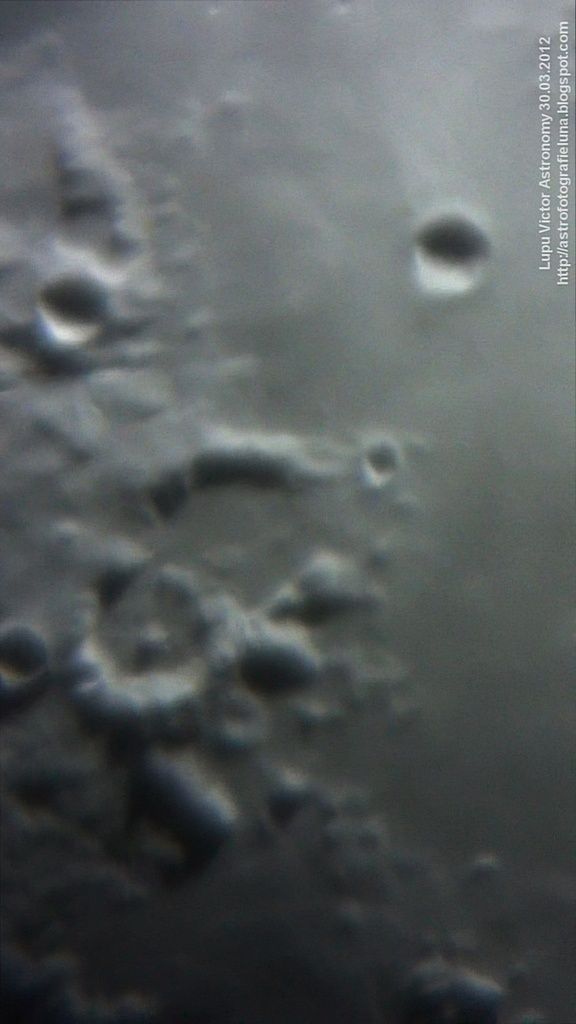
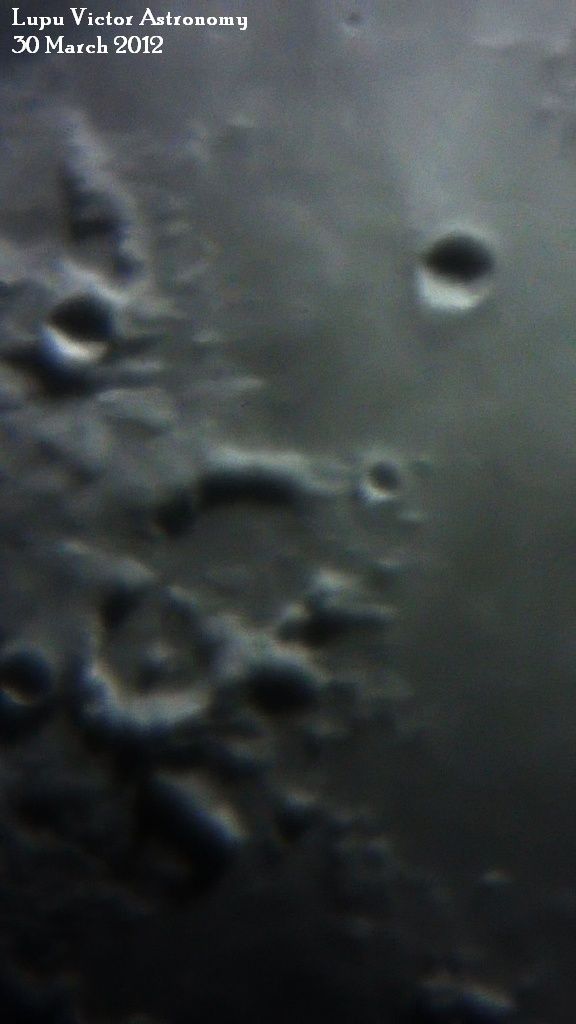
Pallas and Murchison (50 and 58 km) are two craters separated by a straight interrupted wall. I can not figure out what caused this wall. At first glance you would say it is the rim of these craters, but it intrigues me that the wall extends at both ends, not being rounded. Is it possible that Pallas and Murchison have formed simultaneously from two impacts of two bodies that collided with the Moon, coming from opposite sides?

Pallas and Murchison communicate with each other through an opening in the wall. Murchison's rim, is at south-east "eated", making an exit to the Sinus Medii area, which is at the south.

Optics: Celestron C8 "-Newtonian telescope, 20 mm Plossl, 2x Barlow
Mount: CG5 (EQ5)
Device: Sony CX-130
Video Mode: Full HD 1920x1080 progressive
Filter: no
Date: 30/03/2012
Location: Baia Mare, Romania
Processing and editing: Sony Vegas 10 FastStone


Image from Mai 11, 2011.


Saturday, 14 September 2013

High resolution images Sinus Medii and surrounding craters.

24 video frames, 90% best quality, Gaussian in Registax.
30 video frames, 90% best quality, Gaussian in Registax.


In color images of this area are many of the central features of the Moon, as seen from Earth.

  Sinus Medii, a basin that it has some notable craters on its surface, here has a greenish color which I think is not the result of some aberrations of the optical system of the telescope, and these images are the result of processing in Registax program in which are optimized many
finest frames of a video. In this way, the image quality resulting from the processing is one much better than a video frame, like the one below where I labeled craters, in which we barely perceive colors.

Among notable craters in the images, we see Triesnecker (26 km), Bruce (7 km), Blagg (5.4 km) and Chladni (14 km), which are located on Sinus Medii, and Pallas (50 km), Murchison (58 km), Rheaeticus (43x49 km) Dumbowsky (26 km), Mosting (26 km), Ukert (23 km), which are craters surrounding
Sinus Medii.
Video captures can be seen here: Sinus Medii Pallas and Murchison Photos by camera and telescope.


Age of the Moon: 7 days
Phase: 51% (0% = New, 100% = Full)
Distance: 384.488 km


Optics: Celestron C8-Newtonian telescope, 20mm Plossl, 2x Barlow
Mount: CG5 (EQ5)
Camera: Sony CX130
Filter: no
Date: 29.04.2012
Location: Baia Mare, Romania
Processing: Images in Registax, FastStone Image Viewer


Monday, 25 February 2013

Sinus Medii Pallas and Murchison Photos by camera and telescope.


Pallas and Murchson (50 and 58 km) are two craters bonded, forming a "shoe". Their location are on the center of the Moon seen from Earth, in the northwest plateau of Sinus Medii. Both craters have weird edges on north, showing the teeth of an excavator that dug into them. These craters are surrounded by three major craters: Bode, Ukert and Triesnecker, the latter being on Sinus Medii at east.

Sinus Medii (Latin for "Golf of the Center") is a small lunar plateau, which lies at the intersection of the moon's equator and the first meridian. Notice that on this area which has a diameter of 335 km, are two smaller craters in the center, called Bruce (7 km) and Blagg (5.4 km).


Surveyor 6 landed on Sinus. On November 10, 1967, Surveyor 6 was the fourth in it's series that has made ​​a successful landing on the Moon. Mission sent a total of 29,952 images and acquired over 100 hours of lunar data on material composition.

Before Surveyor 6, on July 17, 1967, Surveyor 4 had an attempt to descend on the lunar surface, on Sinus Medii, but was a failure because the radio signal was lost just before landing, collapsing.

Moon age: 7 days
Stage: 51% (0% = New, 100% = Full)
Distance: 384.488 km


Optics: Celestron C8-Newtonian telescope, 20mm Plössl, 2x barlow
Mount: CG5 (EQ5)
Camera: Sony CX130
Filter: no
Date: 29/04/2012
Location: Baia Mare, Romania
Processing: video capture, FastStone Image Viewer


Monday, 26 November 2012

Pallas and Murchison Craters of the Moon through telescope

North of Sinus Medii, Pallas (50 km) and Murchison (58 km), somewhat eroded craters formes a duo. These two craters are easy to remember because of the shape of the shoeThey were formed after the massive impact that created the Imbrium basin, and were eroded by the residue in the event.

Other craters around them are Bode, Chladni and Ukert.


Optics: CelestronC8 "-Newtonian telescope, plossl20mm, 2x Barlow
Mount: CG5 (EQ5)
Device: Sony CX-130
Video mode: Full HD progressive 1920x1080
Filter: no
Date: 30/03/2012
Location: Baia Mare, Romania
Processing and editing: Sony Vegas 10


Monday, 24 September 2012

Video Pallas Murchison craters by telescope

Sinus Medii, translation Central Gulf, is 350 km in diameter with an area of 52,000 square kilometers. It's a irregular shaped mare, located near the center of the lunar disk, and links to Mare Vaporum, north of Sinus Medii.
 Around Triesnecker crater (26 km) on north and south, stretches beautiful rilles over Sinus Medii. Rimae Triesnecker consists of several linear rilles that come together to create the most beautiful valley networks on the Moon, if measured from end to end, they would have a total length of approx. 1,000 km.

North of Sinus Medii, the eroded craters Pallas (50 km) and Murchison (58 km) forms a duo. On the opposite side of the Sinus Medii is Rhaeticus crater (45 km).

Video is upside down, as seen through the telescope.


Video: Victor Lupu
Optics: CelestronC8 "-Newtonian telescope, plossl20mm, 2x Barlow
Mount: CG5 (EQ5)
Device: Sony CX-130
Video mode: Full HD progressive 1920x1080
Filter: no
Date: 29/04/2012
Location: Baia Mare, Romania
Processing and editing: Sony Vegas 10


Saturday, 15 October 2011

Light flashes on the Moon-transient lunar phenomenon

Photographer: Victor Lupu
Optical Telescope Celestron C-8 "-Newtonian, plossl 20mm, 2x Barlow
Mount: CG5 (EQ5)
Device: Sony CX105 at 8x optical zoom
Total zoom: 800x

Filter: no
Date: 12/05/2011
Location: Baia Mare, Romania
Processing: video capture, FastStone Image Viewer


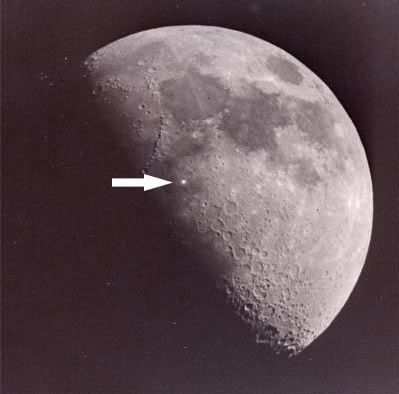
      In the morning of November 15, 1953, an amateur astronomer from Oklahoma, USA, named Dr. Stuart Leon, photographed what he believed to be a massive white ball of fire that was vaporizing, located near the center of the Moon, 16 km south-east of the Pallas crater. If his theory is true, he would be the first and only man in history that has witnessed the impact of an asteroid crashing on the moon's surface.
But today the mystery was solved (just a theory), because the spark could be caused by leakage of gaseous materials within the Moon. This phenomenon is called "transient lunar phenomenon", or TLP.


 In photos above are Pallas (50 km) and Murchison (58 km), region in which the spark was caught by the astronomer Stuart.


The image of a "transient lunar phenomenon" of 1953.TLP is the light from the  center.
Credit: Stuart Leon, Columbia University

Friday, 8 July 2011

Pallas and Murchison Craters-images


Photographer: Victor Lupu
Optics: Celestron C8-Newtonian telescope, plossl 20mm, 2x Barlow
Mount: CG5 (EQ5)
Device: Sony CX105
Filter: No
Date: 11/05/2011
Location: Baia Mare, Romania
Processing: Sony Vegas 10 captures video
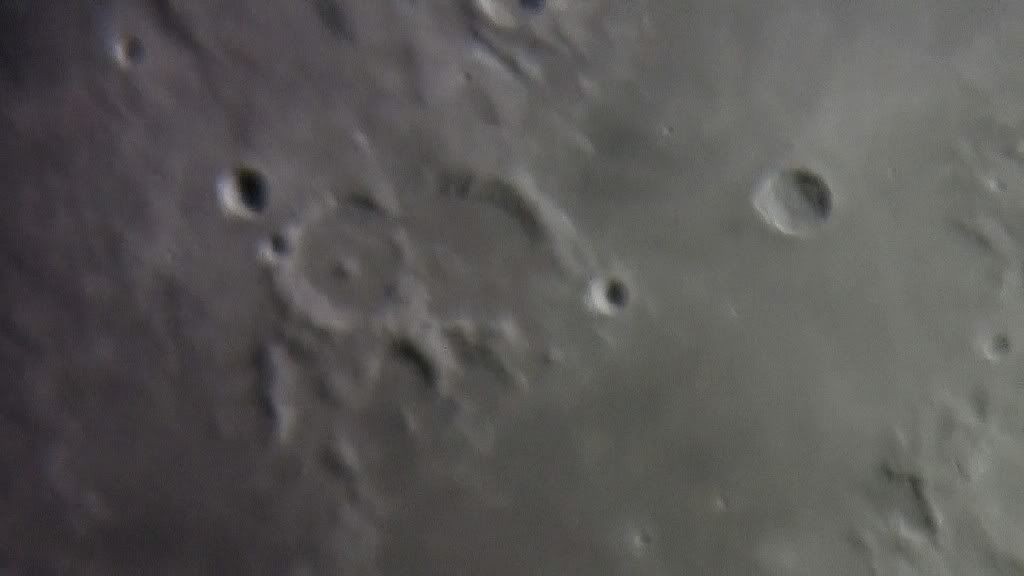
Pallas and Murchison are two craters that are separated by a wall that is not continuous.About these two craters have spoken. These images are newer and closer to the crater.

Wednesday, 27 April 2011

Mare Vaporum and Pallas and Murchison craters

Photographer: Victor Lupu
Optics: Celestron C8-Newtonian reflector telescope, plossl 20mm, 2x Barlow
Mount: CG5 (EQ5)
Device: Sony HDR CX105
Filter: No
Date: 14/11/2010
Location: Baia Mare, Romania
Processing: video capture


        Pallas (50 km), is a heavily eroded lunar crater north of Sinus Medii. To the northwest is Bode (19 km),a smaller crater. Pallas shares a wall with the crater Murchison (58 km) which is attached to the south-east.Through this wall there are two gaps as two passes from one crater to another.
Pallas's interior floor has been flooded with lava, leaving a relatively flat surface. The crater has a central peak.
         Murchison (58 km), was named in honor of the geologist Sir Roderick Murchison.
Murchison shares a section of the crater rim with Pallas. On south-east of Murchison crater is Chladni crater (14 km), and north-east is Ukert (23 km). Further east is the crater Triesnecker. Murchison is "riding" on zenith
line of the Moon. From here, the Earth would appear almost directly overhead.

         Mare Vaporum -245 km, ("Sea of Vapors") is a Moon plateau situated between the southwest edge of the Mare Serenitatis and southeast edge of  Mare Imbrium. The material surrounding of the Sea dates from Imbrian era, and the material of the Sea is from Eratostenian era. It is in an old basin or crater which is the Procellarum basin. South of the Vaporum is a thin pale line. This feature is Rima Hyginus. Sea is bordered by mountain ranges Montes Apenninus . He was named by Giovanni Battista Riccioli in 1651.

 
All images are © Copyright 2010-2015 Lupu Victor. All rights reserved.Images may not be reproduced, published, or copied in any form without written permission of the author. Thank you for respecting the intellectual property rights. ASTROFOTOGRAFIA | Lupu Victor Astronomy - Contact - About
Design by Free WordPress Themes | Bloggerized by Lasantha - Premium Blogger Themes | Online Project management