Visit Worldwide Topsites
Showing posts with label Craters-Orontius. Show all posts

Wednesday, 11 February 2015

Telescope images of Orontius crater through telescope Moon astronomy

122 video frames in Registax.
170 video frames in Registax.
302 video frames in Registax.
Registax Orontius crater telescope moon astronomy
170 video frames in Registax.

Orontius crater was once circular but over the edges occurred two impacts that formed craters Huggins (65 km), east and Orontius A (7 km), at west, and its form suffered. Therefore, this crater is affected by other impacts that have changed the face from the circular, in another shape.

Orontius is 3.1 km deep and 122 km in diameter.
Has satellite craters from A to F, and their diameter varies from 7-41 km. Orontius F is the largest, but is almost visibly embedded in the floor of the north of Orontius because its walls are not high.

Video footage of which I took these pictures is here.
Screenshots if video from which I took these pictures are here.

Info: Orontius.
Coordinates 40.3°S 4.0°W
Diameter 122 km
Depth 3.1 km
Colongitude 4° at sunrise
Eponym Oronce Fine

Moon Age: 9.05 days
Phase: 70.5% (0% = New, 100% = Full)
Distance: 399.221 km


Optics (telescope or lenses): Celestron C8-Newtonian telescope, eyepiece 20mm Plossl, 2x barlow
Mount: CG5 (EQ5)
Camera: Sony CX130
Filter: no
Date: 10/03/2014
Location: Baia Mare, Romania
Processing: Registax,  FastStone Image Viewer


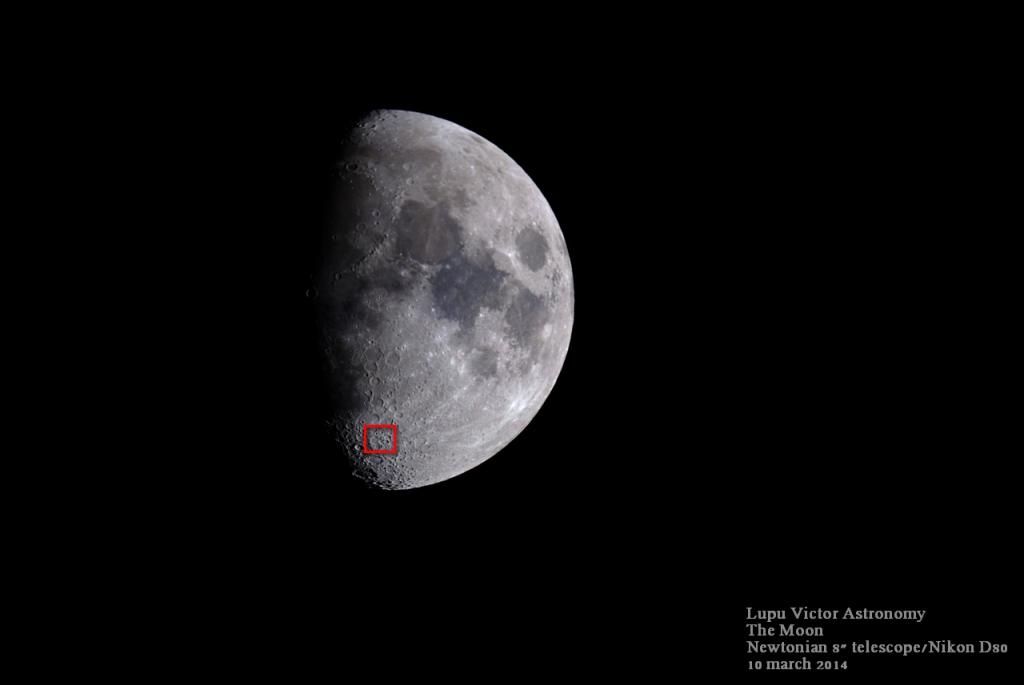
Image for orientation dated 29 April 2012.


Monday, 2 February 2015

Astronomy through telescope. Crater Tycho in Registax.

1104 video frames in Registax.
302 video frames in Registax.
122 video frames in Registax.
199 video frames in Registax.
100 video frames in Registax.
247 video frames in Registax.
199 video frames in Registax.
250 video frames in Registax.
170 video frames in Registax.
Tycho is without question the most interesting southern crater on the Moon. It is small but from it starts rays hundreds of kilometers around it.

Tycho (43ºS 11ºW) has a diameter of 86 km. It is a complex crater with a terraced interior wall and central peaks. This recent crater has a bright ray model, extending for hundreds of kilometers. Extensive impact secondary fields , are visible on the surrounding terrain.

Here, Tycho is half in the dark, shadow that bypasses the central peak on the floor, being left in the light.

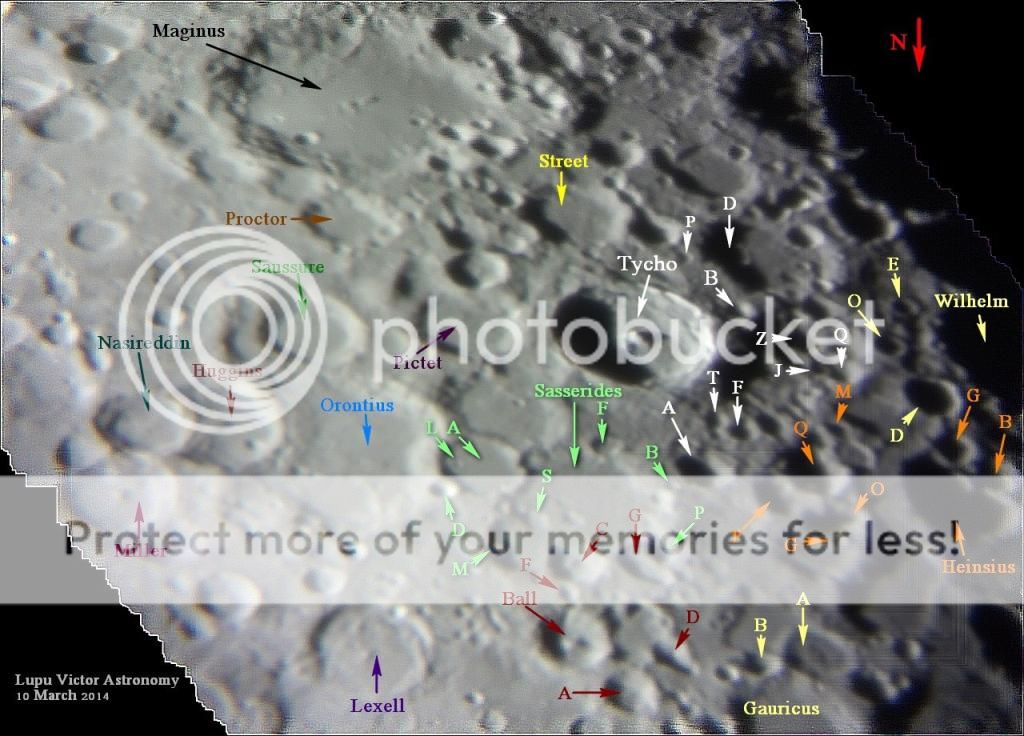
The images captures a much larger area around Tycho, craters that are more in number which is a feature of the South. We can observe Orontius (122 km), Sasserides (90 km), Saussure (54 km), Maginus (163 km), Heraclitus and Licetus (90/75 km), Cuvier (75 km) and the list continues.
Since the telescope moved on a wider area, Registax program has taken all the frames and created a wonderful picture of the area.

You can watch the video from which I've extracted the images and simple video captures, in other articles.

170 video frames in Registax.

Tycho crater info.
Coordinates43.31°S 11.36°
Diameter86 km
Depth4.8 km
Colongitude12° at sunrise
EponymTycho Brahe


Moon Age: 9.05 days
Phase: 70.5% (0% = New, 100% = Full)
Distance: 399.221 km


Optics (telescope or lenses): Celestron C8-Newtonian telescope, eyepiece 20mm Plossl, 2x barlow
Mount: CG5 (EQ5)
Camera: Sony CX130
Filter: no
Date: 10/03/2014
Location: Baia Mare, Romania
Processing: Registax,  FastStone Image Viewer


Tuesday, 13 January 2015

(Video) Craters on the Moon seen clearly through telescope.


The south of the Moon is full of countless craters, where large basins of lava are missing. Craters Heraclitus and Licetus (90/75 km) are some of seen in these images processed also in Registax.

The astronomical telescope is pointed at the Moon's south pole, using motor tracking from Lacerta. Watch here craters as Heraclitus / Licetus (90/75 km) Maginus (163 km), Orontius (122 km), Tycho (85 km), Sasserides (90 km), Saussure (54 km).

The atmospheric quality has helped me quite a lot to shoot clear images of the area. The land in sunlight is white as milk. This color stops at the terminator at the large crater Clavius, where we encounter a hard penetrating dark.

The video was also used in Registax program to process images with higher quality, but also for simple video captures.

The video was made with the camera mounted on the telescope, to be more exact on the telescope eyepiece. To protect the telescope from vibrations, I used a tracking motor from Lacerta, and thus the image was more stable.

However, even with this tracking device for celestial bodies, there were vibrations of the telescope tube, causing the image to be slightly unstable. For this, I used the video stabilization option in Sony Vegas editing software, so the video was 100% correct on this issue.

Images processed in Registax, here.
Unprocessed images (video captures), of craters Heraclitus / Licetus are here.


170 frames, in Registax.

Moon Age: 9.05 days
Phase: 70.5% (0% = New, 100% = Full)
Distance: 399.221 km


Optics (telescope or lenses): Celestron C8-Newtonian telescope, eyepiece 20mm Plossl, 2x barlow
Mount: CG5 (EQ5)
Camera: Sony CX130
Filter: no
Date: 10/03/2014
Location: Baia Mare, Romania
Processing: Sony Vegas HD Platinum 10.0


Saturday, 29 November 2014

Registax. Heraclitus and Licetus. Moon's south craters seen through the telescope.

122 frames, in Registax.
31 frames, in Registax.
108 frames, in Registax.
These pictures, contains a larger area of the southern Moon. Some are framed in the same image, four notable craters, as Tycho (85 km), Maginus (163 km), Orontius (122 km) and Heraclitus (90 km). Images are upside down for a better view of the southern part of the Moon, and are processed in Registax program, which helps greatly to the image quality of any cosmic bodies seen by a telescope.

Light shining over the craters, is perfect for viewing their details.
Heraclitus and Licetus (90/75 km) are beautifully described in this phase among the craters of the surroundings.

Licetus crater , is better defined than divided crater Heraclitus, and dates from the pre-Nectarian times.
It is still a crater affected with some other small craters located on the edge, and along the inner wall. Most notable are on the inner edge of the southeast and the northwest.

Licetus's floor is relatively flat, with a few bumps in the southern half. There are also some small craters in the south-west and east.

The crater is named after Fortunio Liceti, an Italian philosopher and physicist who lived in the 17th century.


 Other images of the area on the same day.

229 frames, in Registax.
Moon Age: 9.05 days
Phase: 70.5% (0% = New, 100% = Full)
Distance: 399.221 km


Optics (telescope or lenses): Celestron C8-Newtonian telescope, eyepiece 20mm Plossl, 2x barlow
Mount: CG5 (EQ5)
Camera: Sony CX130
Filter: no
Date: 10/03/2014
Location: Baia Mare, Romania
Processing: Registax,  FastStone Image Viewer


Wednesday, 10 September 2014

"Caterpillar" crater Orontius on the Moon.


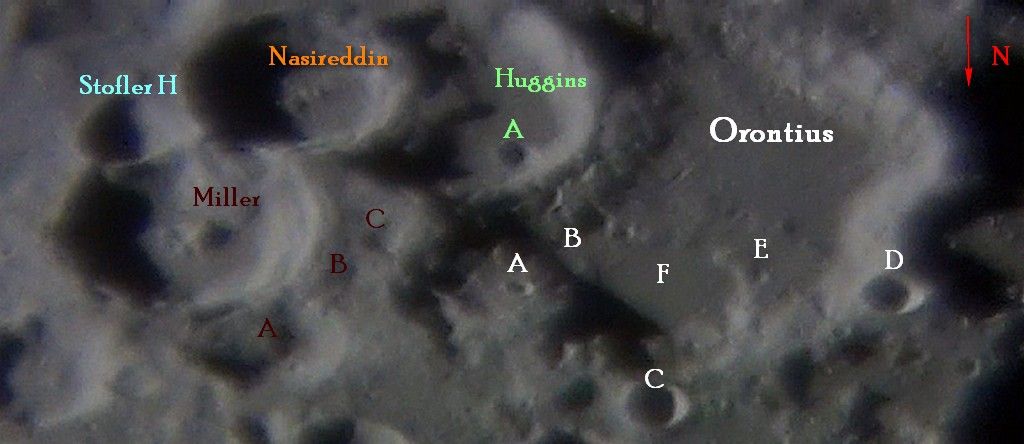
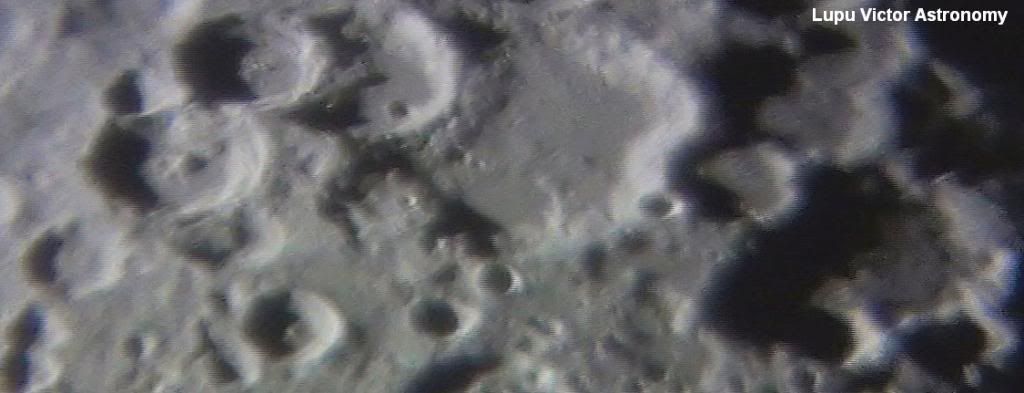
Orontius crater (122 km), would not have been so beautiful and so easy to recognize, unless would not have had attached to it some craters that are arranged in descending order, and its like it forms the body of a caterpillar, its head being Orontius.

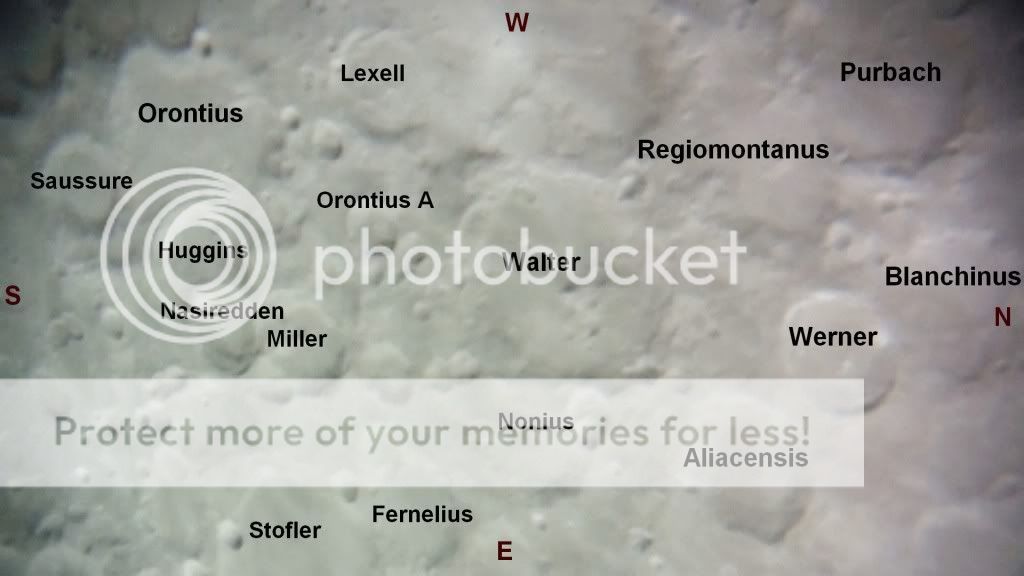
These craters are labeled in the image below for an easier orientation. They are Huggins (65 km), Nasireddin (52 km) and Miller (75 km). All three have two letters side by side as "gg", "dd" and "ll", which I find hard to believe it's a coincidence. Even Stöffler H (27 km), located between Nasireddin and Miller, contains two letters "ff".

Oronţius is the Latin name of Oronce Fine (or Finé), after which was named this crater-Latin: Orontius Finnaeus, Italian: Oronzio Fineo. He was a French mathematician and cartographer.


Image for orientation from 29 aprilie 2012.

Moon Age: 9.05 days
Phase: 70.5% (0% = New, 100% = Full)
Distance: 399.221 km


Optics: Celestron C8-Newtonian telescope, 20mm Plossl, 2x barlow
Mount: CG5 (EQ5)
Camera: Sony CX130
Filter: no
Date: 10/03/2014
Location: Baia Mare, Romania
Processing: FastStone Image Viewer


Monday, 4 March 2013

Orontius and the complex of craters forming a scorpion.


Orontius (122 km), is the head of a line of craters that form a "scorpion" with a curved tail. The craters, which are the body and tail of the "scorpion", are Huggins (65 km), Nasireddin (52 km) and Miller (75 km), Miller C (36 km), being the tip of the tail.

I do not know if the successive impacts were shortly one after another, but it is clear that Orontius is the oldest of them, followed by Huggins, after which were Nasireddin and Miller. We can see that, by observing how they overlap each other.


Orontius is very close to the crater Tycho (85 km). The distance between their edges is only of 78 km. Therefore, this area is full of a very high albedo from the impact that caused the formation of Tycho.


Moon age: 7 days
Stage: 51% (0% = New, 100% = Full)
Distance: 384.488 km


Optics: Celestron C8-Newtonian telescope, 20mm Plössl, 2x barlow
Mount: CG5 (EQ5)
Camera: Sony CX130
Filter: no
Date: 29/04/2012
Location: Baia Mare, Romania
Processing: video captures, FastStone Image Viewer

Monday, 18 February 2013

Deslandres and the surrounding craters. Astronomical telescope images


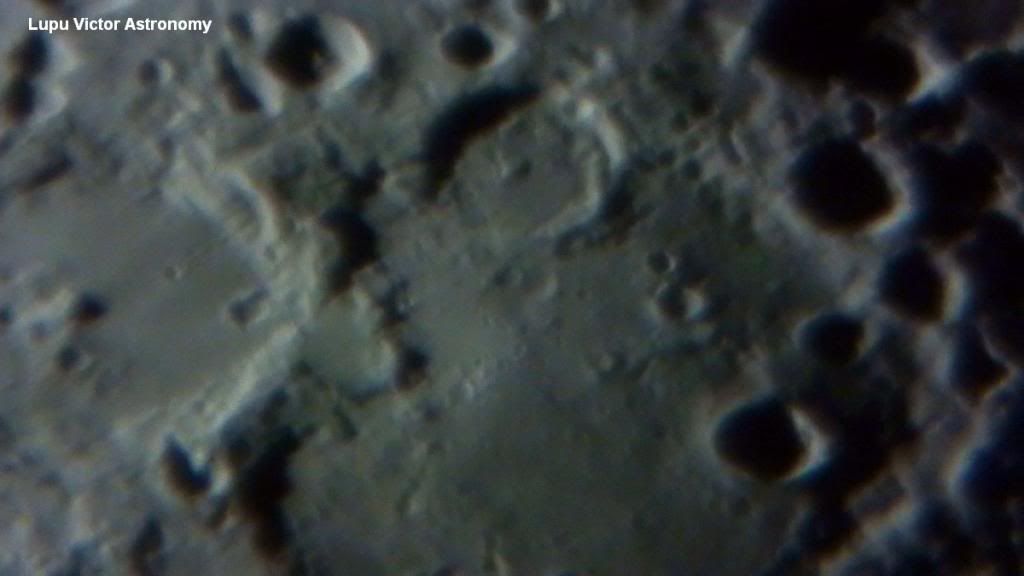
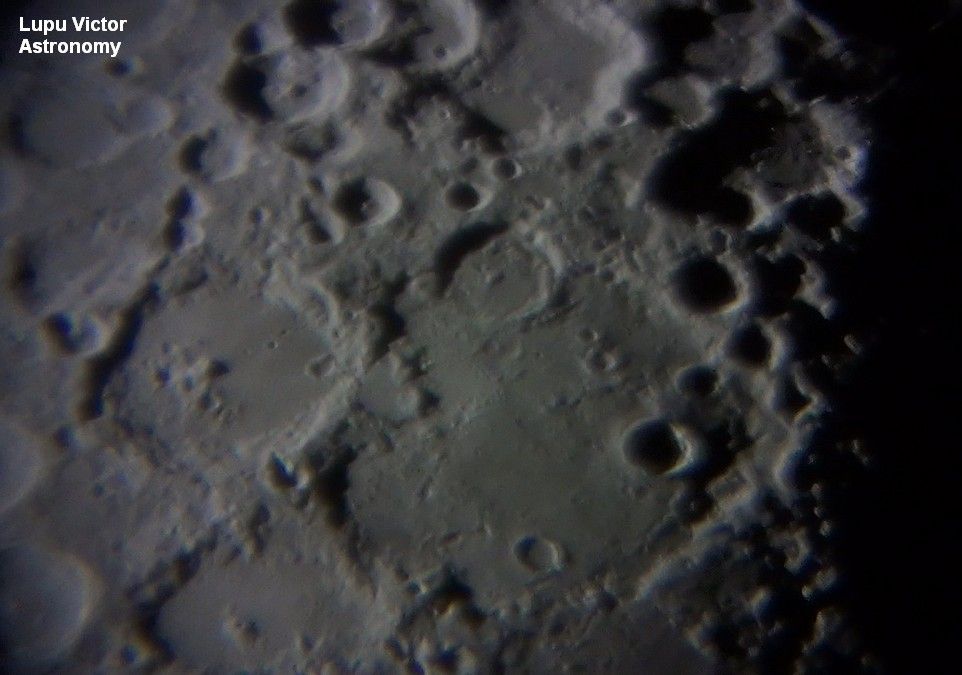
These images are very clear, as the camera focus was bestIn the pictures here, we have the huge crater Deslandres (234 km) north of the bright crater Tycho.  To view the telescope video of these photos, go here.

A very bright rays of Tycho with high albedo, are spread on the whole region, but these are not seen in the photos because of the Moon phase at that time, when the Sun was at a low angle.

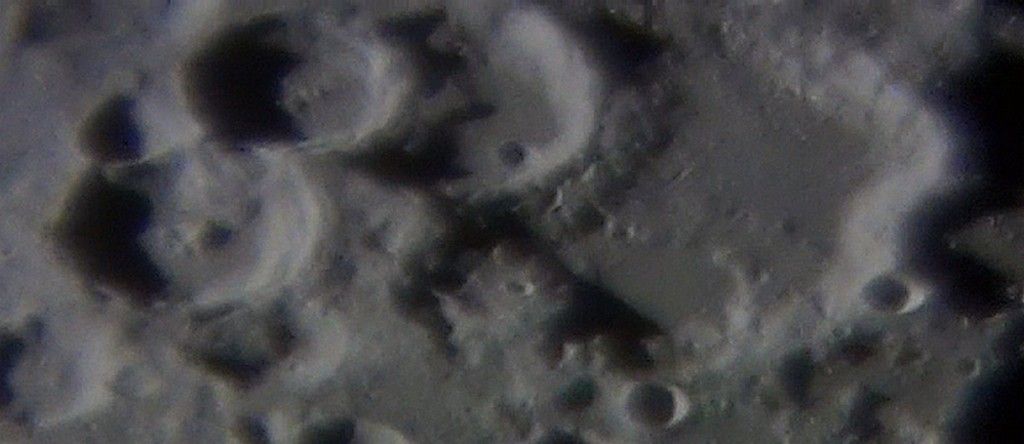
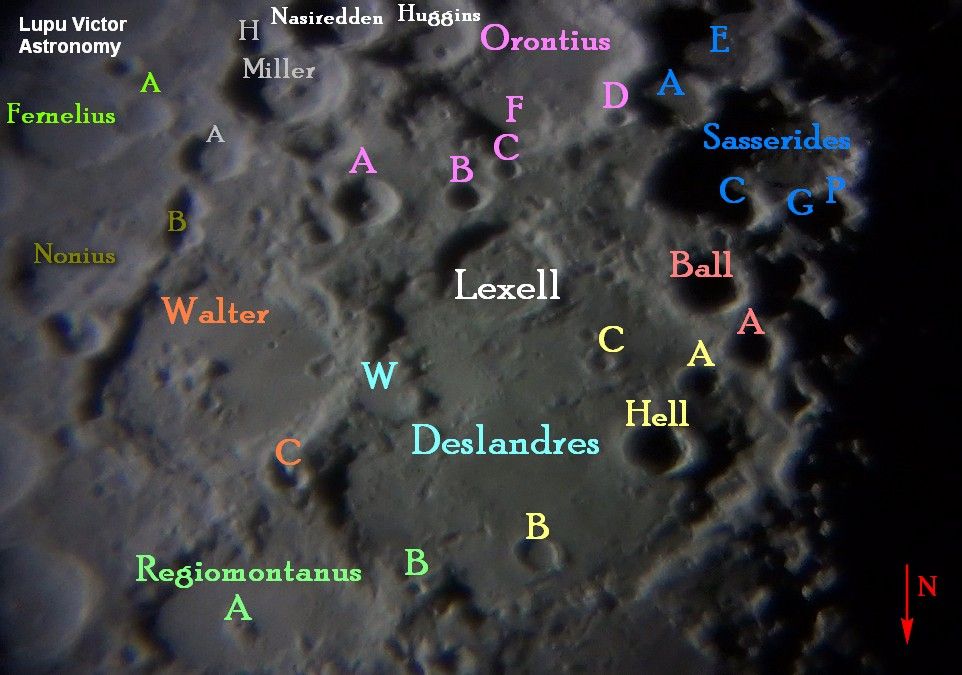
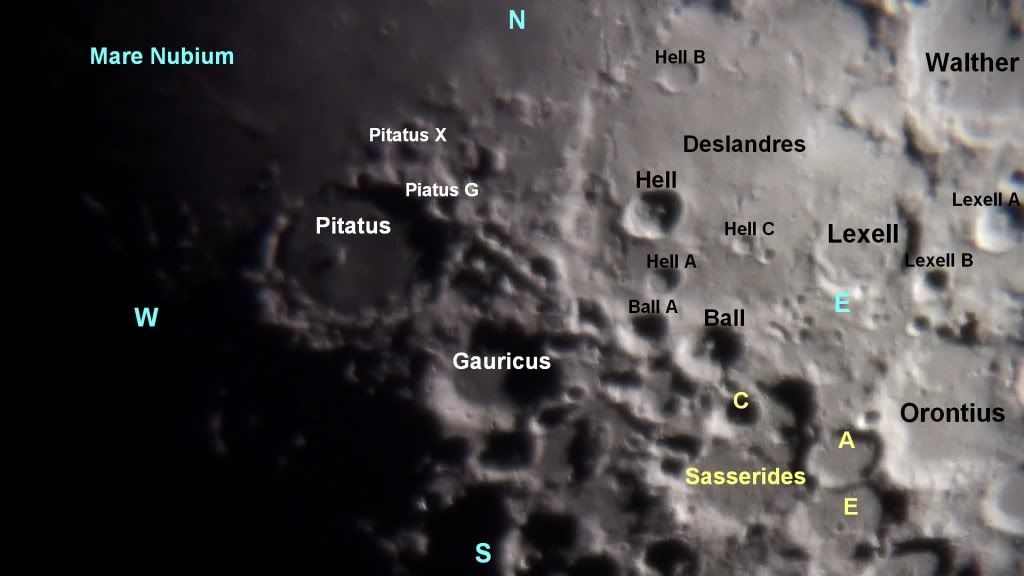
The picture below explains in great detail all craters located inside of Deslandres, and neighbors, as I labeled them each name with color. Images are inverted as seen through the telescope.

As you can see, this area is very rich in craters of all sizes, feature which is common to the south of the Moon. In these pictures, are craters like: Lexell, Sasserides, Walther, Orontius, Hell, Nonius and others.

Info Deslandres crater.
Coordinates32.5°S 5.2°
Diameter256 km
DepthUnknown
Colongitude5° at sunrise
EponymHenri A. Deslandres


Moon age: 7 days
Stage: 51% (0% = New, 100% = Full)
Distance: 384.488 km

Optics: Celestron C8-Newtonian telescope, 20mm Plössl, 2x barlow
Mount: CG5 (EQ5)
Camera: Sony CX130
Filter: no
Date: 29/04/2012
Location: Baia Mare, Romania
Processing: video captures, FastStone Image Viewer

Thursday, 26 July 2012

HD telescope video with heart-shaped Deslandres crater on the Moon.

The video images of this article are upside down (north and south are reversed), as seen through the telescope. Images were stabilized in Sony Vegas 10, because the mount wasn't motorized. The quality of our atmosphere was very good and that is why the lunar surface details are clear.

 Deslandres (234 km), is a desintegrated crater of pre-Nectarian era, and is one of the largest craters on the Moon. I like to think it has a heart shape. Also note in the video below, the eroded crater Lexell (63 km) on its southeastern edge and Hell (33 km), a smaller crater, named for astronomer Maximilian Hell, on the west. Hell Crater, shows a central peak in the center, but not visible due to the shadow that covers the crater floor. You may also notice a line of small craters on the eastern crater floor of Deslandres.


Video: Victor Lupu
Optics: CelestronC8 "-Newtonian telescope, plossl20mm, 2x Barlow
Mount: CG5 (EQ5)
Device: Sony CX-130
Video mode: Full HD progressive 1920x1080
Filter: no
Date: 29/04/2012
Location: Baia Mare, Romania
Processing and editing: Sony Vegas 10


Other large craters in this video, can be identified in the photo below, as Walther, Regiomontanus, Nonius, Sasserides and Orontius.

                                    The picture below was made on May 11, 2011.

Saturday, 17 September 2011

Maginus and Orontius Craters-telescope images

Orontius crater (122 km), is on the bottom of the photos above, along with Huggins (65 km), Nasiredden (52 km) and Miller (75 km). All these are in descending order and are joined to each other.In this area there are some big, big craters, as Maginus (163 km), at the top of the photo, Clavius ​​(225 km), Walther (128 km), and others.
The picture below is older and is for guidance.
Below is Maginus (163 km), located in the center photo. Over all these craters .Tycho crater (85 km) rays, are covering almost the entire southern hemisphere of the Moon.
Photographer: Victor Lupu
Optics: Celestron C8-Newtonian telescope, plossl 20mm, 2x Barlow
Mount: CG5 (EQ5)
Eyepiece Adapter: 1.25 "
Device: Sony CX105 at 7x optical zoom
Total Magnification: 700x
Filter: No
Date: 12/05/2011
Location: Baia Mare, Romania
Processing: video captures, FastStone Image Viewer
Images are upside down, as seen through the telescope.

 
All images are © Copyright 2010-2015 Lupu Victor. All rights reserved.Images may not be reproduced, published, or copied in any form without written permission of the author. Thank you for respecting the intellectual property rights. ASTROFOTOGRAFIA | Lupu Victor Astronomy - Contact - About
Design by Free WordPress Themes | Bloggerized by Lasantha - Premium Blogger Themes | Online Project management