Visit Worldwide Topsites
Showing posts with label Craters-Stöfler and Maurolycus. Show all posts

Friday, 25 March 2016

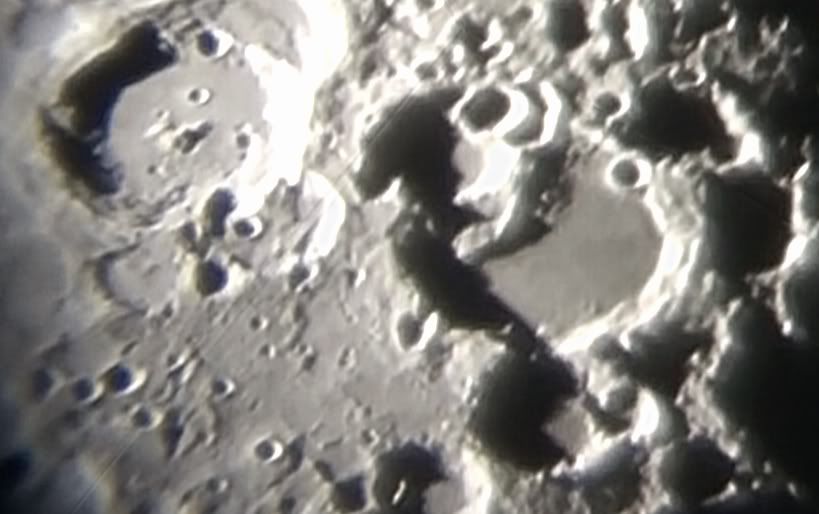
Astronomical telescope images. Lunar craters. Heraclitus and Stofler.

This is a landscape little difficult to see, but at the same time raise the interest for a more detailed investigation of these lunar features.

For example, Stofler crater made me curious when I saw in this light. Its shape is much sharper now that is flooded darkness. This form is actually composed of two craters: Stofler (126 km) and Faraday (70 km). What seems unique from all other moments when I caught this crater is the small crater sitting on the edge of Stofler called Stofler F (18 km). The Shadow that makes Stofler not be circular. These craters are actually Faraday, and left and right Faraday A (21 km) and C (30 km).

 Heraclitus and Licetus (90/75 km) are two stuck together craters, but they are more complex than you think. The shape can confuse you because these are some overlapping craters.
 Heraclitus,  is a complex crater and is located in rugged mountainous areas south of the Moon.The crater is 90 kilometers in diameter and 3.8 kilometers deep. Licetus is combined with Heraclitus and form the southern end.  Cuvier is at west and north is Lilius.


Magnitude: -10.82
Phase: 0.46
Distance: 399.283 km
Illuminated: 45.6% (0% = New, 100% = Full)


Astronomical instrument: Celestron C8-Newtonian telescope,
Eyepiece: Plossl 20mm, 2x Barlow
Mount: CG5 (EQ5)
Camera: Sony CX130
Filter: no
Date: 30.01.2012
Location: Baia Mare, Romania
Processing: FastStone Image Viewer


In the picture below are labeled craters and other lunar features in the region. To better understand this photo, you should note that the label with the name or the letter of larger craters could be found at their center, and on the small craters, you should find them around them, usually above.

The image above is made in 10 February 2011.

Image of 9 February 2011.


Sunday, 14 April 2013

Images with numerous craters on the Moon's south by astronomical telescope Maurolycus Barocius Stofler Heraclitus


In these images, we see the southern craters of the Moon, which are many in number and of all sizes. Most visible at the bottom of the image, are such as Stofler and Maurolycus, Heraclitus and Licetus, Lilius, Jacobi, Curtius, continuing to the edge of the Moon, on which craters are starting to become more oval and less noticeable in detail because of their position, as Hommel and Pitiscus, left.

Pictures are sharp and with fine details, considering they are captures of a video. The two large craters on the Moon, on the top in the pictures, are Mutus and Manzinus. On other evenings, the moon craters of the edge of lunar disk are not so far away, because the Moon has a periodic tilting forward and backward, and so are times when some of the craters are visible, and periods when they are no longer seen at all.

All regions of these pictures are wrapped by Tycho's rays. They are best seen here passing over Stofler and Maurolycus.

These video captures were chosen as the most clear, lacking as much as possible of aberration that gives Earth's atmosphere, which is often guilty of distortion of craters in images. Choosing the frames is quite difficult and much time involved in developing the film frame by frame. Conditions for choosing the best frame for the image to be catalogued the best, are, to be clear, free of atmosphere interference as much as possible, and the focus of the camera to be the best, which has times when is not focusing on desired region.

Moon age: 7 days
Stage: 51% (0% = New, 100% = Full)
Distance: 384.488 km


Optics: Celestron C8-Newtonian telescope, 20mm Plössl, 2x barlow
Mount: CG5 (EQ5)
Camera: Sony CX130
Filter: no
Date: 29/04/2012
Location: Baia Mare, Romania
Processing: video capture, FastStone Image Viewer


The photos above were taken in February 10, 2011. In them you can see some craters in first pictures of the article, including those on the edge of the Moon.

Saturday, 23 March 2013

Beautiful south lunar craters. Stofler and Maurolycus.


There are many craters of all sizes in these images, a common feature to the south of the Moon. The largest in size is Stofler (126 km) and Maurolycus (114 km).

The difference between the two as shown in pictures, is that Stofler has a floor with a half moon shape, because on it is superimposed another smaller crater, Faraday (70 km).

Over the entire area is sprayed the ejections from the impact that created the crater Tycho.

The images are very clear, if we consider that these are video captures.


Moon age: 7 days
Stage: 51% (0% = New, 100% = Full)
Distance: 384.488 km


Optics: Celestron C8-Newtonian telescope, 20mm Plössl, 2x barlow
Mount: CG5 (EQ5)
Camera: Sony CX130
Filter: no
Date: 29/04/2012
Location: Baia Mare, Romania
Processing: video captures, FastStone Image Viewer


Monday, 21 January 2013

Moon craters Faraday Stofler and Maurolycus. Pictures by astronomical telescope.


In these images, the largest craters visible to your attention at first glance, are called Stofler right, and Maurolycus. These should be vice versa, but the image is inverted by the telescope.
Stofler (126 km), is an almost circular crater. Eastern edge is "notched" , and so the floor, as a whole, seem to be like a goose foot. An interesting thing you notice is its flooring where there are several shades. These are limited to three dark spots. Other features, are many very small craters on the floor, which seemed to be riddled by bullets. Another feature of Stofler are satellite craters placed on the edge, such as Stofler K (19 km), on the outer edge to the north-west, and Stofler F (18 km), on the inside of the crater, to the south.

Southeast, stuck to Stofler, is Faraday crater (70 km). It is smaller in size, and also has satellite craters on edge, namely Faraday A (21 km) and C (30 km). The latter has some central peaks inside. Faraday is a circular crater, but distorted by A and C mentioned above.

The second big crater in these pictures, is Maurolycus (114 km), a circular crater which looks messy at first glance, because it has many features. It has smaller subsequent craters but also landforms on the floor.

The interior walls are very wide, especially in the northwest and northeast. On the edges exists craters that occurred after the impact that formed Maurolycus. On the north-west is the crater Maurolycus F (25 km), stuck to Maurolycus B (12 km) and on the south, is Maurolycus A (15 km). On the floor are also craters, on the south-central being Maurolycus J, on West M, on center-east L, and on north N.

The interior walls to V-N-E, are terraced, and are more wide inward to the floor than the south wall. North-west, the wall enters the floor and gives the impression of an extended wall of Maurolycus, right in the center. This higher area than the floor is more affected than the rest of the floor by subsequent impacts. In general, the whole floor is "riddled" with very small craters that are seen only with a powerful telescope and a pure atmosphere.

Please remember about the cardinal points that I wrote in the article, which are correct only if you look at the picture upside down, because the images are inverted as seen through the telescope.


Optical Reflector Telescope Celestron C8-Newtonian inch, 20mm Plössl, 2x Barlow
Mount: CG5 (EQ5)
Camera: Sony HDR CX105 to 8x optical zoom
Total Magnification: 800x
Filter: No
Date: 20/07/2011
Location: Baia Mare, Romania
Processing: Registax


The above image is made ​​in the February 12, 2011.


Friday, 3 June 2011

Faraday Buch and Büsching craters of the south


Photographer: Victor Lupu
Optics: Celestron C8-Newtonian telescope, plossl 20mm, 2x Barlow
Mount: CG5 (EQ5)
Device: Sony CX105
Filter: No
Date: 10/02/2011
Location: Baia Mare, Romania
Processing: 10 Sony Vegas, video captures


Craters Barocius Maurolycus, Stofler, Licetus. Besides these large craters, are: Faraday (70 km), Buch (54 km) and Büsching (52 km).

Faraday (70 km), is a Moon crater located in the southern highlands of the Moon. It lies on the southeast edge of the crater Stöfler and west is Maurolycus.Yhe rim of Faraday was significantly overlapped by subsequent impacts, especially through a pair superimposed on the south-west and north-west. There is a centrally located low ridge to the south-west to north-east, dividing the crater floor in half. The floor is almost flat in the north-west.
The name comes from Michael Faraday (22/9/1791-25/8/1867) who was an English chemist and physicist (or natural philosopher, in the terminology of the time), which contributed to the fields of electromagnetism and electrochemistry.

Buch (52 km), is an old and worn crater. It lies northeast of the crater Maurolycus and Büsching, similar size, is attached to the northern edge . The rim has been eroded by many smaller impacts, so the edge is rounded. The crater floor is relatively flat with no features, with no central peak in the middle. There are only a small crater near the north-west side.
Crater is the name given by Christian Leopold Freiherr von Buch (26.4.1774-4.03.1853) who was a German geologist and paleontologist.

Büsching (52 km), has been eroded over a long period of subsequent impacts, so that the edge was brought down and rounded. Several small craters are located along the edgeThe interior is without a central peak in the middle.
The name comes from the crater Büsching Anton Friedrich (1724-1793) who was a German theologian and geographer.

South
North

Saturday, 2 April 2011

Stöfler Maurolycus and Barocius craters

Stöfler and Maurolycus Registax 80 frames 90% lowest quality.                                                                  -click to enlarge
Stöfler and Maurolycus Registax 32 frames 100% lowest quality.                                                                    -click to enlarge
Stöfler and Maurolycus Registax 14 frames 100% lowest quality.                                                                       -click to enlarge

Stöfler and Maurolycus Registax 78 frames 95% lowest quality.                                                                                                    

Photographer: Victor Lupu
Optics: Celestron C8-Newtonian reflector telescope, plossl 20mm, 2x Barlow
Mount: CG5 (EQ5)
Device: Sony HDR CX105
Filter: No
Date: 09/02/2011
Location: Baia Mare, Romania
Processing: Registax

        Stöfler (126 km) is a large lunar crater located in the mountainous areas south of the Moon.It is named after Johannes Stöffler. It is located west of Maurolycus (east on the photo). A distorted crater, Fernelius is attached to the edge of the south and at east are Nasireddin and Miller (not visible in photos). Faraday (70 km), is a damaged crater located at the northwestern edge of Stöfler.
     Stöfler's edge is eroded, but the outline remains relatively intact except for the region where it overlaps with Faraday crater (75 km). The crater located north of Stöfler is Licetus .
    Craters Maurolycus and Barocius (114-82 km) are located west of Stöfler.


          Barocius (82 km.) is an ancient lunar crater that is located in the southern highlands of the Moon. In north it lies Maurolycus. In the north-east of Barocius is Clairaut.
Barocius's edge has been eroded by many subsequent impacts. The most notable, Barocius B, which is located in west side of Barocius, and mingle with the Barocius C. A remnant of a crater, Barocius W , is inside Barocius .
Crater is the name given by Francesco Barozzi (9 August 1537 - 23 November 1604) who was an italian mathematician, astronomer and humanist.


                 Maurolycus (114 km.) , is one of the most prominent craters in the southern highlands of the Moon. To the north is the crater Barocius.
Crater name is given from Francesco Maurolico (16 September 1494-21 July 1575. He has worked in the fields of mathematics, geometry, optics, mechanics, music, and astronomy.


All images are © Copyright 2010-2015 Lupu Victor. All rights reserved.Images may not be reproduced, published, or copied in any form without written permission of the author. Thank you for respecting the intellectual property rights. ASTROFOTOGRAFIA | Lupu Victor Astronomy - Contact - About
Design by Free WordPress Themes | Bloggerized by Lasantha - Premium Blogger Themes | Online Project management