Visit Worldwide Topsites
Showing posts with label Craters-Vega. Show all posts

Tuesday, 14 February 2012

3 clips by astronomical telescope: Craters Vega, Rheita and Metius

These three wonderful videos of Moon's south craters, are the clearest from the area so far. Atmospheric fluctuations have occasionally blurred the image, but it remains one of the best in quality, along with some clips of Clavius ​​and Copernicus shadow.
Processed images of these clips are here.


Video: Victor Lupu
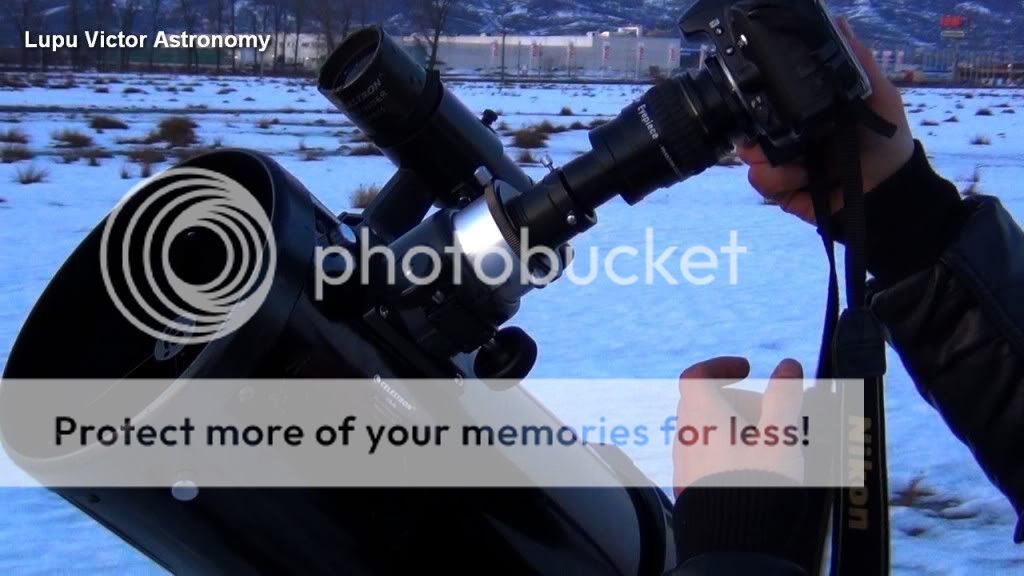
Optics: CelestronC8 "-Newtonian telescope, plossl20mm, 2x Barlow
Mount: CG5 (EQ5)
Device: SonyCX105 at 7x optical zoom
Total Magnification: 700x
Filter: no
Date: 16/08/2011
Location: Baia Mare, Romania
Processing and editing: Sony Vegas 10

Monday, 26 December 2011

Video by astronomical telescope.Reita and Vega craters

This video starts from crater Rheita D,  Rheita, Vallis Rheita, and continues to the south of the Moon, where on the upper right shows a large dark crater called Vega.
Images processed in this video are here.


Optics: CelestronC8 "-Newtonian telescope, plossl20mm, 2x Barlow
Mount: CG5 (EQ5)
Device: SonyCX105 at 7x optical zoom
Total Magnification: 700x
Filter: no
Date: 16/08/2011
Location: Baia Mare, Romania
Processing and editing: Sony Vegas 10

Friday, 16 December 2011

Vega crater and Vallis Rheita. Telescope images

Photographer: Victor Lupu
Optics: Celestron C8-Newtonian telescope, plossl 20mm, 2x Barlow
Mount: CG5 (EQ5)
Device: Sony CX105 to 8x optical zoom
Total Magnification: 800x
Filter: no
Date: 08/16/2011
Location: Baia Mare, Romania
Processing: video captures, FastStone Image Viewer


         Vega (76 km) is an eroded lunar crater and can be seen from Earth even if is located at the Moon's terminal. Southeast of Vega is Peirescius a slightly smaller crater and to the west is the crater Reimarus and the long Vallis Rheita.

Vega crater which is 2.9 km deep, was bombarded and eroded by a long history of impacts. Vega B (30 km), overlaps the southern part of the floor. On the north-eastern edge overlapses with a pair of small craters. The rest of the floor has no features except a few small craters.


 Crater name is given in honor of baron Jurij Bartolomej Vega (Georgius Bartholomaei Vecha)-March 23, 1754 - September 26, 1802, which was a mathematician, physicist and artillery officer.

         Vallis Rheita is a linear valley situated south-east of the Moon, and is oriented to Mare Nectaris. This valley seems to share a common origin with Vallis Snellius which lies to the north-east, because both are orientated in the same direction.
Valley is  445 km long, and a width of about 30 km, but narrows to 10 km to the extreme southeast. It is the longest valley on the Moon, being exceeded only by Vallis Snellius.

       Vallis Rheita was eroded by a series of impacts, and more notable craters are located along this valley. Near the end of the northwest is the crater Rheitalike this valley was also named. Further to the southeast is the crater Young (72 km), almost centered in the valley. Young D (46 km) is located near the valley, but less ,deformed.
Further, to the southeast are craters Mallet (58 miles), and Reimarus (48 km). Satellite crater  Mallet D (42 km), is also covering part of the valley.


For those who like my articles or the images through my telescope, would be nice to pay attention on advertising that appear in the blog by a click, because it is the only way I could buy one day a better telescope.


All images are © Copyright 2010-2015 Lupu Victor. All rights reserved.Images may not be reproduced, published, or copied in any form without written permission of the author. Thank you for respecting the intellectual property rights. ASTROFOTOGRAFIA | Lupu Victor Astronomy - Contact - About
Design by Free WordPress Themes | Bloggerized by Lasantha - Premium Blogger Themes | Online Project management