Visit Worldwide Topsites
Showing posts sorted by relevance for query Metius. Sort by date Show all posts

Friday, 23 August 2013

Images by astronomical telescope Lunar Craters Rheita and Metius

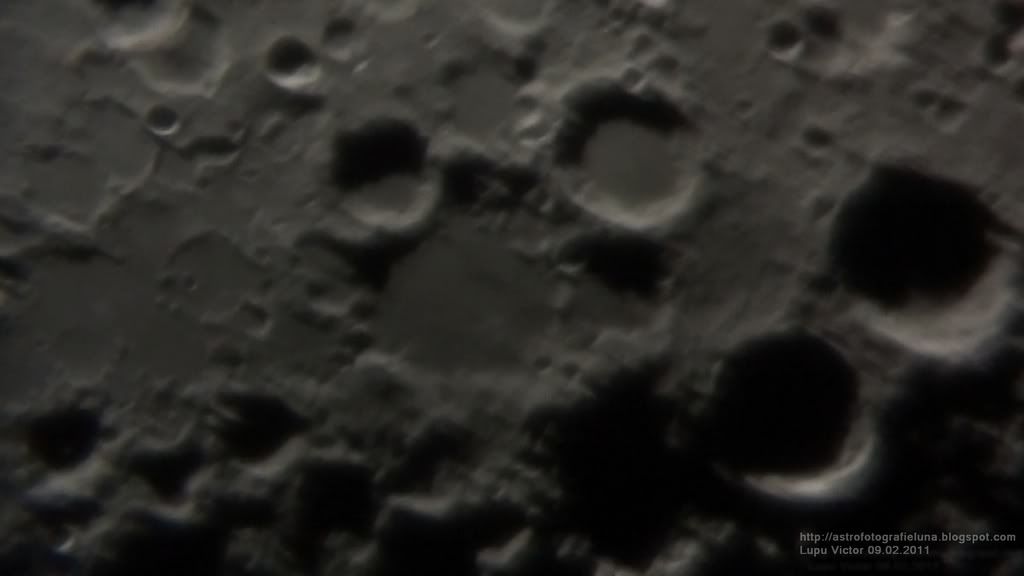
Rheita and Metius. 42 frames at 90% best quality in Registax.


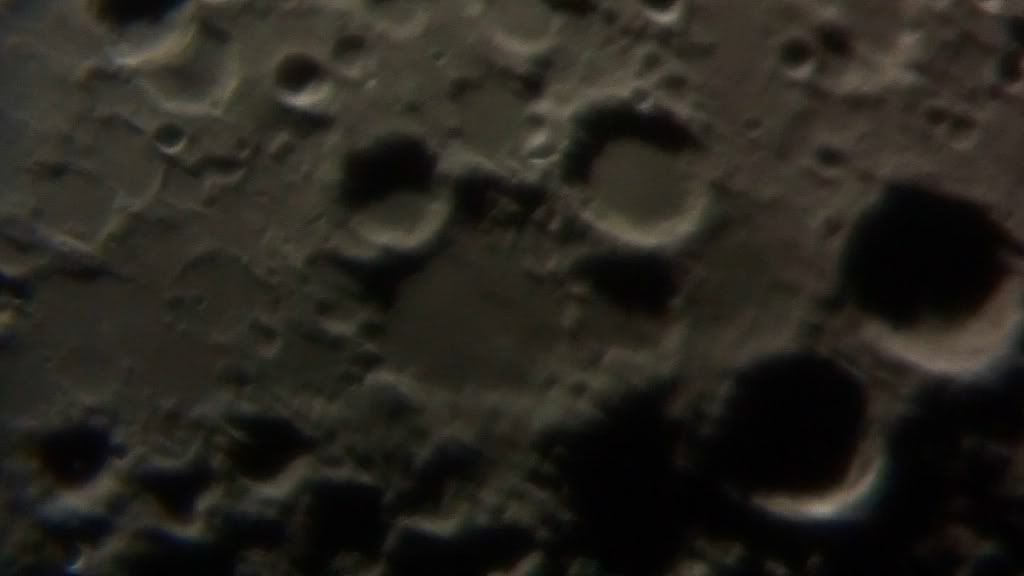
Rheita and Metius. 329 frames at 83% best quality in Registax.


Rheita and Metius (70 km/88 km), are two distinct craters on the Moon southeast. Between them, there is a very long ditch called Vallis Rheita. This name was given because it starts from the crater Rheita, continuing to the south of the Moon, beyond the crater Young D.


Rheita's western edge, is superimposed over the valley to its north. This crater has interior walls bombarded by several smaller impacts, and a mountain is centrally located on the floor.


Metius is a circular crater with a few central peaks that form a semicircle and a smaller crater east of the floor, called Metius B (14 km). To the south west is a new crater, located on the floor of the large crater Janssen, called Fabricius (78 km). New, because the eastern edge overlaps southwest edge of Metius.


   Image processing in Registax of a video that have taken more shots, merged to form a single image. View this video in which I processed these images.


42 frames at 90% best quality in Registax.
74 frames at 85% best quality in Registax.


Images are processings from Registax, of a video from which were taken a variety of shots, merged to form a single image.

Age of the Moon: 17 days
Phase: 93% (0% = New, 100% = full)
Distance: 394.960 km


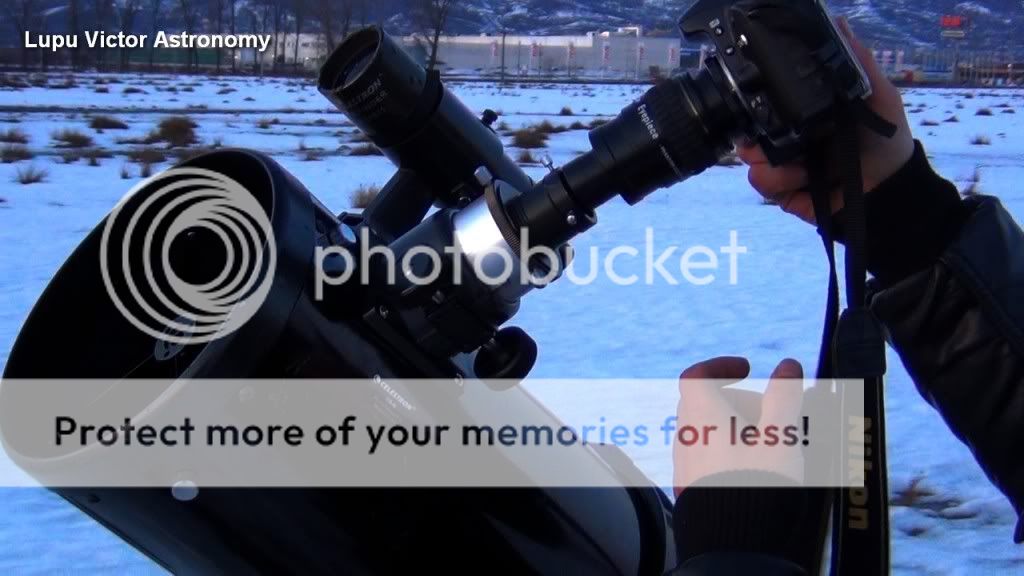
Optics: Celestron C8-Newtonian telescope, 20mm Plossl, 2x Barlow
Mount: CG5 (EQ5) motorized
Camera: Sony CX130
Filter: no
Date: 31/12/2012
Location: Baia Mare, Romania
Processing: Registax, FastStone Image Viewer


Tuesday, 3 January 2012

Astronomy lecture-Photos by telescope.Crater Metius


Rheita and Metius craters through the telescope.
 Metius crater, 88 km across, I forgot to describe it.
Metius is an impact crater located in rugged mountainous areas southeast of the Moon. The rim of the southwest is close to Fabricius. To the northwest is the crater Brenner. Proceeding to the northeast is Rheita and the long valley, Vallis Rheita.

The floor is relatively flat, with small central peaks. Most prominent crater on the floor is Metius B, 14 km, located near the northeastern edge.
This crater is the eponymous of dutch geometer and astronomer Adriaan Adriaanszoon, which was known as Metius.

Photographer: Victor Lupu
Optics: Celestron C8-Newtonian telescope, plossl 20mm, 2x Barlow
Mount: CG5 (EQ5)
Device: Sony CX105 to 8x optical zoom
Total Magnification: 800x
Filter: no
Date: 08/16/2011
Location: Baia Mare, Romania
Processing: video capture, FastStone Image Viewer

Sunday, 11 May 2014

Visual astronomy. Rheita and Metius craters.


The first thing that catches your attention un these video captures is Vallis Rheita a " moat " that spans a distance of 445 Km long, and at this Moon phase is beautifully highlighted . This is interrupted in the middle by a "bridge " to the crater Young (42 km).


At the extreme north, a crater is superimposed over Vallis Rheita, named Rheita (70 km). Notice its fine floor, although half of it is in shade. When we would approached to the crater, we would see some small craters on it , especially on the inside of the crater. One thing is certain , namely that it has a central peak but no other " rille " that would make it more special.


Metius crater ( 88 km ) is larger, and has the same characteristics as Rheita, although peaks in the center can not be distinguished any. Inside the crater is observed a smaller crater called Metius B ( 14 km ) in the north- east.


Images processed with Registax can be viewed here: Images by astronomical telescope Lunar Craters Rheita and Metius.

Age of the Moon: 17 days
Phase: 93% (0% = New, 100% = full)
Distance: 394.960 km


Optics: Celestron C8-Newtonian telescope, 20mm Plossl, 2x Barlow
Mount: CG5 (EQ5) motorized
Camera: Sony CX130
Filter: no
Date: 31/12/2012
Location: Baia Mare, Romania
Processing:  FastStone Image Viewer


Wednesday, 9 March 2011

Rheita and Metius craters


Photographer: Victor Lupu
Optics: Celestron C8-Newtonian reflector telescope, 20mm plossl, 2x Barlow
Mount: CG5 (EQ5)
Device: Sony HDR CX105
Filter: No
Date: 09/02/2011
Location: Baia Mare, Romania
Processing: video capture

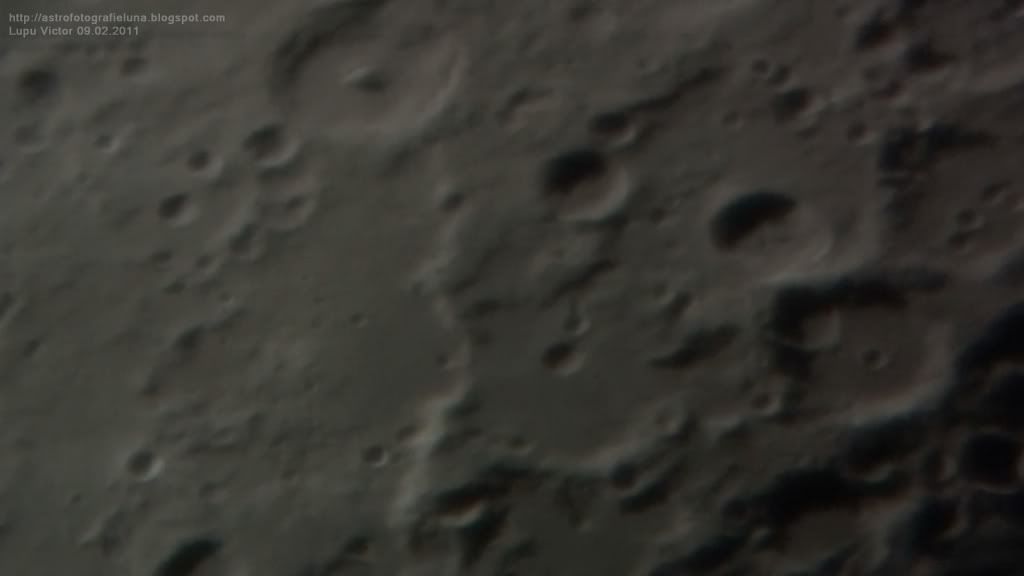
      Craters aligned to the top of the photo from left to right: Rheita E ( elongated), Rheita (70 km.) Metius (88 km.) and Fabricius (78 km.)
       Rheita E, the left and elongated in the picture, has a shape similar to another crater in my opinion ,is about Schiller crater, but Rheita is like in miniature.      Rheita -the next one,is an impact crater located in the south-west of the Moon. . Eastern edge overlaps with Rheita Vallis, a valley stretching over 200 kilometers.


Below is the east surface of the Moon to help localize the craters.

Friday, 12 April 2013

Beautiful large crater Janssen filmed with amateur astronomical telescope

The large crater Janssen (190 km) is filmed in this video through 8-inch astronomical telescope on which I attached a HD camcorder. Clarity is one of the best so far of this crater. The image is inverted as seen through the telescope and I left it so, considering that these are south craters. You would not want to see the lunar craters upside down and not allowing you to notice the complexity of the crater in all its splendor.

Note the deep arched line on the floor of Janssen, called Rima Janssen. Do not confuse Janssen crater with a small crater named Jansen with a single "s", which is located southeast of the crater Plinius, on Mare Tranquillitatis.

Note also the margins of this crater, affected by numerous subsequent impacts. Crater Fabricius (78 km), and Fabricius A, are inside of Janssen, and these two forms its eastern edge. Stuck byFabricius, it is old crater, Metius (88 km), because the eastern edge of Fabricius, is superimposed over that of Metius.

In this area there were not organized Apollo missions, probably because the affected land which is dangerous for a safe landing. If you see where Apollo missions took place, you will find that they were held on low depressions, near, or on large basins called "mare".

   Janssen, with a diameter of 190 km, and 2.9 km in depth, competes with Clavius​​, which has a diameter of 225 km, and a depth of 3.5 km, situated also on the southern Moon.


Optics: CelestronC8 "-Newtonian telescope, plossl20mm, 2x Barlow
Mount: CG5 (EQ5) motorized
Device: Sony CX-130
Video mode: Full HD progressive 1920x1080
Filter: no
Date: 31/12/2012
Location: Baia Mare, Romania
Processing and editing: Sony Vegas 10

Tuesday, 22 March 2016

Craters on the Moon Astro Images: Rheita and Metius.

It is difficult for the camera to capture moonscape when the sun is at a wide angle, but I chose meticulously several relevant sequences, in which the craters of this south-west area are clearer.

On Rheita crater (70 km), we can observe some important features, one being the central peak. To the south is superimposed over a valley 200 km long, called Vallis Rheita.
In the area where the valley ends, is crater Young.

Northeast of Rheita, an unusual crater is visible, with an elongated shape that reminds us of Schiller crater on the south-west of the Moon. This is a satellite crater called Rheita E (66x32 km).

Metius (88 km), is stuck to Fabricius (78 km), which is framed by huge crater Janssen (190 km).

Fabricius is interesting because the interior floor and wall are special. On the floor there is a mountainous formation located centrally and on the eastern side there is a beautiful arched mountainous belt that creates the impression that Fabricius has a double border to the east.


Magnitude: -10.82
Phase: 0.46
Distance: 399.283 km
Illuminated: 45.6% (0% = New, 100% = Full)


Astronomical instrument: Celestron C8-Newtonian telescope,
Eyepiece: Plossl 20mm, 2x Barlow
Mount: CG5 (EQ5)
Camera: Sony CX130
Filter: no
Date: 30.01.2012
Location: Baia Mare, Romania
Processing: FastStone Image Viewer


In the picture below are labeled craters and other lunar features in the region. To better understand this photo, you should note that the label with the name or the letter of larger craters could be found at their center, and on the small craters, you should find them around them, usually above.


Saturday, 5 March 2011

Moon craters - astronomy pictures through telescope

All these pictures are made on 09.02.2011 and I decided to post all of them in a single article
Piccolomini crater (88 km.) in the center pf the photo,and Rupes Altai is the rim that goes down below the crater.(photo above and below)
Apianus G is in the center.Above Apianus G, on right is Apianus (63 km),and on left is Playfair (48 km.)
Aliacensis (80 km.) is on the right of picture,and Werner (70 km.) below it.
Aristoteles (87 km.)-the bigest one, and Euxodus (67 km.)-below.
Hommel and Pitiscus craters-are on center-lower of the photo above
Craters aligned from left to right: Rheita E (the elonged one),Rheita(70 km.),Metius (88 km.) and Fabricius (78 km.)
Crater Janssen (190 km.)-the big one on the left-down,Vlacq (89 km.) and Rosenberger (96 km.) on right
The two craters combined in the center are Watt (66 km.) and Steinheil (67 km.) below it.
Barocius (82 km.) on right-center.Under, is in shadow, Maurolycus (114 km.)
Rupes Altai is the mountain chain-up from left to right.On the right in photo is Zagut (84 km.)
Dalambre Crater (52 km.) which is in the center, beneath is Taylor A and Taylor (41x34 km.)
On the Mare Tranquillitatis are Plinius crater (43 km.) is in left-center, Ross (26 km.) south-east of Plinus, and Arago at the bottom left.

Photographer: Victor Lupu
Optics: Celestron C8-Newtonian reflector telescope, plossl 20mm, 2x Barlow
Mount: CG5 (EQ5)
Device: Sony HDR CX105
Filter: No
Date: 09/02/2011
Location: Baia Mare, Romania
Processing: Sony Vegas 10 Registax

 
All images are © Copyright 2010-2015 Lupu Victor. All rights reserved.Images may not be reproduced, published, or copied in any form without written permission of the author. Thank you for respecting the intellectual property rights. ASTROFOTOGRAFIA | Lupu Victor Astronomy - Contact - About
Design by Free WordPress Themes | Bloggerized by Lasantha - Premium Blogger Themes | Online Project management