Visit Worldwide Topsites
Showing posts with label Craters-Piccolomini. Show all posts

Sunday, 3 July 2016

Piccolomini. Craters on the Moon through a telescope.

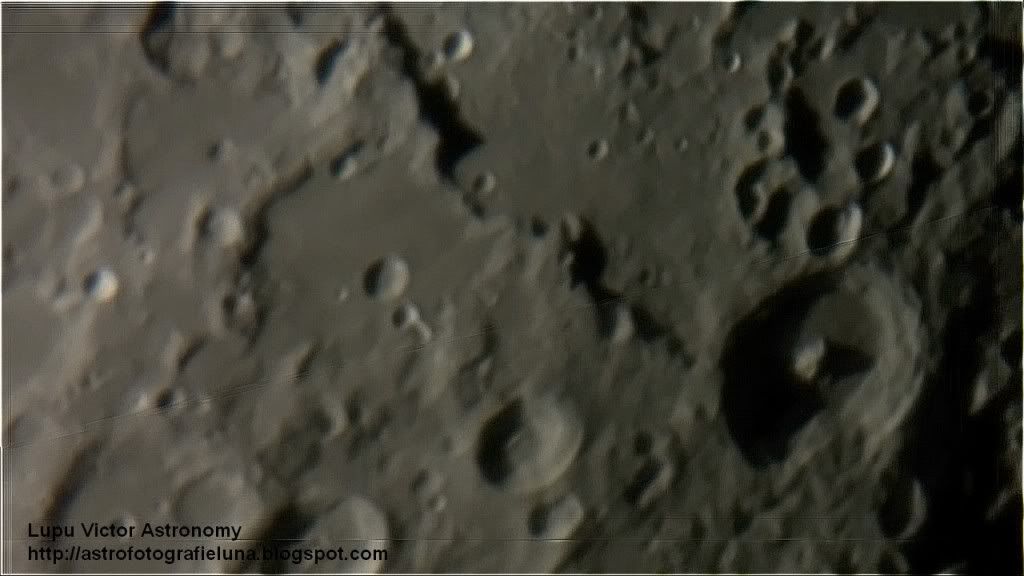
Piccolomini (88 km) crater is interesting because it is overlapped on Rupes Altai wall, which is the second belt formed by the impact that resulted Mare Nectaris basin. This wall is more pronounced from the western edge of Piccolomini. North of the crater, are starting several small ones: Piccolomini M (23 km), D (17 km), E (18 km) and C (26 km) and on south west is adjacent to the crater Rothmann.

Piccolomini has multiple central peaks on its floor which is smooth. The inner wall extends south to the center of the crater due to the angle that hit the object which formed it.


Magnitude: -10.82
Phase: 0.46
Distance: 399.283 km
Illuminated: 45.6% (0% = New, 100% = Full)


Astronomical instrument: Celestron C8-Newtonian telescope,
Eyepiece: Plossl 20mm, 2x Barlow
Mount: CG5 (EQ5)
Camera: Sony CX130
Filter: no
Date: 30.01.2012
Location: Baia Mare, Romania
Processing: FastStone Image Viewer


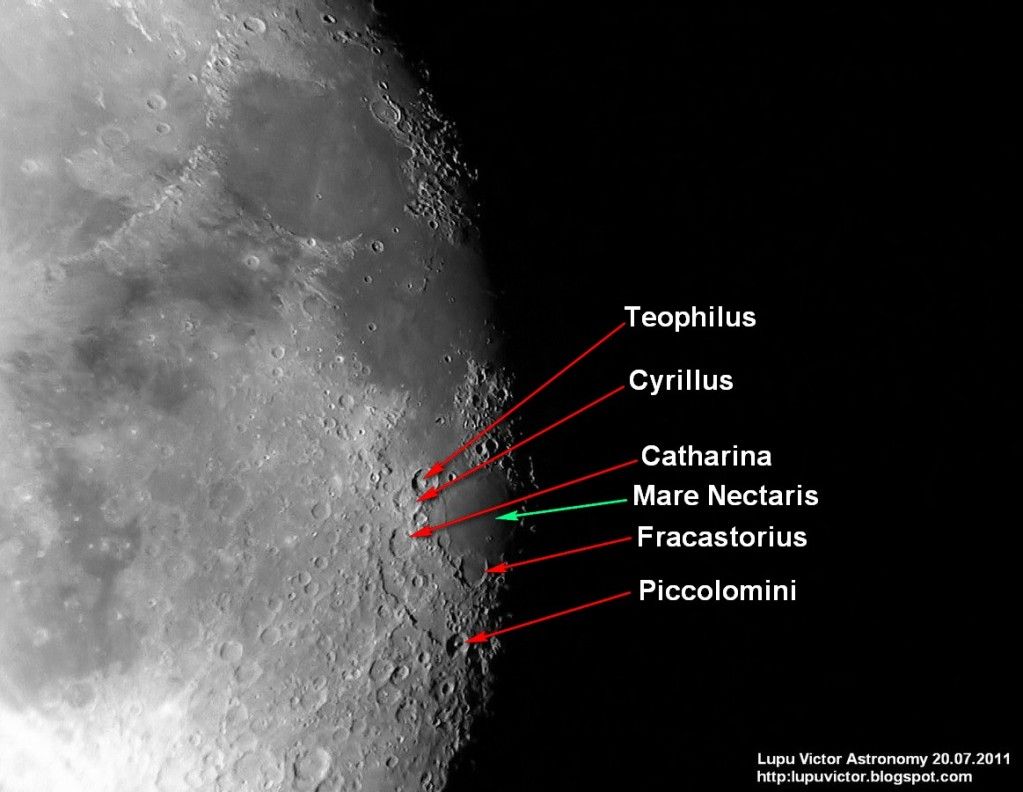
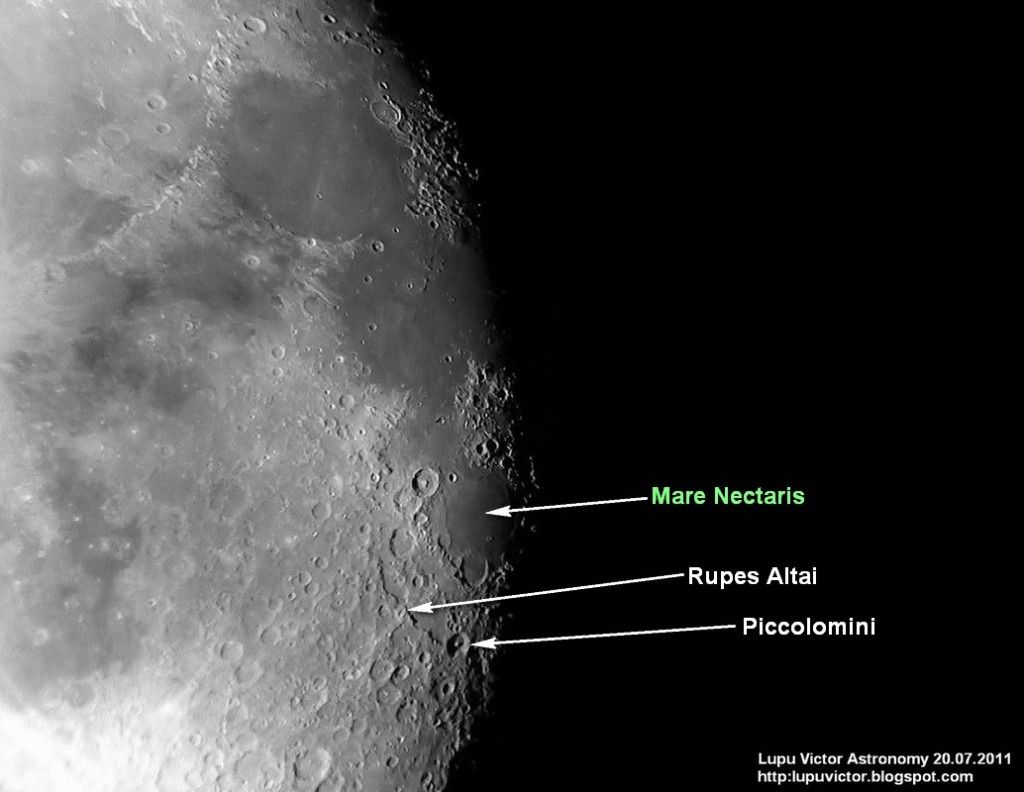
In the picture below are labeled craters and other lunar features in the region. To better understand this photo, you should note that the label with the name or the letter of larger craters could be found at their center, and on the small craters, you should find them around them, usually above.


Tuesday, 10 December 2013

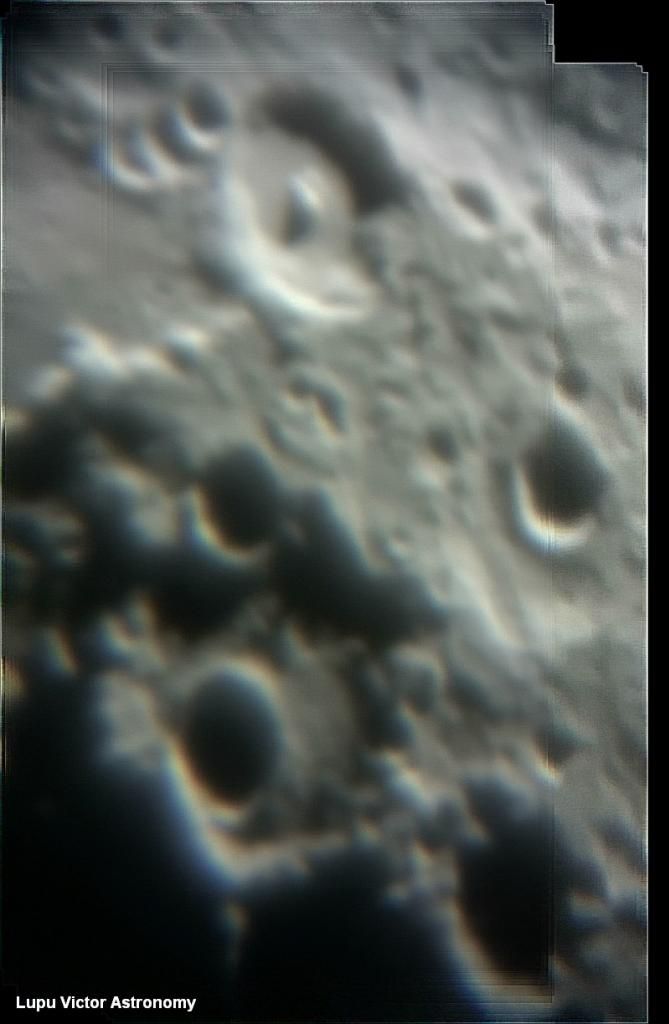
Piccolomini lunar crater reprocessed


22 frames, 95% best quality in Registax.

I have presented these images in another article but not processed in Registax. Those were only video capture.
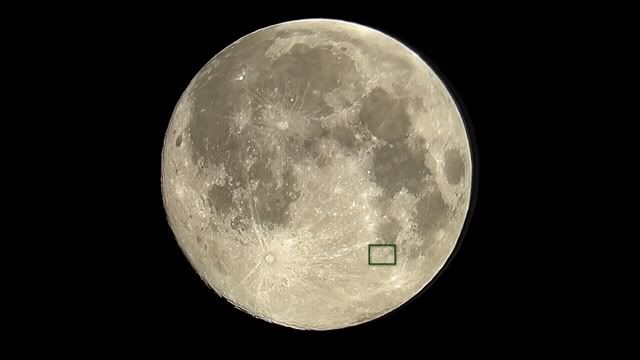
The area discussed here, is the south-east of the Moon
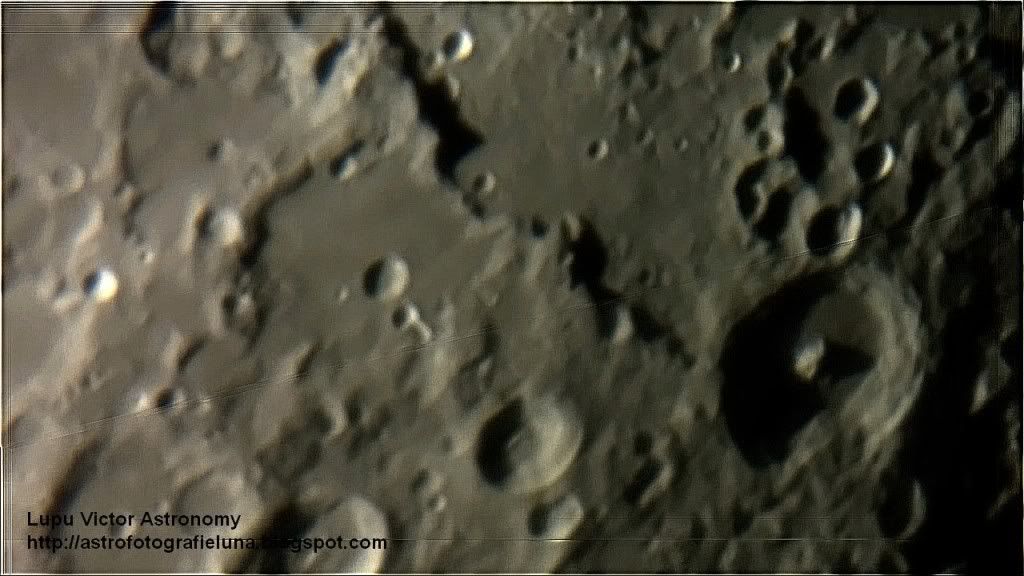
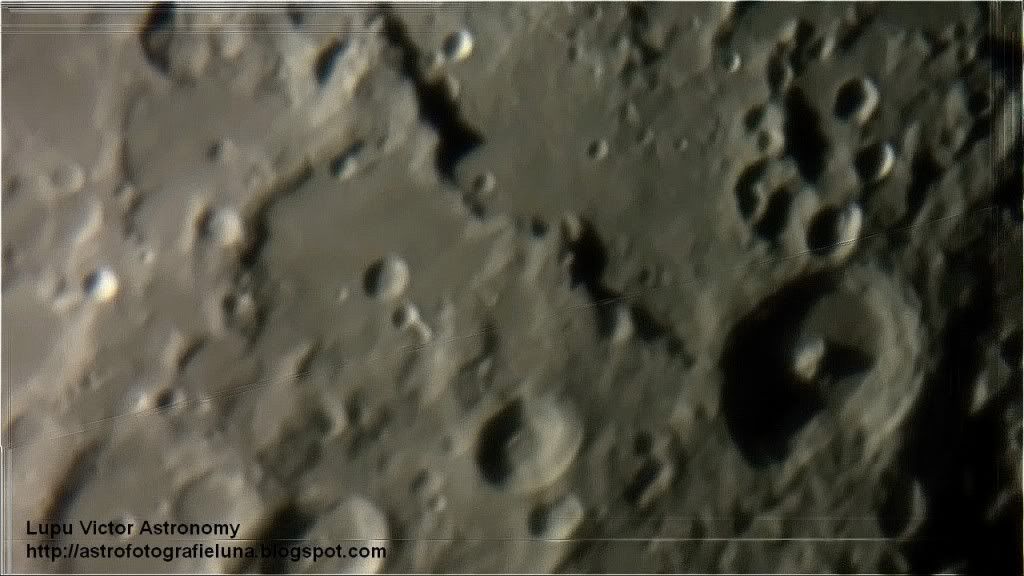
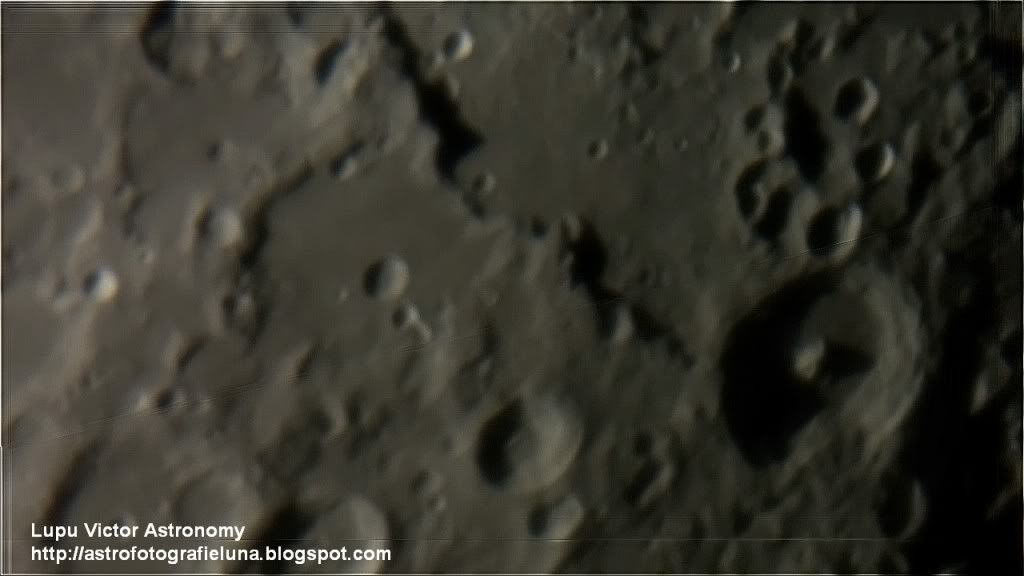
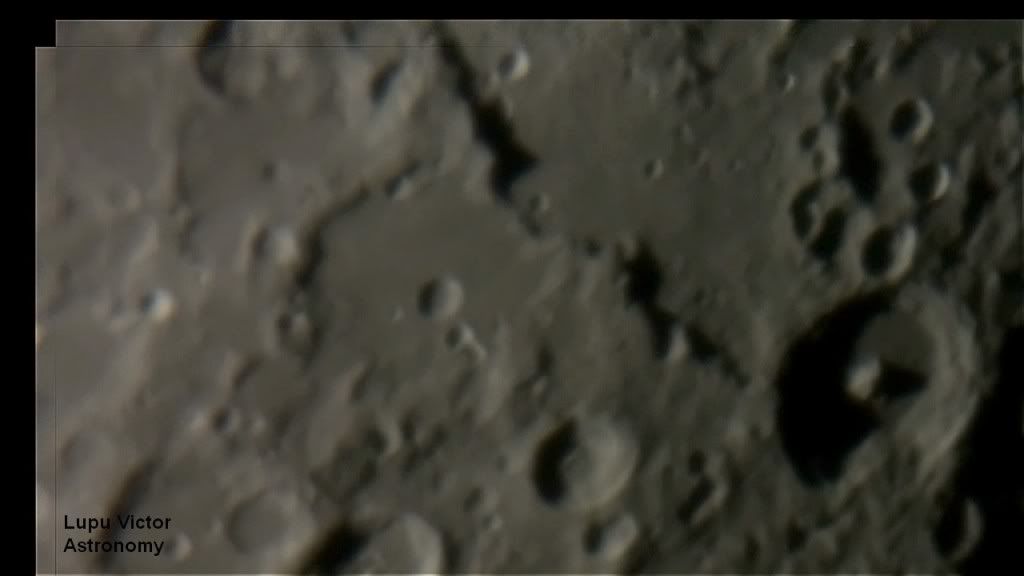
  The crater at the top of the image, is called Piccolomini (88 km) and from the western edge it starts a long "border" called Rupes Altai.

  Piccolomini's central peak is visible here and we can figure out how deep is this circular crater with terraced inner edges.
The advantage to this phase of the Moon, is that you can easily see the elevations by shadows projected onto the lunar terrain.
  Southwest of Piccolomini, two craters are filled by dark completely, one smaller and one larger Rothmann (42 km) and Lindenau (53 km). These two are framed by another crater, in my opinion, but it has no name. In these conditions with the Sun at a low angle, it is clear that this is an eroded and older crater than the others.

Age of the Moon: 27.32 days
Distance: 381.700 km
Phase: 88.8% (0% = New, 100% = full)

Optics: Celestron C8-Newtonian telescope, Plossl 20 mm, 2x Barlow
Mount: CG5 (EQ5)
Camera: Sony CX130
Filter: no
Date: 26/09/2012
Location: Baia Mare, Romania
Processing: Registax, FastStone Image Viewer


Sunday, 10 March 2013

Tycho's rays Piccolomini and Rupes Altai. Pictures by astronomical telescope


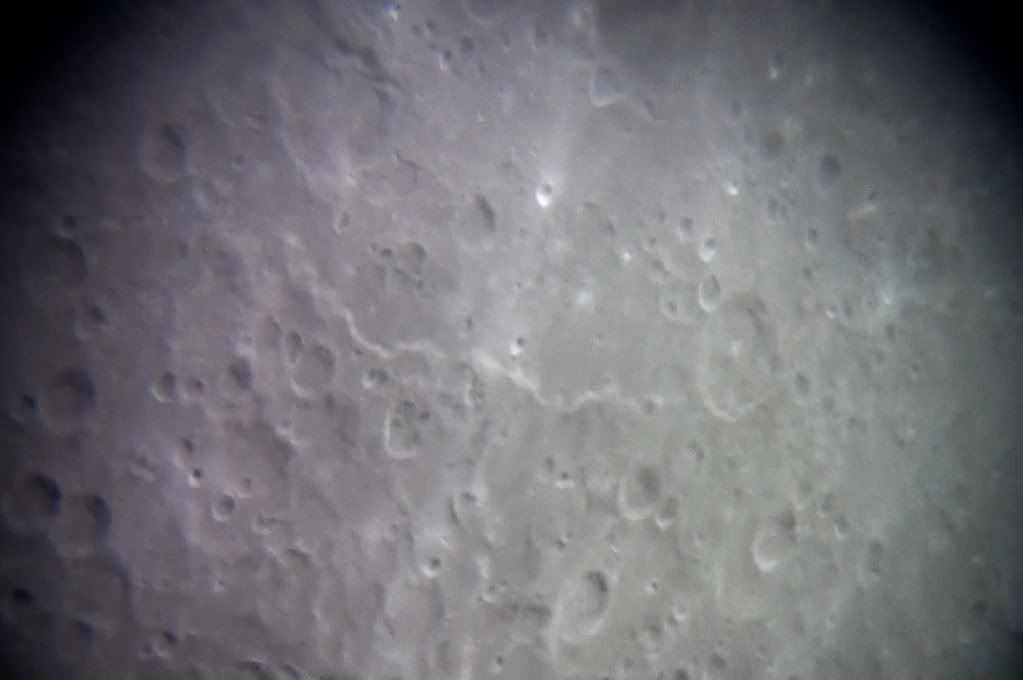
In this article, I"ll give an example of how important is the phase of the Moon and how different looks the lunar landscape at just two days apart. In the photos above, the Moon was illuminated by the Sun 51%, more light than two days ago, when it was lit 32%.

At 51%, are observed other features of the Moon, such as the albedo which is spread on the surface of different craters, and, (see a long band of albedo crossing the Rupes Altai reaching Mare Nectaris). This is a ray of the crater Tycho, which is just 1123 km from Piccolomini.

Moon age: 7 days
Stage: 51% (0% = New, 100% = Full)
Distance: 384.488 km


Optics: Celestron C8-Newtonian telescope, 20mm Plössl, 2x barlow
Mount: CG5 (EQ5)
Camera: Sony CX130
Filter: no
Date: 29/04/2012
Location: Baia Mare, Romania
Processing: video captures, FastStone Image Viewer


Saturday, 17 November 2012

Photos by telescope Craters around Nectaris basin


Piccolomini, Rupes Altai, Janssen, Theophilus, Cyrillus, Catharina, Fracastorius, are just some of the features around Mare Nectaris, visible in these video caprtures.

Abulfeda and Almanon craters are in the dark in these images, and just inside the western edges are lit by the sun.
Mare Nectaris (Sea of Nectar), is dating back 3.9 billion years, framed by several rings of lava formed after the impact. It is a small, well-defined circular basin with an affected southern edge forming a large bay, Fracastorius crater (124 km). Mare Nectaris joins Sinus Asperitatis north.

Rupes Altai is 480 kilometers long, with somewhat a sinuous wall along much of its length. Is parallel to the southwestern border of Mare Nectaris, and actually forms a part of the external ring of Nectaris basin.


Optics: Celestron C8-Newtonian telescope, 20 mm Plössl, 2x barlow
Mount: CG5 (EQ5)
Camera: Sony CX130
Filter: no
Date: 04/27/2012
Location: Baia Mare, Romania
Processing: video capture, FastStone Image Viewer


Wednesday, 15 August 2012

Piccolomini and Rupes Altai on the Moon (Images through telescope)


Piccolomini (88 km), was considered to be a crater of Imbrian era. This crater is superimposed on Rupes Altai mountains at their end, and secondary craters from the Nectaris basin.

In these pictures you can see the crater Piccolomini, and to notice its massive walls and massive peak located centrally.The peak, rises to a height of 2.0 km above the surrounding floor.
Note the southern region of the Piccolomini which has a pinch. This pinch may be an influx of material entered on the south, which flowed down to the bottom. Other important characteristics than the central mountain are not seen on the floor. This magnificent crater is most noticeable at 5 days after New Moon.
Piccolomini has a depth of 4.5 km. and has formed about 3,200,000,000 to 3,800,000,000 years ago.


Photographer: Victor Lupu
Optics: Celestron C8-inch reflector telescope-Newtonian, plossl 20mm, 2x Barlow
Mount: CG5 (EQ5)
Camera: Sony HDR CX105 to 8x optical zoom
total magnification: 800x

Filter: No
Date: 20/07/2011
Location: Baia Mare, Romania
Processing: Video Captures


Thursday, 19 July 2012

Face on Mars? How about man with diving goggles on the Moon?

Man with glasses on the Moon. Have you seen it? In the video below, diving goggles are represented by two craters in darkness: Rothmann (42 km, smaller, right), and Lindenau (53 km, bigger, on the left). Below, seems to distinguish a smile-shaped mouth, small in comparison with the eyes, and on the corners are like some cheeks. The nose is a hollow place.

There is not something mysterious, not a 'face on Moon' showing that was made by aliens. It's just pure coincidence, in which I filmed the Moon when it reached a certain stage; the Moon's relief shadows formed this illusion. That figure could inspire creators of cartoons.
 The image is inverted as seen through the telescope. Craters in question are located on the edge of Rupes Altai mountain string which in video are on the left, and ends with the crater Piccolomini.


Video: Victor Lupu
Optics: CelestronC8 "-Newtonian telescope, plossl20mm, 2x Barlow
Mount: CG5 (EQ5)
Device: Sony CX-130
Video mode: Full HD progressive 1920x1080
Filter: no
Date: 27/02/2012
Location: Baia Mare, Romania
Processing and editing: Sony Vegas 10

Saturday, 16 June 2012

Astronomy Video by telescope Rupes Recta and Janssen on the Moon

This is a video with stabilized images in Sony Vegas. It shows craters on the southeast of our Moon, and Rupes Altai, surrounding the southeast of Mare Nectaris basin. Rupes Altai appears in the first part of the video, on right. It is the long border, ending below with the crater Piccolomini (88km).

Known as Altai scrap, it is a mountain formation that is clearly defined in the southeast quadrant of the Moon. It is a remnant of concentric rings around the Nectaris basin, and forms the southwestern edge of it.

Above Rupes Altai passes an ejected ray of albedo from the impact that created Tycho crater, and reaches the Mare Nectaris plateau.
From 1:49 minute, in images appears the large crater Janssen (190 km) which is centrally located in images. The atmosphere was clear and the details of the lunar soil are visible.
Other craters visible in the video are Lindau (53 km) and Rothman (42 km).


Video: Victor Lupu
Optics: CelestronC8 "-Newtonian telescope, plossl20mm, 2x Barlow
Mount: CG5 (EQ5)
Device: Sony CX-130
Video mode: Full HD progressive 1920x1080
Filter: no
Date: 27/04/2012
Location: Baia Mare, Romania
Processing and editing: Sony Vegas 10


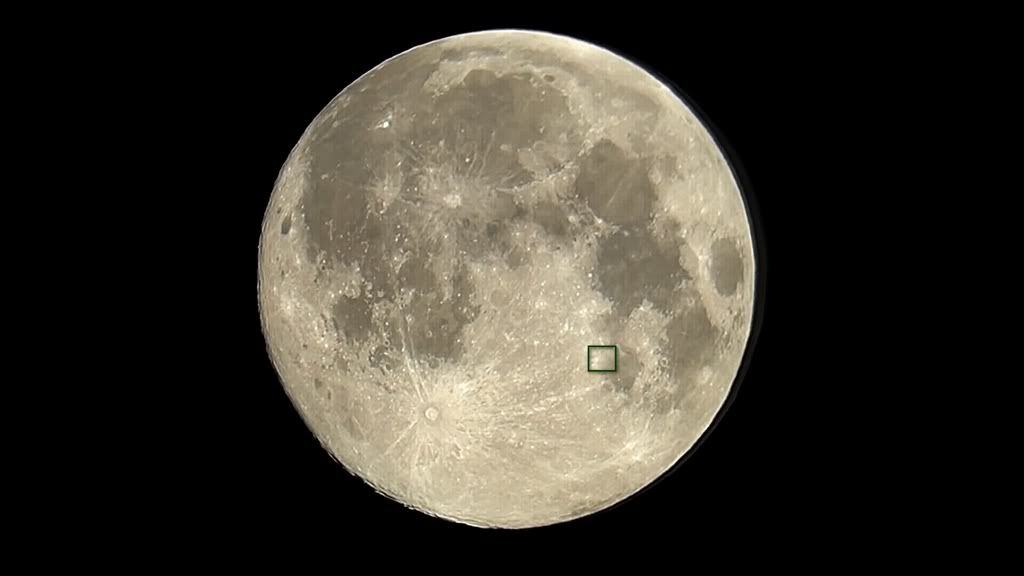
Above: Date: 5/11/2011. Picture for guidance.

Saturday, 17 March 2012

Video by astronomical telescope crater Piccolomini and Rupes Altai Observational astronomy

In this video through telescope, are observed crater Piccolomini and Rupes Altai. Processing in Registax 5, was presented in the article: Registax: Piccolomini Rupes Altai Pictures by astronomical telescope .

Rupes Altai is a mountain range about 507 km long. Are difficult to locate when is Full Moon, when the sun is almost over it, but five days after New Moon, it comes out like a irregular long shadow, when sunlight is at a low angle.

In this video, is not filmed the entirely lenght of Rupes Altai, because they stretch further to the north-west, ending near the western crater Catharina.

 Crater Piccolomini, here is almost half in the dark; the floor of the west is in shadow. This perfectly round crater, has a portion on the the south which gives the impression that a landslide took place inside the crater. Central peak is very bright and shadow projected by the western wall, arrives right to the base of this central mountain on the center, which has a height of 2 km.

Above Piccolomini are seen gathered several smaller craters, forming a semicircle. They are Piccolomini C, M, D, and E.


Video: Victor Lupu
Optics: CelestronC8 "-Newtonian telescope, plossl20mm, 2x Barlow
Mount: CG5 (EQ5)
Device: SonyCX105 at 7x optical zoom
Total Magnification: 700x
Filter: no
Date: 20/07/2011
Location: Baia Mare, Romania
Processing and editing: Sony Vegas 10

Thursday, 15 March 2012

Registax: Piccolomini Rupes Altai Pictures by astronomical telescope


Figure 1 to 4: 30 frames, 85% lowest quality.
Figure 5: 2 frames, 100% lowest quality.

These are images processed in Registax, and shows the crater Piccolomini and Rupes Altai, which is a 'border' that starts from the crater. At this angle, sunlight is perfect to highlight the central peaks of Piccolomini, and the depth of 4.5 km, and Rupes Altai, which is actually the second edge of a large crater surrounding Mare Nectaris.

For the video of these images, see this: Video by astronomical telescope crater Piccolomini and Rupes Altai Observational astronomy .
Photographer: Victor Lupu
Optics: Celestron C8-inch reflector telescope-Newtonian, plossl 20mm, 2x Barlow
Mount: CG5 (EQ5)
Camera: Sony HDR CX105 to 8x optical zoom
Total Magnification: 800x
Filter: No
Date: 20/07/2011
Location: Baia Mare, Romania
Processing: Registax


Above: Date: 5/11/2011. Picture for guidance.

Saturday, 12 November 2011

Rupes Altai-telescope images, description

Photographer: Victor Lupu
Optics: Celestron C8-Newtonian telescope, plossl 20mm, 2x Barlow
Mount: CG5 (EQ5)
Device: Sony CX105 to 7x zoom Oprica
Total Magnification: 700x
Filter: no
Date: 11/05/2011
Location: Baia Mare, Romania
Processing: Sony Vegas 10 video capture


        Rupes Altai is the outer ring of the Nectaris basin (Mare Nectaris).
There are many Rupes (mountain rock lines) on the lunar surface. These are remnants of the rims of old craters. Rupes Altai is a mountain range 427 km long.

Rupes Altai ends at the western edge of the crater Piccolomini. It is an irregular region with no terminus clearly defined, and where the craters Theophilus, Cyrillus and Catharina are located. Rupes Altai forms the southwest edge of Nectaris impact basin.

Rupes Altai is difficult to locate during the full Moon when the Sun is almost over these formations. It is best observed when the shade is nearby and sunlight reaches a low angle.


Saturday, 5 March 2011

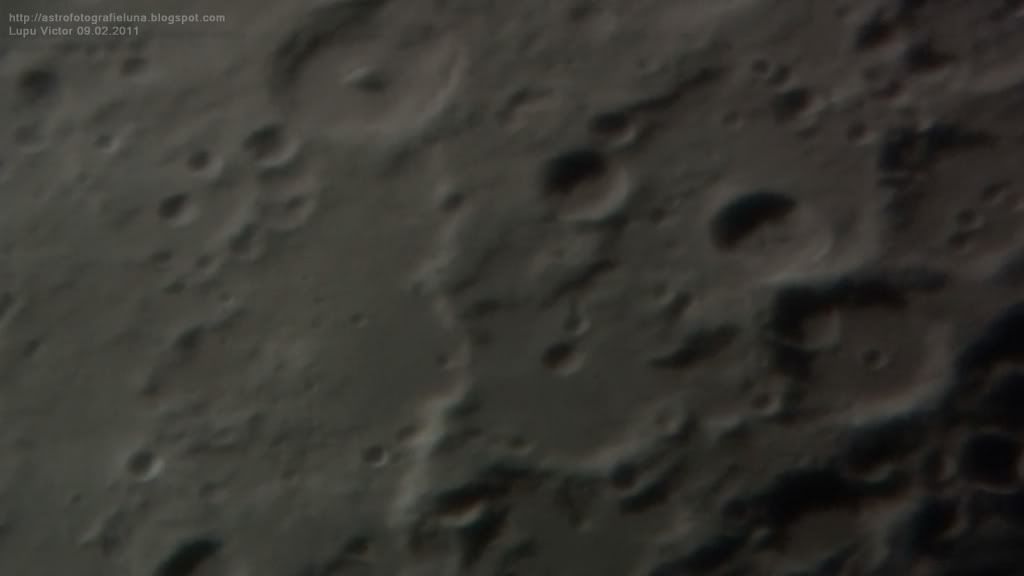
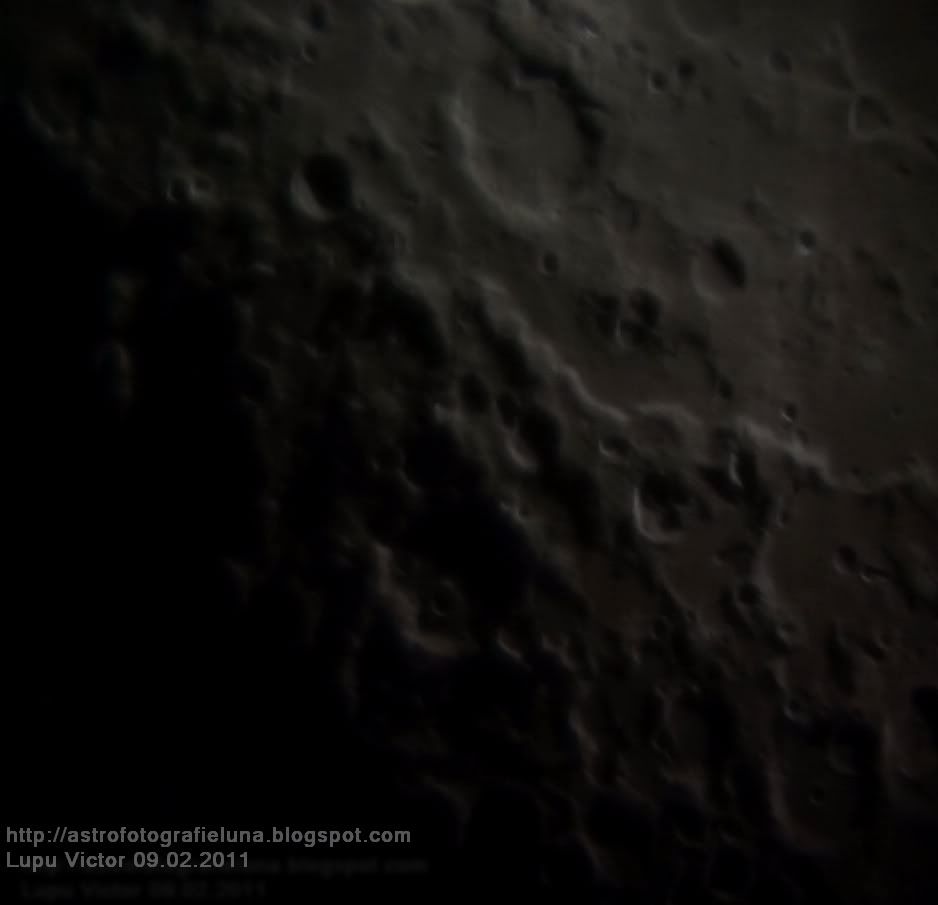
Piccolomini crater and Rupes Altai


Photographer: Victor Lupu
Optics: Celestron C8-Newtonian reflector telescope, plossl 20mm, 2x Barlow
Mount: CG5 (EQ5)
Device: Sony HDR CX105
Filter: No
Date: 09/02/2011
Location: Baia Mare, Romania
Processing: Sony Vegas 10 Registax


Piccolomini -in first photo is in the center, is a lunar crater located on the south-east of the Moon. Rothmann crater lies to the south-est.Rupes Altai starts at the southern of Piccolomini.Piccolomini is 88 km in diameter and 4500 meters deep and has a length of 3.8 - 3.2 billion years.It is named after the 16th  italian bishop and
astronomer Alessandro Piccolomini .
Rupes Altai is located in the southeastern quadrant of the Moon's near side. It is named for the Altai Mountains in Asia and it has a length of about 427 km.
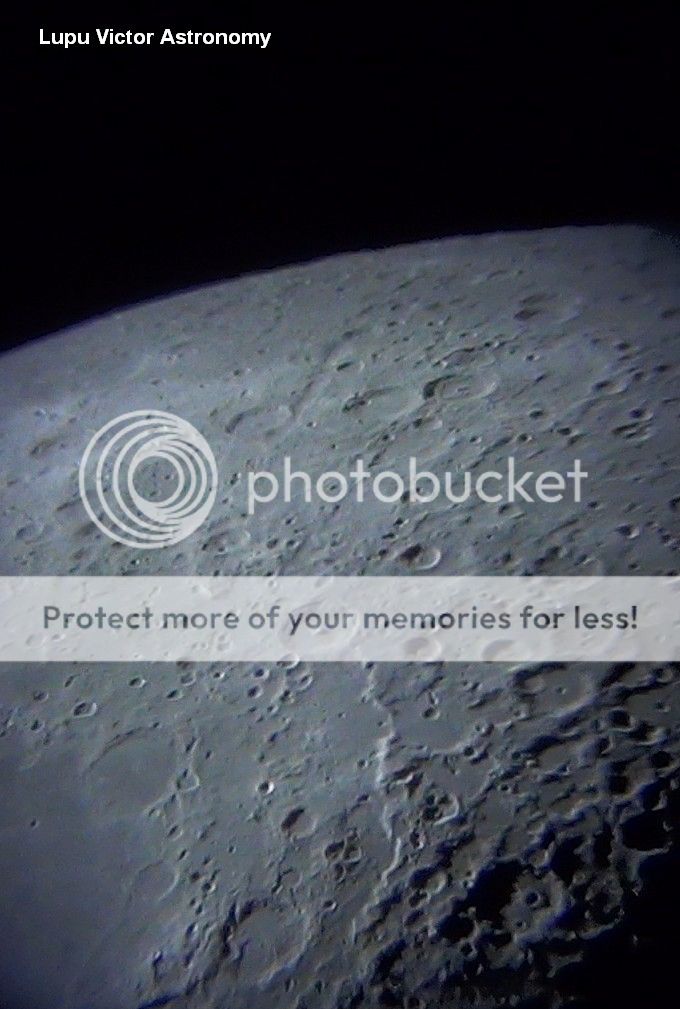
Below is the east of the Moon to help localize the craters.

 
All images are © Copyright 2010-2015 Lupu Victor. All rights reserved.Images may not be reproduced, published, or copied in any form without written permission of the author. Thank you for respecting the intellectual property rights. ASTROFOTOGRAFIA | Lupu Victor Astronomy - Contact - About
Design by Free WordPress Themes | Bloggerized by Lasantha - Premium Blogger Themes | Online Project management