Visit Worldwide Topsites
Showing posts with label Craters-Catharina. Show all posts

Saturday, 17 November 2012

Photos by telescope Craters around Nectaris basin


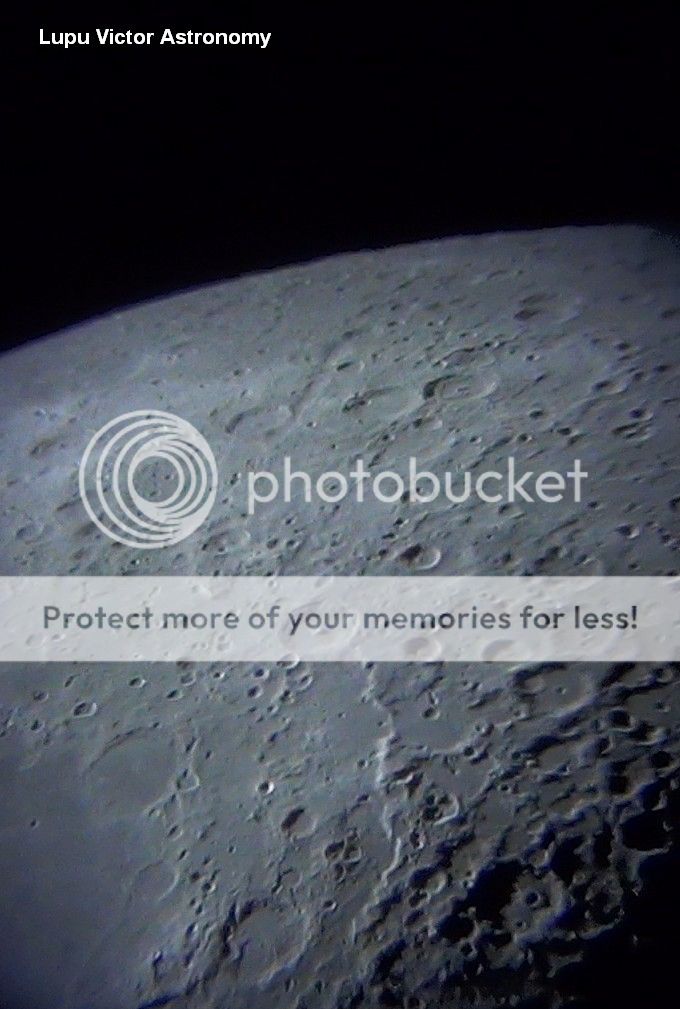
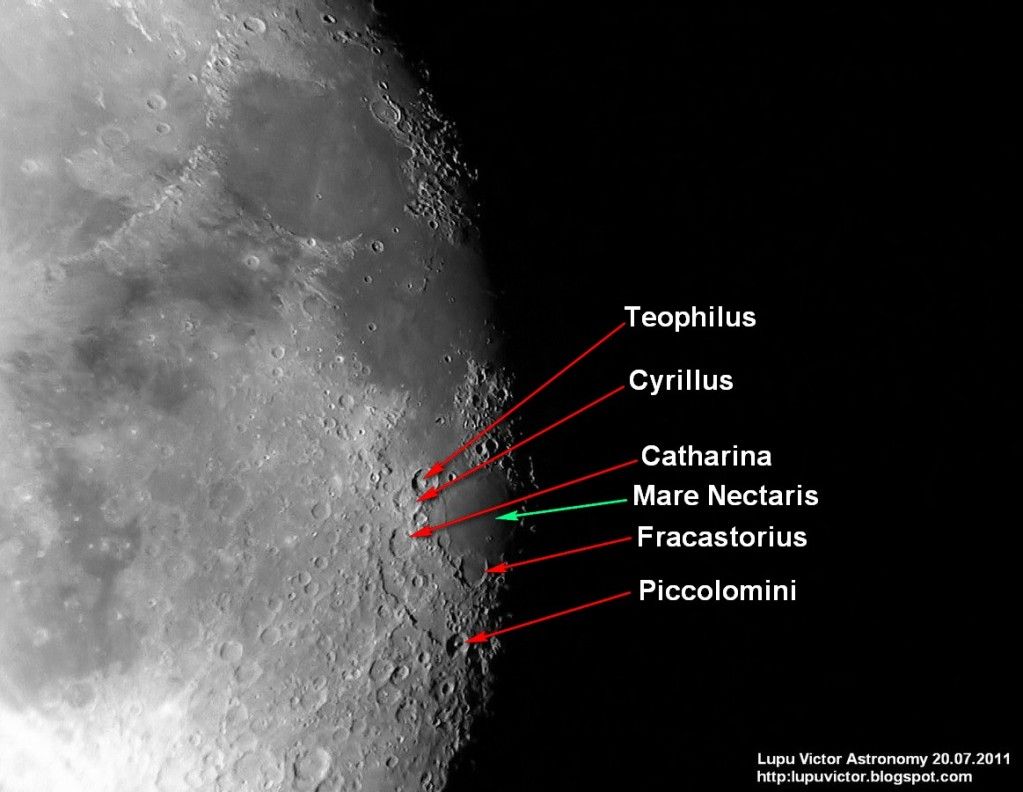
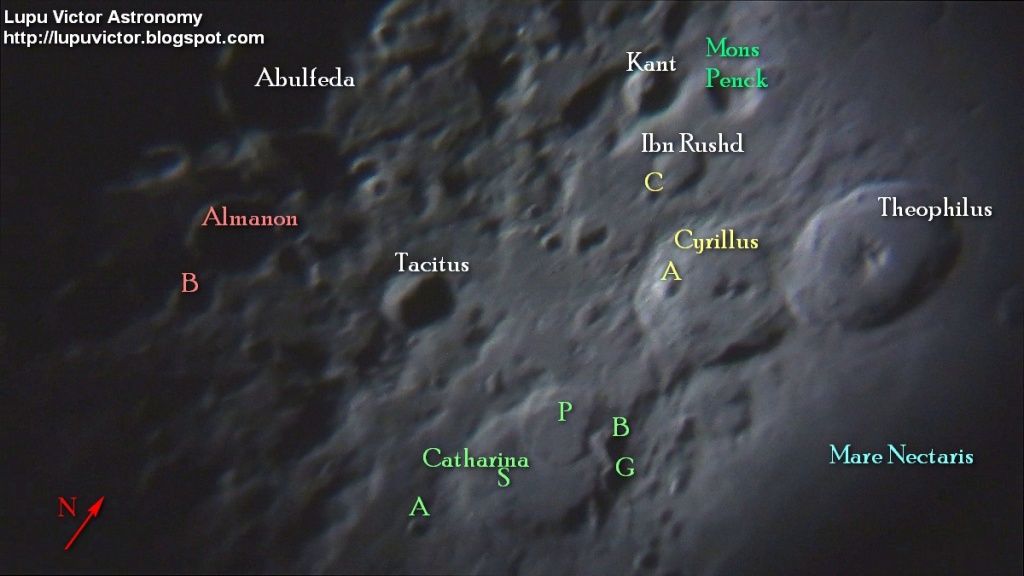
Piccolomini, Rupes Altai, Janssen, Theophilus, Cyrillus, Catharina, Fracastorius, are just some of the features around Mare Nectaris, visible in these video caprtures.

Abulfeda and Almanon craters are in the dark in these images, and just inside the western edges are lit by the sun.
Mare Nectaris (Sea of Nectar), is dating back 3.9 billion years, framed by several rings of lava formed after the impact. It is a small, well-defined circular basin with an affected southern edge forming a large bay, Fracastorius crater (124 km). Mare Nectaris joins Sinus Asperitatis north.

Rupes Altai is 480 kilometers long, with somewhat a sinuous wall along much of its length. Is parallel to the southwestern border of Mare Nectaris, and actually forms a part of the external ring of Nectaris basin.


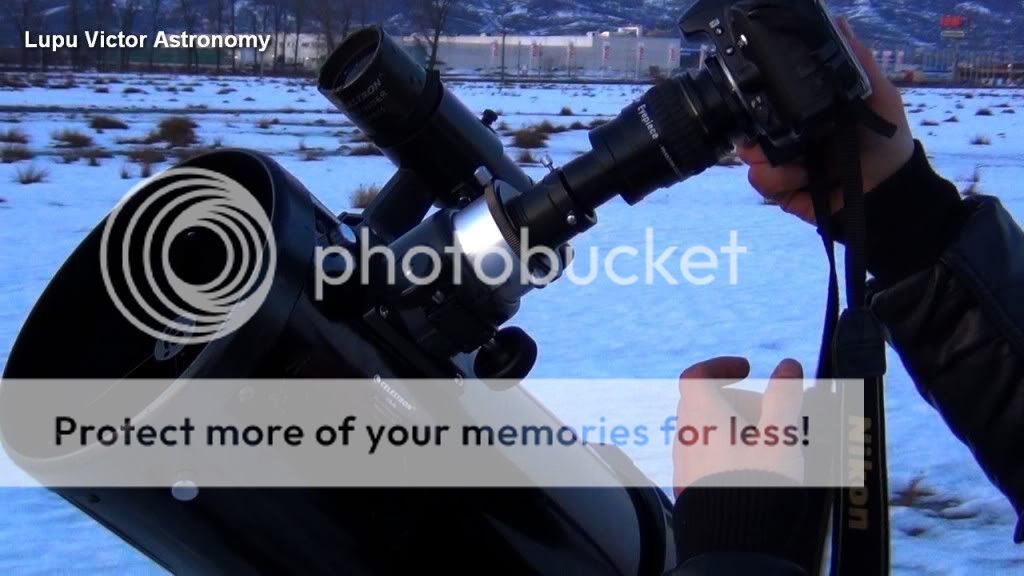
Optics: Celestron C8-Newtonian telescope, 20 mm Plössl, 2x barlow
Mount: CG5 (EQ5)
Camera: Sony CX130
Filter: no
Date: 04/27/2012
Location: Baia Mare, Romania
Processing: video capture, FastStone Image Viewer


Friday, 12 October 2012

Pictures by astronomical telescope Theophilus Cyrillus and Catharina


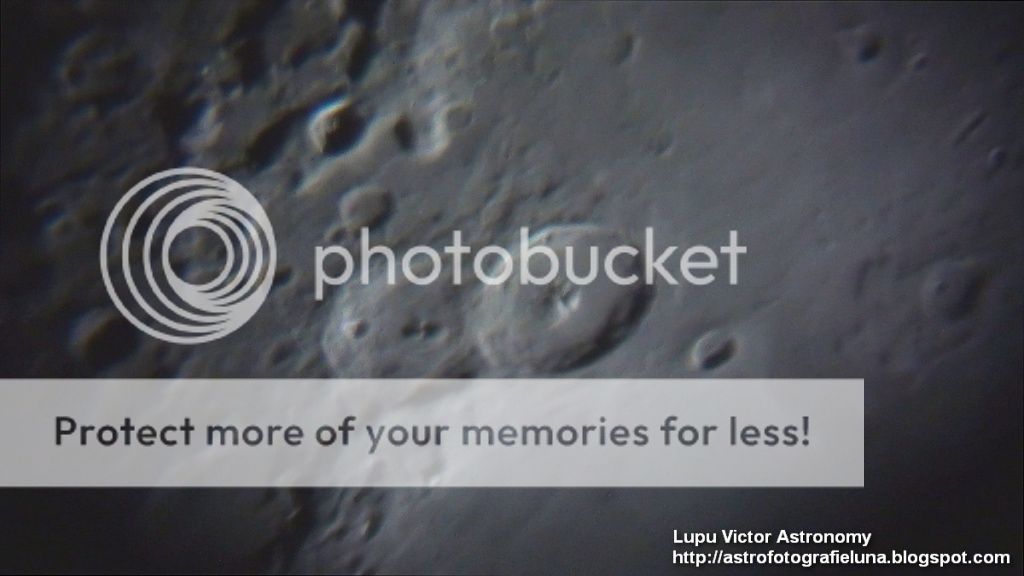
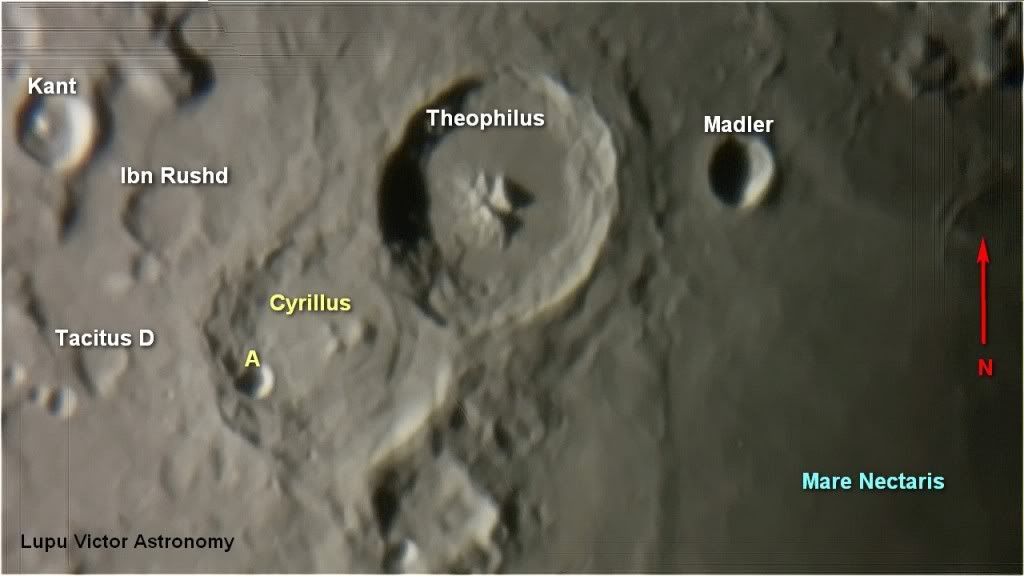
Theophilus (100 km), a deep crater, is visible on the northwest border of Mare Nectaris. Inner walls of the crater, display intricate terraces and a large group of peaks that rise up to 1400 m above the floor. The group of three central peaks are called Theophilus Alpha Phi and Psi.
 Theophilus overlaps Cyrillus (98 km) south-west, which is connected to the crater Catharina (100 km). Together, the trio makes a beautiful landscape under the sun at a low angle. Central peaks of Theophilus are very bright when touched by the sun, unlike Cyrillus and Catharina, whose peaks are harder to identify.
Theophilus is a beautiful structure. Prominent circular edge rises 1,200 m above the Mare Nectaris, situated east. Inside its walls are a complex series of terraces.

Video of the images you can see here: A closer look of lunar craters by telescope (HD Video)

Optics: Celestron C8-Newtonian telescope, 20mm Plössl, 2x barlow
Mount: CG5 (EQ5)
Camera: Sony CX130
Filter: no
Date: 04/27/2012
Location: Baia Mare, Romania
Processing: video capture, FastStone Image Viewer


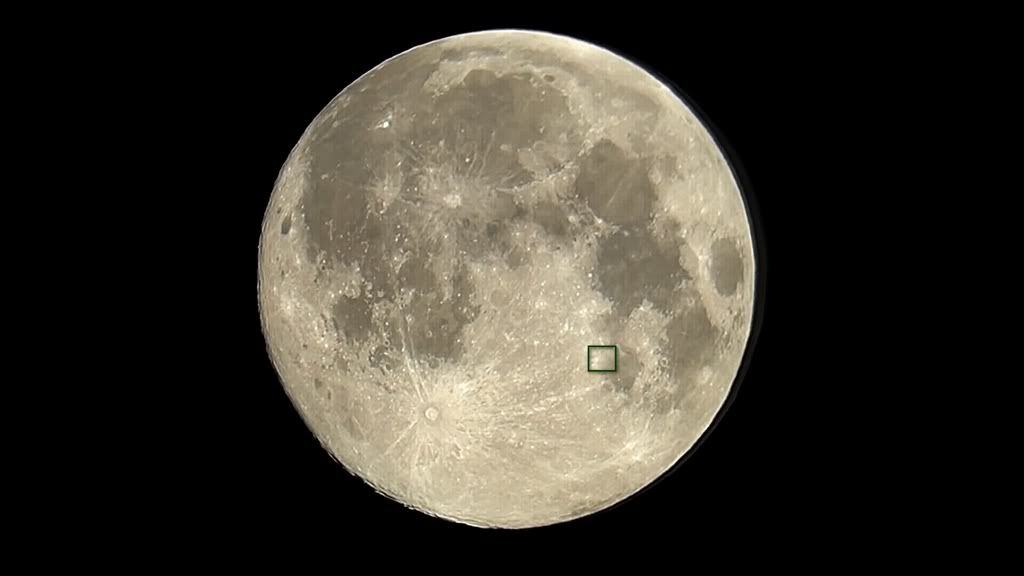
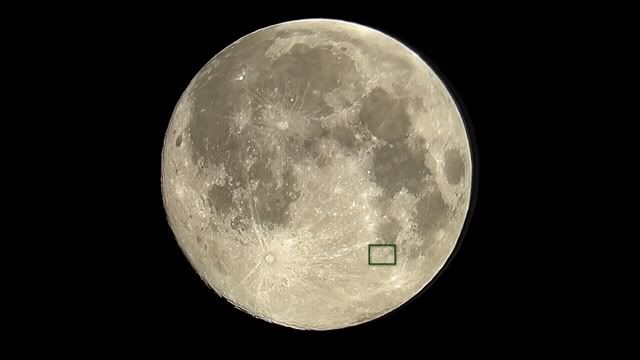
 Image for orientation made ​​on July 20, 2011.

Wednesday, 4 July 2012

A closer look of lunar craters by telescope (HD Video)

On the southeast quadrant of the Moon are interesting features, although it is not a strong cratered area compared with its south pole. The area that makethe subject of this article, is the south-west of Mare Nectaris. Here we find three large craters grouped, about the same size. They are Theophilus (100 km), Cyrillus (98 km) and Catharina (100 km).

Theophilus, shows rays with a lower albedo. In ideal conditions, some of its rays are still visible over Sinus Asperitatis.

Cyrillus crater in the center of the three, is older than Theophilus, which overlaps the eastern wall of Cyrillus, and is much eroded. Notice Cyrillus's two twin central peaks, the degraded walls, and that Theophilus enters into it. Note also the secondary crater Cyrillus A (17 km) on the west wall. Note Mons Penck, nearby crater Ibn Rushd (33 km) and Kant (32 km) north-west, and a third small central peak in the crater Cyrillus .

Catharina is the oldest of the three craters with five small craters in it. Probably dates from pre-Imbrian era because elongated craters on the north-eastare aligned to Mare Imbrium . Note the large crater Catharina P (46 km), within it. Two elongated craters Catharina B (24 km) and G (17 km), are located on the northeast wall. Moon phase at the time was ideal to observe features not seen well in other conditions.

Zollner (46 km). Zöllner crater's edge is irregularly oval in north-south direction. The wall is not high and is worn, such as the distorted depression attached to the southern edge. Floor still retains a narrow central peak. In this video, the crater is almost submerged in shadow. Just the eastern inside wall is illuminated by the sun.


Video: Victor Lupu
Optics: CelestronC8 "-Newtonian telescope, plossl20mm, 2x Barlow
Mount: CG5 (EQ5)
Device: Sony CX-130
Video mode: Full HD progressive 1920x1080
Filter: no
Date: 27/04/2012
Location: Baia Mare, Romania
Processing and editing: Sony Vegas 10


                  Date: 20/07/2011

Saturday, 12 November 2011

Rupes Altai-telescope images, description

Photographer: Victor Lupu
Optics: Celestron C8-Newtonian telescope, plossl 20mm, 2x Barlow
Mount: CG5 (EQ5)
Device: Sony CX105 to 7x zoom Oprica
Total Magnification: 700x
Filter: no
Date: 11/05/2011
Location: Baia Mare, Romania
Processing: Sony Vegas 10 video capture


        Rupes Altai is the outer ring of the Nectaris basin (Mare Nectaris).
There are many Rupes (mountain rock lines) on the lunar surface. These are remnants of the rims of old craters. Rupes Altai is a mountain range 427 km long.

Rupes Altai ends at the western edge of the crater Piccolomini. It is an irregular region with no terminus clearly defined, and where the craters Theophilus, Cyrillus and Catharina are located. Rupes Altai forms the southwest edge of Nectaris impact basin.

Rupes Altai is difficult to locate during the full Moon when the Sun is almost over these formations. It is best observed when the shade is nearby and sunlight reaches a low angle.


Thursday, 11 August 2011

Catharina and Geber lunar craters-images

Photographer: Victor Lupu
Optics: Celestron C8-Newtonian telescope, plossl 20mm, 2x Barlow
Mount: CG5 (EQ5)
Device: Sony CX105
Filter: No
Date: 11/05/2011
Location: Baia Mare, Romania
Processing: Sony Vegas 10 video captures

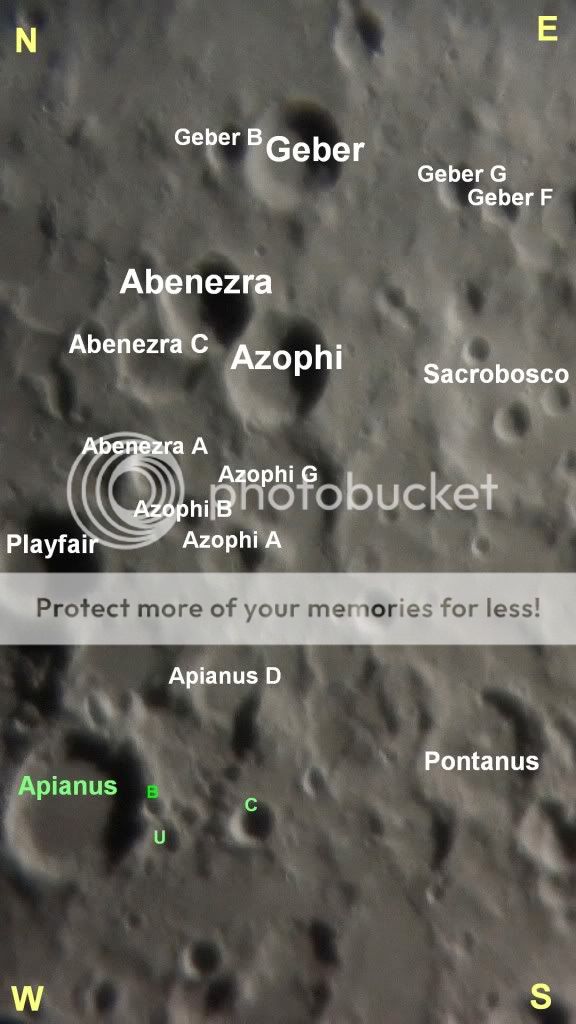
          Catharina (100 km), is a Moon impact crater located in the mountainous south, and is located west between Rupes Altai wich is a steep slope,and Mare Nectaris at east. To the northwest is the Tacitus crater. In the north it borders Cyrillus and Teophillus. Catharina form a prominent group along with the two craters, which are framed by Rupes Altai. There is a difference between the ages of the three craters, their age increasing from north to south.
Catharina's edge is very worn and irregular, especially in the north wall where is Catharina P crater (46 km). Northeast wall is deeply affected by several small craters. The floor is relatively flat with a curved ridge formed by Catharina P.
            Eponymous of this crater is Saint Catherine of Alexandria, also known Holy Great Martyr Catherine, who is a Christian saint and martyr, and is believed to have lived in the early fourth century.
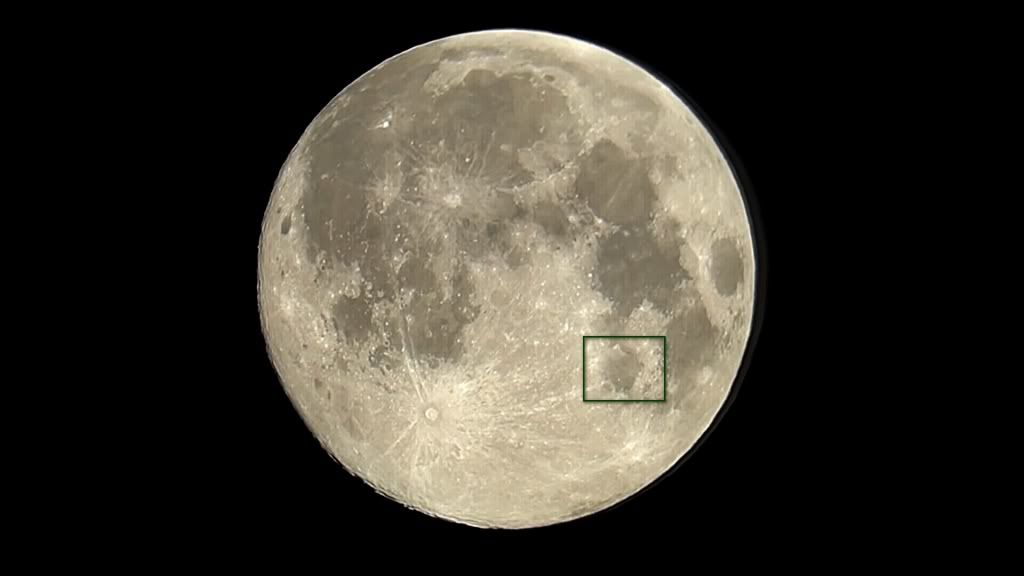
          Geber crater is located halfway between Almanon crater at northeast  and the pair craters Abenezra and Azophi on southwest. Further to the southeast is Sacrobosco. Geber is 45 kilometers in diameter and 3510 meters deep.
The name of the crater comes from Abu Muhammad Jabir ibn Aflaḥ or Geber / Gebir (1100-1150), the Muslim astronomer and mathematician of Seville.

Wednesday, 23 February 2011

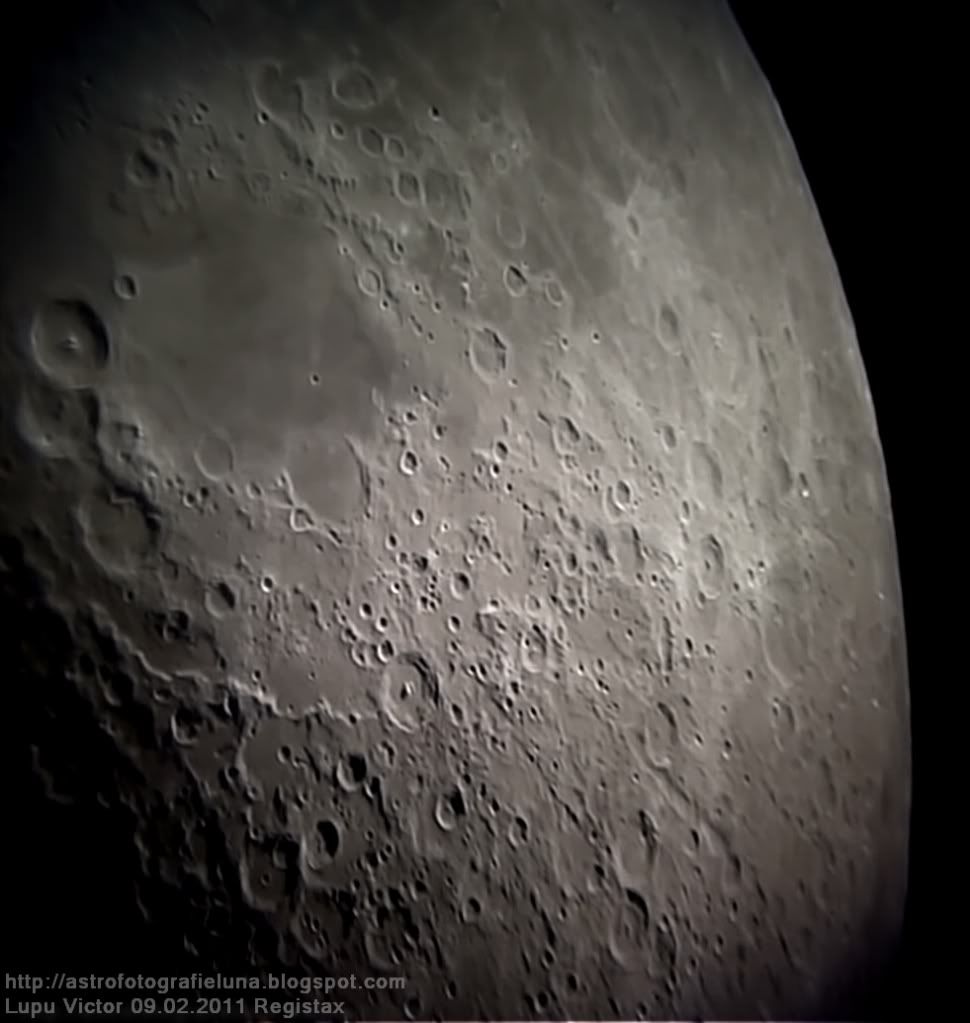
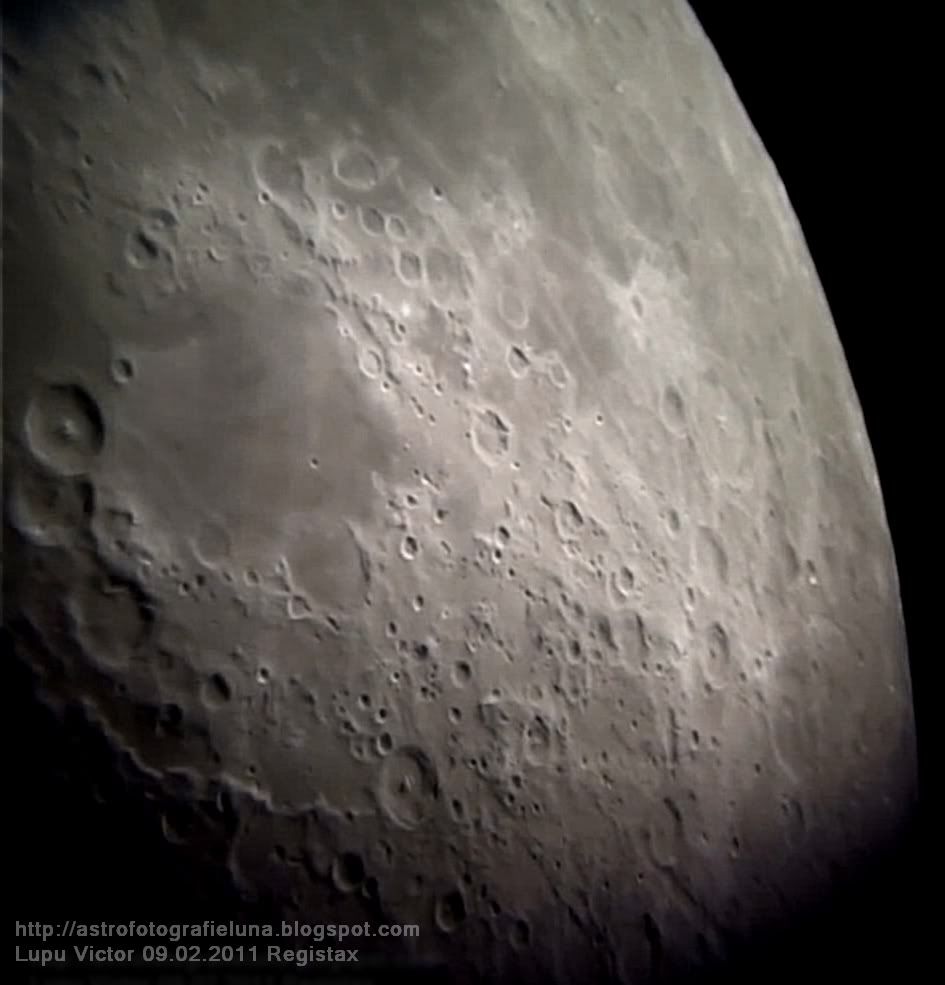
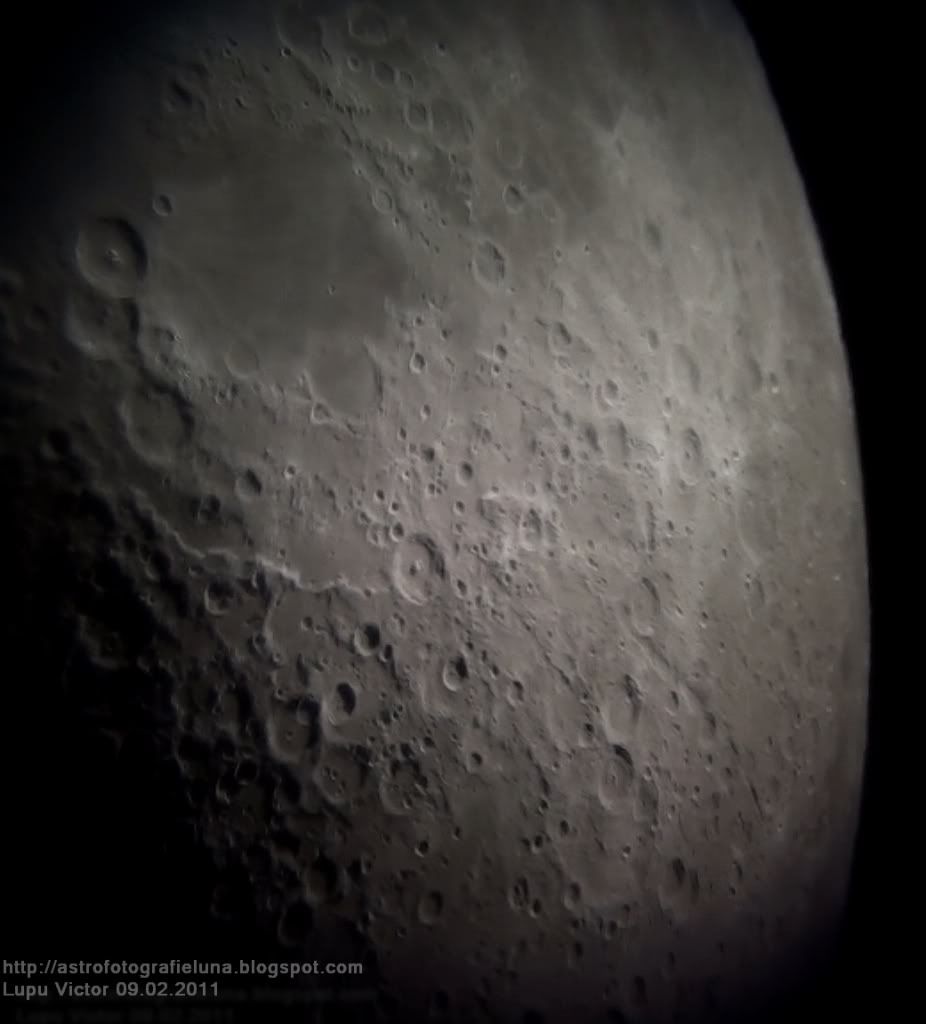
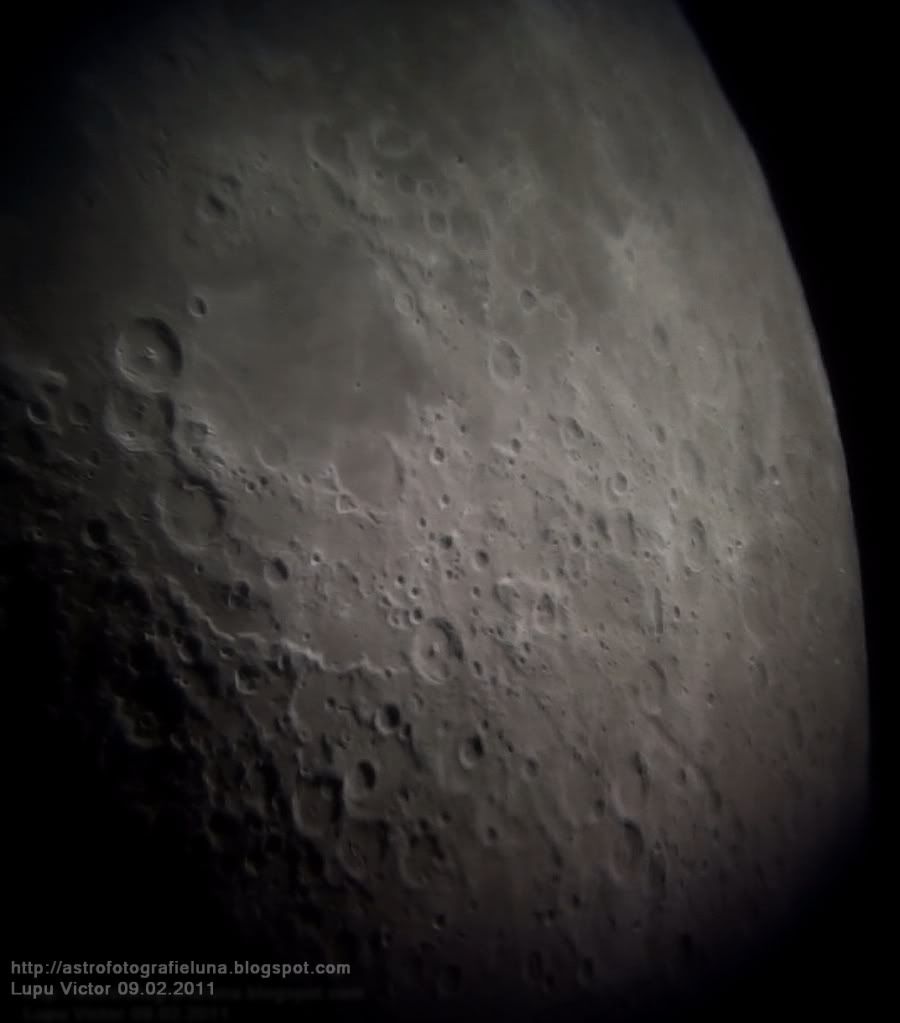
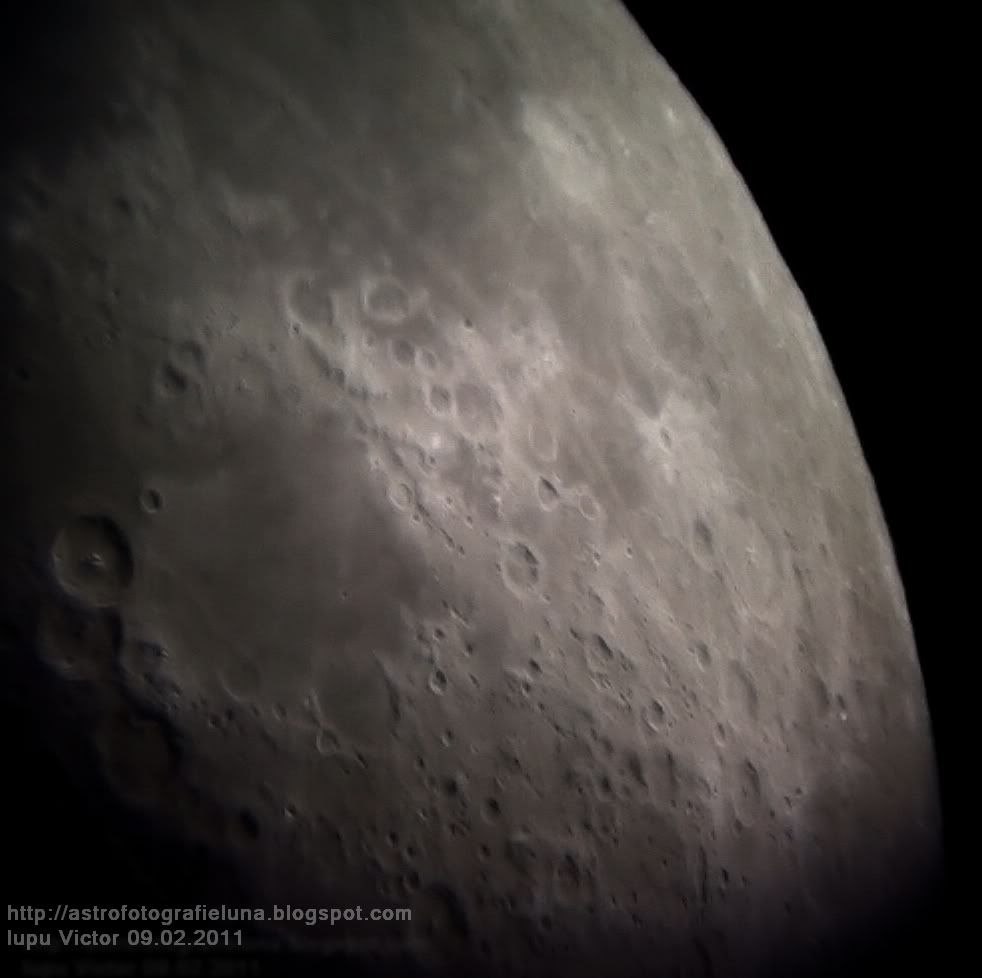
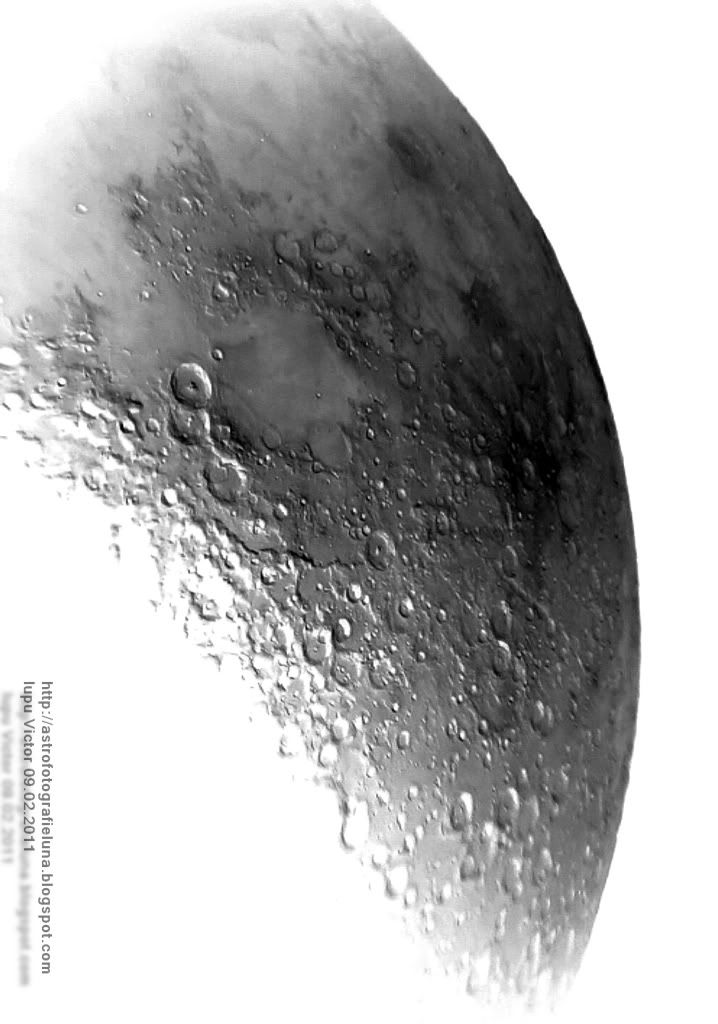
Mare Nectaris

The images above are processed in Registax 55 and 52 frames at 80% and 100% Highest quality
The images below are snapshots from video
                    FastStone bump map effect,FastStone is a simple program to edit photos.

Photographer: Victor Lupu
Optics: Celestron C8-N telescope, plossl 20mm, 2x Barlow
Mount: CG5 (EQ5)
Device: Sony HDR CX105
Filter: No
Date: 09/02/2011
Location: Baia Mare, Romania
Processing: Sony Vegas 10 Registax


 Sea of Nectar (Mare Nectaris)-plateau above on the left in the pictures, is filled with volcanic lava and is situated between Sea Tranquility (Mare Tranquillitatis) and the Sea of Fecundity (Mare Fecunditatis). At south east of Mare Nectaris is a small crater like a point known as Rosse crater (12 km.). Mare Nectaris is 101.000 km ² and it is a bay of the Sea of Tranquility (Mare Tranquillitatis).

        At the bottom of the sea you can see a horseshoe-shaped crater called Fracastorius (124 km.).
     The two craters, which are intertwined in the left of photos are Theophilus and Cyrillus, and the one that looks like Theophilus and Cyrillus, little lower, is called Catharina. A chain forming like mountains are Rupes Altai and at the end is Piccolomini crater (88 km.).

 
All images are © Copyright 2010-2015 Lupu Victor. All rights reserved.Images may not be reproduced, published, or copied in any form without written permission of the author. Thank you for respecting the intellectual property rights. ASTROFOTOGRAFIA | Lupu Victor Astronomy - Contact - About
Design by Free WordPress Themes | Bloggerized by Lasantha - Premium Blogger Themes | Online Project management