Visit Worldwide Topsites
Showing posts with label Craters-J. Herschel. Show all posts

Thursday, 5 November 2015

The northern part of the Moon. Craters through a telescope. J. Herschel.


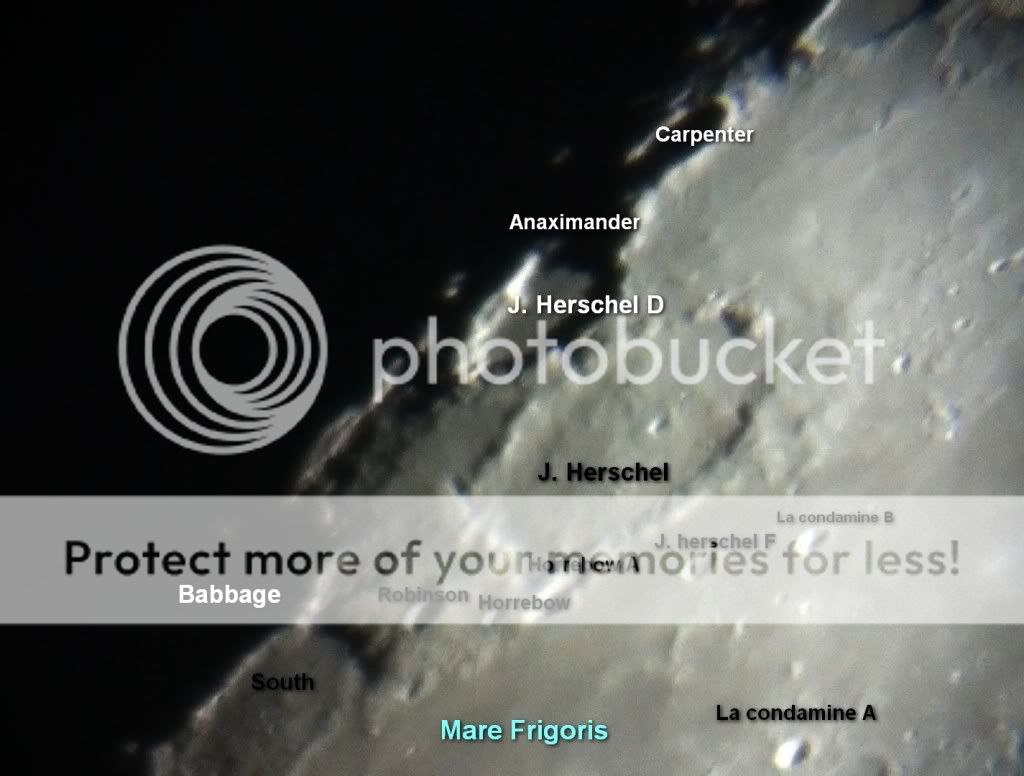
In the images we see a part of the Mare Frigoris on the bottom of the pictures, large craters as J. Herschel (156 km), Pythagoras and South, and small craters which are looking like pearls. The majority are satellite craters.

South crater (104 km), is a vague memory of an impact that formed it. Only its northern rim remained visible. On its floor are scattered very small craters.

J. Herschel is similar to South but has no walls missing, although it shows that had greatly suffered.

One of the craters that I love to watch on the northern Moon is Pythagoras, for its oval shape as seen from Earth because it is located on the edge of the lunar disk, but also for interior terraces and peaks in its center, features that make it a special crater when seen through an astronomical telescope.

In the picture below are labeled craters and other lunar features in the region. To better understand this photo, you should note that the label with the name or the letter of larger craters could be found at their center, and on the small craters, you should find them around them, usually above.


Magnitude: -12.03
Phase: 70.5% (0% = new, 100% = full)
Distance: 398.311 km
Sidereal Period: 27.32 days
Illuminated: 92.2%


Optics: Celestron C8-Newtonian astronomical telescope 
Eyepiece: Plossl 20mm, 2x Barlow
Mount: CG5 (EQ5)
Camera: Sony CX130
Filter: no
Date: 14/03/2014
Location: Baia Mare, Romania
Processing: FastStone Image Viewer


Thursday, 9 July 2015

Video Astronomy Telescope Moon craters Pythagoras, Babbage, J. Herschel in a HD video.

In these video images, you can see on the Moon crater like Babbage (144 km.), J. Herschel (156 km), Philolaus (71 km) and Oenopides (67 km). All these lunar craters are located on the northern Moon.
To view video captures of this clip, press here.

Babbage has a depth of 2 km. It is an old lunar crater located near the northwest edge of the Moon, named after Charles Babbage. It is attached on southeast edge of the prominent crater Pythagoras (130 km). The remnant crater floor called South enters the southeast of Babbage.

Charles Babbage (December 26, 1791 - October 18, 1871) was an English poet, mathematician, philosopher, inventor and mechanical engineer. Babbage is best remembered for originating the concept of programmable computer.


Moon Age: 1.00 days
Illuminated: 99.8% (0% = New, 100% = Full)

Magnitude: -12.20
Distance: 398.772 km


Optics (telescope or lenses): Celestron C8-Newtonian telescope, eyepiece 20mm Plossl, 2x barlow
Mount: CG5 (EQ5)
Camera: Sony CX130

Video mode: 1080p
Filter: no
Date: 14/03/2014
Location: Baia Mare, Romania
Processing: Sony Vegas HD Platinum 10.0


Images were obtained by attaching a camera directly into the eyepiece of an astronomical telescope of 8 inch Newtonian; For this reason the eyepiece visual field was increased.

This video was also used also for simple video captures.

In the picture below are labeled craters and other lunar features in the region. To better understand this photo, you should note that the label with the name or the letter of larger craters could be found at their center, and on the small craters, you should find them around them, usually above.


Saturday, 28 June 2014

Lunar craters filmed through a telescope: J. Herschel.


Crater in the center image is J. Herschel (156 km), one of huge size, but with a very affected edge, which gives a more ugly look.

Located on the northern part of the Moon,  north of Mare Frigoris, this crater has a floor full of swamps, small craters and hills, in a word irregular, otherwise as his edge.

Over the edge of the southern rim, is a crater called Horrebow (24 km).

Northwest of J. Herschel, touched by the terminal, is a crater whose eastern edge projects its shadow on the floor, called Anaximander (68 km).

Age of Moon: 11 days
Distance: 386 658
Phase: 85% (0% = New, 100% = Full)


Optical Telescope Celestron C8 "Newtonian, 20mm Plossl, 2x Barlow
Mount: CG5 (EQ5)
Device: Sony CX-130
Video Mode: Full HD 1920x1080 progressive
Filter: no
Date: 23/03/2013
Location: Baia Mare, Romania
Processing and editing: Sony Vegas 10 FastStone.


Wednesday, 14 September 2011

J. Herschel crater-telescope images


Photographer: Victor Lupu
Optics: Celestron C8-Newtonian telescope, plossl 20mm, 2x Barlow
Mount: CG5 (EQ5)
Device: Sony CX105 at 5x optical zoom
Total zoom: 500x zoom
Filter: No
Date: 05/14/2011
Location: Baia Mare, Romania
Processing: FastStone, video capture
          J. Herschel is a large crater of 156 km. It is located in the north of the Moon surface, and therefore looks through a telescope oval in shape, when viewed from the Earth.South of the crater is Mare Frigoris. To the northwest is the crater Anaximander (68km). To the south west is a small crater called Horrebow (24 km).
Crater eponymous is Sir John Frederick William Herschel (March 7, 1792 - May 11, 1871) which was an English mathematician, astronomer, chemist, photographer / inventor.


All images are © Copyright 2010-2015 Lupu Victor. All rights reserved.Images may not be reproduced, published, or copied in any form without written permission of the author. Thank you for respecting the intellectual property rights. ASTROFOTOGRAFIA | Lupu Victor Astronomy - Contact - About
Design by Free WordPress Themes | Bloggerized by Lasantha - Premium Blogger Themes | Online Project management