


 Tuesday, September 04, 2012
 Unknown

In this article are posted photos with Nikon D80 and Sony CX-130 by astronomical telescope.
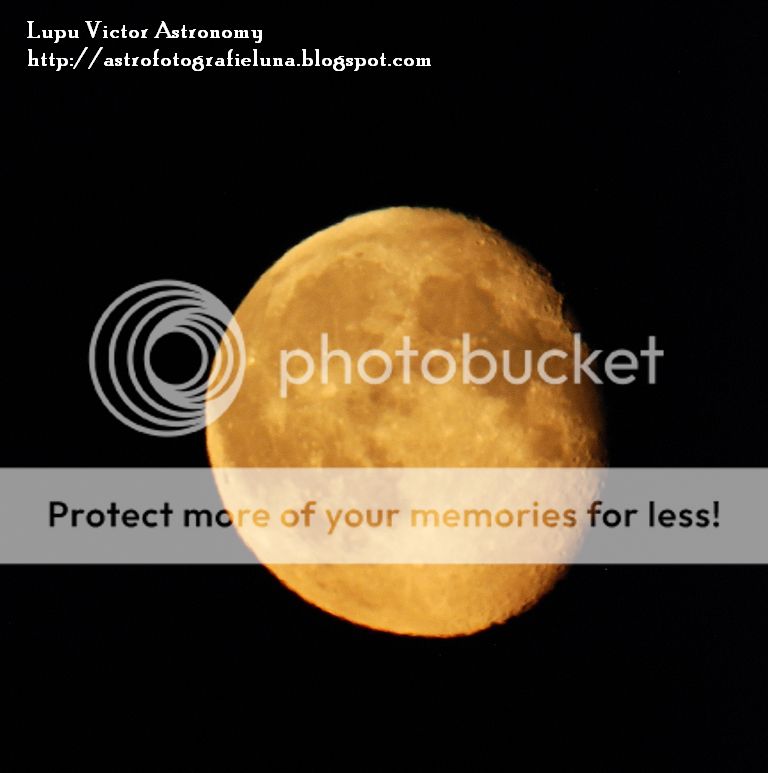
Photos through the telescope and DSLR below, are in chronological order as the rising of the Moon in the sky last night in Baia Mare, Romania. At 9:20 p.m., the Moon rose and was at the horizon. Therefore, it was more reddish in color. This is because the Earth's atmosphere produces this color. The amount of air is much bigger in quantity when you look horizontally than observing the sky vertically.
When the Moon is on the horizon, it is recommended to take artistic photos, with buildings, mountains, trees, monuments, etc. To shoot the Moon craters details, I recommend you to wait for the Moon to rise up in the sky for the Moon, to escape the heavy atmosphere. The same thing happens with any celestial body, whether it is a planet, star, comet, etc.
As you look at these pictures, taken later, Moon's color changes from orange to white, and is much brighter. Unlike the first picture, the latter are clearer.


Location: Baia Mare, Romania
Date: September 3, 2012 at: 9:20 p.m. to 11:04 p.m.
Telescope: Celestron 8 "Newtonian reflector
Eyepiece: no (T ring)
Camera: Nikon D80
Maximum aperture: F1
Exposure / ISO:
Picture 1 - 1/20 sec, 500
Picture 2 - 1/320 sec, 1000
Picture 3 - 1/500 sec, 1000
Picture 4 - 1/500 sec, 320
Below, is the same Moon but the pictures are captures taken by video camera Sony HDR CX-130.


Optics Telescope Celestron C8 "-Newtonian, 20mm Plössl
Mount: CG5 (EQ5) motorized
Device: Sony CX-130
Video Mode: Full HD 1920x1080 progressive
Filter: no
Date: 03/09/2012
Location: Baia Mare, Romania
Processing and editing: FastStone
Photos through the telescope and DSLR below, are in chronological order as the rising of the Moon in the sky last night in Baia Mare, Romania. At 9:20 p.m., the Moon rose and was at the horizon. Therefore, it was more reddish in color. This is because the Earth's atmosphere produces this color. The amount of air is much bigger in quantity when you look horizontally than observing the sky vertically.
When the Moon is on the horizon, it is recommended to take artistic photos, with buildings, mountains, trees, monuments, etc. To shoot the Moon craters details, I recommend you to wait for the Moon to rise up in the sky for the Moon, to escape the heavy atmosphere. The same thing happens with any celestial body, whether it is a planet, star, comet, etc.
As you look at these pictures, taken later, Moon's color changes from orange to white, and is much brighter. Unlike the first picture, the latter are clearer.


Location: Baia Mare, Romania
Date: September 3, 2012 at: 9:20 p.m. to 11:04 p.m.
Telescope: Celestron 8 "Newtonian reflector
Eyepiece: no (T ring)
Camera: Nikon D80
Maximum aperture: F1
Exposure / ISO:
Picture 1 - 1/20 sec, 500
Picture 2 - 1/320 sec, 1000
Picture 3 - 1/500 sec, 1000
Picture 4 - 1/500 sec, 320
Below, is the same Moon but the pictures are captures taken by video camera Sony HDR CX-130.


Optics Telescope Celestron C8 "-Newtonian, 20mm Plössl
Mount: CG5 (EQ5) motorized
Device: Sony CX-130
Video Mode: Full HD 1920x1080 progressive
Filter: no
Date: 03/09/2012
Location: Baia Mare, Romania
Processing and editing: FastStone


