Visit Worldwide Topsites
Showing posts with label Craters-Balmer and Vendelinus. Show all posts

Friday, 25 October 2013

Sharp images of Petavius crater on the Moon.

255 frames at 80% best quality in Registax.
199 frames at 80% best quality in Registax.
340 frames at 80% best quality in Registax.

If someone would give me a few choice spots on the Moon on which to visit , one of them would be Petavius (177 km) ​​crater for sure . I love this crater due to its ordered shape , especially the trench which starts at the western edge cutting the floor to its central mountains , looking through the telescope as a clock showing 20:00. This crack seems to end up in those mountains , but it bends to the north and continues less obvious to the northern edge of the crater .

The basin that can be identified as the darker area in the image above, is an extension of Mare Fecunditatis which narrows to a point giving birth to this " tumor " reaching Petavius's ​​northwest . Soldered the northwest edge of Petavius ​​, notice a smaller crater called Wrottesley (57 km) .

Top right in the last picture , is a bigger crater named Vendelinus .

All this region is at the southeastern Moon, or quadrant 2 of the 4 . Images are processings in Registax program of a video made with the telescope.

Age of the Moon: 15 days
Distance: 390.666 km
Phase: 95% (0% = New, 100% = Full)

Optics: Celestron C8"-Newtonian telescope, 20mm Plossl, 2x Barlow
Mount: CG5 (EQ5)
Camera: Sony CX130
Filter: no
Date: 02/09/2012
Location: Baia Mare, Romania
Processing: Registax, FastStone Image Viewer

Image of 16 August 2011.

Friday, 27 April 2012

Pictures by telescope Vendelinus lunar crater


This is Vendelinus crater (147 km), through telescope and video camcorder, and the images in this article are captures.
Details are fine and I applied several edits to photos like brightness and sharpness in FastStone program.
This crater is not oval but round, but it is seen from Earth like that because its position.


Photographer: Victor Lupu
Optics: Celestron C8 inch-Newtonian telescope, plossl 20mm, 2x Barlow
Mount: CG5 (EQ5)
Device: Sony CX105 to 8x optical zoom
Total Magnification: 800x
Filter: no
Date: 08/16/2011
Location: Baia Mare, Romania
Processing: video capture, FastStone Image Viewer


Friday, 27 January 2012

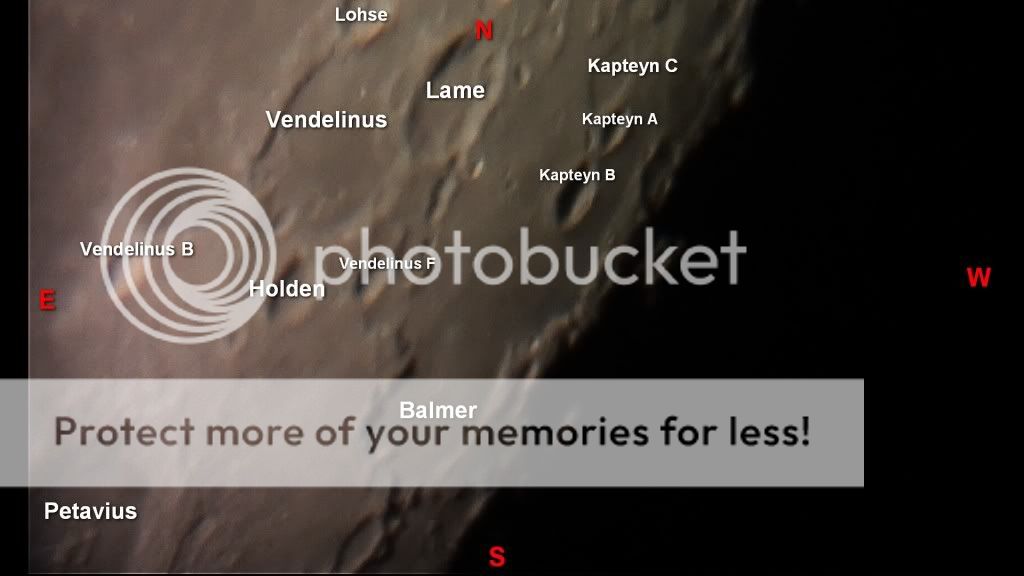
Video by astronomical telescope Lunar craters Kapteyn, Barkla, Lohse, Lame and Holden.

In this astronomical video of the Moon craters on the eastern side through the telescope. Langrenus, Balmer and Vendelinus are close together to get all the same images.

Other craters have I have not talked about so far are Kapteyn, Barkla, LohseLame and Holden. In the pictures below you can see them all.

Kapteyn (49 km) is a Moon impact crater, which is near the eastern limb of the Moon, west of the crater La Perouse. Barkla is west of Kapetyn, and further to the west-northwest is Langrenus, a prominent crater.
Kapteyn has circular shape, although it seems oval when viewed from Earth. It does not show craters along the edge or interior walls.. In the middle of the crater is a central peak.
Kapteyn has satellite craters in the south, which are quite large, and are seen in the last photo in this article: A (31 km), B (39 km) and C (48 km).

Lohse (42 km), is a lunar crater on the eastern edge of the Mare Fecunditatis, with a depth of 2.2 km. It is attached to the northern edge of the much bigger crater Vendelinus. Lohse's interior has a notable central peak. An old impact is attached to the northern boundary, called Langrenus E (30 km).
Lamé (84 km), is an impact crater, 3.3 km in depth, which is overlapping the north-east of the crater Vendelinus, east of Mare Fecunditatis. The east inner crater is covered by a series of overlapping craters that form a chain of almost a hundred kilometers. This chain goes out of the inside of the crater rim to the south. In the middle floor is a small ridge, forming a central peak.

Crater name is given from Gabriel Léon Jean Baptiste Lamé  (22, July 1795 - 1, May 1870) which was a french mathematician.
On some old maps, crater was named Smith or Vendelinus C before being renamed by the IAU (International Astronomical Union).

Holden (47 km), is a lunar crater attached to the southeast edge of Vendelinus, not visible in the video, but only in the pictures below. Crater rim is affected by small craters in the north-west, and has a terrace along the north-eastern interior wall. Its floor is flat, with no central peaks. A small crater lies on the floor south of the midpoint.


Video: Victor Lupu
Optics: CelestronC8 "-Newtonian telescope, plossl20mm, 2x Barlow
Mount: CG5 (EQ5)
Device: SonyCX105 at 7x optical zoom
Total Magnification: 700x
Filter: no
Date: 16/08/2011
Location: Baia Mare, Romania
Processing and editing: Sony Vegas 10

The images below are made ​​on 16 July 2011 and serves for guidance.

Sunday, 27 November 2011

Langrenus crater through the telescope (Video)

There are many craters presented in these clips made ​​through the telescope, and I did even talked about it recently.
In the first video, the most predominant is Langrenus crater.
In video two, Balmer and Vendelinus craters are added at the bottom.
In the third clip, is the large crater Petavius​​.


Video by: Victor Lupu
Optics: Celestron C8"-Newtonian telescope, plossl 20mm, 2x Barlow
Mount: CG5 (EQ5)
Device: Sony CX105 at 7x-8x optical zoom
Optictotal Zoom: 700x-800x

Video resolution: 1920x1080
Filter: No
Date: 16/07/2011
Location: Baia Mare, Romania
Edit: Sony Vegas 10 stabilized video

Friday, 25 November 2011

Balmer and Vendelinus craters-telescope images

Photographer: Victor Lupu
Optics: Celestron C8-Newtonian telescope, plossl 20mm, 2x Barlow
Mount: CG5 (EQ5)
Device: Sony CX105 to 8x optical zoom
Total magnification: 800x
Filter: no
Date: 16/07/2011
Location: Baia Mare, Romania
Processing: FastStone, video capture
Read more:
http://astrofotografieluna.blogspot.com/2011/11/craterul-balmer-si-vendelinus-imagini.html#ixzz1ejaIP2Ai
In this eastern region of the Moon there are many important large craters, I have not discussed about and I have not photographed.
           Balmer (112 km) is a lunar crater flooded by lava. Only sections of the south, west and east of the crater survived, the rest being covered by a lava flow that joins the nearby sea. Balmer is east-southeast of the crater Vendelinus.
It was named after Johann Jakob Balmer (May 1, 1825 - March 12, 1898), a mathematician and physicist.

           Vendelinus (147 km), is a large and ancient impact crater at the eastern edge of Mare Fecunditatis, and is a 2.6 km deep crater. On the north of Vendelinus is the  prominent Langrenus, while on the southeast is Petavius , forming a chain of prominent craters on the eastern edge of the sea. Due to its location the crater appears oblong because of its position.

Crater is heavily worn and overlapped by several craters, making it more difficult to identify. Irregular rim is broken in several places overlapped by other craters. The most important of these is a break in the wall of the north-east, by superimposing the crater Lamé  (84 km). Lohse (42 km) overlaps on north-west, and at the south end of the crater is joined with Holden (47 km).

Vendelinus's floor is flat and covered with dark lava flow. It lacks of a central peak, but has several impact craters of different sizes.

 
All images are © Copyright 2010-2015 Lupu Victor. All rights reserved.Images may not be reproduced, published, or copied in any form without written permission of the author. Thank you for respecting the intellectual property rights. ASTROFOTOGRAFIA | Lupu Victor Astronomy - Contact - About
Design by Free WordPress Themes | Bloggerized by Lasantha - Premium Blogger Themes | Online Project management