

 Friday, January 27, 2012
 Unknown

In this astronomical video of the Moon craters on the eastern side through the telescope. Langrenus, Balmer and Vendelinus are close together to get all the same images.
Other craters have I have not talked about so far are Kapteyn, Barkla, Lohse, Lame and Holden. In the pictures below you can see them all.
Kapteyn (49 km) is a Moon impact crater, which is near the eastern limb of the Moon, west of the crater La Perouse. Barkla is west of Kapetyn, and further to the west-northwest is Langrenus, a prominent crater.
Kapteyn has circular shape, although it seems oval when viewed from Earth. It does not show craters along the edge or interior walls.. In the middle of the crater is a central peak.
Kapteyn has satellite craters in the south, which are quite large, and are seen in the last photo in this article: A (31 km), B (39 km) and C (48 km).
Lohse (42 km), is a lunar crater on the eastern edge of the Mare Fecunditatis, with a depth of 2.2 km. It is attached to the northern edge of the much bigger crater Vendelinus. Lohse's interior has a notable central peak. An old impact is attached to the northern boundary, called Langrenus E (30 km).
Lamé (84 km), is an impact crater, 3.3 km in depth, which is overlapping the north-east of the crater Vendelinus, east of Mare Fecunditatis. The east inner crater is covered by a series of overlapping craters that form a chain of almost a hundred kilometers. This chain goes out of the inside of the crater rim to the south. In the middle floor is a small ridge, forming a central peak.
Crater name is given from Gabriel Léon Jean Baptiste Lamé (22, July 1795 - 1, May 1870) which was a french mathematician.
On some old maps, crater was named Smith or Vendelinus C before being renamed by the IAU (International Astronomical Union).
Holden (47 km), is a lunar crater attached to the southeast edge of Vendelinus, not visible in the video, but only in the pictures below. Crater rim is affected by small craters in the north-west, and has a terrace along the north-eastern interior wall. Its floor is flat, with no central peaks. A small crater lies on the floor south of the midpoint.
Video: Victor Lupu
Optics: CelestronC8 "-Newtonian telescope, plossl20mm, 2x Barlow
Mount: CG5 (EQ5)
Device: SonyCX105 at 7x optical zoom
Total Magnification: 700x
Filter: no
Date: 16/08/2011
Location: Baia Mare, Romania
Processing and editing: Sony Vegas 10
The images below are made on 16 July 2011 and serves for guidance.

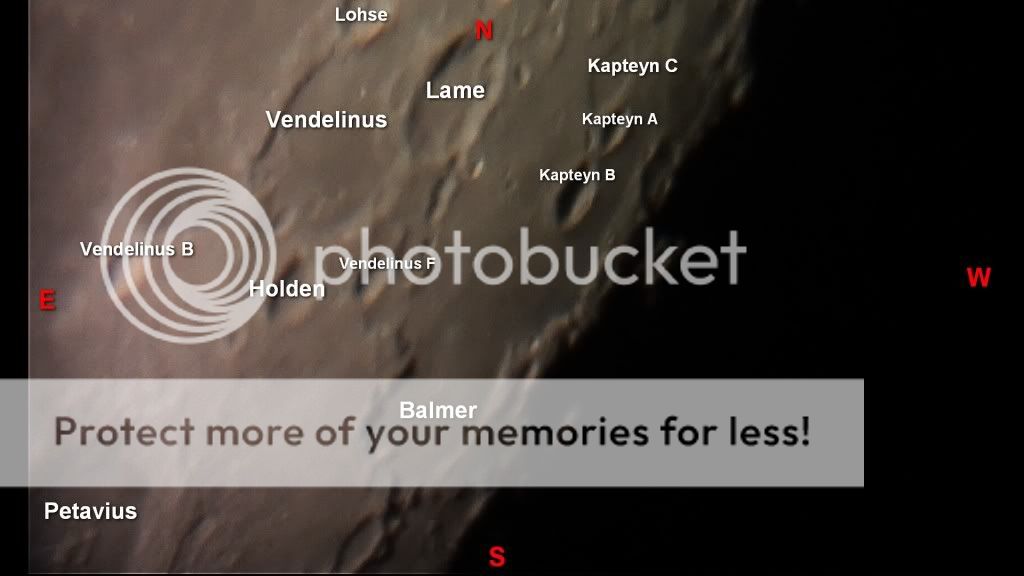
Other craters have I have not talked about so far are Kapteyn, Barkla, Lohse, Lame and Holden. In the pictures below you can see them all.
Kapteyn (49 km) is a Moon impact crater, which is near the eastern limb of the Moon, west of the crater La Perouse. Barkla is west of Kapetyn, and further to the west-northwest is Langrenus, a prominent crater.
Kapteyn has circular shape, although it seems oval when viewed from Earth. It does not show craters along the edge or interior walls.. In the middle of the crater is a central peak.
Kapteyn has satellite craters in the south, which are quite large, and are seen in the last photo in this article: A (31 km), B (39 km) and C (48 km).
Lohse (42 km), is a lunar crater on the eastern edge of the Mare Fecunditatis, with a depth of 2.2 km. It is attached to the northern edge of the much bigger crater Vendelinus. Lohse's interior has a notable central peak. An old impact is attached to the northern boundary, called Langrenus E (30 km).
Lamé (84 km), is an impact crater, 3.3 km in depth, which is overlapping the north-east of the crater Vendelinus, east of Mare Fecunditatis. The east inner crater is covered by a series of overlapping craters that form a chain of almost a hundred kilometers. This chain goes out of the inside of the crater rim to the south. In the middle floor is a small ridge, forming a central peak.
Crater name is given from Gabriel Léon Jean Baptiste Lamé (22, July 1795 - 1, May 1870) which was a french mathematician.
On some old maps, crater was named Smith or Vendelinus C before being renamed by the IAU (International Astronomical Union).
Holden (47 km), is a lunar crater attached to the southeast edge of Vendelinus, not visible in the video, but only in the pictures below. Crater rim is affected by small craters in the north-west, and has a terrace along the north-eastern interior wall. Its floor is flat, with no central peaks. A small crater lies on the floor south of the midpoint.
Video: Victor Lupu
Optics: CelestronC8 "-Newtonian telescope, plossl20mm, 2x Barlow
Mount: CG5 (EQ5)
Device: SonyCX105 at 7x optical zoom
Total Magnification: 700x
Filter: no
Date: 16/08/2011
Location: Baia Mare, Romania
Processing and editing: Sony Vegas 10
The images below are made on 16 July 2011 and serves for guidance.