Visit Worldwide Topsites
Showing posts with label Craters-Bullialdus. Show all posts

Sunday, 17 August 2014

Backyard Astrophotography. Bullialdus crater.


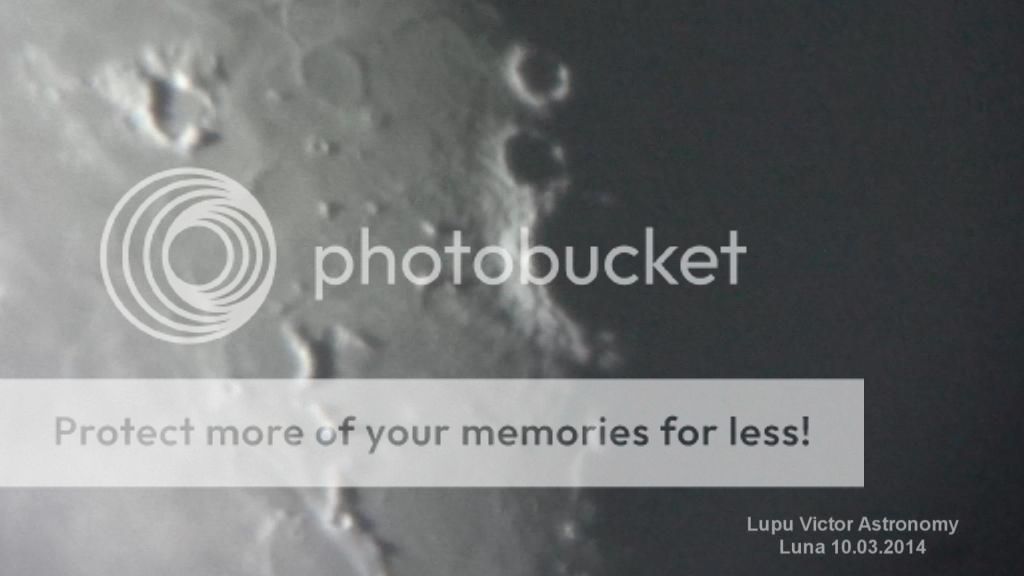
I've never caught Bullialdus crater (61 km) to such phase, the terminal line passes over it and over its satellite craters Bullialdus A (26 km) and B (21 km).

You have to keep in mind, that the images are inverted, as seen through a telescope. So the cardinal points are also reversed.

In these lighting conditions we can see how high Bullialdus's edge compared to other craters.

Other craters visible here are Wolf (25 km) and Gould (34 km). On the west of Wolf, we see a crater, a circle drawn on the Moon. It is a satellite crater of Wolf, called Wolf T (27 km). It has such an appearance because it was almost completely covered by lava.

Moon Age: 9.05 days
Phase: 70.5% (0% = New, 100% = Full)
Distance: 399.221 km


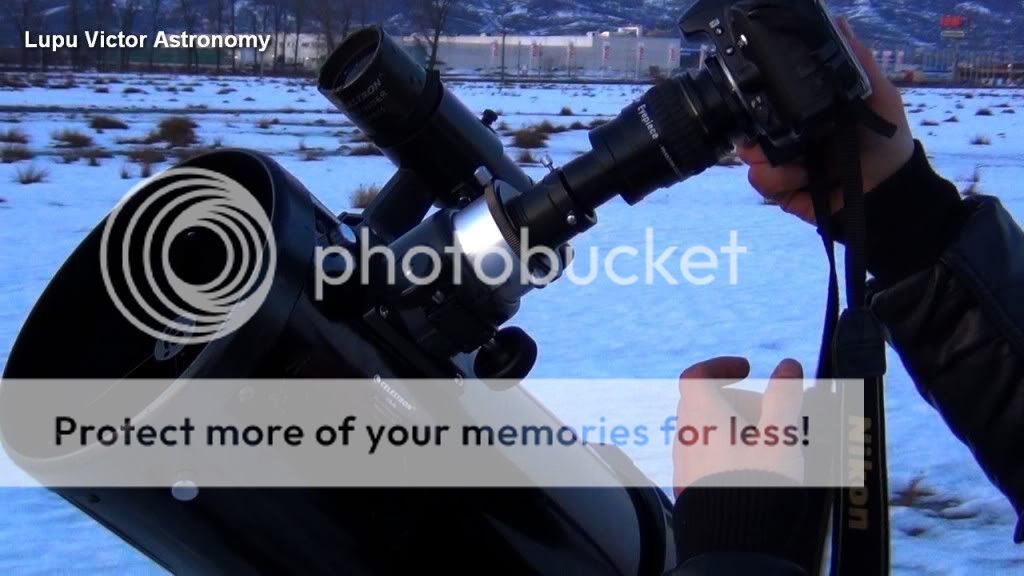
Optics: Celestron C8-Newtonian telescope, 20mm Plossl, 2x barlow
Mount: CG5 (EQ5)
Camera: Sony CX130
Filter: no
Date: 10/03/2014
Location: Baia Mare, Romania
Processing: FastStone Image Viewer



Thursday, 1 May 2014

Astronomy video captures of Bullialdus crater on the Moon.


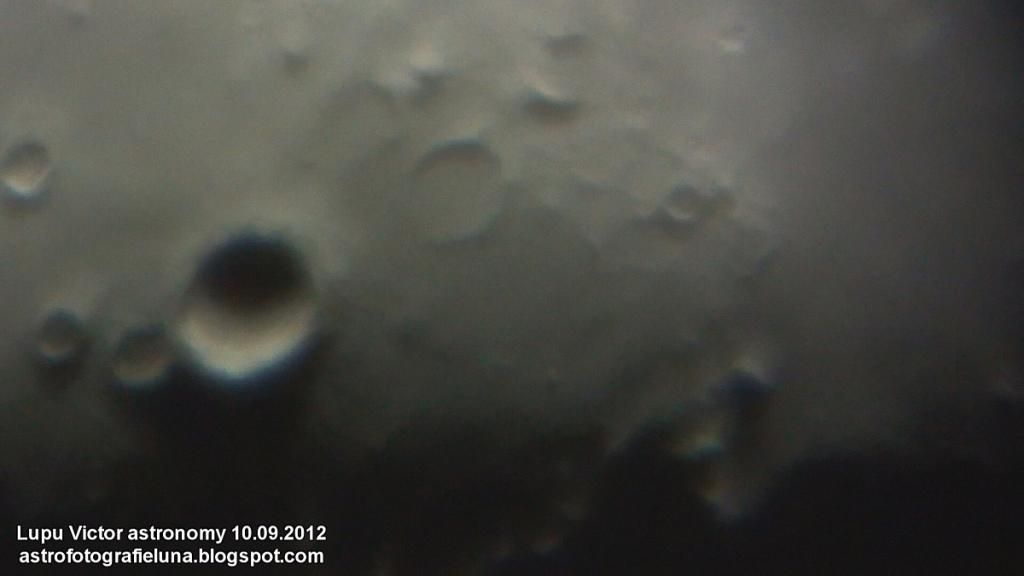
I've never seen in this light Bullialdus (61 km) and its complex craters. They are seen here when the sun shines at a low angle. Bullialdus's floor is almost covered by shade here and its satellite craters Bullialdus A (26 km) and B (21 km). In continuation of these craters is Konig (23 km), forming a bow like with Bullialdus's craters.


North of Bullialdus are observed Lubiniezky crater (44 km) and south of Bullialdus B is Kies (44 km).

In the upper left are two craters side by side: Campanus (48 km) and Mercator (47 km).

Images are upside down and the cardinal points do not correspond to images unless you see the Moon right.


Distance: 393696 km
Phase: 26.6% (0% = New, 100% = Full)


Optical Telescope CelestronC8 "Newtonian, plossl20mm, 2x Barlow
Mount: CG5 (EQ5)
Device: Sony CX-130
Video Mode: Full HD 1920x1080 progressive
Filter: no
Date: 10/09/2012
Location: Baia Mare, Romania
Processing and editing: Sony Vegas 10 video captures


Sunday, 2 October 2011

Bullialdus half in shadow-crater images through telescope

Photographer: Victor Lupu
Optics: Celestron C8-Newtonian telescope, plossl 20mm, 2x Barlow
Mount: CG5 (EQ5)
Device: Sony CX105 at 5x optical zoom
Total zoom:500x 
Eyepiece Adapter: 1.25 "
Filter: No
Date: 12/05/2011
Location: Baia Mare, Romania
Processing: FastStone, video captures

          Bullialdus may have a composition distinct from the surrounding region and the central peak has a height of 1000 meters and a depth of 3.5 km.
Moon is the best preserved laboratory and accessible to study impacts, which are the most important historical data from the Solar System. On Earth, which was struck by bodies four billion years ago, wind and rain erosion has degraded craters, making them difficult to study. On the Moon, however, these craters are well preserved.

          Smaller craters in images that "fall" below Bullialdus, I think they are the same age, and Bullialdus T, was once a large crater, but was subsequently flooded by the lava of Mare Nubium, as Lubiniezky (44 km), also . From this we understand that Bullialdus is from an impact after Mare Nubium was formed.


Wednesday, 6 April 2011

Bullialdus crater

Photographer: Victor Lupu
Optics: Celestron C8-Newtonian reflector telescope, plossl 20mm, 2x Barlow
Mount: CG5 (EQ5)
Device: Sony HDR CX105
Filter: No
Date: 13/02/2011
Location: Baia Mare, Romania
Processing: video capture


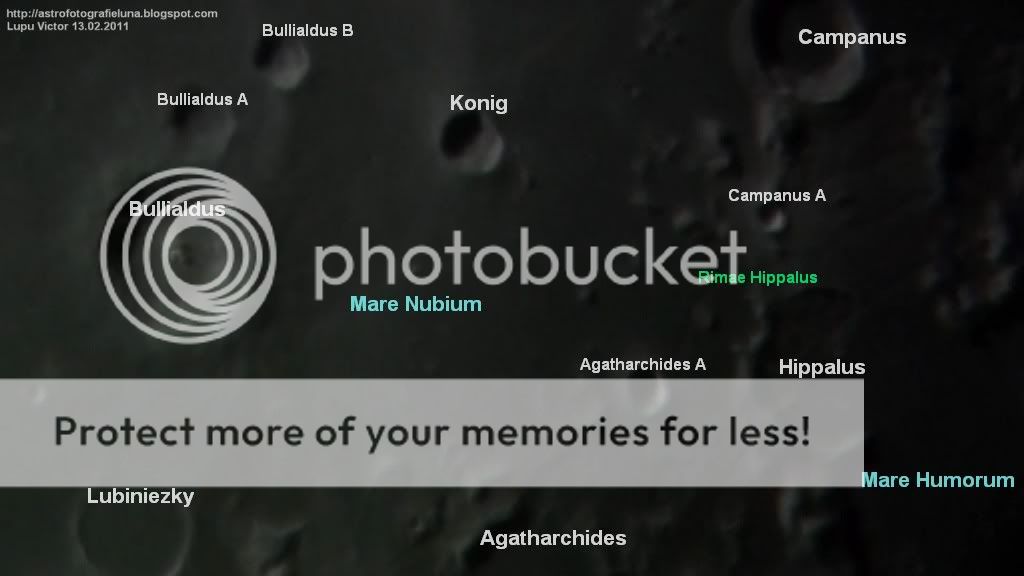
        Bullialdus (61 km) at Mare Nubium, which is close to Mare Humorum.Bullialdus is an impact crater located on the west of Mare Nubium. To the south is Lubiniezky crater (44 km) in the form of broken frame, being flooded by lava. In the north-east of Bullialdus in photo, is König (23 km), a smaller crater.
     because of relatively isolated location of Bullialdus we can highlight its shape well formed. Bullialdus has a large outer rim that is circular, but observers have noted is slight polygonal. The interior walls are terraced and contain many signs of landslides.
     Crater floor is somewhat convex, rounded up to the middle. When the sun is at a high angle, the central mountains appear brighter than the surroundings, and the white spots can be viewed on the crater floor.
     Two small craters, north of the crater,are: Bullialdus A and Bullialdus B.

 
All images are © Copyright 2010-2015 Lupu Victor. All rights reserved.Images may not be reproduced, published, or copied in any form without written permission of the author. Thank you for respecting the intellectual property rights. ASTROFOTOGRAFIA | Lupu Victor Astronomy - Contact - About
Design by Free WordPress Themes | Bloggerized by Lasantha - Premium Blogger Themes | Online Project management