Visit Worldwide Topsites
Showing posts with label Craters-Gruemberger and Cysatus. Show all posts

Saturday, 7 February 2015

Telescope Photo Moon. Gruemberger and Cysatus in Registax.

68 video frames in Registax.
1 video frames in Registax.
616 video frames in Registax.

This southern region of the Moon, is caught between light and darkness, (at terminator). For this reason craters become special in observation for that particular shade shows out many features of the craters. The struggle between light and darkness on the Moon is very fruitful in terms of the observer through the telescope, because the results are wonderful, if you use information storage elements such as video or photo cameras.

Gruemberger and Cysatus (94/49 km) are two neighboring craters of Moretus (114 km). We can observe here also the Moon terminal, (its edge).

You can see the video from which I have extracted these images, and simple video captures.
Simple video captures, are here.
You can view video of which I took these pictures, here.


Moon Age: 9.05 days
Phase: 70.5% (0% = New, 100% = Full)
Distance: 399.221 km


Optics (telescope or lenses): Celestron C8-Newtonian telescope, eyepiece 20mm Plossl, 2x barlow
Mount: CG5 (EQ5)
Camera: Sony CX130
Filter: no
Date: 10/03/2014
Location: Baia Mare, Romania
Processing: Registax,  FastStone Image Viewer


Wednesday, 28 January 2015

Astronomy through Telescope. Craters on the Moon in Registax: Moretus.

68 video frames in Registax.
240 video frames in Registax.
616 video frames in Registax.
1 video frames in Registax.

To be short, in the images are craters located on the south of the Moon as we see from Earth, near its edge (the terminal).

The crater Moretus (114 km) is emphasized here and its neighboring craters.
Moretus crater at the lunar south, (the largest in the center), is seen here more oblique than usual due to the Moon's position (bent forward). At the bottom of it, in images (north of) are two craters bonded together: Cysatus and Gruemberger (94/49 km).

Moretus is easily observed through the telescope sometimes, but other times its difficult. This is due to libration of the Moon which is found sometimes inclined forward and sometimes on the back. The best time to observe the crater Moretus, is when the Moon is bent back, so the lunar south is facing us.
Simple video captures, are here.
You can view video of which I took these pictures, here.


Info Moretus.
Coordinates70.6°S 5.5°WCoordinates: 70.6°S 5.5°W
Diameter114 km
Depth5.0 km
Colongitude7° at sunrise
EponymThéodore Moretus

616 video frames in Registax.

Moon Age: 9.05 days
Phase: 70.5% (0% = New, 100% = Full)
Distance: 399.221 km


Optics (telescope or lenses): Celestron C8-Newtonian telescope, eyepiece 20mm Plossl, 2x barlow
Mount: CG5 (EQ5)
Camera: Sony CX130
Filter: no
Date: 10/03/2014
Location: Baia Mare, Romania
Processing: Registax,  FastStone Image Viewer


Wednesday, 7 January 2015

Telescope Images processed in Registax: Zach Curtius Moretus craters.

38 video frames, in Registax.

In the image above we notice south of Moon craters near the edge of it, from Motetus and continuing to the north of it (image is upside down).

There are many craters here, but can be more easily recognized in the picture below, made in the same evening. If you want to know the craters of the Moon's south and where they are located, see these maps of south of the Moon (images are labeled with their names).

Craters seen here are Moretus, Gruemberger / Cysatus, Zach.
Moretus can not be seen with the naked eye. For this you will need at least some powerful binoculars or an astronomical telescope.

Video from which I have extracted the image, can be viewed in this article.
Video captures images are in this article.
Other images from the same evening are here.

Info Moretus.
Coordinates70.6°S 5.5°WCoordinates: 70.6°S 5.5°W
Diameter114 km
Depth5.0 km
Colongitude7° at sunrise
EponymThéodore Moretus


Moon Age: 9.05 days
Phase: 70.5% (0% = New, 100% = Full)
Distance: 399.221 km


Optics (telescope or lenses): Celestron C8-Newtonian telescope, eyepiece 20mm Plossl, 2x barlow
Mount: CG5 (EQ5)
Camera: Sony CX130
Filter: no
Date: 10/03/2014
Location: Baia Mare, Romania
Processing: Registax,  FastStone Image Viewer


Friday, 2 January 2015

Video and astrophotography by telescope Moretus crater.


I always liked to shoot the edge of the Moon, to observe closely the characteristics of vertices outside the lunar disk out. These shapes always fascinated me, because the edge of the Moon is the only area where you can enjoy a "3D" view of its relief, and the south is best suited for this.

Atmosphere quality was satisfactory during video recording. Some turbulence are observed, but there are moments of great clarity. Craters seen here are Moretus, Gruemberger/Cysatus, Zach.


The video was also used in Registax program to process images with higher quality, but also for simple video captures.
Simple video capture Images are here, and here.


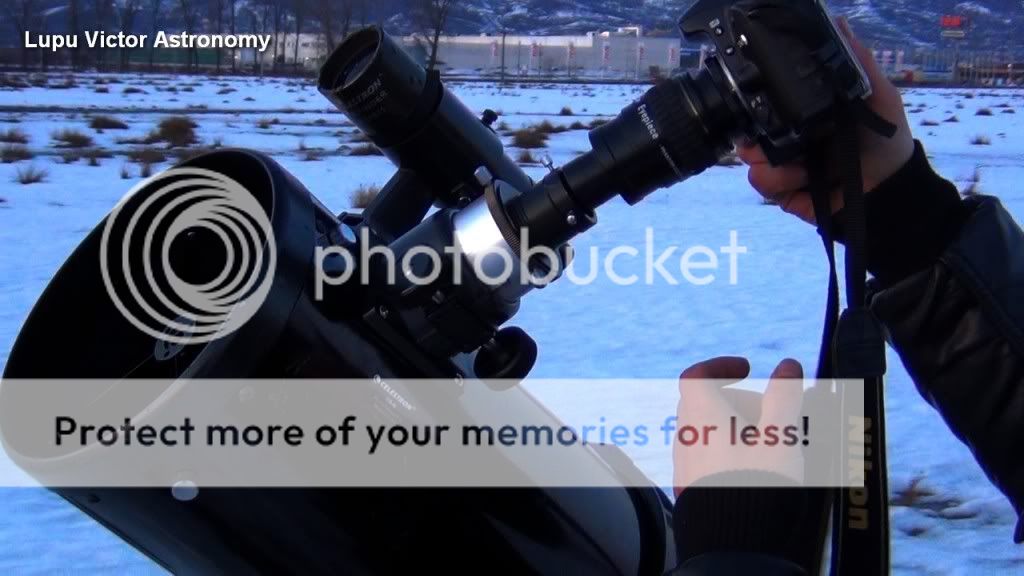
The video was done with the camera mounted on the telescope, specifically on the telescope eyepiece. To protect telescope of vibrations, I used a guide motor from Lacerta, and thus the image was more stable. 


However, even with this tracking device for celestial bodies, there were vibrations of the telescope tube, causing the image to be slightly unstable. For this, I used the video stabilization option in Sony Vegas editing software, so the video was 100% correct on this issue.

Moon Age: 9.05 days
Phase: 70.5% (0% = New, 100% = Full)
Distance: 399.221 km


Optics (telescope or lenses): Celestron C8-Newtonian telescope, eyepiece 20mm Plossl, 2x barlow
Mount: CG5 (EQ5)
Camera: Sony CX130
Filter: no
Date: 10/03/2014
Location: Baia Mare, Romania
Processing: Sony Vegas HD Platinum 10.0


Tuesday, 21 October 2014

Moretus and Gruemberger. South Lunar craters seen through the telescope.


Moretus (114 km) crater at the lunar south, (the largest in the center), is seen here more oblique than usual due to the Moon's position (bent forward). At the bottom of it, in images (north of) are two craters bonded together: Cysatus and Gruemberger (94/49 km).

The central peak located on the floor of Moretus, is beautifully depicted here, its shadow being projected to the edge.
 
This crater can not be seen with the naked eye of course. For this you will need at least some powerful binoculars or an astronomical telescope.

The crests we see rising at the Moon's terminator, are not mountains but edges of craters, including Short's rim (70 km).
 
Moretus name was given after Théodore Moret, also known as Moretus (Antwerp 1602 - Breslau 1667). He was a mathematician at a school in Antwerp, but he Spent most of his life in Prague in the Bohemian kingdom.

Other images from that evening, are here.


Info Moretus.
Coordinates70.6°S 5.5°WCoordinates: 70.6°S 5.5°W
Diameter114 km
Depth5.0 km
Colongitude7° at sunrise
EponymThéodore Moretus

Moon Age: 9.05 days
Phase: 70.5% (0% = New, 100% = Full)
Distance: 399.221 km


Optics: Celestron C8-Newtonian telescope, 20mm Plossl, 2x barlow
Mount: CG5 (EQ5)
Camera: Sony CX130
Filter: no
Date: 10/03/2014
Location: Baia Mare, Romania
Processing: FastStone Image Viewer


Saturday, 18 October 2014

Astroinfo: Craters by astronomical telescope: Gruemberger and Cysatus.


What we look at in these images, is the South of the Moon. Although it seems that we look at the top of the Moon, in fact the pictures are upside down for better observation of the area.

Gruemberger and Cysatus (94/49 km) are two craters located between Clavius (225 km) ​​and Moretus (114 km), but closer to Moretus.

Gruemberger is larger in size with destroyed edges compared to Cysatus, which has sharp edges. Cysatus at this phase has a dark floor. It overlaps slightly on the eastern edge of Gruemberger.
Even if seen very obliquely because the Moon's position, on the floor of Gruemberger crater is observed a smaller one, called Gruemberger A (20 km).

Other images from that evening, are here.


Moon Age: 9.05 days
Phase: 70.5% (0% = New, 100% = Full)
Distance: 399.221 km


Optics: Celestron C8-Newtonian telescope, 20mm Plossl, 2x barlow
Mount: CG5 (EQ5)
Camera: Sony CX130
Filter: no
Date: 10/03/2014
Location: Baia Mare, Romania
Processing: FastStone Image Viewer


Tuesday, 19 August 2014

Craters on the Moon: Moretus Gruemberger and Cysatus


Note here an area where I had always loved to turn my telescope, namely Southern Moon, where are numerous craters of all shapes. Moretus (114 km) is the most beautiful of them, but I have will not talk about it here. There are plenty of other articles in which is described in details.

As a new observation for me, are the two craters northwest of Moretus, called Gruemberger (94 km) and Cysatus (49 km), because I have never seen it with this look, like at this phase.

Although Gruemberger is eroded, with very worn edges, at this phase looks to be more "ordered" than it actually is.

I'm pretty sure that you guys like what you see in these pictures. I can not take my eyes off that high peaks in sunlight at the edge of the Moon. The heights are not mountains, but the edges of craters which lies between the seen and unseen side of the Moon.

Other craters seen here are Curtius (95 km), Zach (71 km), Pentland (56 km), Sempilius (70 km), and Short (71 km).


Info Moretus.
Coordinates70.6°S 5.5°WCoordinates: 70.6°S 5.5°W
Diameter114 km
Depth5.0 km
Colongitude7° at sunrise
EponymThéodore Moretus


Moon Age: 9.05 days
Phase: 70.5% (0% = New, 100% = Full)
Distance: 399.221 km


Optics: Celestron C8-Newtonian telescope, 20mm Plossl, 2x barlow
Mount: CG5 (EQ5)
Camera: Sony CX130
Filter: no
Date: 10/03/2014
Location: Baia Mare, Romania
Processing: FastStone Image Viewer


All images are © Copyright 2010-2015 Lupu Victor. All rights reserved.Images may not be reproduced, published, or copied in any form without written permission of the author. Thank you for respecting the intellectual property rights. ASTROFOTOGRAFIA | Lupu Victor Astronomy - Contact - About
Design by Free WordPress Themes | Bloggerized by Lasantha - Premium Blogger Themes | Online Project management