Visit Worldwide Topsites
Showing posts with label Montes Haemus. Show all posts

Wednesday, 30 March 2016

Stunningly beautiful astronomical telescope: craters Menelaus and Manilius.

In these images we see lakes, mountains, craters and seas located on the central-east of the Moon.

We mention Menelaus crater (27 km), Manilius (39 km) and Boscovich (46 km), the 3 lakes Gaudii, Lenitatis and Hiemalis, Montes Haemus, Mare Serenitatis and Mare Vaporum.

These snapshots were chosen as the clearest made of a video camera attached to the telescope.

Menelaus crater is small but visually easy to locate thanks to the layout of the south shore of Mare Serenitatis and the foothills Montes Haemus.

Manilius is larger but with a well defined edge, south of Lacus Doloris. It has a depth of 3.1 km, and to this phase is almost totally in shadow.

Boscovich (46 km), is located southeast of Manilius. It is almost entirely eroded by impacts, and therefore its shape is not circular. Its floor is cut by a system of Rille called Rima Boscovich. Interesting is the satellite crater Boscovich P (67 km), which is elongated in the direction of the crater Manilius.
Mare Vaporum is at the terminator, and therefore there is less light present.

As a conclusion, these pictures are very beautiful and interesting at the this phase of the moon. The features that you are glaring from the first moment, are crater Manilius and Montes Haemus.


Magnitude: -10.82
Phase: 0.46
Distance: 399.283 km
Illuminated: 45.6% (0% = New, 100% = Full)


Astronomical instrument: Celestron C8-Newtonian telescope,
Eyepiece: Plossl 20mm, 2x Barlow
Mount: CG5 (EQ5)
Camera: Sony CX130
Filter: no
Date: 30.01.2012
Location: Baia Mare, Romania
Processing: FastStone Image Viewer


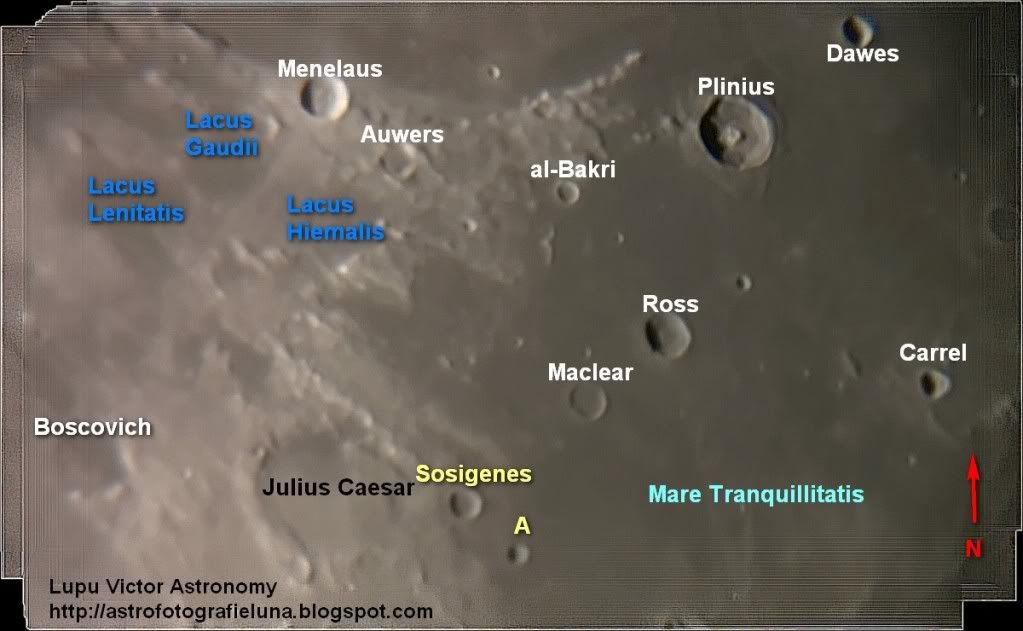
In the picture below are labeled craters and other lunar features in the region. To better understand this photo, you should note that the label with the name or the letter of larger craters could be found at their center, and on the small craters, you should find them around them, usually above.


Tuesday, 25 December 2012

West of Mare Serenitatis, Menelaus and Montes Haemus. Astronomical telescope images


Menelaus crater with a diameter of 27 km, is located on the western edge of Mare Serenitatis, and around Montes Haemus. This is a large region on the lunar surface, perfect for careful study.

In Menelaus crater we can not notice details in these pictures, because it is in shadow and only the inner western edge is in light. But it has bright interior walls and central peaks on it's floor.

Note Montes Haemus, and note the linear nature of their structure and large massif northwest of Menelaus crater. Its height is 4.2 km.

Video of these photos can be seen in another article.


Optics: Celestron C8-Newtonian telescope, 20 mm Plössl, 2x barlow
Mount: CG5 (EQ5)
Camera: Sony CX130
Filter: no
Date: 04/27/2012
Location: Baia Mare, Romania
Processing: video capture, FastStone Image Viewer


Photo above is done in May 11, 2011, with the same astronomical instruments.


Saturday, 23 June 2012

Wonderful Moon video Serenitatis-Tranquillitatis seas area through the telescope.

Certainly, in this video below are much to see. This is because here are many types of moon features such as seas, lakes, craters and mountains. For example, I never saw Menelaus crater (27 km.) in these shadows. It lies on the southwest edge of Mare Serenitatis and is immersed in a nearly total darkness. Only the imterior western wall is in sunlight.

      On the 'sharp tooth' as of a predator that comes between the two major seas Serenitatis and Tranquillitatis, there are many features, such as Montes Haemus more to root of the 'tooth', crater Menelaus, and at its left are the three lakes which are arranged in a triangle: Gaudii, Hiemalis and Lenitatis. They can be seen closer in the last photo of this article.

      Auwers crater (20 km), lies south-west of Menelaus. We can't go without mentioning Sinus Honoris, which is on the outside of the 'sharp tooth', nor the crater Julius Caesar (90 km.), which can be seen in the lower left corner of the video.
At the end of the 'sharp tooth' is Promotorium Archerusia, named after the promoters of the Black Sea on Earth. The 'tooth' seems to be heading towards to 'smash' the solitary crater Plinius (43 km.), which is located between the two seas, but it misses. In the right of Plinius, is a smaller crater, only 18 km, Dawes, wich is lying on the sea plateau too, and is surrounded by a higher albedo.


Video: Victor Lupu
Optics: CelestronC8 "-Newtonian telescope, plossl20mm, 2x Barlow
Mount: CG5 (EQ5)
Device: Sony CX-130
Video mode: Full HD progressive 1920x1080
Filter: no
Date: 27/04/2012
Location: Baia Mare, Romania
Processing and editing: Sony Vegas 10

         Photo above is made out in May 11, 2011,with  the same astronomical instruments.

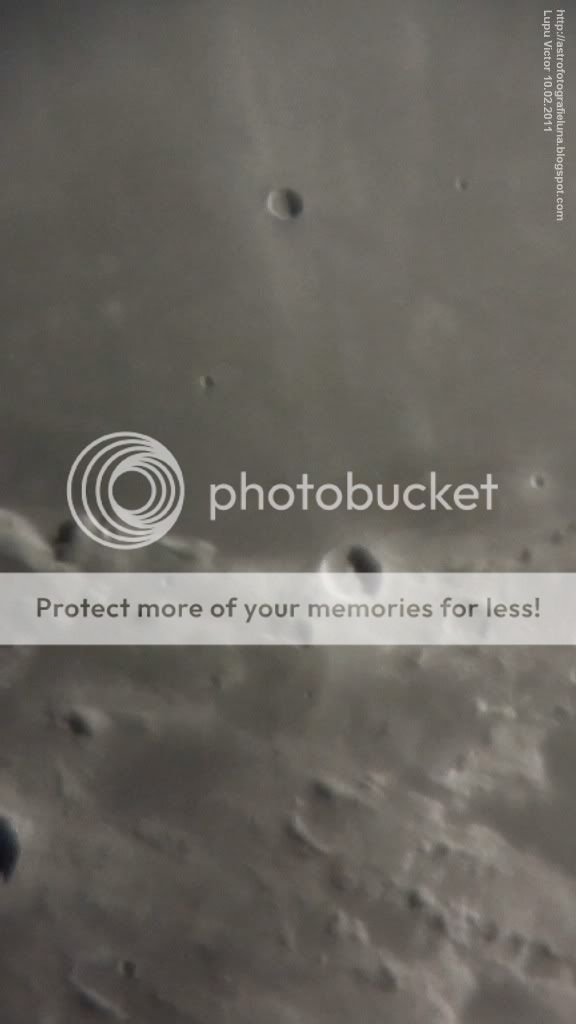
         Photo above is made out in February 10, 2011,with the same astronomical instruments.

         Photo above is made out in July 20, 2011,with the same astronomical instruments.

Tuesday, 14 June 2011

Menelaus crater and Montes Haemus

Photographer: Victor Lupu
Optics: Celestron C8-Newtonian telescope, plossl 20mm, 2x Barlow
Mount: CG5 (EQ5)
Device: Sony CX105
Filter: No
Date: 10/02/2011
Location: Baia Mare, Romania
Processing: 10 Sony Vegas, video captures

         Menelaus (27 km), is a young crater situated on the southern shore of Mare Serenitatis near the eastern end of the Montes Haemus mountains. In the southeast is Auwers (20 km),and at south-west is Daubrée (14 km). North-East is a weak furrows called Rima Menelaus.
Menelaus's walls have a slightly irregular shape with a sharp edge and terraced walls on the interior.It  is 3 km deep. The interior has a high albedo, which is prominent. There are multiple peaks on the floor. Crater has a moderate ray system most prominent to the northeast, on Mare Serenitatis. The crater was named after the king of Sparta from Illiad, Menelaus of Alexandria.

         Montes Haemus (560 km), is a curved range of mountains forming the southwestern edge of Mare Serenitatis basin. They joins with Montes Apenninus at the northern end. Eastern edge ends with Archerusla Promontorium, north-west of the crater Plinius (43 km).
More small "lakes", consisting of basaltic lava, lies along the south-west slopes of the mountains. From north-west to south-east they are: Lacus Odii , Lacus Doloris, Lacus Gaudii and Lacus Hiemalis. Lacus Lenitatis  is further on south.


         Bessel (16 km) is a small lunar crater that is located in the southern half of Mare Serenitatis. Despite its small size, this is the largest crater on this plateau. It lies north-northeast of the crater Menelaus (27 km). This crater is circular and bowl-shaped with an edge that has a higher albedo than the surrounding floor or the sea. The exterior is not affected, and there are no features inside. Bessel was named after Friedrich Wilhelm Bessel (22 July 1784-17 Mar 1846) who was a German astronomer and mathematician.

 
All images are © Copyright 2010-2015 Lupu Victor. All rights reserved.Images may not be reproduced, published, or copied in any form without written permission of the author. Thank you for respecting the intellectual property rights. ASTROFOTOGRAFIA | Lupu Victor Astronomy - Contact - About
Design by Free WordPress Themes | Bloggerized by Lasantha - Premium Blogger Themes | Online Project management