Visit Worldwide Topsites
Showing posts with label Craters-Aristillus and Autolycus. Show all posts

Wednesday, 15 April 2015

Pictures by astronomical telescope Aristillus and Autolycus.


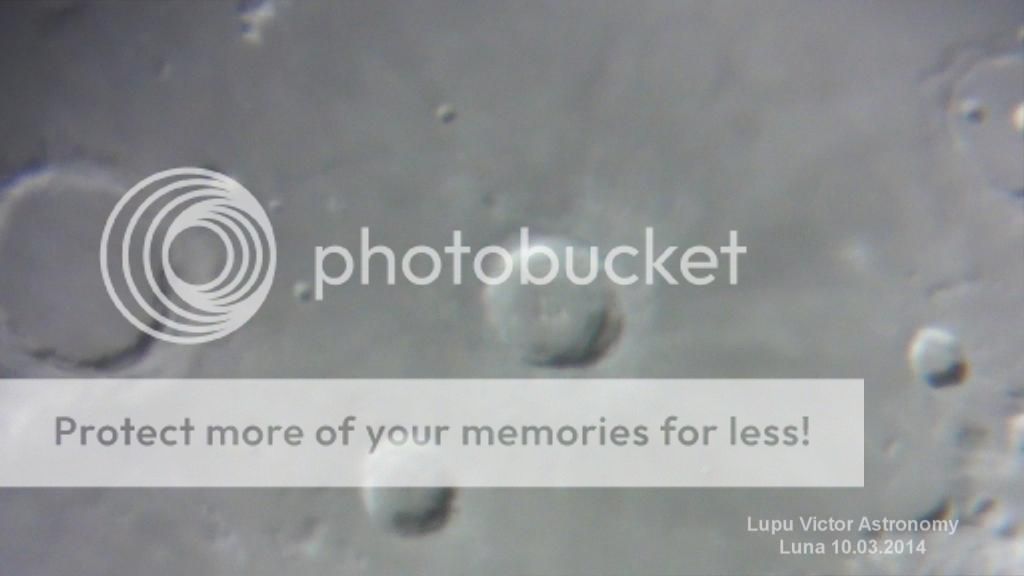
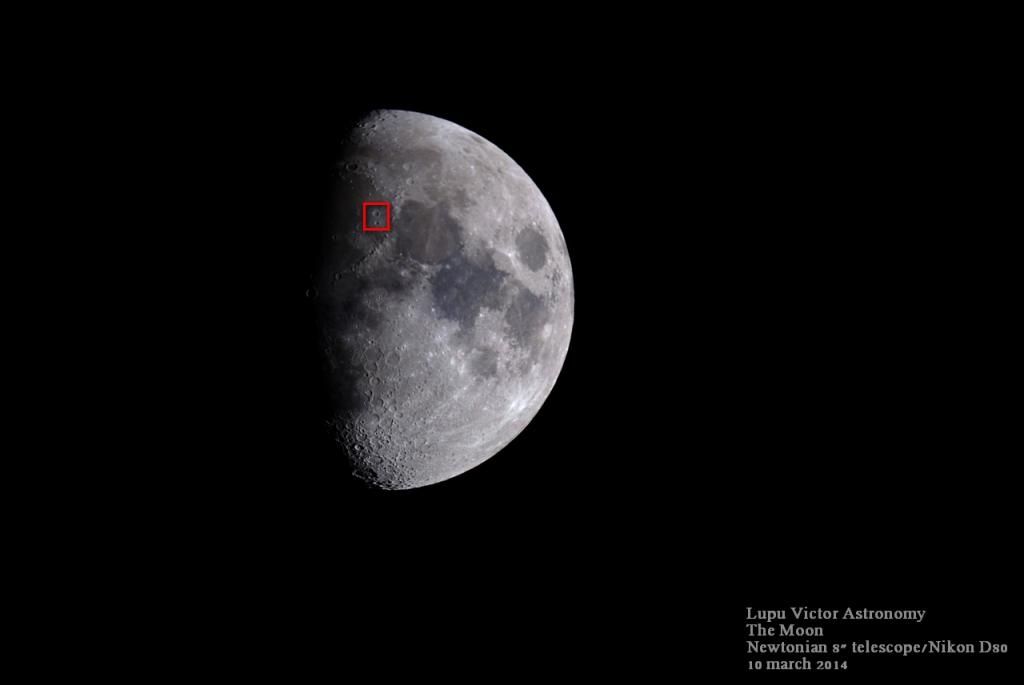
The images depict west area of Montes Caucasus on the Moon, where we meet Aristillus and Autolycus craters, and the larger crater Archimedes, located on Mare Imbrium.

The area is "quiet", without too many rough terrain and craters. Here you see the light rays that start from the crater Aristillus over the smooth plateau of Imbrium basin.

Moon Age: 9.05 days
Phase: 70.5% (0% = New, 100% = Full)
Distance: 399.221 km


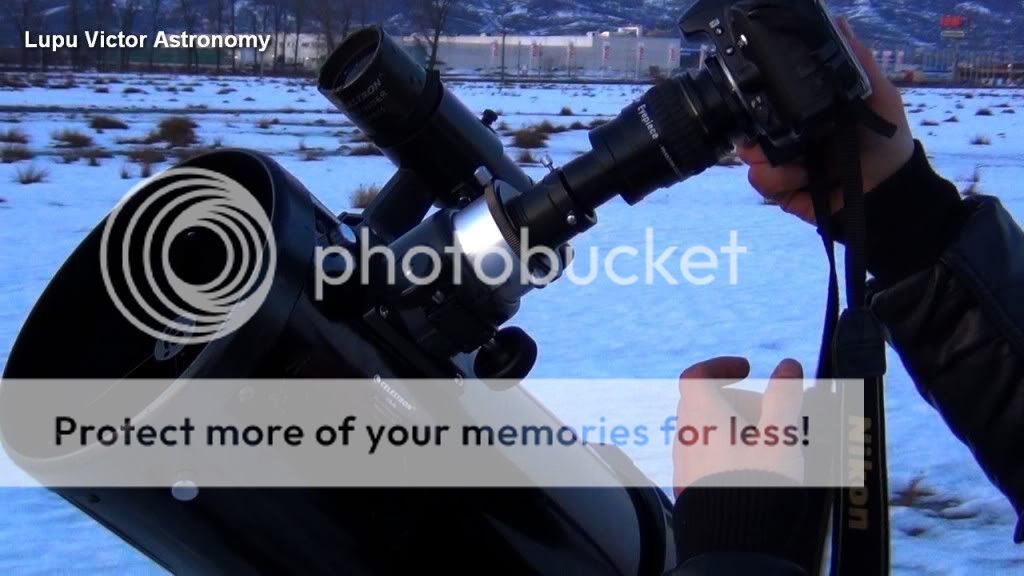
Optics (telescope or lenses): Celestron C8-Newtonian telescope, eyepiece 20mm Plossl, 2x barlow
Mount: CG5 (EQ5)
Camera: Sony CX130
Filter: no
Date: 10/03/2014
Location: Baia Mare, Romania
Processing: Registax,  FastStone Image Viewer


Wednesday, 5 November 2014

Photos of the Moon through the telescope. Crater Archimedes.


Archimedes (83 km) is located on a "clean" area except its western part, on which are some heights called Montes Archimedes, named after the crater.

This crater is the largest of all that are on Mare Imbrium, and is a circular flooded one without central peaks, but only very small craters scattered on its floor. On the floor we can observer some whitish stains, which are most likely remnants of the impact that created the crater Autolycus (39 km), at east.


Moon Age: 9.05 days
Phase: 70.5% (0% = New, 100% = Full)
Distance: 399.221 km


Optics: Celestron C8-Newtonian telescope, 20mm Plossl, 2x barlow
Mount: CG5 (EQ5)
Camera: Sony CX130
Filter: no
Date: 10/03/2014
Location: Baia Mare, Romania
Processing:  FastStone Image Viewer


Image from July 20, 2011.


Sunday, 28 September 2014

Astronomy for beginners. Aristillus and Autolycus on the Moon.


Aristillus and Autolycus (55/39 km) are two craters on the Moon's northern hemisphere. They are positioned so that they can be confused by those that are just beginning to know craters, with Aristoteles and Euxodus (87/67 km), which are located to the north-east, just that those are much larger.
Southwest of the two, is located Archimedes (83 km), with a smooth crater floor because it was flooded by lava.

Moon Age: 9.05 days
Phase: 70.5% (0% = New, 100% = Full)
Distance: 399.221 km


Optics: Celestron C8-Newtonian telescope, 20mm Plossl, 2x barlow
Mount: CG5 (EQ5)
Camera: Sony CX130
Filter: no
Date: 10/03/2014
Location: Baia Mare, Romania
Processing: FastStone Image Viewer


Image from 20 July 2011


Wednesday, 21 August 2013

Telescope images of crater Archimedes

19 frames, at 90 best quality in Registax.

12 frames, at 90 best quality in Registax.


If you reached this page, it means that you were interested in the craters of the Moon, or the name of the personalities of these craters: Archimedes, and Autolycus Aristillus.

These beautiful craters located on the eastern Mare Imbrium basin, are easily observed by an 8-inch telescope.

The bigger one, is Archimedes (83 km), a large circular crater, situated on the northern mountains with the same name, but not seen in the image. Around of Archimedes, there are several smaller satellite craters.

The crater is called after Archimedes, a mathematician, physicist, inventor, engineer and astronomer, born in 287 years before Christ.

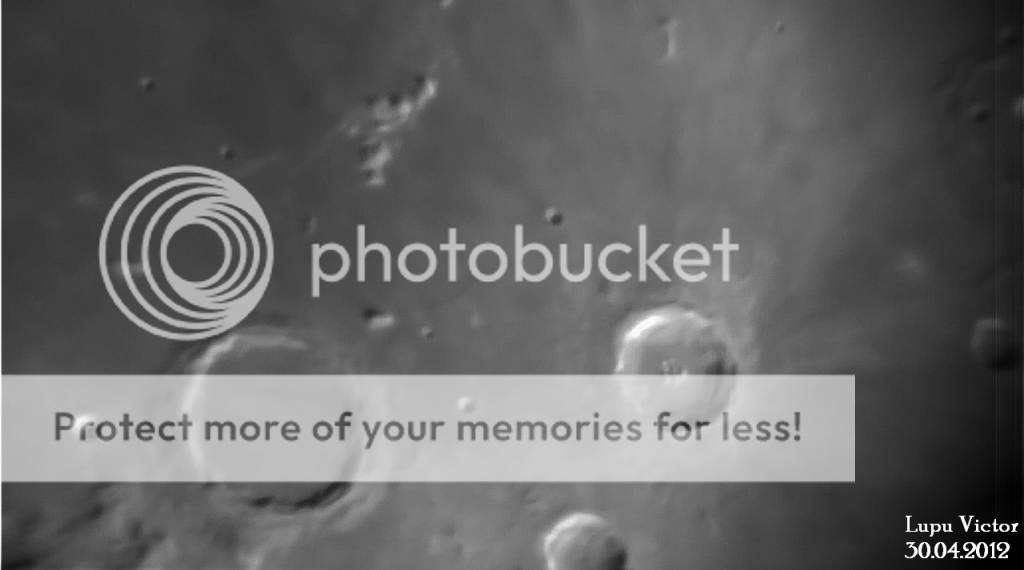
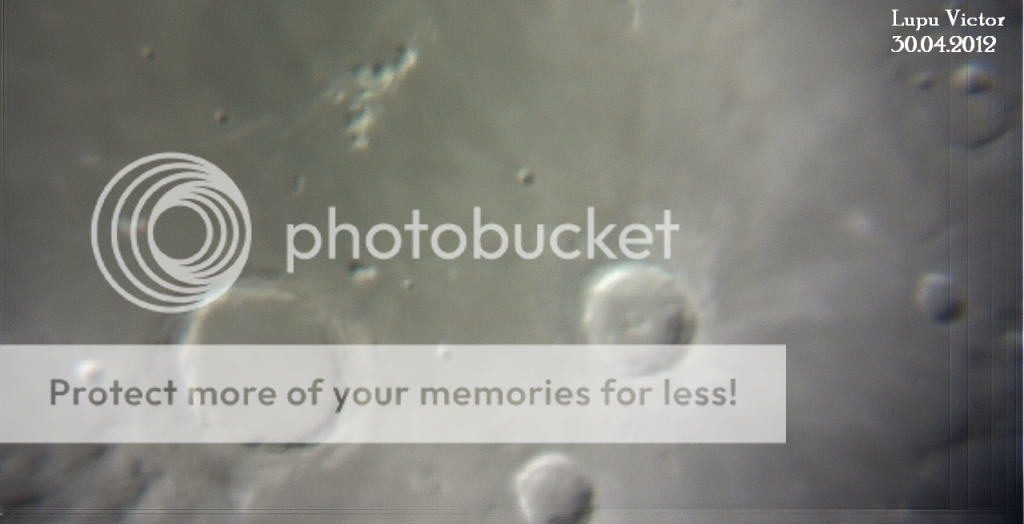
Note the isolated mountains north of Archimedes. Here are the Montes Spitzbergen and are sectioned to the south. Aristillus and Autolicus, unlike the Archimedes are not flooded. They therefore don't have a smooth floor.

  Aristillus (55 km) has several peaks centrally located on the floor and interior walls are nice terraced. This crater shows rays from the impact that caused the crater; albedo rays are more intense in the northeast. This crater has its name from Aristillus, an astronomer has been born 261 years before Christ, being contemporary with Archimedes.

Autolycus (39 km), a smaller crater, located south of Aristillus, has a floor full of low peaks. Autolycus is a name given from Greek mythology, and is translated as "wolf himself." He was the son of Hermes.

Between Archimedes, Montes Spitzbergen and Aristillus with Autolycus is Lacus Lunicus, which is not distinct or clearly delineated, but is an area on Mare Imbrium, which was given this name.

Images are processings in Registax that have taken some shots from a video, merged to form a single image. The first picture is processed black and white and the second is color.

Image from July 20, 2011.


Age of the Moon: 8 days
Phase: 62% (0% = New, 100% = full)
Distance: 379.486 km


Optics: Celestron C8-Newtonian telescope, 20mm Plossl, 2x Barlow
Mount: CG5 (EQ5)
Camera: Sony CX130
Filter: no
Date: 30/04/2012
Location: Baia Mare, Romania
Processing: Registax, FastStone Image Viewer


Friday, 7 December 2012

Video by telescope crater Archimedes AstroInfo

A beautiful trio of craters, is in the western part of Mare Imbrium, crater Archimedes (83km) with it's smooth floor, prominent impact crater Aristillus (55km) with its central peaks, terraced walls and system of rays, and the smaller Autolycus (39 km). Montes Spitzbergen are 60 km long mountains, with peaks up to 1500 m, which in video are observed at the top of the screen, named because of their similarity to Spitzbergen Islands.

Archimedes, is a beautiful crater with flat floor, flooded with lava, which dominates the south-east of Mare Imbrium. The floor is ribbed with many rays of light emanating from Autolycus, at east, and have three very small craters, near the inner wall. The floor is flat with no features, even at very low angles of illumination.

Aristillus, is a magnificent crater, with slightly polygonal edges and a large interior wall that displays contoured terraces and has a central compact group of mountains which rise on the smooth floor.


Optics: CelestronC8 "-Newtonian telescope, plossl20mm, 2x Barlow
Mount: CG5 (EQ5)
Device: Sony CX-130
Video mode: Full HD progressive 1920x1080
Filter: no
Date: 30/04/2012
Location: Baia Mare, Romania
Processing and editing: Sony Vegas 10


Archimedes Crater photo from July 20, 2011.

Monday, 19 March 2012

Registax: Archimedes Autolycus and Aristillus through astronomical telescope.


Picture 1-3: 259 frames, 90% Lowest quality.

In these pictures of the Moon's surface, are craters located on the northern hemisphere. Craters are apparently close to each other.
Aristillus, unlike the Autolycus, that is smaller, below Aristillus, shows the center of some central peaks. An interesting feature of Aristillus, is the north-east wall, on which sis seen two channels, forked on the outside and down the crater to its floor, they are joined. Most likely, in this channel, lava once flowed.

On the floor of the crater Archimedes, it seems that someone has gone over it with a  broken bag of flour. The horizontal white stripes in the crater, can be only be ejection soil  that spread from onother crater  afterviolent impact.
Region between the three craters, is called Sinus Lunicus.

 Montes Spitzbergen is a high formation north of Archimedes, a distance of a crater, and they are solitary mountains located on Mare Imbrium.


Photographer: Victor Lupu
Optics: Celestron C8 inch reflector telescope-Newtonian, plossl 20mm, 2x Barlow
Mount: CG5 (EQ5)
Camera: Sony HDR CX105 to 8x optical zoom
Total Magnification: 800x
Filter: No
Date: 20/07/2011
Location: Baia Mare, Romania
Processing: Registax

Saturday, 25 February 2012

Montes Apenninus Registax Observational astronomy Telescope images.


Date: February 15, 2011, Registax 54 frames to 85% Lowest quality.

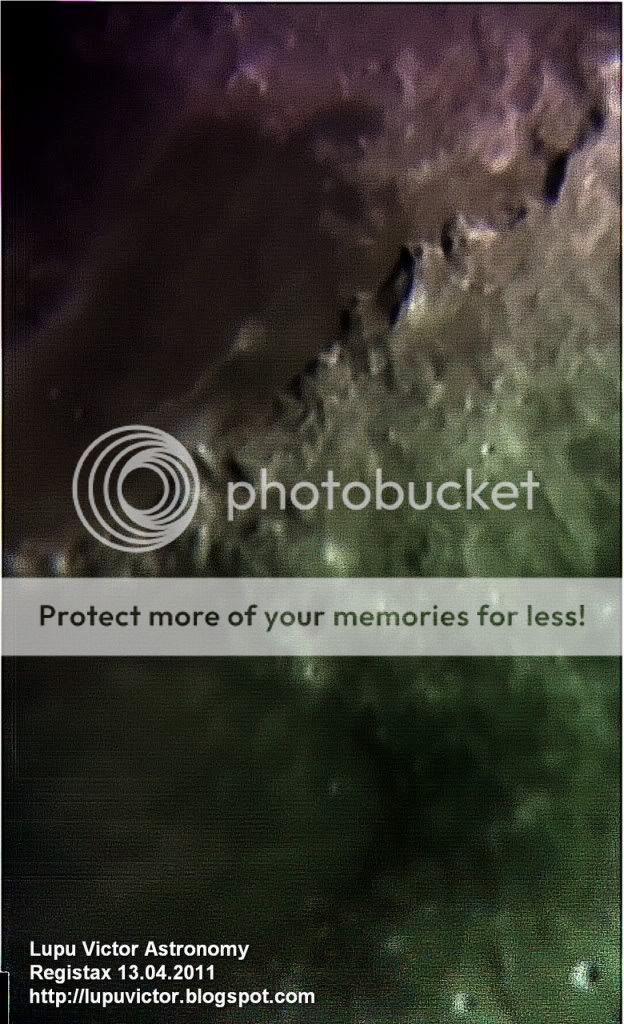
In the images of this article, Montes Apenninus are photographed on different days, and that is why the shadows fall different on mountains. Because of that, some features are visible in some pictures, but in others, not.

In pictures processed in Registax above, the Sun is at a lower angle, and the shadow of mountains stretch more than their shadow in pictures below, where the Sun is at an angle higher, and less features are visible . For example, in the pictures above, along with Apenninus massive mountains at north, goes a broken mountain chain, that in the pictures below is almost nonexistent.

Date: April 13, 2011, 127 frames Registax Lowest 90% quality.

Photographer: Victor Lupu
Optics: Celestron C8-Newtonian telescope, plossl 20mm, 2x Barlow
Mount: CG5 (EQ5)
Device: Sony CX105
Filter: no
Location: Baia Mare, Romania
Processing: Sony Vegas 10, Registax


Thursday, 23 February 2012

VideoAstro Sinus Lunicus and Aristillus Autolycus and Archimedes lunar craters through the telescope.

The three craters Aristillus, Autolycus and Archimedes are close to each other on the north central Moon seen from Earth, and forms a triangle in the center of which is a depression called Sinus Lunicus.

      Sinus Lunicus-de 126 km (in Latin "Lunik Bay"), is a large lunar area, along the southeast edge of Mare Imbrium. It consists of the area bounded by the southwest craters Archimedes southwest, Autolycus southeast, and Aristillus at northeast. Golf is open to the northwest, and meet Montes Spitzbergen, a small mountain range.

This gulf was called Bay of Lunik by International Astronomical Union (IAU) in 1970 to honor the landing of the first space probe that has made contact with another interplanetary body. Luna 2 landed between Archimedes and Autolycus craters on September 14, 1959.


Video: Victor Lupu
Optics: CelestronC8 "-Newtonian telescope, plossl20mm, 2x Barlow
Mount: CG5 (EQ5)
Device: SonyCX105 at 7x optical zoom
Total Magnification: 700x
Filter: no
Date: 20/07/2011
Location: Baia Mare, Romania
Processing and editing: Sony Vegas 10

Friday, 1 April 2011

Aristillus and Autolycus craters

Photographer: Victor Lupu
Optics: Celestron C8-Newtonian reflector telescope, plossl 20mm, 2x Barlow
Mount: CG5 (EQ5)
Device: Sony HDR CX105
Filter: No
Date: 09/02/2011
Location: Baia Mare, Romania
Processing: Registax 18 frames at 90% lowest quality


        Aristillus (55 km.) big-bottom-foto, is a prominent lunar crater that lies to the east of Mare Imbrium. To the north in photo is Autolycus (39 km), smaller, while on the northeast is Archimedes (83 km.), which is not visible in the shaddow.Montes Caucasus are in the photo left, and above are Montes Apenninus.
      Aristillus's edge is large, irregular exterior is relatively easy to distinguish due to the surrounding flat surface. The impact created a ray system that extends over a distance of 600 kilometers. The edge is generally circular in shape. In the middle of the crater are three peaks, which have a height of about 0.9 km.
       Autolycus is a lunar impact crater that is located in the south-east of Mare Imbrium.


All images are © Copyright 2010-2015 Lupu Victor. All rights reserved.Images may not be reproduced, published, or copied in any form without written permission of the author. Thank you for respecting the intellectual property rights. ASTROFOTOGRAFIA | Lupu Victor Astronomy - Contact - About
Design by Free WordPress Themes | Bloggerized by Lasantha - Premium Blogger Themes | Online Project management