Visit Worldwide Topsites
Showing posts with label Craters-Deslandres and Lexell. Show all posts

Wednesday, 18 February 2015

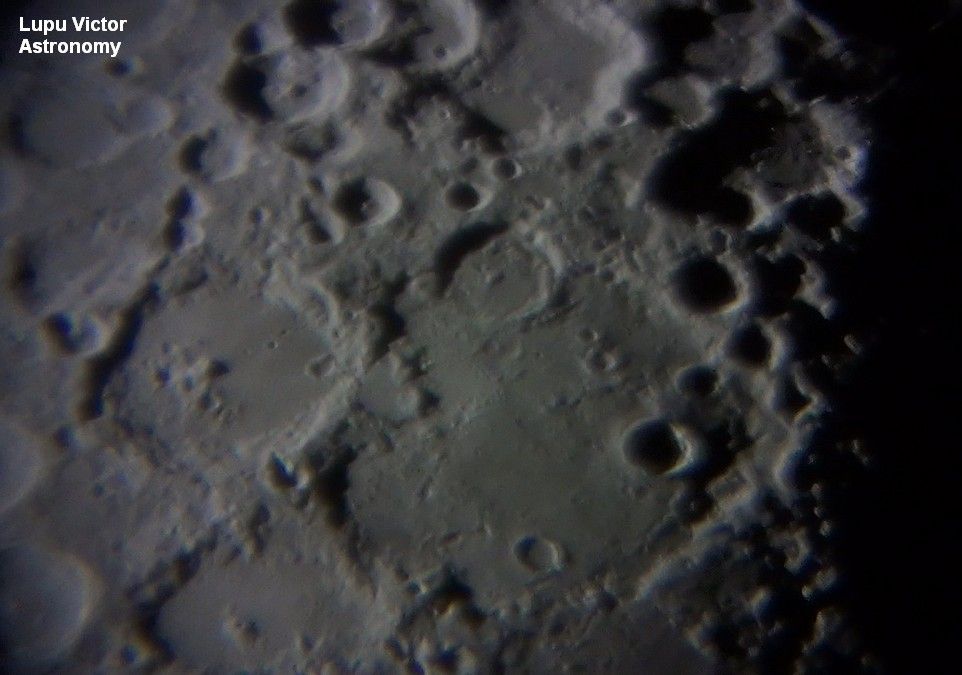
Lunar craters. Images by astronomical telescope. Deslandres (Registax).

145 video frames in Registax.
195 video frames in Registax.
1 video frames in Registax.
143 video frames in Registax.

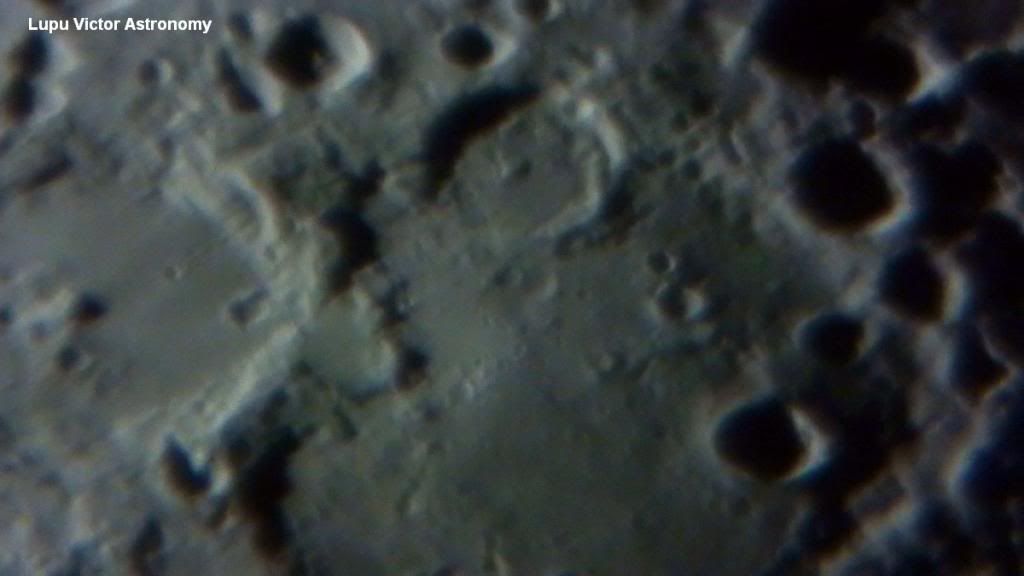
Of course, the most impressive feature that captures your attention in these images is the huge crater Deslandres (256 km). Despite its size, it can not be detected by simple binoculars, but through an astronomical telescope. This is not strange because Deslandres, even if it is very large, is not quite so deep to be distinguished visually observed when using a small power instrument, and thus is easily confused by the surrounding land.

Deslandres is a remnant of a crater, very affected. It is located south-east of the Mare Nubium on the southern part of the Moon.

In size, it is the second-largest crater on the visible Moon after Bailly crater, which is 303 km.

Other neighboring craters of this huge crater, are Oronţius (122 km), Walther (128 km), Sasserides, Regiomontanus (126 km), Pitatus (97 km) and Ball (41 km). . Embedded in Deslandres crater, are small crater Hell (33 km), and Lexell (63 km).

These images processed in Registax are extracted from a video which can be viewed here.
Simple video capture in this article are posted here.

Info Deslandres crater.

Coordinates32.5°S 5.2°
Diameter256 km
DepthUnknown
Colongitude5° at sunrise
EponymHenri A. Deslandres

Moon Age: 9.05 days
Phase: 70.5% (0% = New, 100% = Full)
Distance: 399.221 km


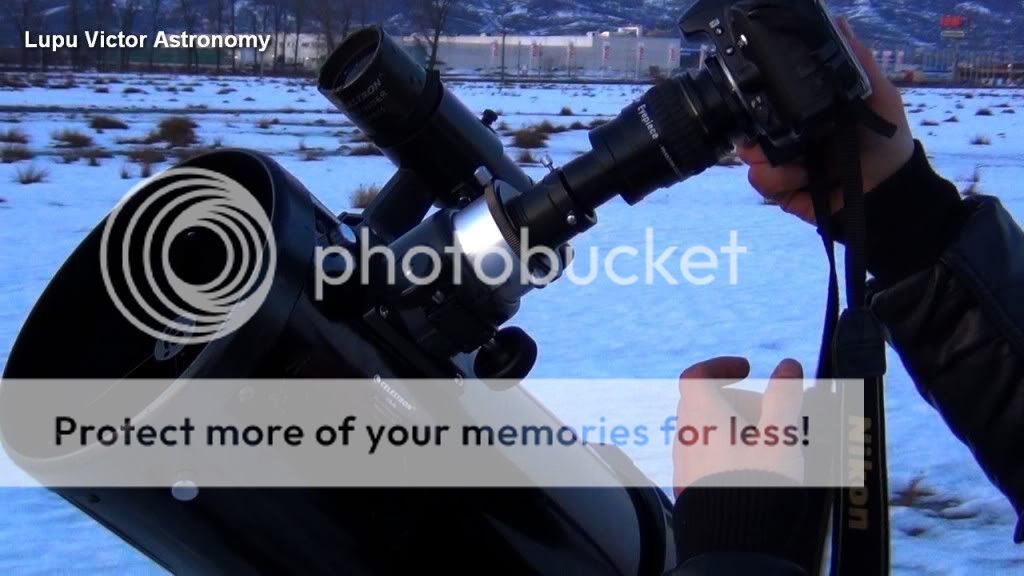
Optics (telescope or lenses): Celestron C8-Newtonian telescope, eyepiece 20mm Plossl, 2x barlow
Mount: CG5 (EQ5)
Camera: Sony CX130
Filter: no
Date: 10/03/2014
Location: Baia Mare, Romania
Processing: Registax,  FastStone Image Viewer


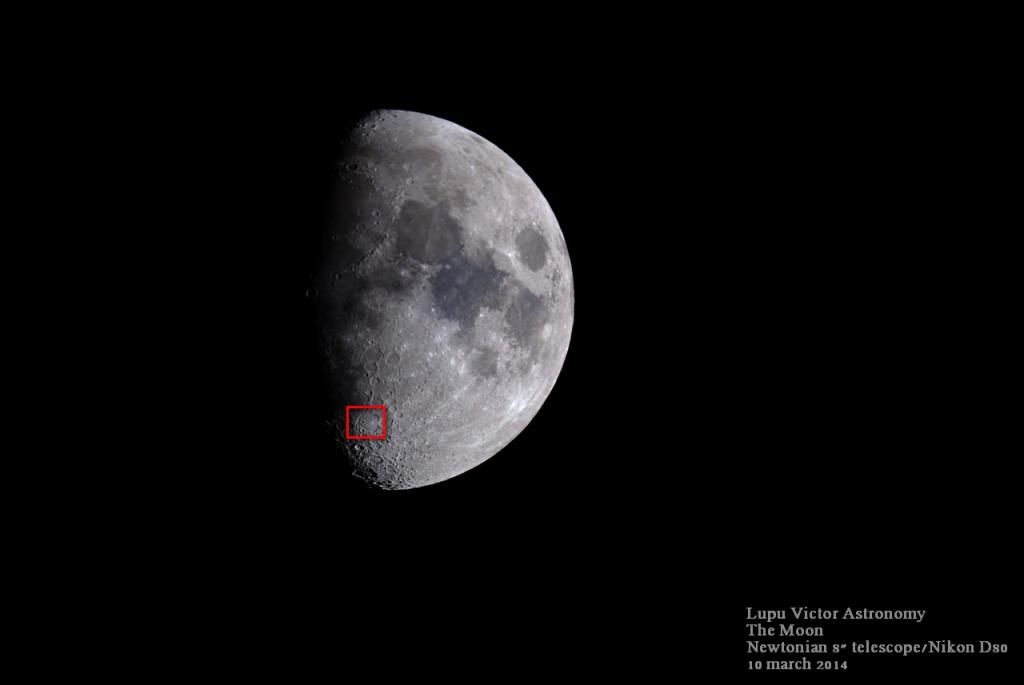
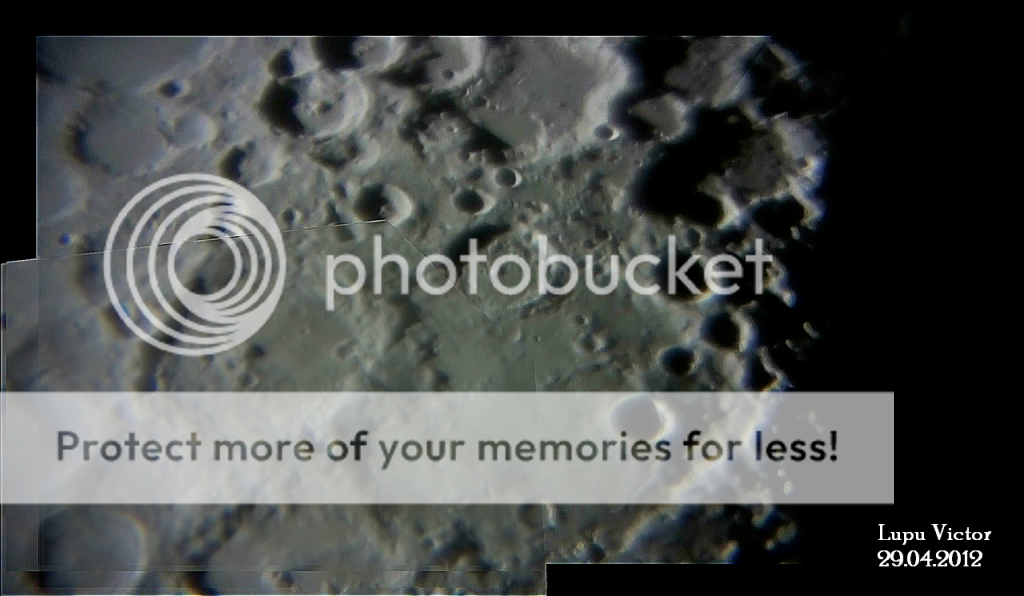
Image for orientation dated April 29 2012.

Astronomy moon craters telescope Deslandres


Monday, 8 September 2014

Huge crater Deslandres on the Moon. Images by telescope.


It is very easy to locate craters with their name, in the image below.

In these images crater Deslandres (234 km) dominates the area. It is the "lying heart" as I like to call it, and I think it is not hard to figure out why. It is framed here only three quarters of this huge crater.

Deslandres crater name is given from Henri Alexandre Deslandres (July 24, 1853 - January 15 1948). It was during his life a French astronomer, director of astronomical observatories in Meudon and Paris, who conducted intensive studies of the behavior of the Sun's atmosphere.

Another crater that I have discussed in other articles, is Pitatus (97 km), whose floor is beautifully observed with central peaks.

Info Deslandres crater.
Coordinates32.5°S 5.2°
Diameter256 km
DepthUnknown
Colongitude5° at sunrise
EponymHenri A. Deslandres


Image for orientation from 29 april 2012.


Moon Age: 9.05 days
Phase: 70.5% (0% = New, 100% = Full)
Distance: 399.221 km


Optics: Celestron C8-Newtonian telescope, 20mm Plossl, 2x barlow
Mount: CG5 (EQ5)
Camera: Sony CX130
Filter: no
Date: 10/03/2014
Location: Baia Mare, Romania
Processing: FastStone Image Viewer


Monday, 14 October 2013

Sony handycam Astrophotography. Deslandres near terminal.

98 frames, 85% best quality in Registax.
520 frames, 90% best quality in Registax.
2 frames, 100% best quality in Registax.


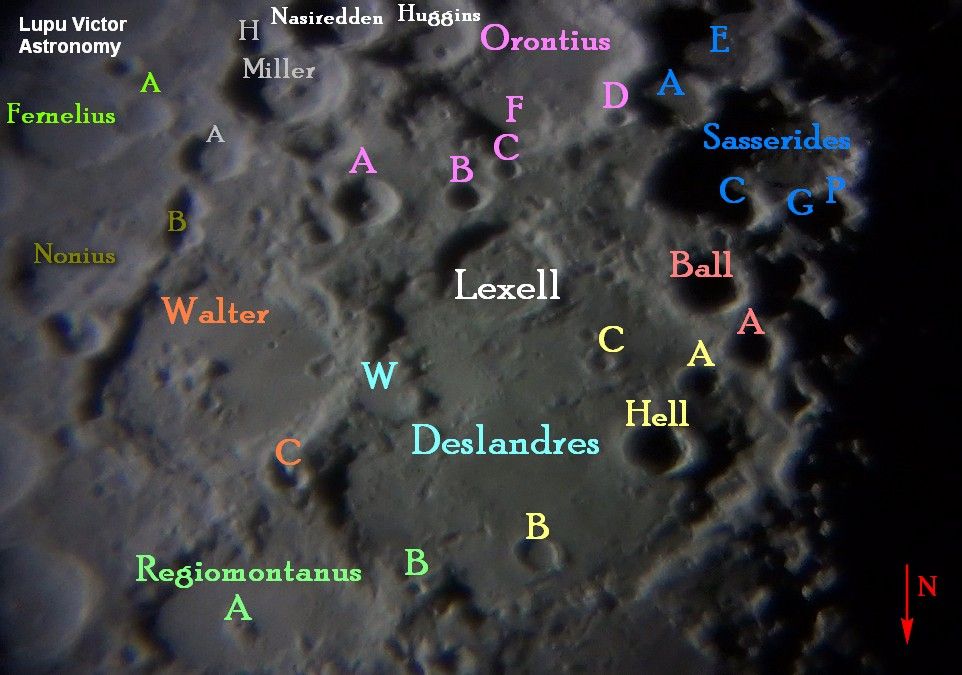
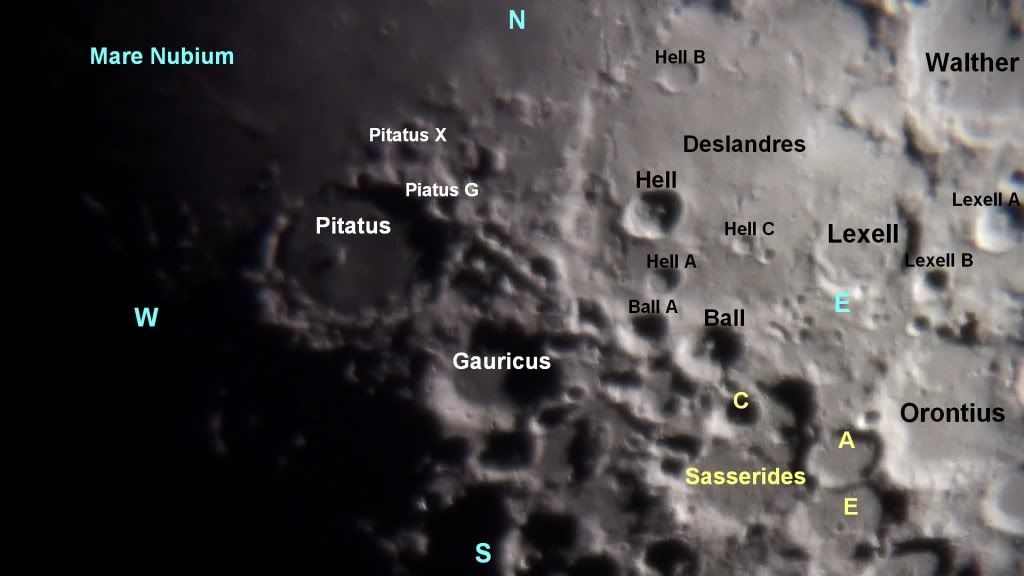
The processed video images above are much clearer than the video captures from another article. We can notice the difference in the still image below, in which I labeled each crater.

In these images that are upside down as seen through the telescope, are craters situated on the southern hemisphere of the Moon, where they are numerous, deep and large.

The large "heart" lying on the right side is a heavily eroded crater which was  formed by a major impact, Deslandres, a crater whose features are well brought out in the light on this Moon phase, and in which the terminal is near the crater, at east.

On the uneven floor of Deslandres
(234 km), we observe the smaller one, Hell (33 km), whose name fits here, being fully submerged in darkness, as Ball crater (41 km), located at the outer edge on the west of Deslandres.

Other craters visible images are Orontius
(122 km), Sasserides (90 km), Walther, Regiomontanus
(128/126 km).  
Video captured images: Deslandres and the surrounding craters. Astronomical telescope images.

Info Deslandres crater.
Coordinates32.5°S 5.2°
Diameter256 km
DepthUnknown
Colongitude5° at sunrise
EponymHenri A. Deslandres

Age of the Moon: 7 days
Phase: 51% (0% = New, 100% = Full)
Distance: 384.488 km


Optics: Celestron C8-Newtonian telescope, 20mm Plossl, 2x Barlow
Mount: CG5 (EQ5)
Camera: Sony CX130
Filter: no
Date: 29.04.2012
Location: Baia Mare, Romania
Processing: Images in Registax, FastStone Image Viewer


Video capture.


Monday, 18 February 2013

Deslandres and the surrounding craters. Astronomical telescope images


These images are very clear, as the camera focus was bestIn the pictures here, we have the huge crater Deslandres (234 km) north of the bright crater Tycho.  To view the telescope video of these photos, go here.

A very bright rays of Tycho with high albedo, are spread on the whole region, but these are not seen in the photos because of the Moon phase at that time, when the Sun was at a low angle.

The picture below explains in great detail all craters located inside of Deslandres, and neighbors, as I labeled them each name with color. Images are inverted as seen through the telescope.

As you can see, this area is very rich in craters of all sizes, feature which is common to the south of the Moon. In these pictures, are craters like: Lexell, Sasserides, Walther, Orontius, Hell, Nonius and others.

Info Deslandres crater.
Coordinates32.5°S 5.2°
Diameter256 km
DepthUnknown
Colongitude5° at sunrise
EponymHenri A. Deslandres


Moon age: 7 days
Stage: 51% (0% = New, 100% = Full)
Distance: 384.488 km

Optics: Celestron C8-Newtonian telescope, 20mm Plössl, 2x barlow
Mount: CG5 (EQ5)
Camera: Sony CX130
Filter: no
Date: 29/04/2012
Location: Baia Mare, Romania
Processing: video captures, FastStone Image Viewer

Thursday, 26 July 2012

HD telescope video with heart-shaped Deslandres crater on the Moon.

The video images of this article are upside down (north and south are reversed), as seen through the telescope. Images were stabilized in Sony Vegas 10, because the mount wasn't motorized. The quality of our atmosphere was very good and that is why the lunar surface details are clear.

 Deslandres (234 km), is a desintegrated crater of pre-Nectarian era, and is one of the largest craters on the Moon. I like to think it has a heart shape. Also note in the video below, the eroded crater Lexell (63 km) on its southeastern edge and Hell (33 km), a smaller crater, named for astronomer Maximilian Hell, on the west. Hell Crater, shows a central peak in the center, but not visible due to the shadow that covers the crater floor. You may also notice a line of small craters on the eastern crater floor of Deslandres.


Video: Victor Lupu
Optics: CelestronC8 "-Newtonian telescope, plossl20mm, 2x Barlow
Mount: CG5 (EQ5)
Device: Sony CX-130
Video mode: Full HD progressive 1920x1080
Filter: no
Date: 29/04/2012
Location: Baia Mare, Romania
Processing and editing: Sony Vegas 10


Other large craters in this video, can be identified in the photo below, as Walther, Regiomontanus, Nonius, Sasserides and Orontius.

                                    The picture below was made on May 11, 2011.

Wednesday, 10 August 2011

Video-Deslandres Pitatus and Lexell lunar craters


        Lexell crater is inside the large crater Deslandres and at west is Pitatus.

These clips are made in the same evening of May 11 and the atmosphere was not very good, but in each one are times when the clarity is good.
Deslandres crater has a heart-shape lying on the right,as it is sleeping; as shown in the last video, the "heart" occupies the entire screen ..This was my first impression when I looked first time at it.
In the last video image is reversed.

Wednesday, 13 July 2011

Walther Purbach Aliacensis and Werner lunar craters

Photographer: Victor Lupu
Optics: Celestron C8-Newtonian telescope, plossl 20mm, 2x Barlow
Mount: CG5 (EQ5)
Device: Sony CX105
Filter: No
Date: 11/05/2011
Location: Baia Mare, Romania
Processing: Sony Vegas 10 captures video
Walther, Purbach ,Regiomontanus , Aliacensis and Werner are neighboring craters, but also with Deslandres and Blanchinus. The area they are in is full of huge craters. A tourist would certainly not be bored when he gets there .At least for climbing the "mountains" that separate craters between them.

Saturday, 9 July 2011

Deslandres and Lexell craters

Fotograf: Victor Lupu
Optica: telescop Celestron C8-newtonian, plossl 20mm, Barlow 2x
Montura: CG5 (EQ5)
Aparat: Sony CX105
Filtru: nu
Date: 11.05.2011
Locatie: Baia Mare, România
Procesare: Sony Vegas 10, video captures
        Deslandres (256 km) is a lunar crater affected and distorted. It is located southeast of Mare Nubium on the rugged southern highlands of the Moon. It is the second largest crater on the visible Moon from Earth after crater Bailly (303 km). It is marked by cracks with numerous craters. There is a small area of basalt lava material along the eastern interior floor.
Walther crater is attached to the east, and Ball, on south vest.
The remnant crater Lexell is on south-east edge, forming a "port". Regiomontanus crater is attached to the irregular edge northeast of Deslandres.Crater Hell lies entirely within the crater to the west.

 
All images are © Copyright 2010-2015 Lupu Victor. All rights reserved.Images may not be reproduced, published, or copied in any form without written permission of the author. Thank you for respecting the intellectual property rights. ASTROFOTOGRAFIA | Lupu Victor Astronomy - Contact - About
Design by Free WordPress Themes | Bloggerized by Lasantha - Premium Blogger Themes | Online Project management