Visit Worldwide Topsites
Showing posts sorted by date for query almanon. Sort by relevance Show all posts

Wednesday, 21 January 2015

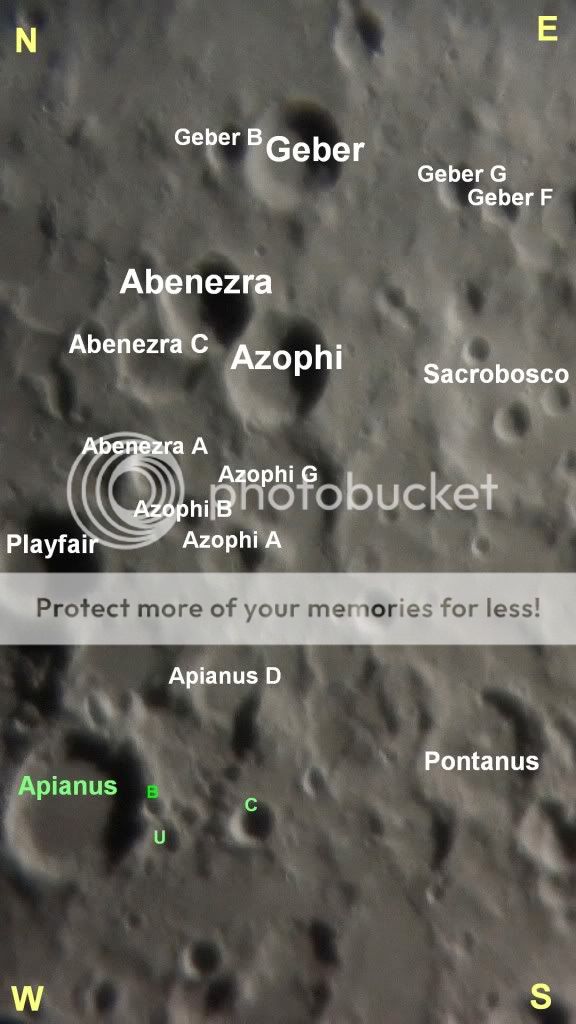
Astrophotography Registax. Craters by telescope: Abenezra and Azophi.

120 video frames, in Registax.
Moon craters telescope astronomy geber abenezra azophi
1 video frames, in Registax.
Moon craters telescope astronomy geber abenezra azophi
20 video frames, in Registax.

The images capture some craters on the face of Moon, similar in shape and size. Almost like you could tell at first glance, that were formed all at the same time. The inner edges of these craters are opened at an open angle, like brioche molds.

These are Geber, Abenezra, Azophi (45/42/48 km) and Almanon (49 km). Abenezra C (44 km) is obviously older than Abenezra because Abenezra is superimposed over half of it.

The area is very bright, and so the land has a milky appearance, which I like very much.

We can also watch the video of which I took these pictures in another article, but also simple video captures. In this article are presented images processed in Registax of that video.

Moon craters telescope astronomy geber abenezra azophi
250 video frames, in Registax.

Moon Age: 9.05 days
Phase: 70.5% (0% = New, 100% = Full)
Distance: 399.221 km


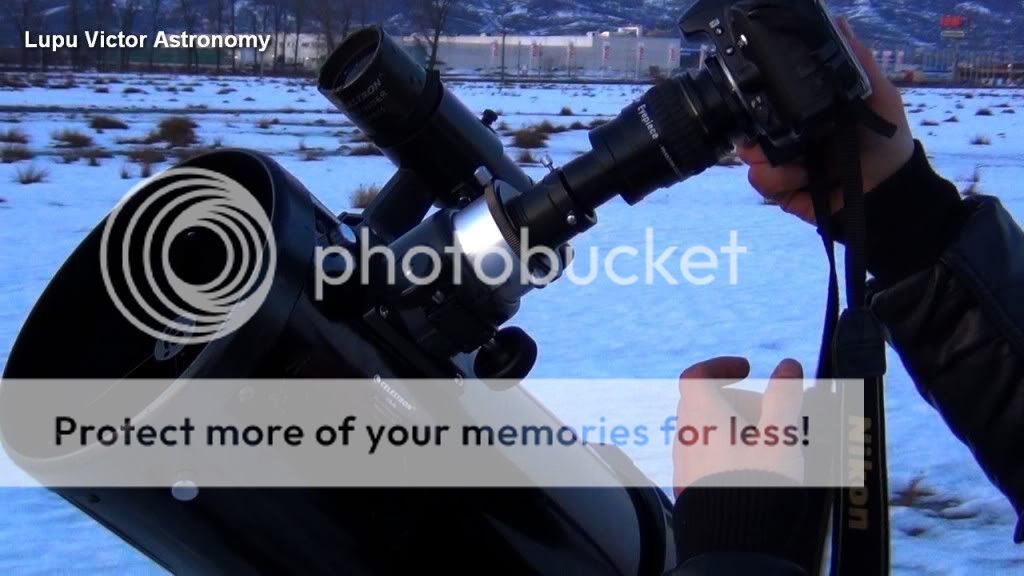
Optics (telescope or lenses): Celestron C8-Newtonian telescope, eyepiece 20mm Plossl, 2x barlow
Mount: CG5 (EQ5)
Camera: Sony CX130
Filter: no
Date: 10/03/2014
Location: Baia Mare, Romania
Processing: Registax,  FastStone Image Viewer


Tuesday, 24 June 2014

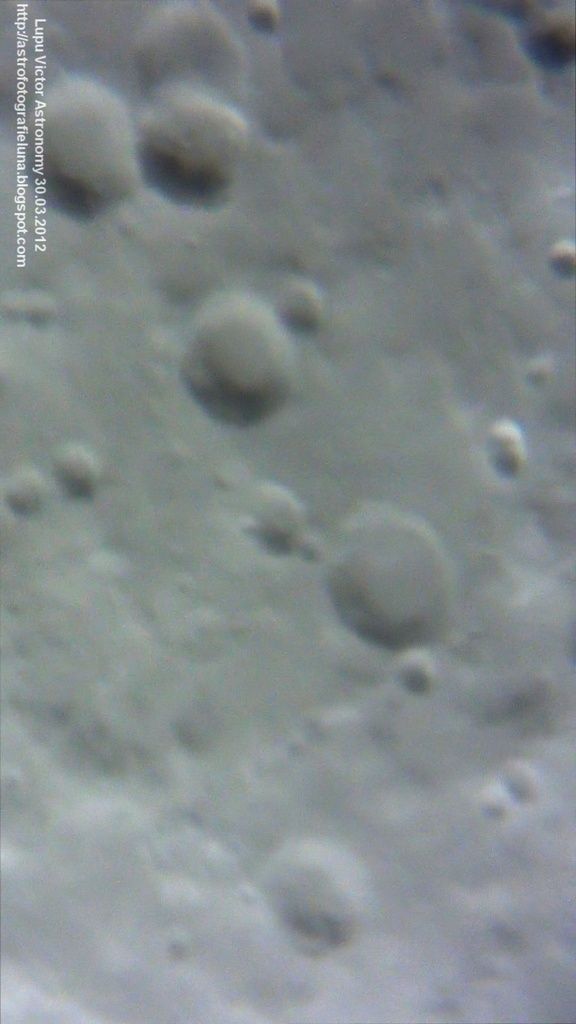
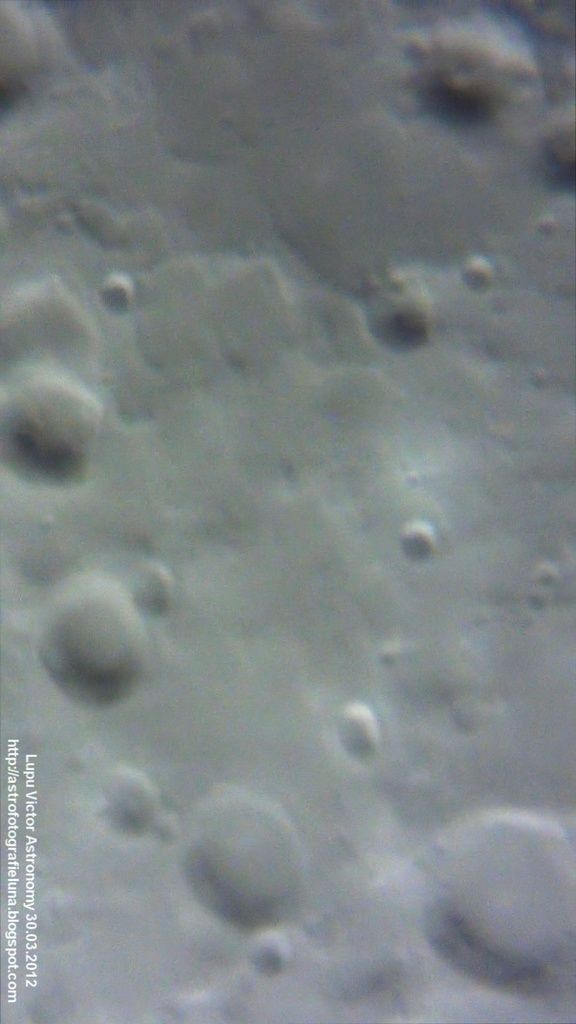
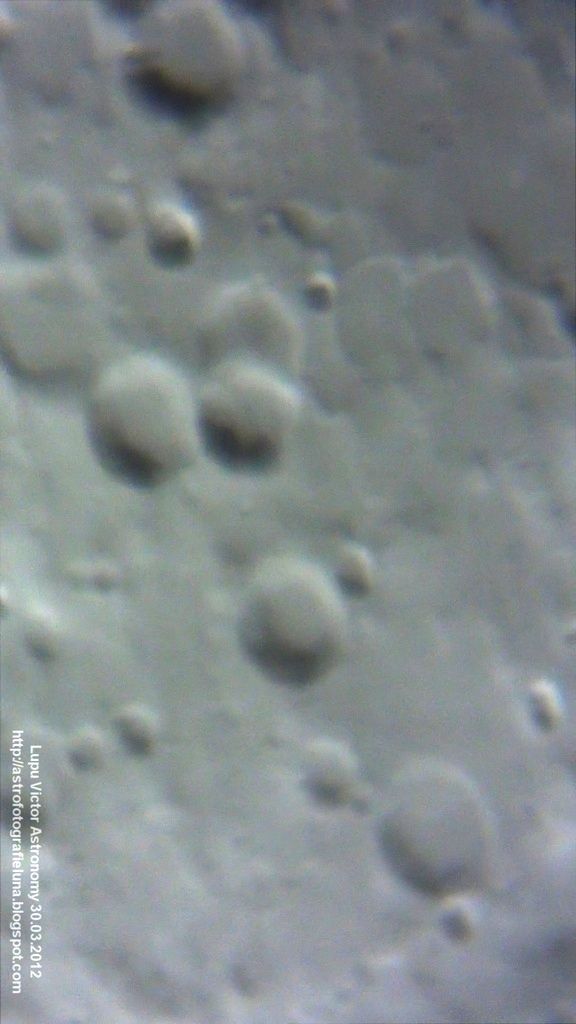
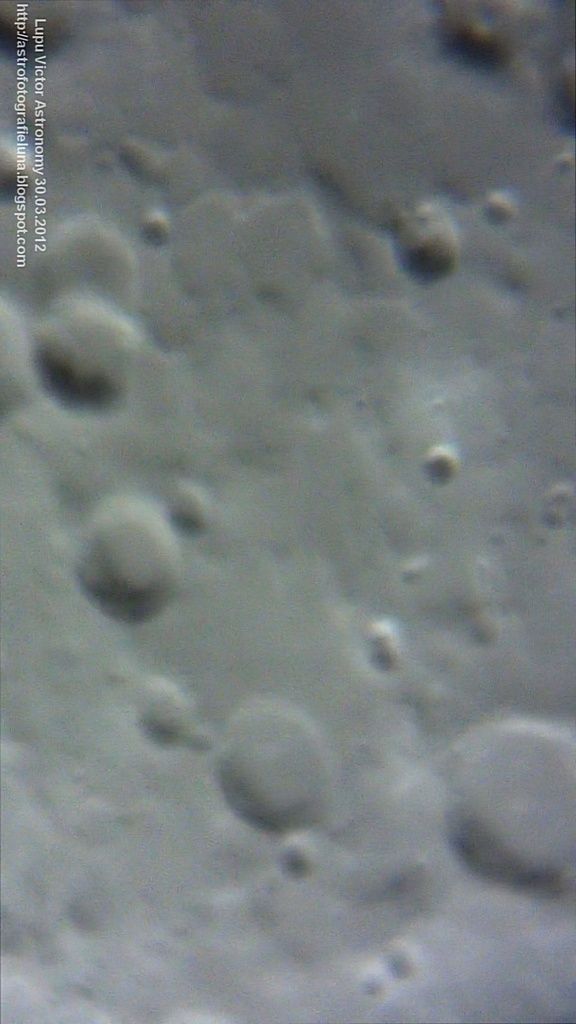
Lunar craters filmed through a telescope: Abenezra, Azophi and Geber.


Abenezra (42 km), Azophi (48 km), Geber (45 km), Abulfeda and Almanon (49 miles) are just a few craters seen in these images taken by the astronomical telescope, images that landmark south-central area of the Moon .

Many of these craters resemble each other in size, some are straddling each other, as Abenezra over Abenezra C (44 km).

We note here Almanon crater with its satellite craters Almanon A (10 km) and B (25 km) south of it, and C (16 km) stuck to east edge.

Crater that I like to watch here, is Geber, which is the most ordered of all, having the floor free of other small craters and lacks a central peak and its edge is almost perfectly circular.


Optics: Celestron C8 "-Newtonian telescope, 20mm Plossl, 2x Barlow
Mount: CG5 (EQ5)
Device: Sony CX-130
Video Mode: Full HD 1920x1080 progressive
Filter: no
Date: 30/03/2012
Location: Baia Mare, Romania
Processing and editing: Sony Vegas 10 FastStone


Image from 12 mai 2011.


Wednesday, 17 April 2013

List of Moon's center features. Astronomy lecture

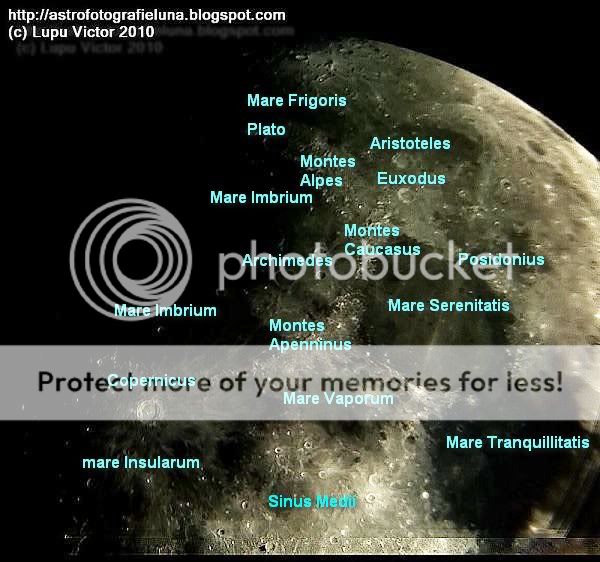
Craters at the center of the lunar disk, as seen from the Earth, are the most visible because their entire structure is facing us, revealing the floors and their perfect detail, even with a modest telescope. On the center, there are many features, such as mountains, seas (mare) and large craters. Apenninus Mountains are easily spotted, and craters as Eratosthenes, Copernicus, the great crater Ptolemaeus but others that can be found in the lists below.

The craters on the Moon are named after great personalities of the branch of science such as astronomers, mathematicians, inventors and not only.

The results of the links may not have as title the craters, mountains or other features you are looking for, but in the content of the articles, those features are presented.


Craters of the Moon's center area.


Abulfeda
Agrippa
Almanon
Andel
Aratus
Albategnius
Alpetragius
Alphonsus
Argelander
Arzachel
Airy
Blagg
Bode
Bonpland
Bowen
Bruce
Bumham
 
Cone
Conon
Copernicus
Davy
Delambre
Dembowsky
Dollond
Eratosthenes
Flammarion
Fra Mauro
Gambart
Gay Lussac
Godin
Gylden
Halley
Herschel
Hind
Hipparchus
Horrocks
Hyginus
Klein
Lade
Lalande
Lassell
Lindsay
Marco Polo
Mosting
Muller
Murchison
Oppilzer Pallas
Pallas
Palissa
Parrot
Pickering
Playfair
Ptolemaeus
Reamur
Reinhold
Rhaeticus
Ritchey
Saunder
Schroter
Seeliger
Sommering
Sporer
Stadius
Sulpicius Gallus
Taylor
Thebit
Triesnecker
Turner
Ukert
Vogel
Wallace


Seas of the Moon's center area.

Mare Vaporum
Mare Nubium
Mare Cognitum
Mare Insularum
Mare Imbrium


Mountains of the Moon's center area

Montes Apenninus
Montes Carpatus
Montes Riphaeus


Other forms of relief on the center area of the Moon.

Sinus Aestuum
Sinus Fidei
Sinus Medii
Lacus Felicitatis
Lacus Odii
Lacus Doloris
Promotorium Taenarium
Rupes Recta
Rimae Alphonsus
Rimae Ariadaeus
Rimae Bode
Rimae Vladimir
Rimae Bradley
Rimae Flammarion
Rimae Gay Lussac
Rimae Hadley
Rimae Hyginus
Rimae Oppolzer
Rimae Yangel
Rimae Parry
Rimae Reamur
Rimae Schroter
Rimae Sulpicius Gallus
Rimae Triesnecker


Space missions on the center area of the Moon.

Apollo 11
Apollo 12
Apollo 14
Apollo 15
Apollo 16
Apollo 17

Luna 5 (1965) USSR due to a malfunction, it crashed on the lunar surface.

Ranger 7 (1964) USA- intentionally crashed, and successfully sent 4308 images with a resolution of up to 0.5m.

Surveyor 3 (1967) USA has landed successfully transmitted images to Earth 6326.

Apollo 14 USA-Extravehicular Activity (EVA). On February 5, 1971, the crew of Apollo 14 landed on the lunar surface in the Fra Mauro formation near Cone crater.


To see the photographic map of the center area of the Moon, view: Photographic map of the Moon: Center Zone. Lunar Atlas.


For those who like my astro pictures or my articles, it woul be great if you could pay attention on advertising that appear in the blog by a click and maybe one day I could buya better telescope.

Saturday, 17 November 2012

Photos by telescope Craters around Nectaris basin


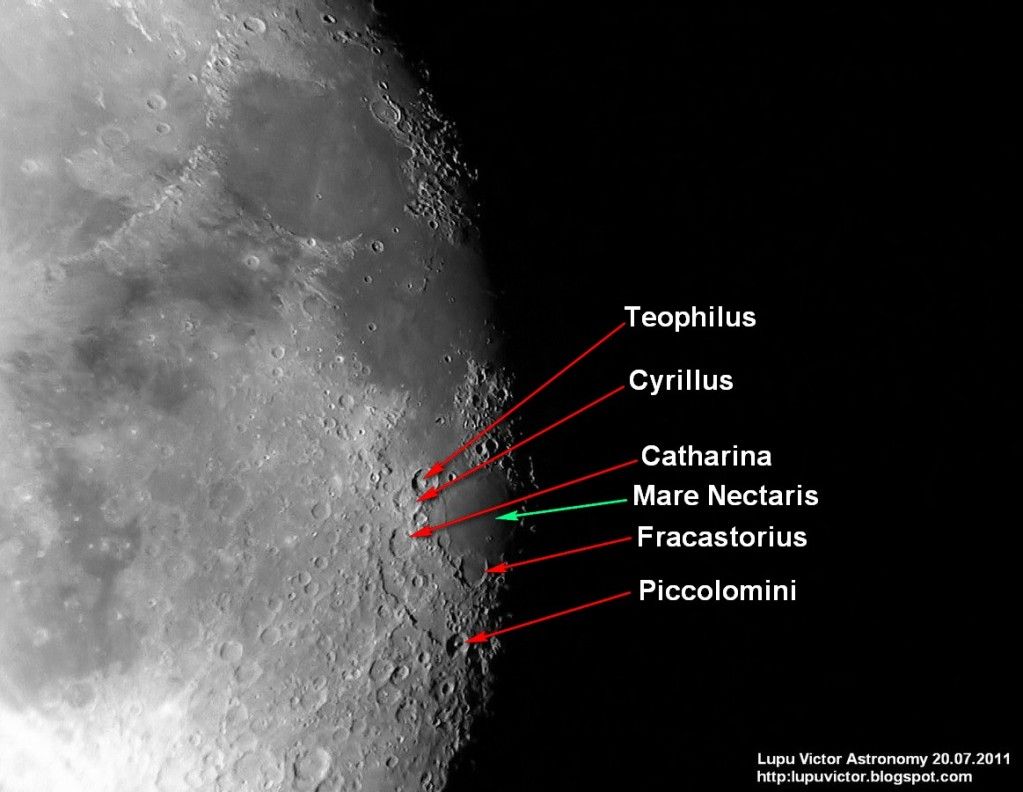
Piccolomini, Rupes Altai, Janssen, Theophilus, Cyrillus, Catharina, Fracastorius, are just some of the features around Mare Nectaris, visible in these video caprtures.

Abulfeda and Almanon craters are in the dark in these images, and just inside the western edges are lit by the sun.
Mare Nectaris (Sea of Nectar), is dating back 3.9 billion years, framed by several rings of lava formed after the impact. It is a small, well-defined circular basin with an affected southern edge forming a large bay, Fracastorius crater (124 km). Mare Nectaris joins Sinus Asperitatis north.

Rupes Altai is 480 kilometers long, with somewhat a sinuous wall along much of its length. Is parallel to the southwestern border of Mare Nectaris, and actually forms a part of the external ring of Nectaris basin.


Optics: Celestron C8-Newtonian telescope, 20 mm Plössl, 2x barlow
Mount: CG5 (EQ5)
Camera: Sony CX130
Filter: no
Date: 04/27/2012
Location: Baia Mare, Romania
Processing: video capture, FastStone Image Viewer


Wednesday, 4 July 2012

All astronomy labels Images Videos News

These are all astronomy labels in one page. If they are too many and did not fit on the main page of the site.You can choose to press 'Ctrl-F' to find what you are interested in.


3D Moon in 3Dfication program(2)About me(6)Accessories(3)Astronomical calendar 2012(1)Astronomical Observatories(1)Astronomical Phylosophy(1)Astronomy news(13)Astronomy Questions and Answers(1)Astronomy terms(2)Astrophotography cameras(2)Astrophotography without telescope(4)Conjunctions(2)Contact me(1)Craters(162)Craters of the center(35)Craters of the east(25)Craters of the north pole(32)Craters of the south pole(50)Craters of the west(29)Craters-Abulfeda and Almanon(4)Craters-Albategnius(4)Craters-Alexander(1)Craters-Apianus(5)Craters-Archimedes(6)Craters-Archytas and Timaeus(2)Craters-Aristarchus and Herodotus(2)Craters-Aristillus and Autolycus(4)Craters-Aristoteles and Eudoxus(8)Craters-Arzachel Thebit and Rupes Recta(5)Craters-Bailly(2)Craters-Balmer and Vendelinus(4)Craters-Biela(2)Craters-Boussingault(9)Craters-Bullialdus(2)Craters-Burg(1)Craters-Byrgius(2)Craters-Capuanus and Palus Epidemiarum(4)Craters-Casatus and Klaproth(2)Craters-Cassini and Vallis Alpes(5)Craters-Catharina(4)Craters-Clavius(7)Craters-Cleomedes(4)Craters-Condorcet(5)Craters-Copernicus(7)Craters-Crüger(1)Craters-Dalambre Taylor and Dolland(1)Craters-Deslandres and Lexell(3)Craters-Endymion(4)Craters-Eratosthenes and Sinus Aestuum(4)Craters-Firmicus and Apollonius(3)Craters-Flammarion Mösting Gyldén and Réaumur(1)Craters-Fracastorius(1)Craters-Furnerius(2)Craters-Gassendi(7)Craters-Geber Abenezra and Azophi(1)Craters-Goldschmidt and Anaxagoras(8)Craters-Grimaldi(6)Craters-Guericke and Parry(1)Craters-Gutenberg(1)Craters-Gärtner and Democritus(1)Craters-Hainzel(3)Craters-Heraclitus and Licetus(6)Craters-Hercules and Atlas(7)Craters-Hommel and Pitiscus(1)Craters-J. Herschel(1)Craters-Janssen(3)Craters-Julius Caesar(4)Craters-Kepler(4)Craters-Langrenus(3)Craters-Letrone(1)Craters-Lilius(1)Craters-Macrobius(4)Craters-Manilius(3)Craters-Manzinus and Curtius(2)Craters-Maurolycus and Barocius(6)Craters-Menelaus(5)Craters-Messala and Geminus(1)Craters-Moretus(9)Craters-Nearch Jacobi and Boguslawsky(3)Craters-Oenopides(1)Craters-Orontius(4)Craters-Pallas and Murchison(3)Craters-Pentland Scott and Demonax(3)Craters-Petavius(7)Craters-Philolaus(2)Craters-Phocylides and Nasmyth(5)Craters-Piccolomini(5)Craters-Plato(7)Craters-Plinius(4)Craters-Pontecoulant(2)Craters-Posidonius(5)Craters-Proclus(6)Craters-Ptolemaeus Alphonsus and Alpetragius(5)Craters-Reinshold and Lansberg(1)Craters-Rhaeticus(1)Craters-Rheita and Metius(5)Craters-Sasserides and Gauricus(1)Craters-Scheiner(4)Craters-Schickard(10)Craters-Schiller(6)Craters-Scoresby(1)Craters-Steinheil and Watt(2)Craters-Stevinus and Snellius(3)Craters-Strabo and Thales(1)Craters-Stöfler and Maurolycus(2)Craters-Theaetatus and Calippus(3)Craters-Theophilus and Cyrillus(4)Craters-Triesnecker(4)Craters-Tycho Longomontanus and Maginus(12)Craters-Vega(3)Craters-Vieta Mersenius and Cavendish(2)Craters-Vlacq and Rosenberger(2)Craters-W.Bond and Meton(6)Craters-Walther Purbach and Regiomontanus(6)Craters-Wilhelm and Pitatus(2)Craters-Wolf(1)Craters-Zucchius Bettinus Kircher(2)Download astronomy softwares(3)DSLR astronomy pictures(10)Eclipses(6)Eclipses-Lunar(4)Eclipses-Solar(1)Equipment(5)Eyepieces(1)Gallery(12)Gallery- Mosaics(2)Gallery-DSLR(17)Gallery-Registax(21)Gallery-Snapshots(12)How to(7)How to edit a picture(2)How to know names of Moon craters(1)How to maintain Newtonian telescope's mirror(1)How to mount DSLR to the telescope(1)How to take pictures of the Moon(1)How to work astrophotography(1)Lacus Excellentiae(1)Lacus Mortis(1)Lacus Somniorum(2)Lacus Timoris(1)Lakes on the Moon(1)Lunar atlas Center maps(1)Lunar atlas East maps(1)Lunar atlas North maps(1)Lunar atlas South maps(1)Lunar atlas West maps(1)Map of the Moon craters(1)Mare Australe(1)Mare Crisium(7)Mare Fecunditatis(1)Mare Frigoris(3)Mare Humorum(4)Mare Imbrium(1)Mare Marginis(1)Mare Nectaris(2)Mare Nubium(1)Mare Oceanus Procellarum(3)Mare on the Moon Lunar Seas(2)Mare Serenitatis and Mare Tranquillitatis(6)Mare Smythii(1)Mare Spumans(4)Mare Undarum(4)Mare Vaporum(1)Montes Alpes(3)Montes Apenninus(6)Montes Carpatus(1)Montes Caucasus(3)Montes Haemus(2)Montes Jura(3)Montes Riphaeus(1)Montes Spitzbergen(2)Montes Taurus(1)Moon Art(13)Moon Perigee(1)Moon Sun Halo(1)Mosaics(6)Mountains of the Moon(14)My way of editing Moon photos(4)Occultations(1)Palus Somni(3)Planets(16)Planets-Jupiter(9)Planets-Mars(3)Planets-Saturn(8)Planets-Venus(8)Rupes Altai(4)Sinus Iridium(7)Sinus Lunicus(2)Sinus Medii(1)Sinus Succesus(1)Stars(9)Stars-Aldebaran(1)Stars-Arcturus(2)Stars-Betelgeuse(2)Stars-Casiopeia(1)Stars-Orion(4)Stars-Pleiades(4)Stars-Rigel(1)Stars-Sirius(2)Sunspots(6)Telescopes(1)The colours of the Moon(4)The Moon(9)The Sun(9)Things about the Moon(5)Venus transition 2012(2)Videos of the Moon(120)Weird sightings(3)Wich camera is good for astrophotography?(4)


Thursday, 11 August 2011

Catharina and Geber lunar craters-images

Photographer: Victor Lupu
Optics: Celestron C8-Newtonian telescope, plossl 20mm, 2x Barlow
Mount: CG5 (EQ5)
Device: Sony CX105
Filter: No
Date: 11/05/2011
Location: Baia Mare, Romania
Processing: Sony Vegas 10 video captures

          Catharina (100 km), is a Moon impact crater located in the mountainous south, and is located west between Rupes Altai wich is a steep slope,and Mare Nectaris at east. To the northwest is the Tacitus crater. In the north it borders Cyrillus and Teophillus. Catharina form a prominent group along with the two craters, which are framed by Rupes Altai. There is a difference between the ages of the three craters, their age increasing from north to south.
Catharina's edge is very worn and irregular, especially in the north wall where is Catharina P crater (46 km). Northeast wall is deeply affected by several small craters. The floor is relatively flat with a curved ridge formed by Catharina P.
            Eponymous of this crater is Saint Catherine of Alexandria, also known Holy Great Martyr Catherine, who is a Christian saint and martyr, and is believed to have lived in the early fourth century.
          Geber crater is located halfway between Almanon crater at northeast  and the pair craters Abenezra and Azophi on southwest. Further to the southeast is Sacrobosco. Geber is 45 kilometers in diameter and 3510 meters deep.
The name of the crater comes from Abu Muhammad Jabir ibn Aflaḥ or Geber / Gebir (1100-1150), the Muslim astronomer and mathematician of Seville.

 
All images are © Copyright 2010-2015 Lupu Victor. All rights reserved.Images may not be reproduced, published, or copied in any form without written permission of the author. Thank you for respecting the intellectual property rights. ASTROFOTOGRAFIA | Lupu Victor Astronomy - Contact - About
Design by Free WordPress Themes | Bloggerized by Lasantha - Premium Blogger Themes | Online Project management