Visit Worldwide Topsites
Showing posts with label Craters-Capuanus and Palus Epidemiarum. Show all posts

Sunday, 2 August 2015

West region of the Moon. Registax images.

We talked about this area and other articles such as those in the links below, where we examined the southwest region of the Moon. The difference here is that picture quality is even better since these are Registax processings.

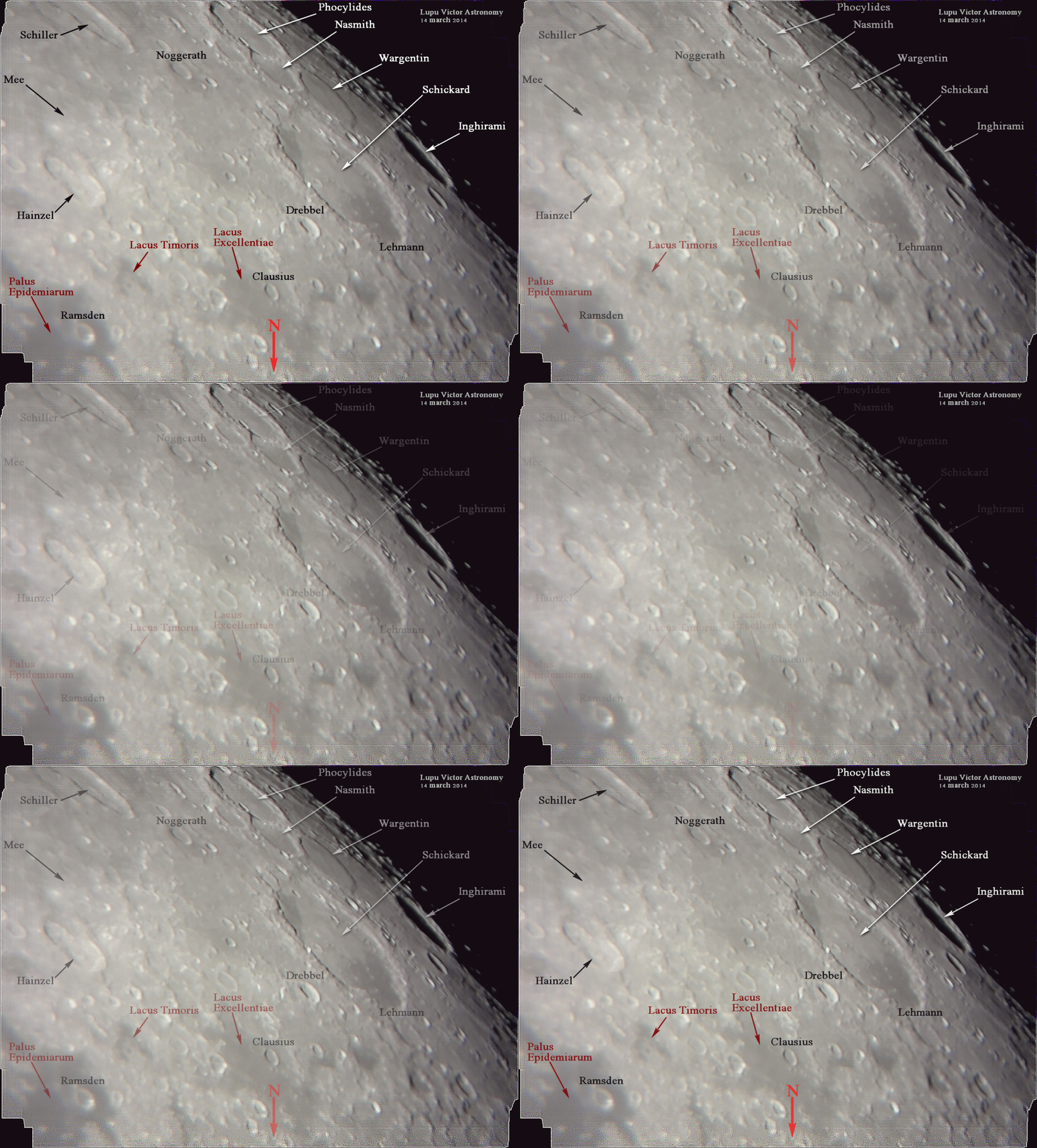
The images are overturned, so therefore cardinal points are reversed, but that's for a more relaxing view of these craters of various sizes. Among them we mention craters like Schickard (227 km) Hainzel (70 km), Noggerath (31 km), Drebbel (30 km), Phocylides and Nasmith (114/77 km) Wargentin (84 km) and Inghirami (91 km). Other features are Palus Epidemiarum, and Lacus Timoris and Lacus Excellentiae.

The video from which I extracted the images are here.
Video captures (snapshots) are here.

2938 video frames in Registax.
1173 video frames in Registax.
2938 video frames in Registax.

Images were obtained by attaching a camera directly into the eyepiece of an astronomical telescope of 8 inch Newtonian; For this reason the eyepiece visual field was increased.

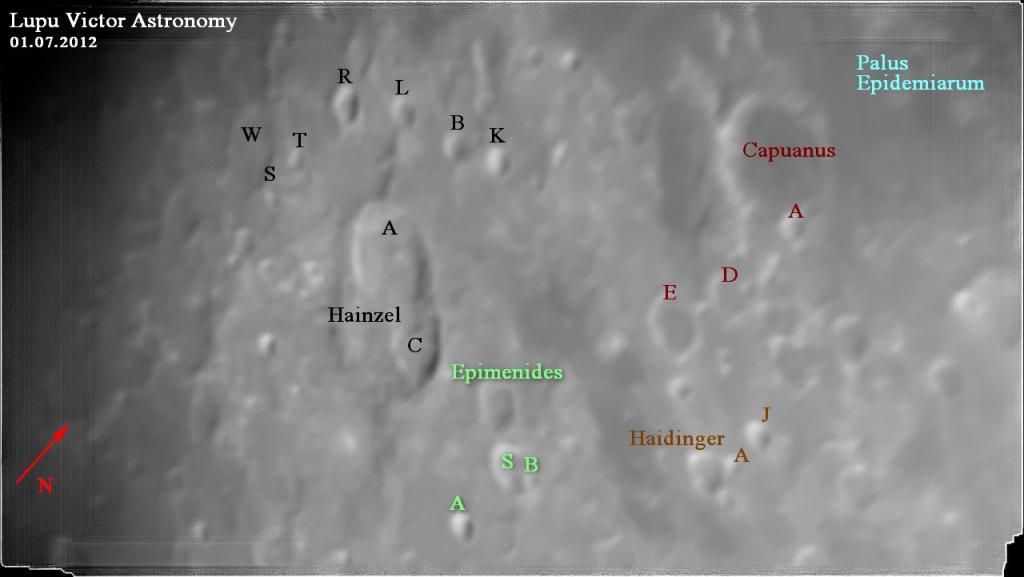
In the picture below are labeled craters and other lunar features in the region. To better understand this photo, you should note that the label with the name or the letter of larger craters could be found at their center, and on the small craters, you should find them around them, usually above.


Magnitude: -12.03
Phase: 70.5% (0% = new, 100% = full)
Distance: 398.311 km
Sidereal Period: 27.32 days
Illuminated: 92.2%


Optics: Celestron C8-Newtonian astronomical telescope 
Eyepiece: Plossl 20mm, 2x Barlow
Mount: CG5 (EQ5)
Camera: Sony CX130
Filter: no
Date: 14/03/2014
Location: Baia Mare, Romania
Processing: Registax, FastStone Image Viewer


Tuesday, 29 April 2014

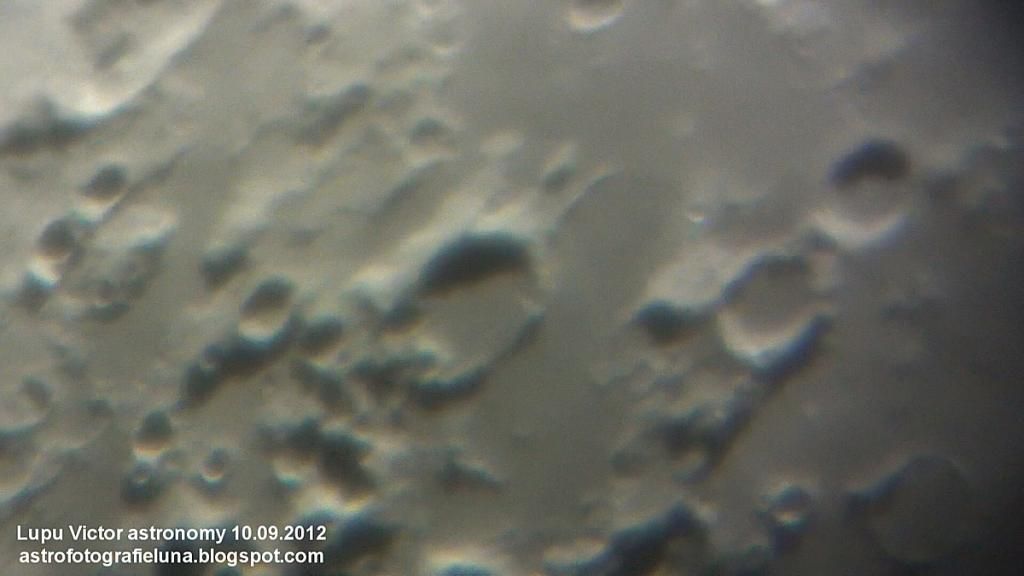
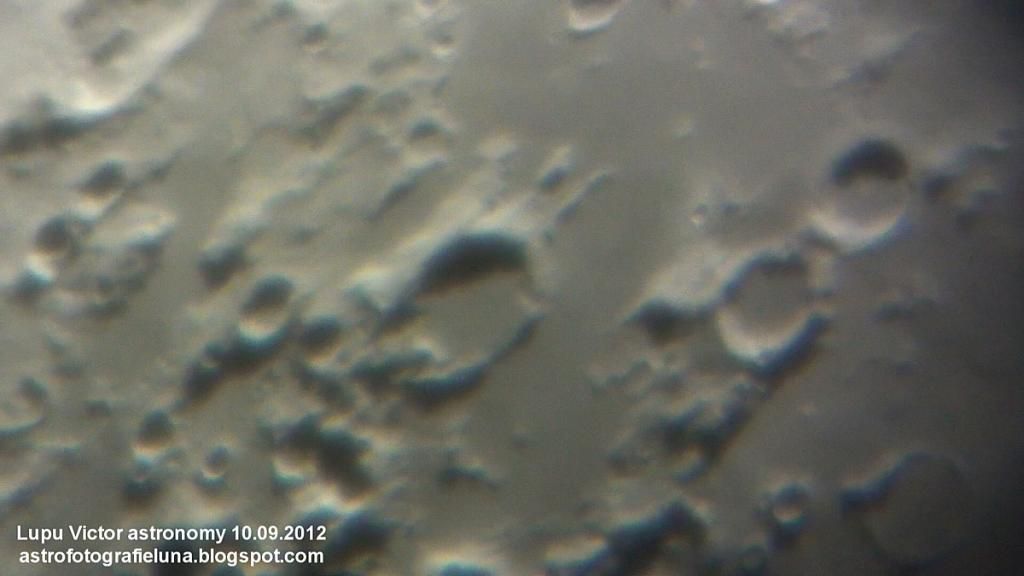
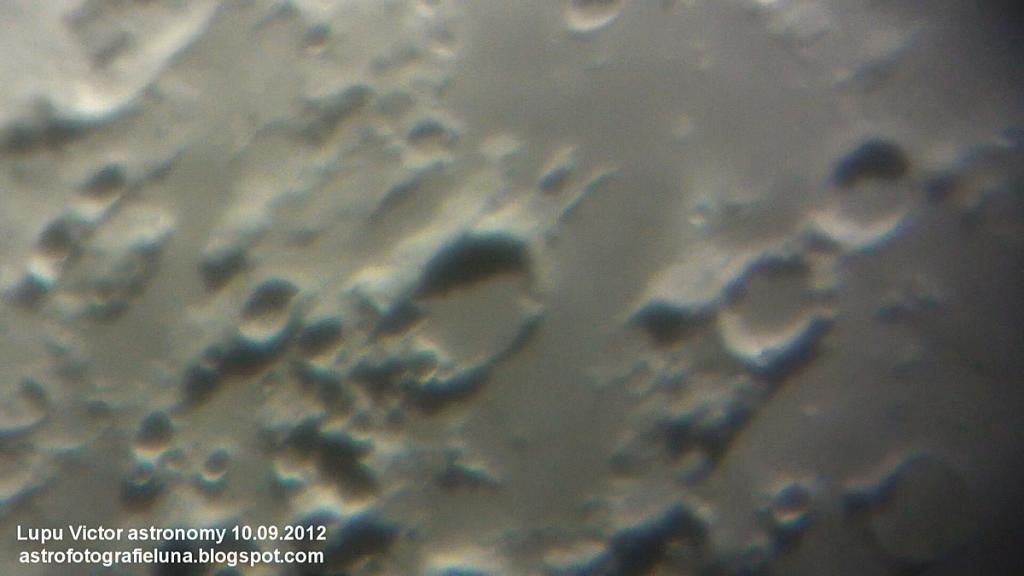
Capuanus Region by astronomical telescope.


I can only describe this area as a beautiful landscape in this light that makes the terrain to be smooth . You would almost say it was done by an architect .


Capuanus (60 km) has a special feature which makes it recognizable every time. This feature is not found on other craters, namely the three mountainous extensions that start from its western edge like fingers . This flooded crater , which has a smooth floor seen in the images, is located on Palus Epimemiarum .

Smaller craters are satellite craters of Capuanus and Cichus .


Campanus and Mercator (48,47 km) , the two craters close to the right side of the image , are also placed here. We can see the floor characteristics at this phase , and their edge , both having similar size but are different in appearance .


The difference between the two is that Mercator (1,8 km in depth) is totally flooded by lava and Campanus not, the last one having a greater depth (2,1 km in depth) and on the floor a central peak .


Distance: 393,696 km
Phase: 26.6% (0% = New, 100% = Full)


Optical Telescope CelestronC8" Newtonian, plossl 20mm, 2x Barlow
Mount: CG5 (EQ5)
Device: Sony CX-130
Video Mode: Full HD 1920x1080 progressive
Filter: no
Date: 10/09/2012
Location: Baia Mare, Romania
Processing and editing: Sony Vegas 10 video captures


Image from March, 23 2013.


Saturday, 15 February 2014

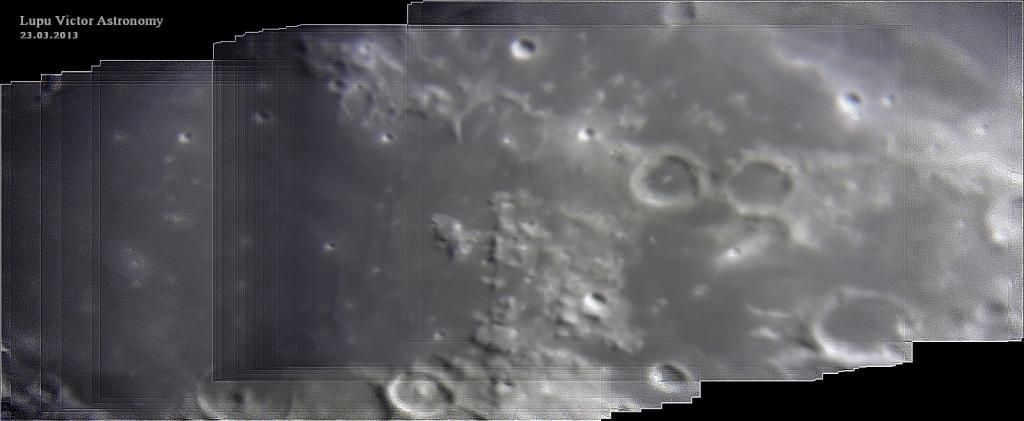
Capturing the Moon: Campanus and Mercator craters.

56 frames at 85% best quality in Registax.
9 frames at 85% best quality in Registax.

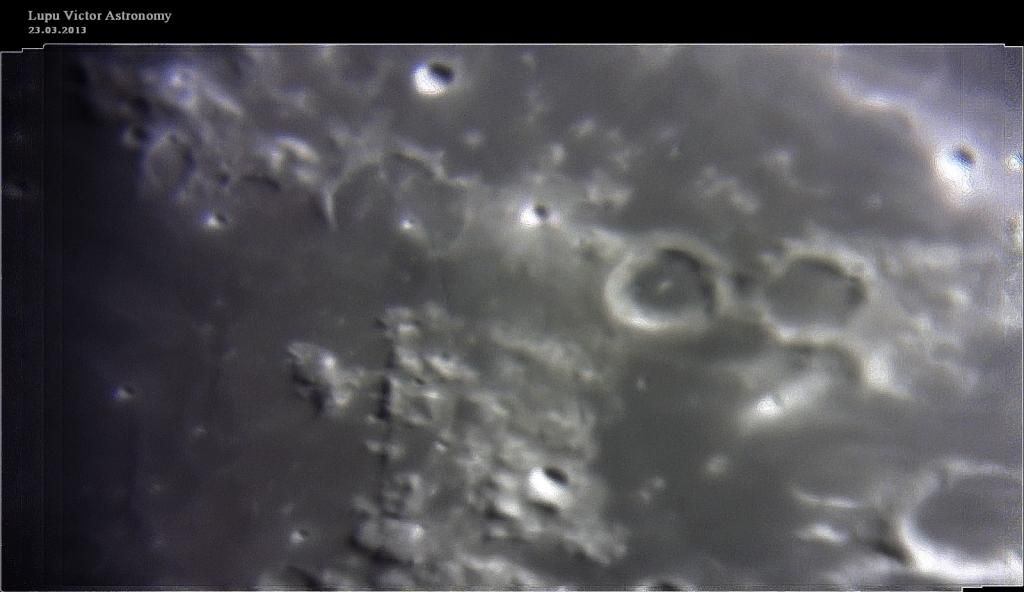
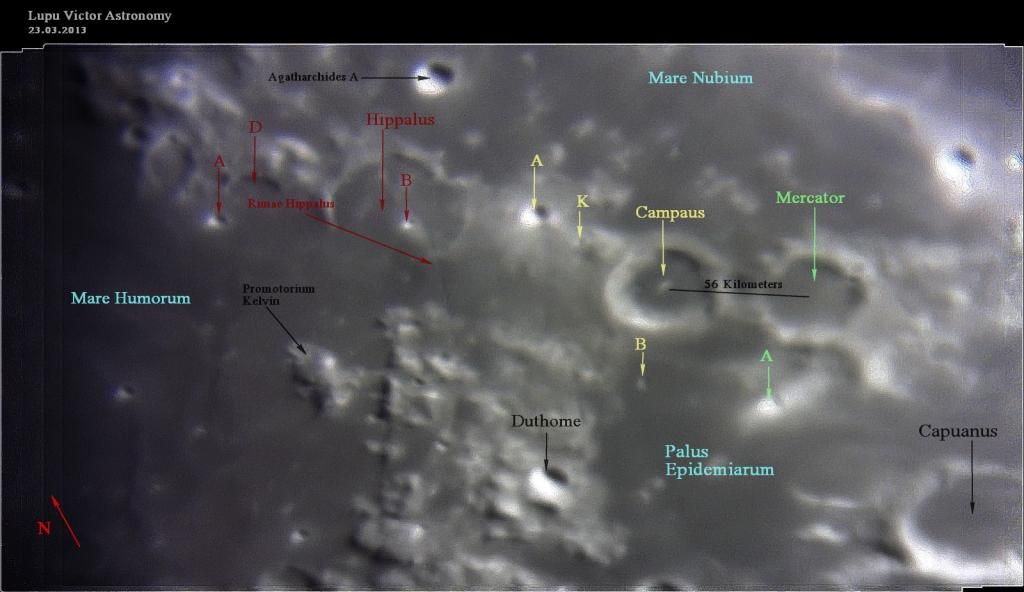
In these images we see Mare Humorum basin (plateau, left), and craters on its west (on the right). Among them, we see two craters that resemble each other in shape and size, called Campanus and Mercator. They are located between of 2 basins: Palus Epidemiarum and Mare Nubium

Mercator (47 km), lacks a central peaks, but Campanus (48 km) has in center a mountain formation like a semicircle.
Northwest of Campanus, is Hippalus crater (58 km), a flooded one, which completely lacks the south-west wall. Hippalus's floor is cut in the middle of one of the ridges called Rima Hippalus that are more in number and spreads near Campanus.
As an interesting feature, Campanus A (11 km) small crater has a higher albedo, in, and around it.
Other interesting feature is Promotorium Kelvin, east of Mare Humorum.


Age of the Moon: 11 days
Distance: 386 658
Phase: 85% (0% = New, 100% = complete)

Optical Telescope Celestron C8 "Newtonian, plossl 20mm, 2x Barlow
Mount: CG5 (EQ5)
Device: Sony CX-130
Video Mode: Full HD 1920x1080 progressive
Filter: no
Date: 23/03/2013
Location: Baia Mare, Romania
Processing and editing: Sony Vegas 10, Registax


Thursday, 6 February 2014

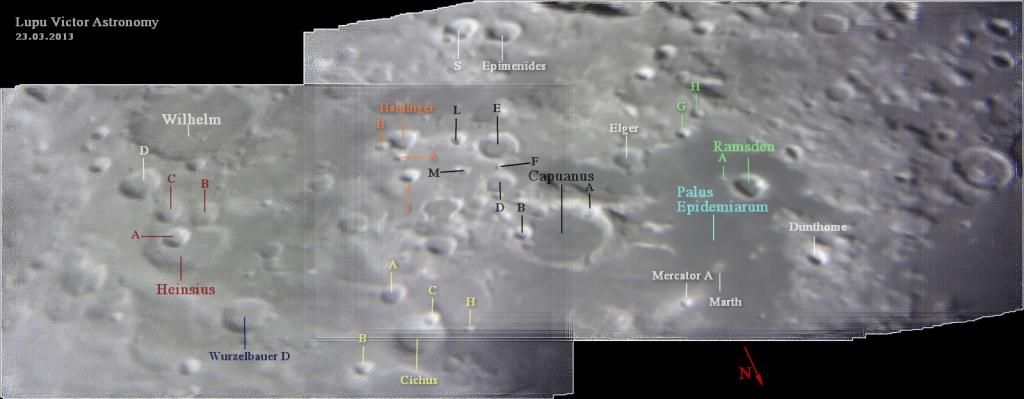
New presentation of crater Capuanus by Newtonian telescope.

51 frames at 85% best quality in Registax.

Capuanus (60 km), is a flooded crater integrated into Palus Epidemiarum at the southeastern Mare Humorum Basin . It can be recognized by a special feature , namely after the 3 " claws " that start from the northwestern edge of it.

On Palus Epidemiarum also, is crater Ramsden (25 km) , around which are some grooves called Rima Ramsden .
Images are inverted as seen through the telescope.

A crater that seems more special , although small, is Marth (6 km), located on the plateau Epidemiarum . It has the appearance of a crater in the crater because it has two sets of edges , the two rings placed one on another like a bull's eye . Maybe just for these interesting features of this crater was given a name without being regarded as a satellite of another crater , like most small craters on the Moon .
Even if this crater has a diameter of 6 km, Marth has even a satellite crater of 3 km, named Marth K.

East of Palus Epidemiarum, is the eroded crater, Cichus (41 km) .
Other craters seen in the image are the satellite craters of those mentioned above, and also Heinsius (64 km) and Wilhelm (107 km).
Video can be seen here: Enjoying the Moon.

Age of the Moon: 11 days
Distance: 386 658
Phase: 85% (0% = New, 100% = complete)

Optical Telescope Celestron C8 "Newtonian, plossl 20mm, 2x Barlow
Mount: CG5 (EQ5)
Device: Sony CX-130
Video Mode: Full HD 1920x1080 progressive
Filter: no
Date: 23/03/2013
Location: Baia Mare, Romania
Processing and editing: Sony Vegas 10, Registax


Wednesday, 27 November 2013

Visual astronomy. Hainzel crater on the Moon.

461 frames at 79% best quality in Registax.


Hainzel crater (70 km), 3 km in depth, is a strange shaped one, located at the southern Mare Humorum Basin. This is affected by other impacts, and generally, looked as a whole, we can distinguish three impacts that formed​​ it. Inside Hainzel, there are two other craters called Hainzel A (53 km) and C (38 km).

Their floor is a rugged terrain with peaks centrally located, and Hainzel A, has the peculiarity that its inner edges have terraces which are evident, reaching the floor at its central peak.

Above Hainzel, notice four craters in the chain formation of approximately the same size. These are its other satellite craters called Hainzel K (14 km), B (15 km), L (16 km) and R (19 km).
Northeast of Hainzel, Palus Epidemiarum is a smooth region, which has an undefined shape, with a few craters on its surface, the biggest being Capuanus (60 km) a flooded crater that identifies the shade of the plateau .


Age of the Moon: 27 days
Distance: 360.270 km
Phase: 94.6% (0% = new, 100% = complete)


Optics: Celestron C8-Newtonian telescope, Plossl 20 mm, 2x Barlow
Mount: CG5 (EQ5)
Camera: Sony CX130
Filter: no
Date: 02/07/2012
Location: Baia Mare, Romania
Processing: Registax, FastStone Image Viewer
If you like, you can see some interesting images of the crater in other lighting conditions here: Hainzel Moon crater.
To see a short video of crater Hainzel: Video-Hainzel and Capuanus lunar craters through telescope.


Tuesday, 8 October 2013

Enjoying the Moon. Video of Tycho crater on the Moon by telescope.

Some of the largest mass extinctions of life on Earth could have been caused by cosmic catastrophes such as those in the Moon . But we do not really know how often are these events . Records preserved on the Moon might be able to help us as well.

With a very thin atmosphere , the Moon is collecting meteorites more than Earth, because of the large impact craters on it , making it to be a very good site digging for space debris containing valuable information about the past of our Solar System .

In the video shown below , we see craters on the Moon's south as Tycho (85 km) , Wilhelm (107 km), Hainzel (70 km), Capuanus ( 60 km ), and Lacus Timoris continuing onto south of Mare Humorum where are craters as Lee (41 km), Vitello (42 km ) or Doppelmayer (64 km), crater with a semicircular shape and a central peak in the middle, seen in the and of the video.

Tycho, is a lunar crater on the south , on which may be given full attention in times of Full Moon . At this stage it can be observed through binoculars , and also with the naked eye even if it is not large . With the naked eye we can not see the crater , but its light rays that spread on a large part of the southern hemisphere of the Moon , and in this way you can realize where it is , ie where the luminous intensity is the most intense , where all the rays unites.
When shooting this impressive crater , albedo which fills it and that on the outside, is alive and dominate the images.

Age of the Moon: 11 days
Distance: 386 658
Phase: 85% (0% = New, 100% = Full)


Optical Telescope CelestronC8 "-Newtonian plossl20mm, 2x Barlow
Mount: CG5 (EQ5)
Device: Sony CX-130
Video Mode: Full HD 1920x1080 progressive
Filter: no
Date: 23/03/2013
Location: Baia Mare, Romania
Processing and editing: Sony Vegas 10


Sunday, 11 December 2011

Video-Hainzel and Capuanus lunar craters through telescope

A short video of Hainzel and Capuanus crater. Most craters are illuminated by the Sun.


Video: VictorLupu
Optics: CelestronC8 "-Newtonian telescope, plossl20mm, 2x Barlow
Mount: CG5 (EQ5)
Device: SonyCX105 at 7x optical zoom
Total Magnification: 700x
Filter: no
Date: 14/05/2011
Location: BaiaMare, Romania
Processing and editing: Registax 6, FastStone

Wednesday, 29 June 2011

Capuanus Campanus and Mercator craters


Photographer: Victor Lupu
Optics: Celestron C8-Newtonian telescope, plossl 20mm, 2x Barlow
Mount: CG5 (EQ5)
Device: Sony CX105
Filter: No
Date: 13/04/2011
Location: Baia Mare, Romania
Processing: Sony Vegas 10 captures video


The video from these captures can be seen here: Video Capuanus lunar crater.

          Campanus (48 km), is an impact crater that is located on the southwestern edge of Mare Nubium. Mercator crater forms a pair with Campanus and the two craters are on  Palus Epidemiarum. Campanus's rim is circular, with a passive bulge along the western margin and an  active bulge north-west .The interior consists basaltic lava, leaving only a small central peak above the surface. The floor has the same low albedo as the surroundings, giving it a dark appearance. The name is given from Campanus of Novara (c. 1220-1296) a mathematician, astronomer, astrologer, and physicist who is best known for the elements of Euclid.
Other craters in these captures are Bullialdus , Capuanus si Ramsden.

Monday, 13 June 2011

Video-Capuanus crater astronomy telescope


Capuanus crater video. I like this crater because of the shape and especially when it has shadow.Maybe because it is filled with lava and the floor is at the same level with the plateau Palus Epidemiarum.
Video by: Victor Lupu
Optics: Celestron C8-Newtonian telescope, plossl 20mm, 2x Barlow
Mount: CG5 (EQ5)
Device: Sony CX105
Filter: No
Date: 13/04/2011
Location: Baia Mare, Romania

Saturday, 26 March 2011

Capuanus crater

Photographer: Victor Lupu
Optics: Celestron C8-Newtonian reflector telescope, plossl 20mm, 2x Barlow
Mount: CG5 (EQ5)
Device: Sony HDR CX105
Filter: No
Date: 13/02/2011
Location: Baia Mare, Romania
Processing: video capture


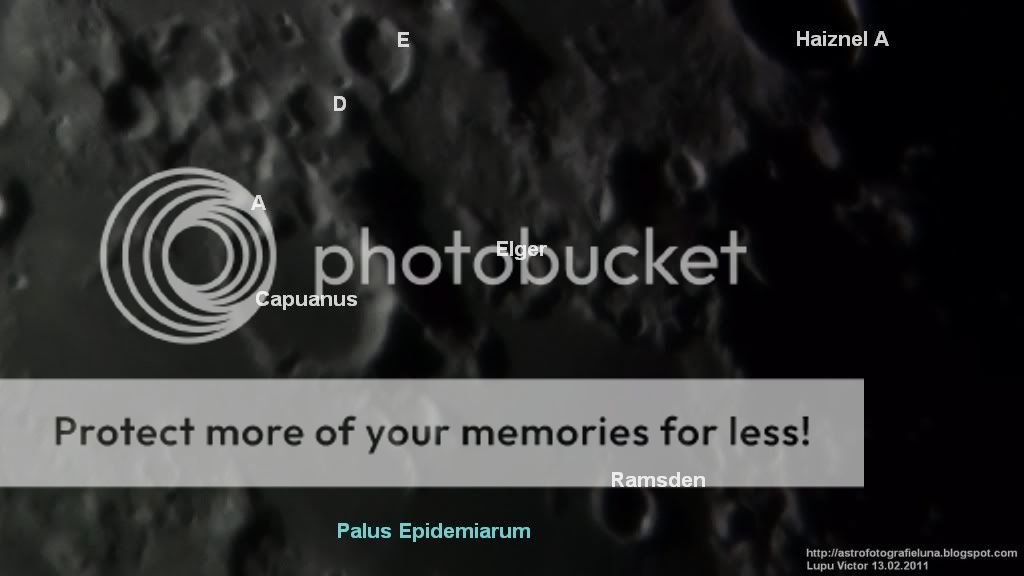
        Capuanus (60 km.) crater in the center-left in photo 1, is a lunar crater that lies along the southern edge of Palus Epidemiarum ( plateau below Capuanus) on the south-west of the Moon. Crater interior has been restored, filled with basaltic lava .
       The crater is named after the italian astronomer Francesco Capuano Di Manfredonia Another crater in photo is of Ramsden crater (25 km)-at the bottom of the foto.The floor was also flooded with lava.The rim is somewhat irregular oval shape with depressions, north and south of the walls.It doesn't have a central peak, or a ray system.


Palus Epidemiarum (286 km).This mare is notable for a system of rilles in the western end named the Rimae Ramsden, and for the wide Rima Hesiodus that extends from near the mid-point to the east-northeast roughly 300 km.

 
All images are © Copyright 2010-2015 Lupu Victor. All rights reserved.Images may not be reproduced, published, or copied in any form without written permission of the author. Thank you for respecting the intellectual property rights. ASTROFOTOGRAFIA | Lupu Victor Astronomy - Contact - About
Design by Free WordPress Themes | Bloggerized by Lasantha - Premium Blogger Themes | Online Project management