Visit Worldwide Topsites
Showing posts with label Craters-Schiller. Show all posts

Wednesday, 14 September 2016

Schickard through a telescope November 8, 2011.

In these stabilized video images with Sony Vegas 10, we see many craters on the moon's south-west. Most evidenced by its size is Schickard (227 km), followed by Schiller crater (180 km), Phocylides and Nasmith (114/77 km) and Wargentin.
By the end of the clip is filmed Hainzel (70 km) also.

These craters can not be detected visually with the naked eye but through an astronomical telescope, or even with binoculars if it comes to Schickard which is quite large, but binoculars will be mounted on a tripod so that the image is fixed.


Magnitude: -12.11
Phase: 0.96
Distance: 401.329 km
Illuminated: 96.2% (0% = New, 100% = Full)


Astronomical instrument: Celestron C8-Newtonian telescope,
Eyepiece: Plossl 20mm, 2x Barlow
Mount: CG5 (EQ5)
Apparatus: Sony CX130
Filter: no
Date: 08.11.2011
Location: Baia Mare, Romania
Processing: Sony Vegas 10


Images were acquired by attaching a video camera directly to an Newtonian astronomical 8 inches (203 mm) telescope's eyepiece; For this reason the eyepiece visual field was increased.
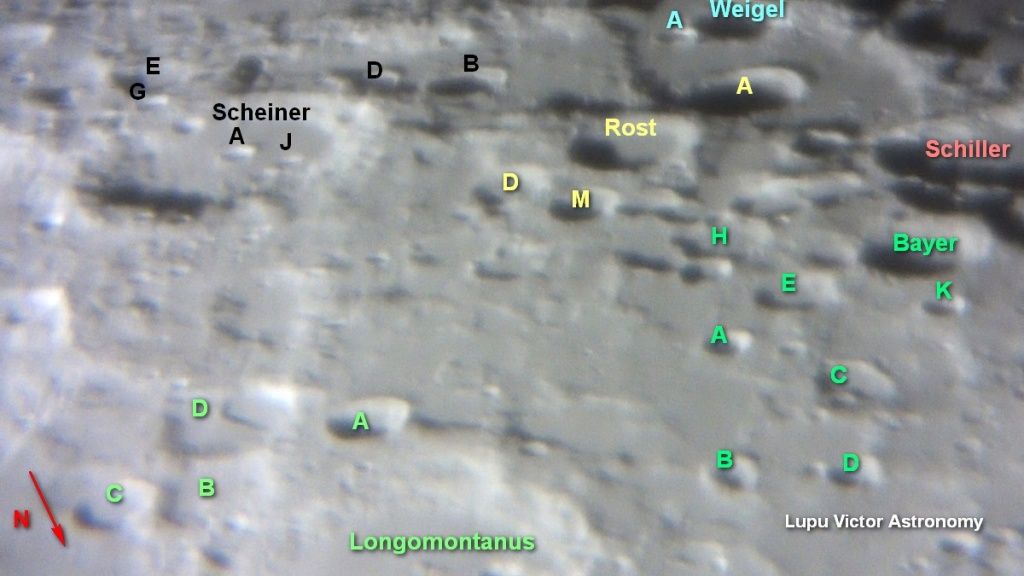
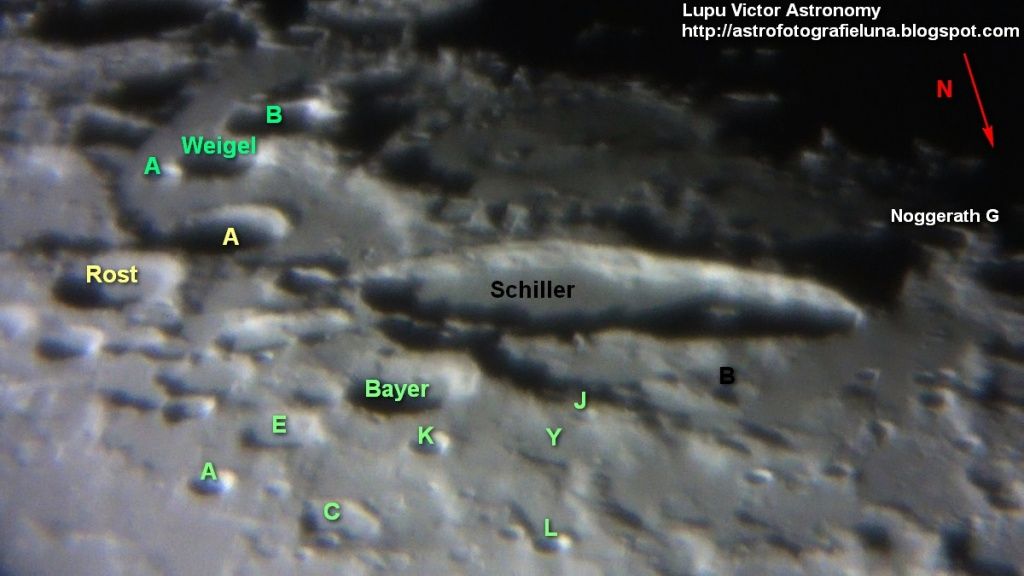
In the picture below are labeled craters and other lunar features in the region. To better understand this photo, you should note that the label with the name or the letter of larger craters could be found at their center, and on the small craters, you should find them around them, usually above.


Monday, 1 February 2016

Schiller crater on the west of the Moon.

In this article we turn again to the elongated Schiller crater (180 km) west of the moon. Astronomical telescope was pointed at the area with the camera attached to the eyepiece and from the video I took of the best frames with most important details.

Although Schiller seems to be drawn in these images, it has a length of 179 km and a width of 71 km with a depth of 3.9 km. You can estimate how long is this distance if we report say 2 places on earth, and I give as an example the distance between Baia-Mare city and Turda, which is 176 km.


Magnitude: -12.11
Phase: 0.96
Distance: 401.329 km
Illuminated: 96.2% (0% = New, 100% = Full)

Astronomical instrument: Celestron C8-Newtonian telescope,
Eyepiece: Plossl 20mm, 2x Barlow
Mount: CG5 (EQ5)
Camera: Sony CX130
Filter: no
Date: 08.11.2011
Location: Baia Mare, Romania
Processing: FastStone Image Viewer


Sunday, 30 August 2015

Schiller crater through astronomical telescope. Processing in Registax.

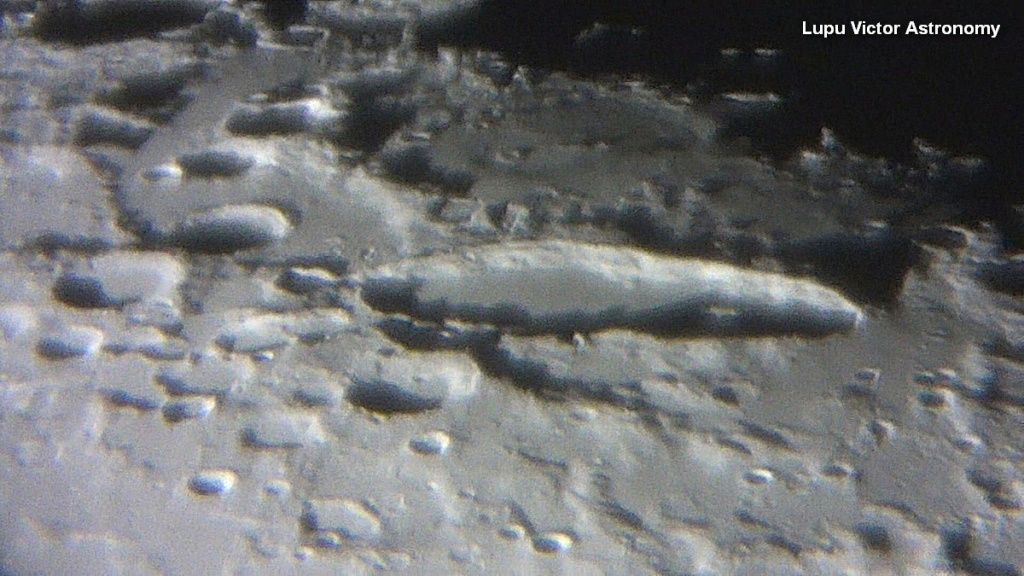
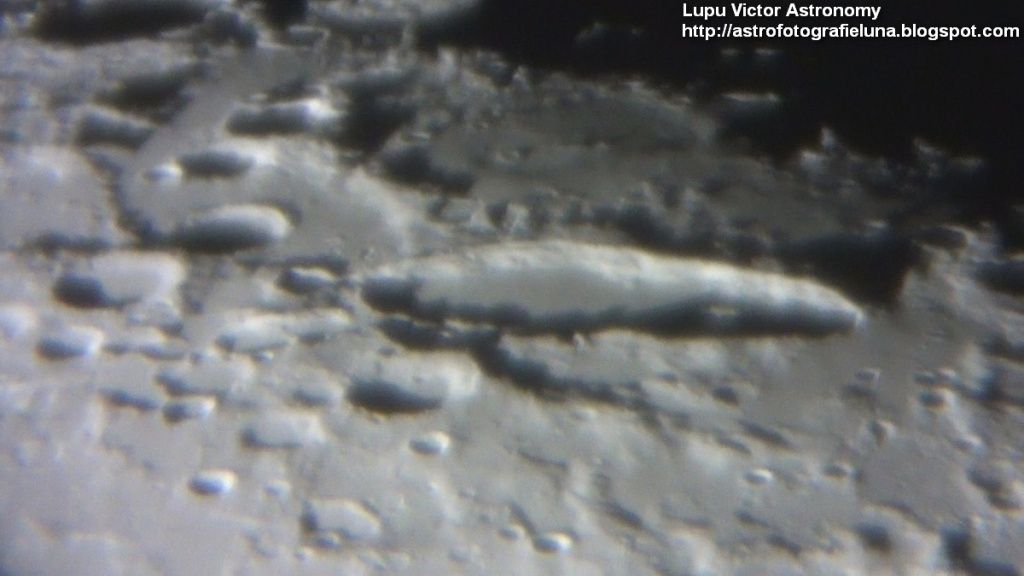
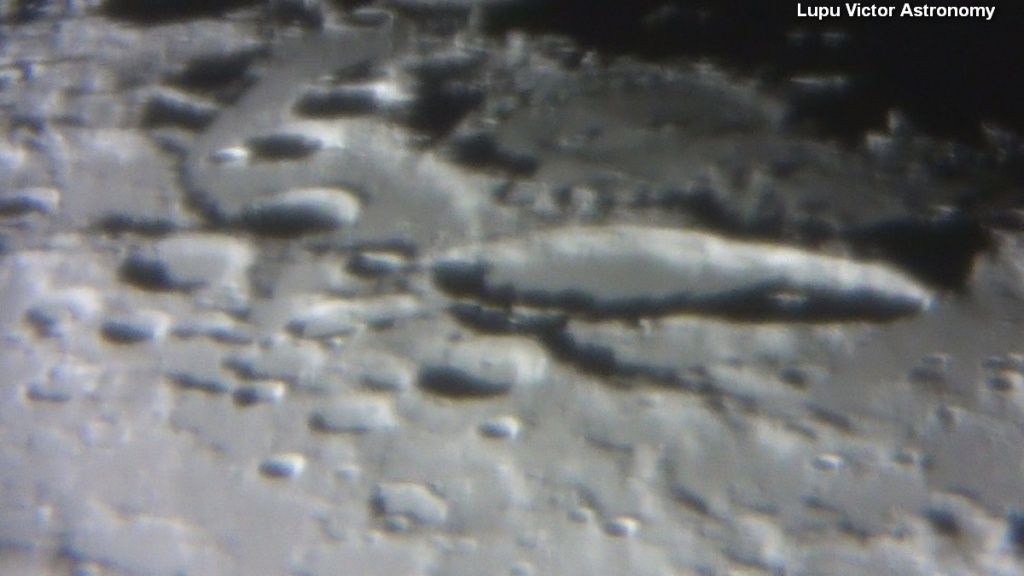
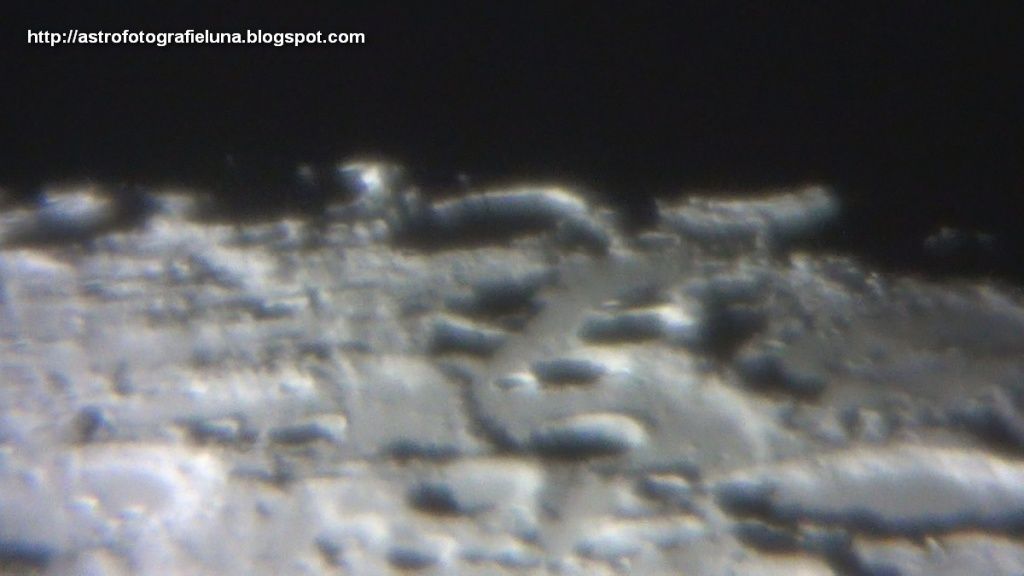
Our Moon is full of craters of all shapes and sizes. One of the craters with a more unusual shape, is Schiller. This "worm" on the west of the Moon, has a length of 179 km and a width of 71 km. It is positioned so that if follows the contour of the lunar disk frpm our perspective.

In these images we see an extra wall located along the eastern edge of Schiller (in images on west because the images are upsidedown).

The area has a milky appearance due to sunlight that makes it seem so. Frankly, that kind of illumination I really like because of various white intensities of the craters. It seems that the saying that the Moon is made of cheese it even makes sense here.

Craters neighboring Schiller are: to the south-southeast is Rost (48 km) and Rost A (39 km) west near the terminal is Schiller C (an incomplete crater) to the east sticking to Schiller, is Bayer (47 km), and north is Nöggerath (31 km) and Nöggerath G (21 km).

159 video frames in Registax.
668 video frames in Registax.

These images are processed in Registax 5 program, of a video with the camera attached to the telescope.

Magnitude: -12.10
Phase: 0.96%
Distance: 402.464 km
Illuminated: 96% (0% = new, 100% = full)


Astronomical Instrument: Celestron C8-Newtonian telescope, plossl 20mm, 2x Barlow
Mount: CG5 (EQ5)
Camera: Sony CX105
Filter: no
Date: 08 november 2011
Location: Baia Mare, Romania
Processing: Registax 5 FastStone Image Viewer

In the picture below are labeled craters and other lunar features in the region. To better understand this photo, you should note that the label with the name or the letter of larger craters could be found at their center, and on the small craters, you should find them around them, usually above.

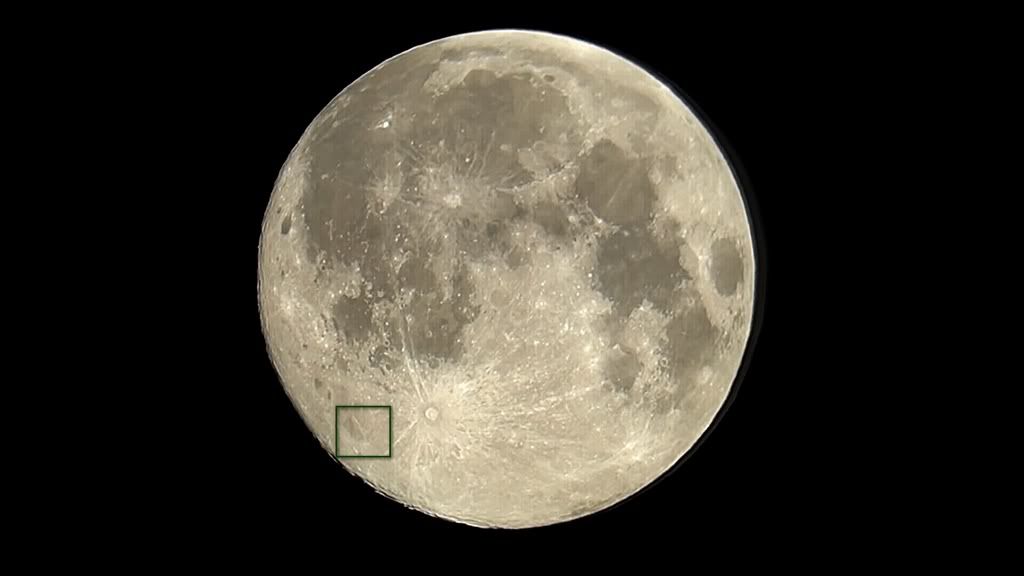
Image for orientation  23/03/2013.


Wednesday, 9 April 2014

Schiller crater filmed by astronomical telescope.
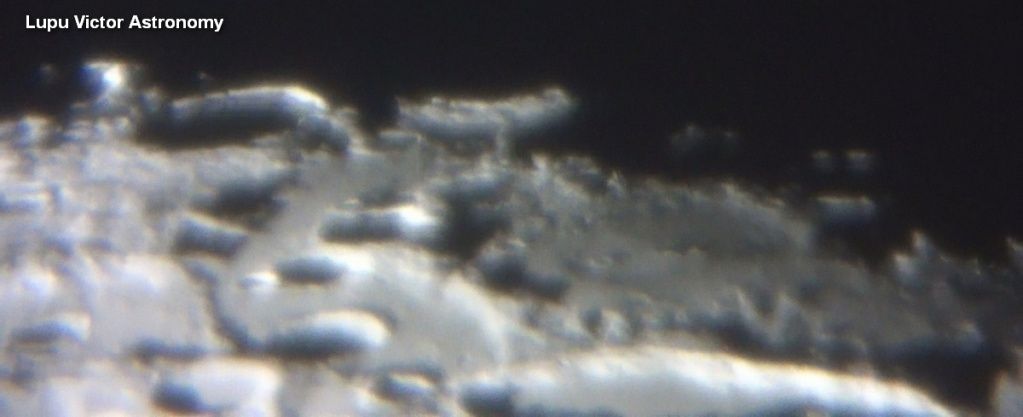


Elongated crater Schiller (180 km long) video through telescope under average visibility. Schiller is on the south-west of the Moon.
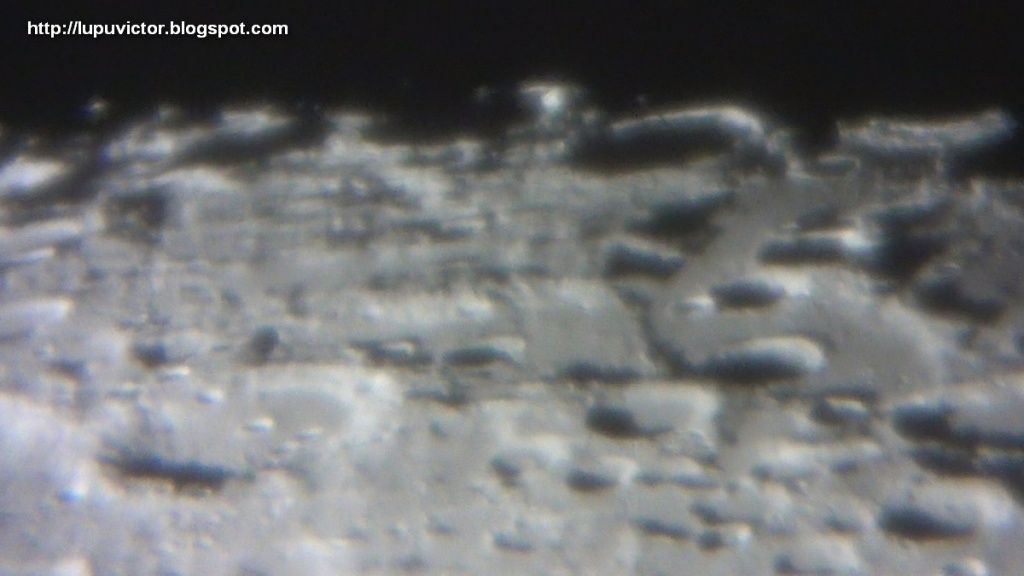

Optics: Celestron C8 "-Newtonian telescope, 20mm Plossl, 2x Barlow
Mount: CG5 (EQ5)
Device: Sony CX-130
Video Mode: Full HD 1920x1080 progressive
Filter: no
Date: 26/September/2012
Location: Baia Mare, Romania
Processing and editing: Sony Vegas 10


Saturday, 25 January 2014

More Imaging of the Moon. The beautiful elongated crater Schiller.

142 frames at 75% best quality in Registax.
221 frames at 65% best quality in Registax.
28 frames at 85% best quality in Registax.
49 frames at 85% best quality in Registax.
108 frames at 85% best quality in Registax.
121 frames at 80% best quality in Registax.
188 frames at 75% best quality in Registax.
13 frames at 75% best quality in Registax.
55 frames at 80% best quality in Registax.

Schiller (180 km) elongated crater is one of the rarest on the lunar surface, of those who have such a strange aspect.
Do not forget that images shown here are upside down, as seen through a telescope, but also to be better observed and the description of craters will use real compass.


Schiller's neighboring craters are: south-southeast is Rost (48 km) and Rost A (39 km), near the terminal is Schiller C (an incomplete crater), to the east, sticking to Schiller is Bayer (47 km) crater, and north is Nöggerath (31 km) and Nöggerath G (21 km).


These images are processings in Registax program, of a video taken with the camera attached to the telescope. I am pleased with the results. Images are clear, much better than a simple video screenshot.


Video: Great video of south craters of the Moon.


Age of the Moon: 11 days
Distance: 386 658
Phase: 85% (0% = New, 100% = complete)

Optical Telescope Celestron C8 "Newtonian, plossl 20mm, 2x Barlow
Mount: CG5 (EQ5)
Device: Sony CX-130
Video Mode: Full HD 1920x1080 progressive
Filter: no
Date: 23/03/2013
Location: Baia Mare, Romania
Processing and editing: Sony Vegas 10


Thursday, 23 January 2014

Sharp images of west craters on the Moon by telescope.

139 frames at 85% best quality in Registax.
90 frames at 80% best quality in Registax.
92 frames at 80% best quality in Registax.

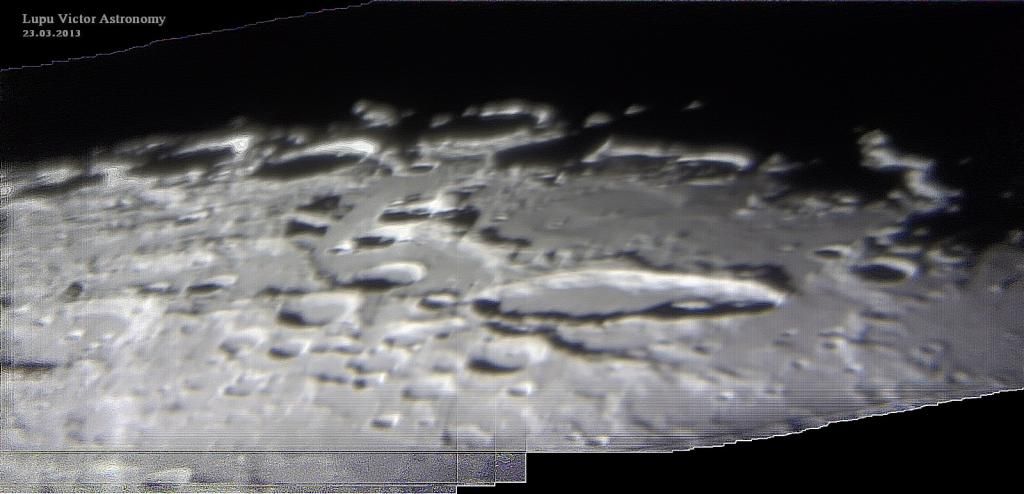
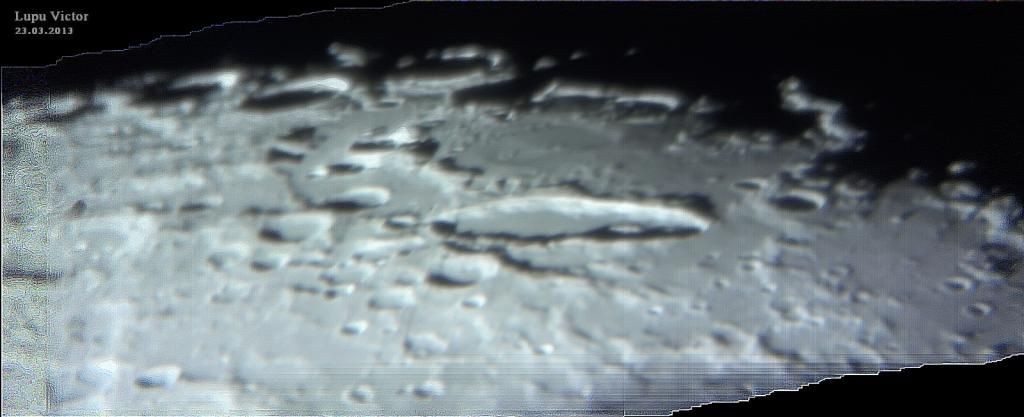
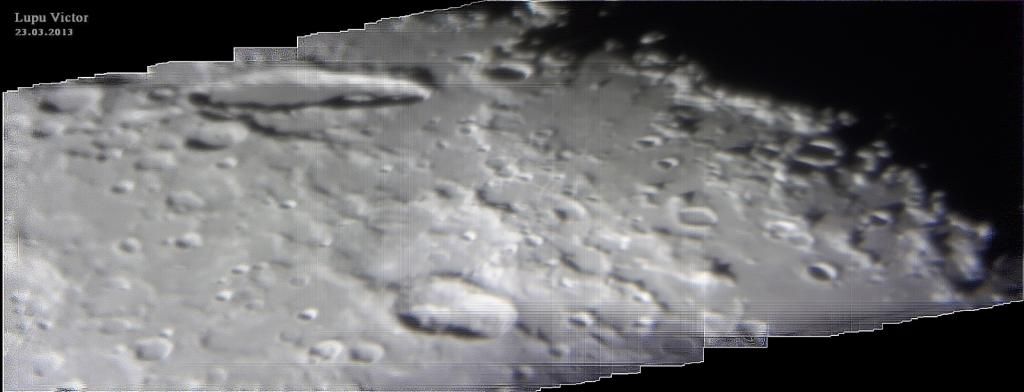
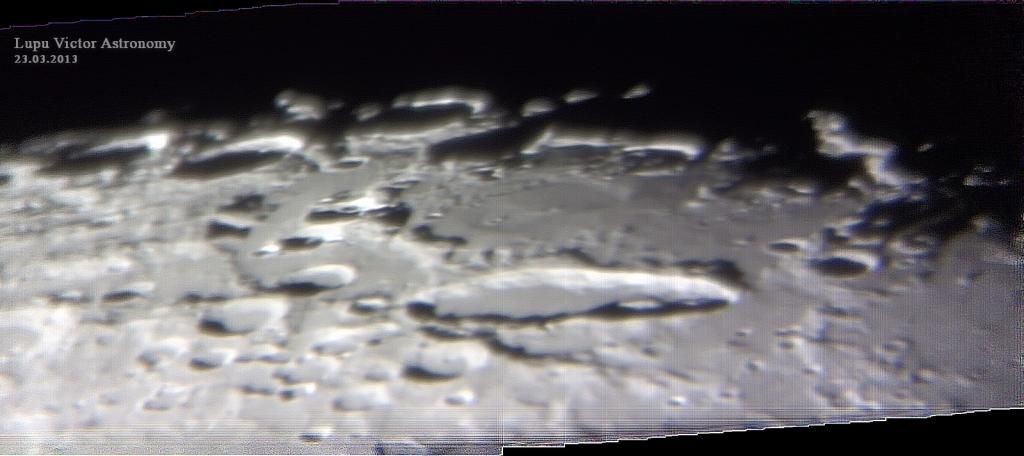
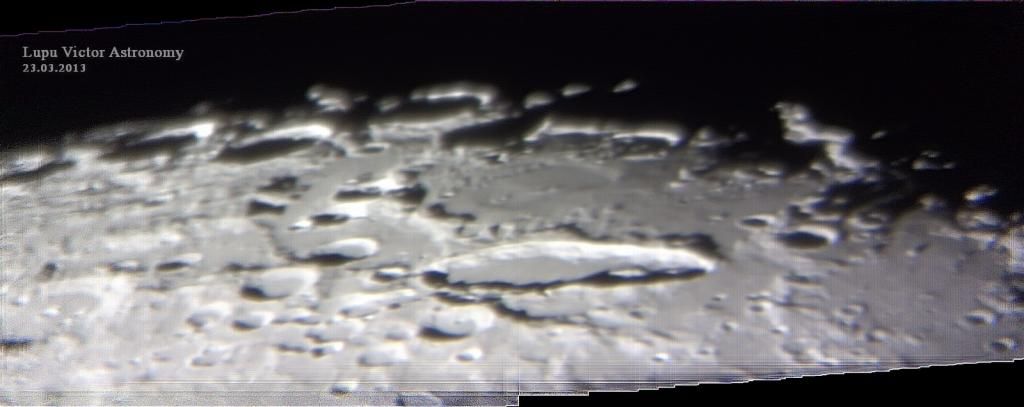
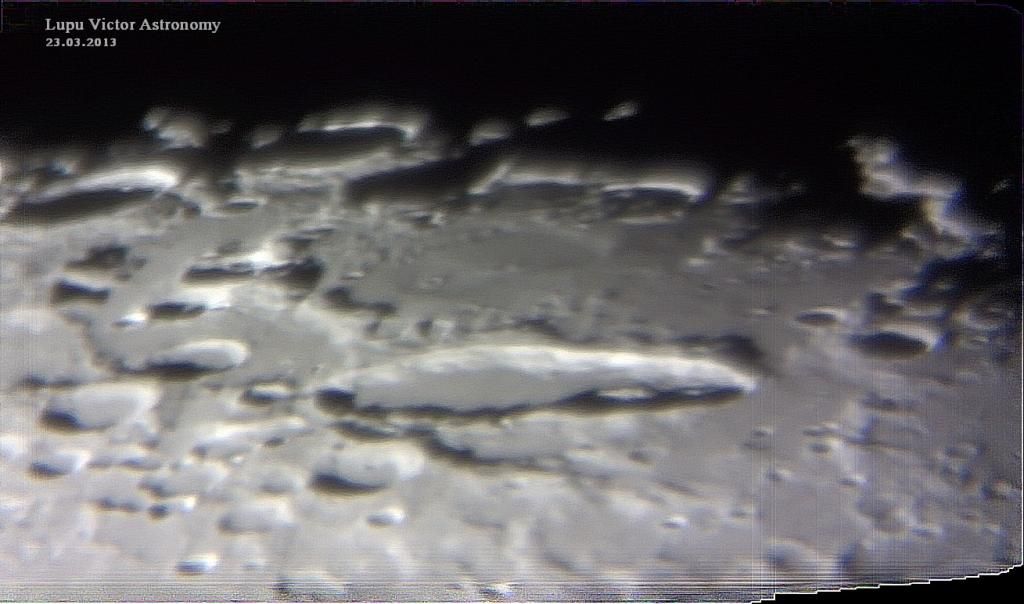
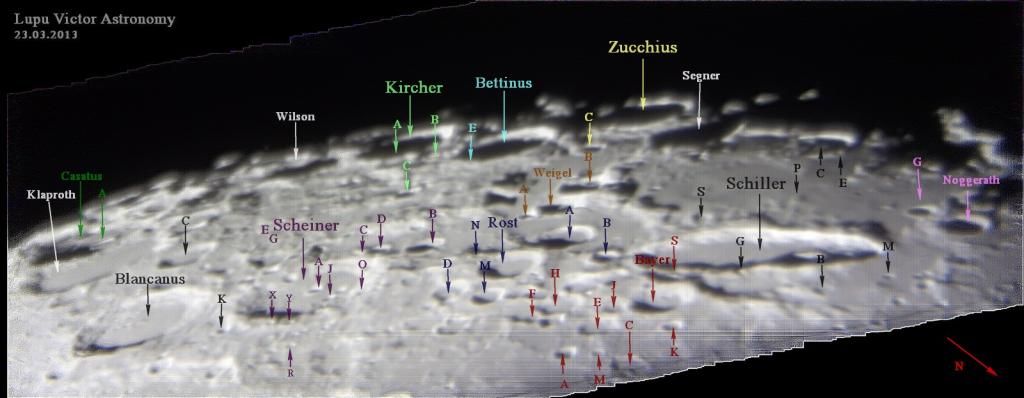
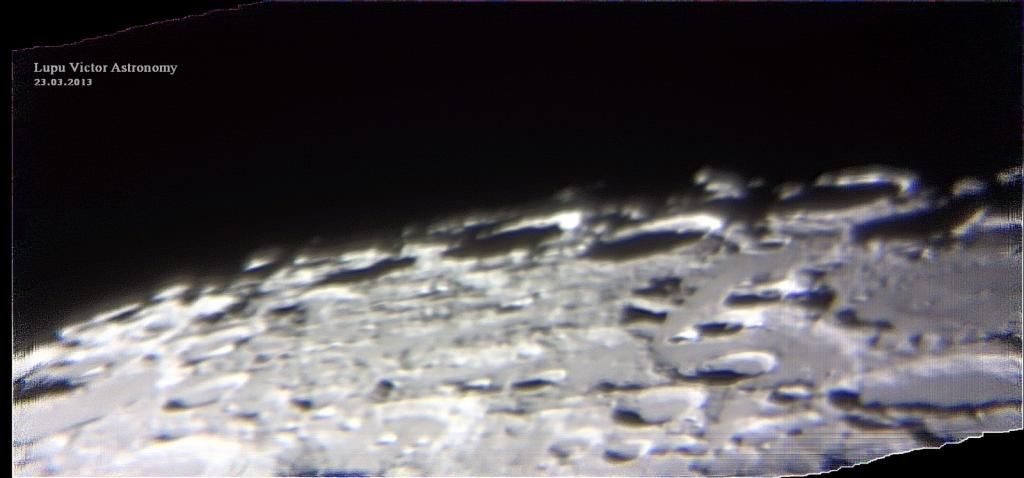
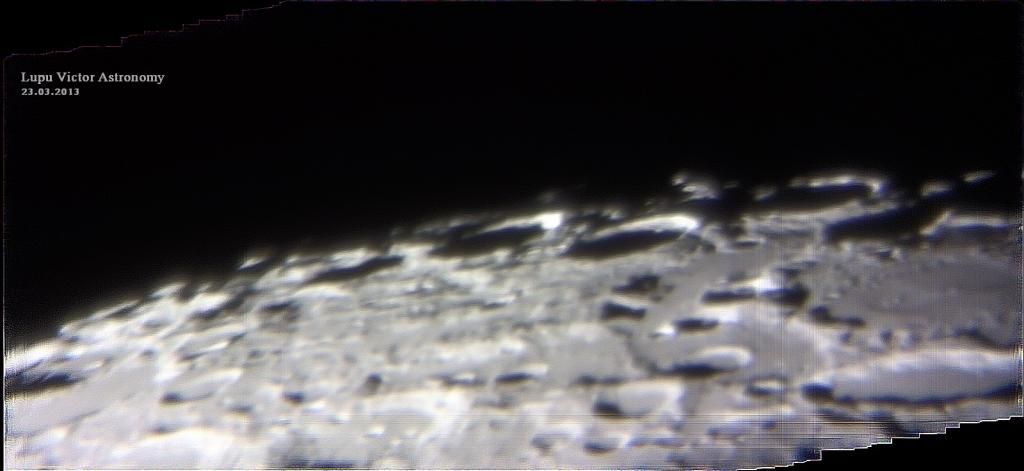
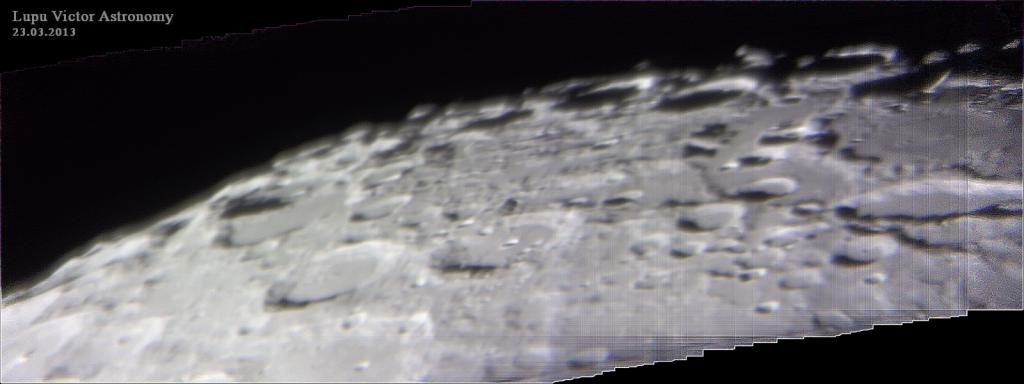
Although we think we look at the edge of the Moon, especially as we look at the top of the pictures, the  craters becoming more oval , hinting that are on the edge, we are actually only close to the edge , but we're still not there. The darkness on the top is actually the terminal , that phase of the Moon at that time, the area between light and shadow .

Observe larger craters flooded by the dark. They appear to be the same size . These ones are arranged in a zig -zag , and although 3 are visible, 4 craters are actually there, called from left to right: Kircher (73 km) , Bettinus (71 km) , Zucchius (64 km) and Segner (67 km) , the latter being flooded by lava , leaving only its lip on the surface .

From Zucchius to Schiller , observe a smooth valley which is in contrast to most of the rugged cratered terrain. This " valley " has on it a few large craters : Weigel A (17 km), B (37 km) , and Rost A (39 km), being the closest to the caterpillar-shaped crater , Schiller (180 km) .

Circular and eroded crater at the bottom of images, is Scheiner (110 km) and his left is another, similar in size , called Blancanus (105 km) .
Klaproth (119 km) , over which is superimposed Casatus (111 km) crater is seen on the left in the image , close to the terminal.
These images are processings in Registax program , of a video taken with the camera attached to the telescope.

Video: Great video of south craters of the Moon.


Age of the Moon: 11 days
Distance: 386 658
Phase: 85% (0% = New, 100% = complete)

Optical Telescope Celestron C8 "Newtonian, plossl 20mm, 2x Barlow
Mount: CG5 (EQ5)
Device: Sony CX-130
Video Mode: Full HD 1920x1080 progressive
Filter: no
Date: 23/03/2013
Location: Baia Mare, Romania
Processing and editing: Sony Vegas 10


Friday, 6 December 2013

All Eyes on Schiller. New astro-imaging of Moon craters.

106 frames at 80% best quality in Registax.
123 frames at 80% best quality in Registax.

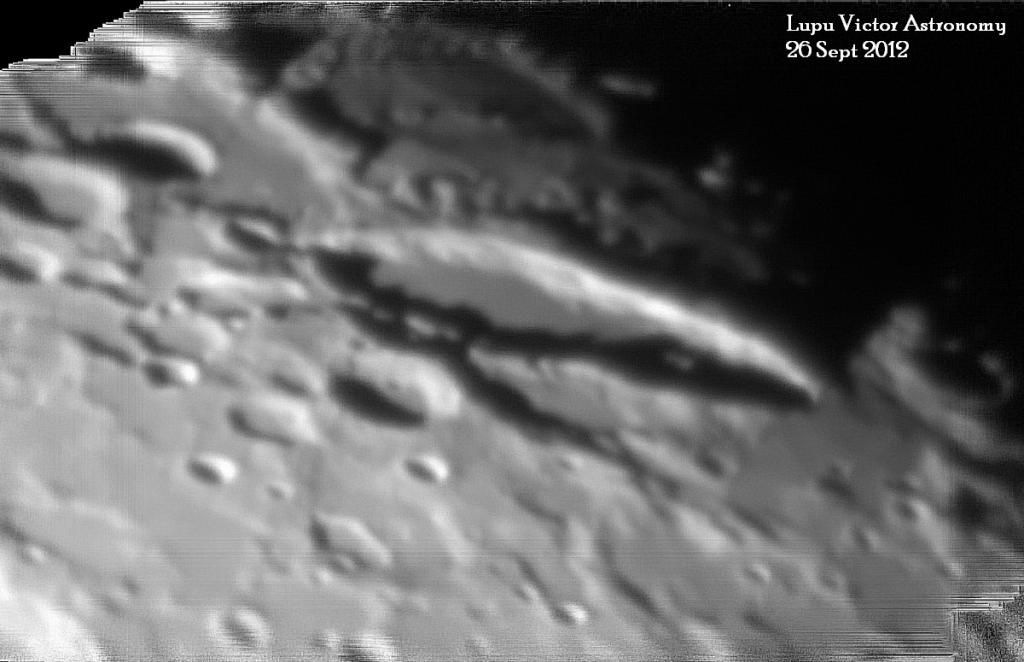
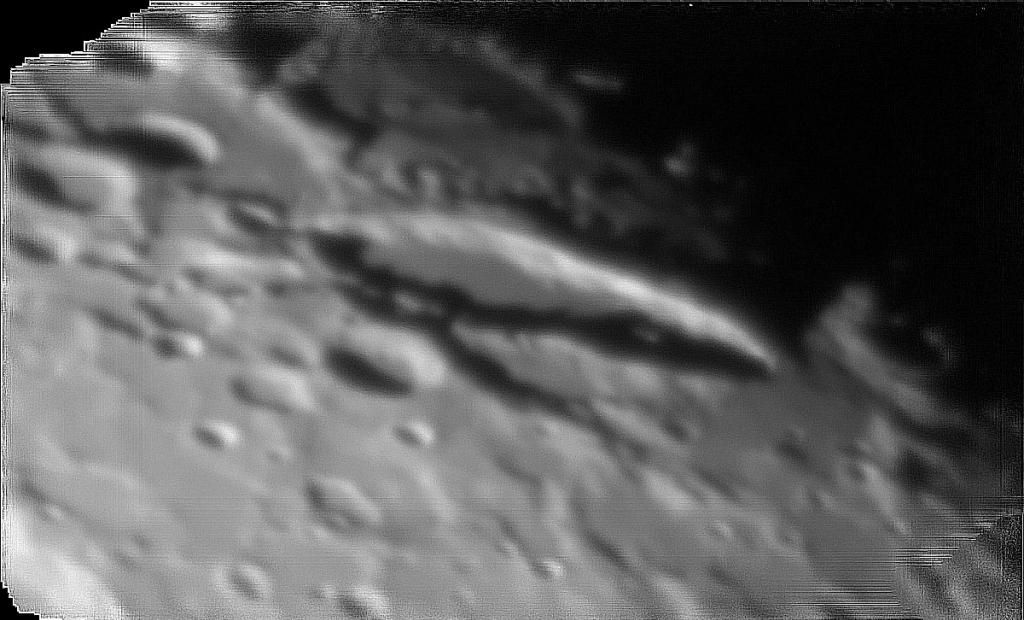
This " worm " on the west of the Moon, has a length of 179 km and a width of 71 km . Looks more like a canyon. I do not know the circumstances in which this crater formed and how it came to look elongated .
It seems that the cosmic body that collided with the Moon looks more like bounced but if would be so, I could not say where it came from and where it stopped . However, even if the crater is seen from Earth so narrow , looked from there, above it , it is more wide, but looks narrow because it is located closer to the edge of the Moon.

In the pictures above I got the moment when beautiful crater Schiller is not far from the terminal.South inner edge (note that the pictures are upside down), is in full sunlight and shadow of the northern edge is projected on the crater floor. Notice the chain of central peaks on the floor, although it is surrounded by darkness. Circular crater near its southern edge, is Bayer (47 km), which here is half in shadow.

Age of the Moon: 27.32 days
Distance: 381.700 km
Phase: 88.8% (0% = New, 100% = full)


Optics: Celestron C8-Newtonian telescope, Plossl 20 mm, 2x Barlow
Mount: CG5 (EQ5)
Camera: Sony CX130
Filter: no
Date: 26/09/2012
Location: Baia Mare, Romania
Processing: Registax, FastStone Image Viewer


Image for orientation from 23/03/2013

Monday, 23 September 2013

Great video of south craters of the Moon.

Unlike Earth's surface which is constantly affected by erosion and plate tectonics, the Moon is old and full of scars, tried by some of the largest impact craters in the Solar System.

These lunar craters, tells the story of the latest bombing and chaos in the
Solar System shortly after the formation of the inner planets. In this period of intense bombardment, our Moon could probably hold a record of the history of life on Earth, or a lot of dangers in our galaxy, which represented a threat to us.

In this video through the telescope, the camera goes from left to right, starting from the crater Moretus (114 km), to Blancanus (105 km), Scheiner (110 km), then the 3 craters on limb of the Moon: Kircher (73 km), Bettinus (71 km), and Zucchius (64 km), continuing with Schiller (179x71 km).


Age of the Moon: 11 days
Distance: 386 658
Phase: 85% (0% = New, 100% = Full)


Optics: Celestron C8 "-Newtonian plossl20mm, 2x Barlow
Mount: CG5 (EQ5)
Device: Sony CX-130
Video Mode: Full HD 1920x1080 progressive
Filter: no
Date: 23/03/2013
Location: Baia Mare, Romania
Processing and editing: Sony Vegas 10


Sunday, 15 September 2013

Astronomical observations through telescope. Video of Moretus and Clavius​​ craters.

In this video, we make a survey the southern Moon craters and see, from left to right, starting with Moretus (114 km), the large crater Clavius ​​(225 km), Blancanus (105 km) and Scheiner (110 km), and the last is Schiller (179x71 km). From Moretus to Schiller, the elongated crater, are 726 km from center to center.

At the moment the region was filmed, it was full of sunshine, which made all the craters to shine in the light.

As an interesting feature, observe the peaks on the edge of the Moon, which are embossed and which are not mountains, but  the edge of Newton crater (79 km), located south of Short crater (71 km), on the Moon, as it was seen in that moment from Earth.

Age of the Moon: 11 days
Distance: 386, 658
Phase: 85% (0% = New, 100% = full)


Video: Victor Lupu
Optical Telescope CelestronC8 "-Newtonian, 20 mm, Plossl, 2x Barlow
Mount: CG5 (EQ5)
Device: Sony CX-130
Video Mode: Full HD 1920x1080 progressive
Filter: no
Date: 23/03/2013
Location: Baia Mare, Romania
Processing and editing: Sony Vegas 10


Image of crater Scheiner from March 4, 2012.

Monday, 25 June 2012

Schiller crater through telescope The southwest quadrant of the Moon


       There are many flooded craters in the south-west of the Moon, one of the most unusual crater being the elongated  Schiller crater of 179 km long and 71 km wide. The south floor of Schiller, which is larger, is smooth, but the northern half, which is shaded by the north wall in photos, has a prominent central mountain ridge, which can be seen here in the light, surrounded by the darkness.

    A large basin occupies the area between Schiller and Zucchius (64 km). The Schiller-Zucchius basin, as is known, has a diameter of about 380 km and an interior flooded inner ring of 210 km. In a big angle of light, Zucchius - Schiller basin can be identified through binoculars as a gray patch. In photo below, the basin is above Schiller.

East of Segner, the inner ring is composed of a series of ridges overlapping with craters, including craters Weigel (36 km) and Weigel B (34 km), that are curved to the south of Schiller.


Photographer: Victor Lupu
Optics: Celestron C8-Newtonian telescope, plossl 20mm, 2x Barlow
Mount: CG5 (EQ5)
Device: Sony CX130
Filter: no
Date: 04/03/2012
Location: Baia Mare, Romania
Processing: Sony Vegas 10 video captures


Monday, 5 March 2012

Registax: Photos by astronomical telescope Schickard and Schiller.


Registax 134 frames 90% lowest quality.

Craters Schickard, Schiller and Phocylides processed in Registax program.
These craters are located on the south-west of the Moon. Phocylides is the dark crater.

Photographer: Victor Lupu
Optics: Celestron C8-Newtonian reflector telescope, plossl 20mm, 2x Barlow
Mount: CG5 (EQ5)
Camera: Sony HDR CX105 at 8x optical zoom
Total Magnification: 800x
Filter: No
Date: 15/02/2011
Location: Baia Mare, Romania
Processing: Registax


Unprocessed photos are here: Schickard Drebbel Lehmann and Nöggerath craters .
Video of these images are here: Video - Schickard Schiller Phocylides and Nasmith - lunar craters .


All images are © Copyright 2010-2015 Lupu Victor. All rights reserved.Images may not be reproduced, published, or copied in any form without written permission of the author. Thank you for respecting the intellectual property rights. ASTROFOTOGRAFIA | Lupu Victor Astronomy - Contact - About
Design by Free WordPress Themes | Bloggerized by Lasantha - Premium Blogger Themes | Online Project management