Visit Worldwide Topsites
Showing posts with label Craters-Schickard. Show all posts

Wednesday, 14 September 2016

Schickard through a telescope November 8, 2011.

In these stabilized video images with Sony Vegas 10, we see many craters on the moon's south-west. Most evidenced by its size is Schickard (227 km), followed by Schiller crater (180 km), Phocylides and Nasmith (114/77 km) and Wargentin.
By the end of the clip is filmed Hainzel (70 km) also.

These craters can not be detected visually with the naked eye but through an astronomical telescope, or even with binoculars if it comes to Schickard which is quite large, but binoculars will be mounted on a tripod so that the image is fixed.


Magnitude: -12.11
Phase: 0.96
Distance: 401.329 km
Illuminated: 96.2% (0% = New, 100% = Full)


Astronomical instrument: Celestron C8-Newtonian telescope,
Eyepiece: Plossl 20mm, 2x Barlow
Mount: CG5 (EQ5)
Apparatus: Sony CX130
Filter: no
Date: 08.11.2011
Location: Baia Mare, Romania
Processing: Sony Vegas 10


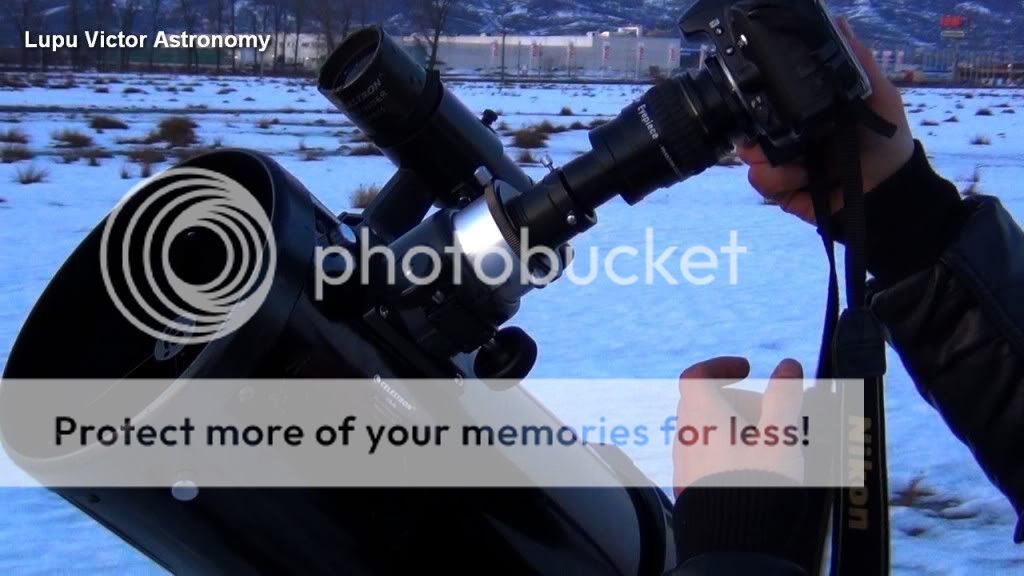
Images were acquired by attaching a video camera directly to an Newtonian astronomical 8 inches (203 mm) telescope's eyepiece; For this reason the eyepiece visual field was increased.
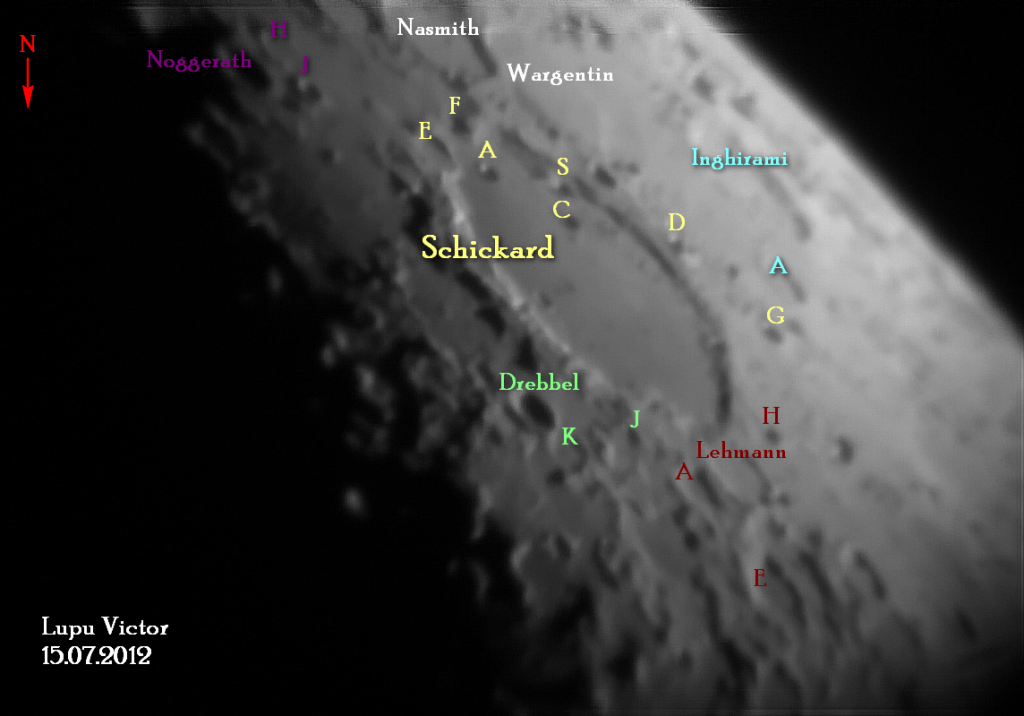
In the picture below are labeled craters and other lunar features in the region. To better understand this photo, you should note that the label with the name or the letter of larger craters could be found at their center, and on the small craters, you should find them around them, usually above.


Friday, 12 February 2016

Schickard by astronomical telescope. Astronomy images.

This is the crater Schickard (227 km), the largest of the images, located on the west of the moon. This crater is like a small basin flooded by lava. Over its surface we see many shades, dark and light. White hue is seen especially in the center of the crater.
The moon was lit more than 96%, so only a little of its disc was left in the shadows as we see here.

Registax images are here.


Magnitude: -12.11
Phase: 0.96
Distance: 401.329 km
Illuminated: 96.2% (0% = New, 100% = Full)


Astronomical instrument: Celestron C8-Newtonian telescope,
Eyepiece: Plossl 20mm, 2x Barlow
Mount: CG5 (EQ5)
Apparatus: Sony CX130
Filter: no
Date: 08.11.2011
Location: Baia Mare, Romania
Processing: FastStone Image Viewer

In the pictures below are labeled craters and other lunar features in the region. To better understand this photo, you should note that the label with the name or the letter of larger craters could be found at their center, and on the small craters, you should find them around them, usually above.


Wednesday, 9 September 2015

Astronomy Images by telescope. Craters of the Moon: Schickard.

In these images processed in Registax light gives a nice look on west craters of the Moon, as Schickard (227 km) Phocylides and Nasmith (114/77 km). On Schickard's floor are shades of color more noticeable which gives us to understand that it was flooded in several lava stages of different composition.

Inghirami crater is totally overwhelmed by darkness, located on the Moon west of Schickard. At this stage we only see its sunlit exterior collar.

The images are the result of processing in Registax 5 from a video made with a video camera attached to the telescope.


595 video frames in Registax.
421 video frames in Registax.

Magnitude: -12.10
Phase: 0.96%
Distance: 402.464 km
Illuminated: 96% (0% = new, 100% = full)


Astronomical Instrument: Celestron C8-Newtonian telescope
Eyepiece: plossl 20mm, 2x Barlow
Mount: CG5 (EQ5)
Camera: Sony CX105
Filter: no
Date: 08.11.2011
Location: Baia Mare, Romania
Processing: Registax 5 FastStone Image Viewer


In the pictures below are labeled craters and other lunar features in the region. To better understand this photo, you should note that the label with the name or the letter of larger craters could be found at their center, and on the small craters, you should find them around them, usually above.

Image of March 14, 2014.


Sunday, 2 August 2015

West region of the Moon. Registax images.

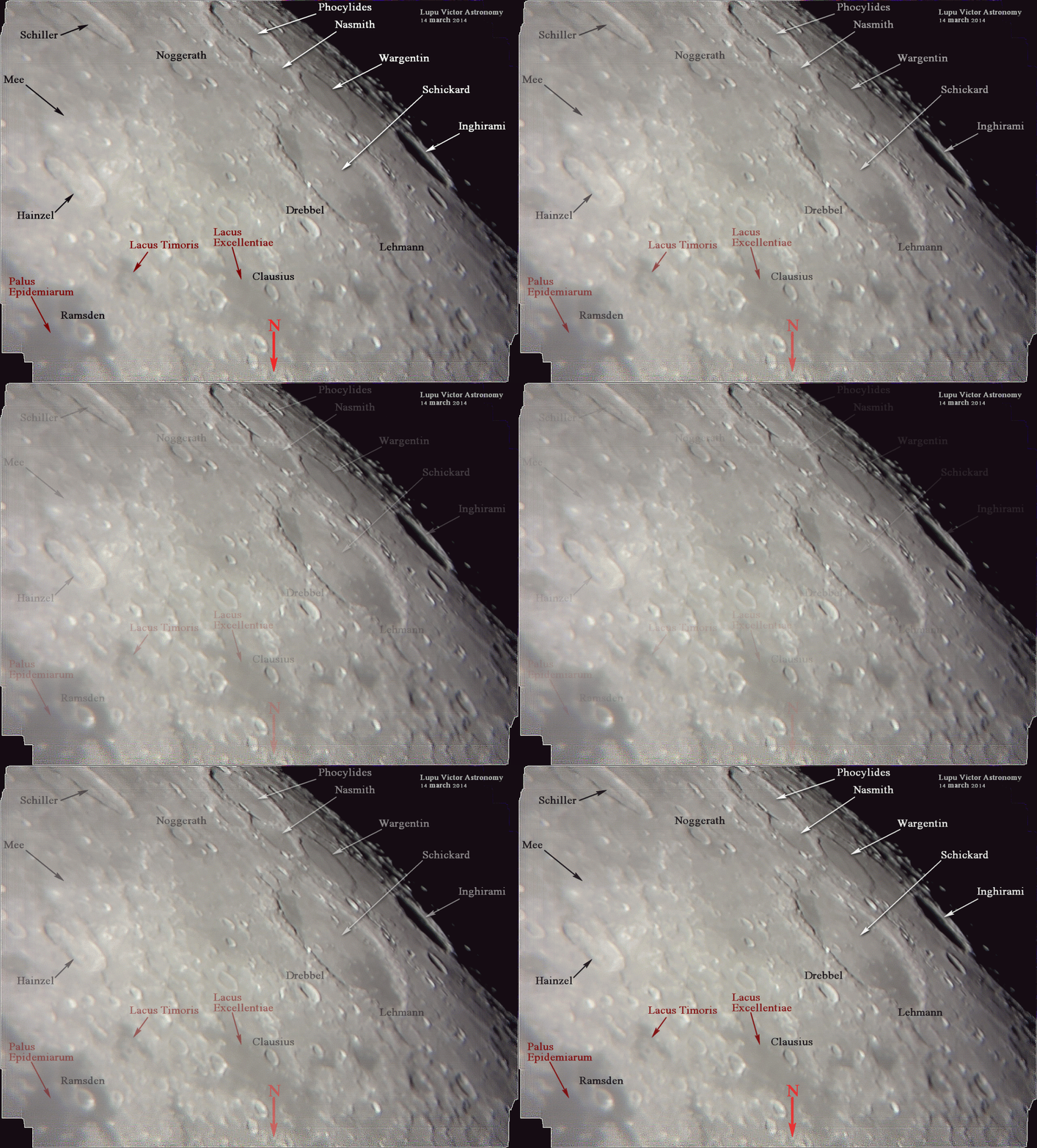
We talked about this area and other articles such as those in the links below, where we examined the southwest region of the Moon. The difference here is that picture quality is even better since these are Registax processings.

The images are overturned, so therefore cardinal points are reversed, but that's for a more relaxing view of these craters of various sizes. Among them we mention craters like Schickard (227 km) Hainzel (70 km), Noggerath (31 km), Drebbel (30 km), Phocylides and Nasmith (114/77 km) Wargentin (84 km) and Inghirami (91 km). Other features are Palus Epidemiarum, and Lacus Timoris and Lacus Excellentiae.

The video from which I extracted the images are here.
Video captures (snapshots) are here.

2938 video frames in Registax.
1173 video frames in Registax.
2938 video frames in Registax.

Images were obtained by attaching a camera directly into the eyepiece of an astronomical telescope of 8 inch Newtonian; For this reason the eyepiece visual field was increased.

In the picture below are labeled craters and other lunar features in the region. To better understand this photo, you should note that the label with the name or the letter of larger craters could be found at their center, and on the small craters, you should find them around them, usually above.


Magnitude: -12.03
Phase: 70.5% (0% = new, 100% = full)
Distance: 398.311 km
Sidereal Period: 27.32 days
Illuminated: 92.2%


Optics: Celestron C8-Newtonian astronomical telescope 
Eyepiece: Plossl 20mm, 2x Barlow
Mount: CG5 (EQ5)
Camera: Sony CX130
Filter: no
Date: 14/03/2014
Location: Baia Mare, Romania
Processing: Registax, FastStone Image Viewer


Monday, 20 July 2015

HD astronomical telescope video on the Moon: Schickard Phocylides and Nasmith.

In this video of a few minutes, we have an observation on southwest craters of the Moon, such as Schickard (227 km), the largest in center of images, Nasmith and Phocylides located south of it, and Inghirami crater (91 km) which is located on the edge of the Moon, it is seen oval and submerged by darkness.

The impact that formed the crater Schickard, occurred in an area predominantly high. This was followed by an episode of flooding that occurred both inside and outside the crater Schickard, which took place before the impact that formed Mare Orientale.

Another episode of flooding followed, creating a thin layer of material that covered the areas that were affected by the first episode of flooding.

A final episode of flooding occurred within the crater Schickard, creating two spots that can be seen today.
Photo images extracted from this video are here.


Moon Age: 1.00 days
Illuminated: 99.8% (0% = New, 100% = Full)

Magnitude: -12.20
Distance: 398.772 km


Optics (telescope or lenses): Celestron C8-Newtonian telescope, eyepiece 20mm Plossl, 2x barlow
Mount: CG5 (EQ5)
Camera: Sony CX130

Video mode: 1080p
Filter: no
Date: 14/03/2014
Location: Baia Mare, Romania
Processing: Sony Vegas HD Platinum 10.0


The video was made with the camera mounted on the telescope, to be more exact on the telescope eyepiece. To protect the telescope from vibrations, I used a tracking motor from Lacerta, and thus the image was more stable.

However, even with this tracking device for celestial bodies, there were vibrations of the telescope tube, causing the image to be slightly unstable. For this, I used the video stabilization option in Sony Vegas editing software, so the video was 100% correct on this issue.

Unstable aspect of the image through the telescope is caused by a combination of turbulence in the Earth's atmosphere and increased streams of heat from the ground and buildings.

Images were obtained by attaching a camera directly into the eyepiece of an astronomical telescope of 8 inch Newtonian; For this reason the eyepiece visual field was increased.

In the picture below are labeled craters and other lunar features in the region. To better understand this photo, you should note that the label with the name or the letter of larger craters could be found at their center, and on the small craters, you should find them around them, usually above.

Imafe from 2010.


Sunday, 28 June 2015

Schickard crater on the Moon by astronomical telescope.

Schickard (227 km) is the huge crater in images with a shallow depth compared to its size. It is located on the southwestern edge of the Moon quite close to it (the terminal). On its floor we see several shades, and a few small satellite craters.

Far more to the terminal, is a flooded crater in shadow, and difficult to observe because of its position on the lunar disc, called Inghirami (91 km). In some images are also present Phocylides, Nasmyth and Wargentin. They are south of Schickard.
Shickard crater lies in the southwest of the Moon near the edge. As a result it appears to be elongated. At the top of the crater lies Lehmann (53 Km.), And farther to the east, Drebbel (30 Km.).
Do not forget that in these pictures the Moon is upside down.


Magnitude: -12.03
Phase: 70.5% (0% = new, 100% = full)
Distance: 398.311 km
Sidereal Period: 27.32 days
Illuminated: 92.2%


Optics: Celestron C8-Newtonian astronomical telescope 
Eyepiece: Plossl 20mm, 2x Barlow
Mount: CG5 (EQ5)
Camera: Sony CX130
Filter: no
Date: 14/03/2014
Location: Baia Mare, Romania
Processing: FastStone Image Viewer


Images were obtained by attaching a camera directly into the eyepiece of an astronomical telescope of 8 inch Newtonian; For this reason the eyepiece visual field was increased.

In the pictures below are labeled craters and other lunar features in the region. To better understand this photo, you should note that the label with the name or the letter of larger craters could be found at their center, and on the small craters, you should find them around them, usually above.


Image from 2010.

Image from January 15, 2011.


Read this article in Romanian.

Monday, 5 May 2014

Ancient crater Schickard-video and images.


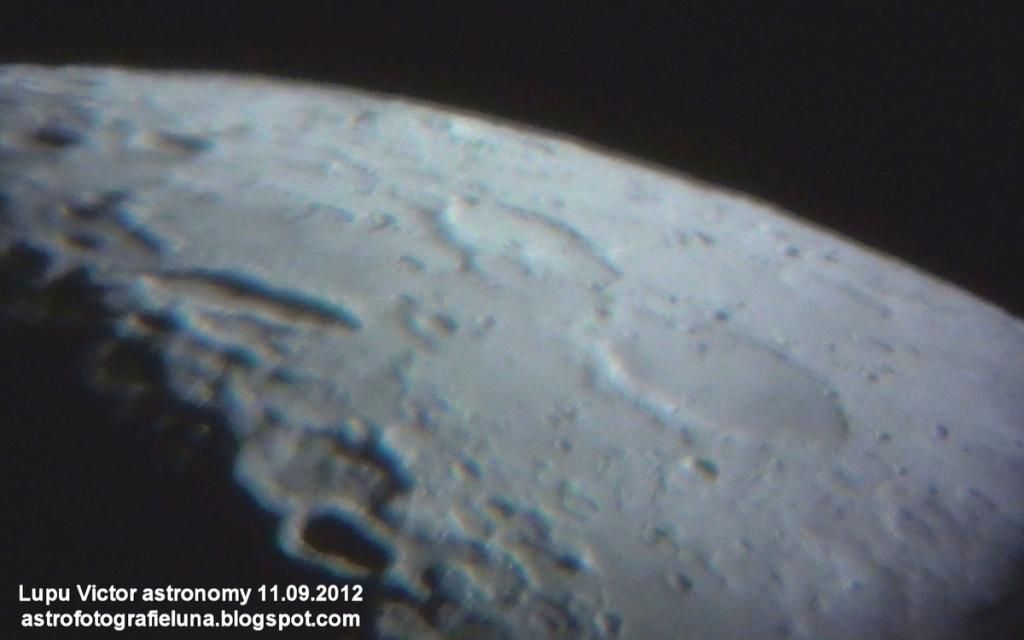
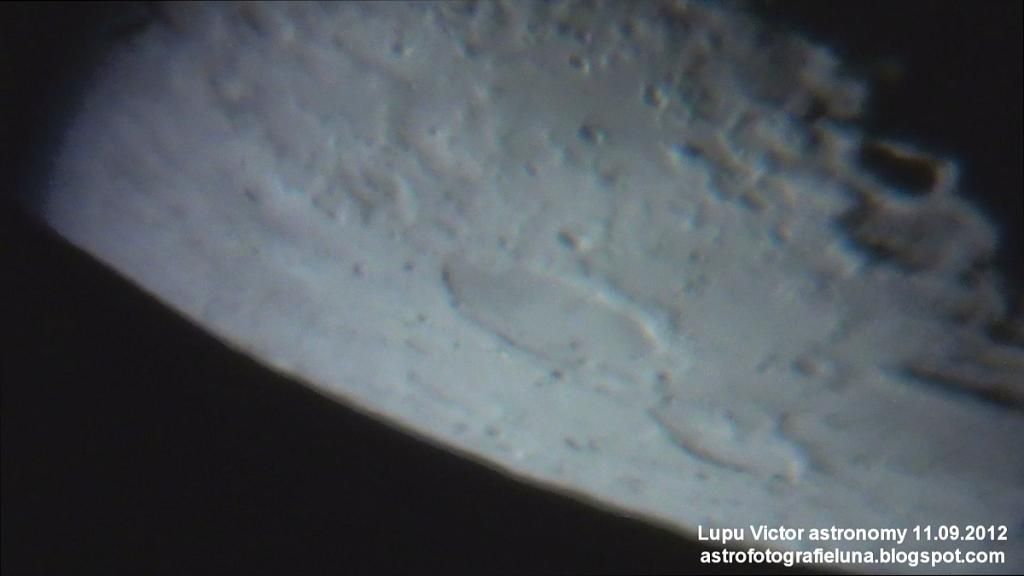
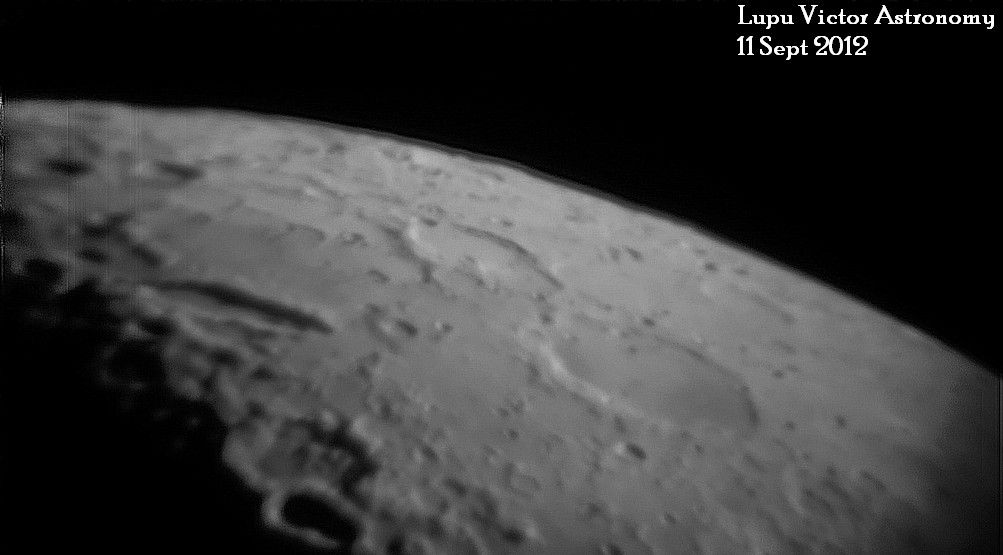
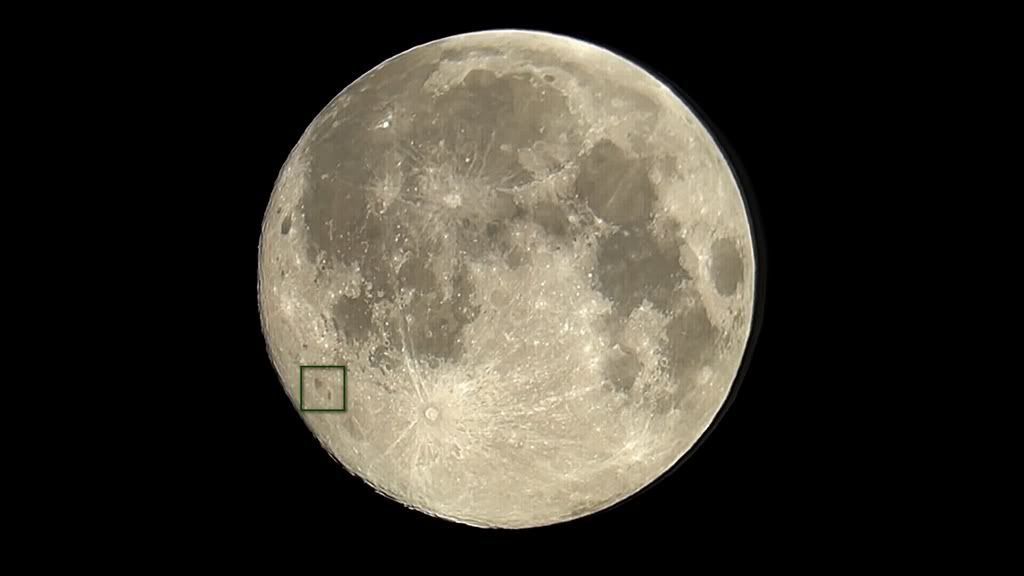
In the first image, the image is reversed for better viewing, the second image shows us as the craters are truly observed on southwest of the Moon, and the third is an overall picture of the Moon that night, so you can tell where Schickard (227 km) crater is .
Clearer images processed in Registax can be found here: Lunar Photo - Schickard.
Age of the Moon: 27 days
Distance: 387.568 km
Phase: 17% (0% = New, 100% = full)


Optics: Celestron C8 "-Newtonian telescope, 20 mm Plossl
Mount: CG5 (EQ5)
Camera: Sony CX130
Filter: no
Date: 11/09/2012
Location: Baia Mare, Romania
Processing: Registax, FastStone Image Viewer


Below, is the video from which I took the images.


Sunday, 10 November 2013

Lunar Photo - Schickard

182 frames at 80% best quality in Registax.
The Moon has it's "mysterious" ways in showing us its surface different, every time we observe it.
This phase reveals the western region, where there is not much, and darkness will cover the entire face of the Moon as we see it from Earth, to begin a New Moon in a few days.
The image is upside down, as seen through the telescope.

Craters seen here are Schickard (227 km), Phocilydes (114 km) and Nasmith (77 km).
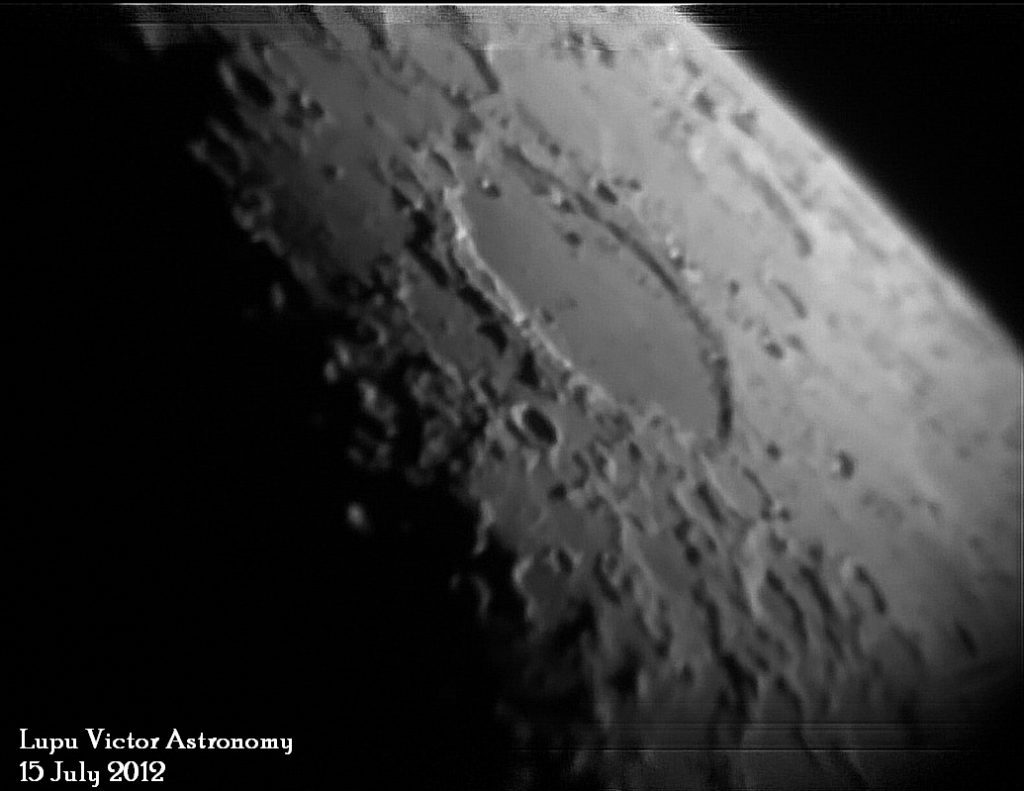
Schickard here is similar to that observed in July 15, 2012. when the Moon was at a roughly similar stage (picture below).

Age of the Moon: 27 days
Distance: 387.568 km
Phase: 17% (0% = New, 100% = full)

Optics: Celestron C8 "-Newtonian telescope, 20 mm Plossl
Mount: CG5 (EQ5)
Camera: Sony CX130
Filter: no
Date: 11/09/2012
Location: Baia Mare, Romania
Processing: Registax, FastStone Image Viewer


Image for guidance of July 15, 2012.


Saturday, 28 September 2013

Schickard Crater Region on the occultation morning.

42 frames to 95% best quality in Registax.

The images shown here are from the same morning Jupiter-Moon occultation took place, and these are video processings in Registax program.

In the moment this crater, Schickard (227 km), was filmed, Jupiter was behind Moon, the occultation of the two bodies being underway.
Images are upside down, as seen through the telescope.

Schickard crater is near terminal on this phase of the Moon. The angle from which the Sun 
enlightens the area, makes the craters appear to be more different than the other phases, and give the impression that they are shallower and have lower edges.


Age of the Moon: 26 days
Phase: 14% (0% = New, 100% = full)
Distance: 402,000 km


Optics: Celestron C8-Newtonian telescope, 20mm Plossl, 2x Barlow
Mount: CG5 (EQ5)
Camera: Sony CX130
Filter: no
Date: 15/07/2012
Location: Baia Mare, Romania
Processing: Images in Registax, FastStone Image Viewer


Tuesday, 13 November 2012

Schickard beautiful crater Video by telescope 2012

Schickard (227 km), is a large, flooded floor crater, in the southwest quadrant, near the edge of the Moon, distinct and uneven, with several tones and dotted with small craters. This crater is easy to locate with binoculars in high sunlight conditions.

In the north there is a big irregular plain, with dark lava called Lacus Excellentiae that is not framed in this video. Of considerable observational  interest, are the connected trio of craters, Phocylides, Nasmyth and Wargentin, visible in the video, south of Schickard.

Lighted by a high sun, a 203 mm telescope will reveal a lot of small impact craters on the floor, in addition to the two bright larger craters Schickard B and Schickard C, both of 12 km, at the east side wall and the other near the southwest wall.

This video was made on the same morning of Moon-Jupiter conjunction, just after the event at 5 o'clock.

I have not shot this crater in this light before.
The image is upside down as seen through the telescope.


Video: Victor Lupu
Optics: CelestronC8 "-Newtonian telescope, plossl20mm, 2x Barlow
Mount: CG5 (EQ5)
Device: Sony CX-130
Video mode: Full HD progressive 1920x1080
Filter: no
Date: 15/07/2012
Location: Baia Mare, Romania
Processing and editing: Sony Vegas 10

Saturday, 14 April 2012

Video through the telescope West of the Moon

These two clips of the west of the Moon, has several craters in the overwhelming light of the Sun.

Video 1 starts with a large area called Oceanus Procellarum south of the crater Aristarchus.
Then comes the images of the extreme terminal west of the Moon. At second 28, the crater Grimaldi, is observed as dark stain, left.
At second 42, crater Byrgius appears directly in the center, with Byrgius A which has an albedo very high, and rays that extend from it, over 400 km.
From minute 1:06 is crater Schickard.

Video 2 shows a whole Moon, with craters mentioned above, if you look west of it.


Video: Victor Lupu
Optics: CelestronC8 "-Newtonian telescope, plossl20mm, 2x Barlow
Mount: CG5 (EQ5)
Device: Sony CX-105
Filter: no
Date: 20/07/2011
Location: Baia Mare, Romania
Processing and editing: Sony Vegas 10

Monday, 5 March 2012

Registax: Photos by astronomical telescope Schickard and Schiller.


Registax 134 frames 90% lowest quality.

Craters Schickard, Schiller and Phocylides processed in Registax program.
These craters are located on the south-west of the Moon. Phocylides is the dark crater.

Photographer: Victor Lupu
Optics: Celestron C8-Newtonian reflector telescope, plossl 20mm, 2x Barlow
Mount: CG5 (EQ5)
Camera: Sony HDR CX105 at 8x optical zoom
Total Magnification: 800x
Filter: No
Date: 15/02/2011
Location: Baia Mare, Romania
Processing: Registax


Unprocessed photos are here: Schickard Drebbel Lehmann and Nöggerath craters .
Video of these images are here: Video - Schickard Schiller Phocylides and Nasmith - lunar craters .


Saturday, 11 February 2012

Schickard "cat's eye" astronomical video by telescope.

Eye of the cat in this video, is the crater Schickard. I say so, because I see that has this resemblance, but only when the crater is in the lightIt is on the southwest quadrant of the Moon, and has 227 km in diameter.

The video is not stabilized, and the area is shot at 500x to 800x with the video camera. Capture images from it are here.


Video: Victor Lupu
Optics: Celestron C8-inch Newtonian telescope, plossl 20mm, 2x Barlow
Mount: CG5 (EQ5)
Camera: SonyCX105 5x-8x optical zoom
Magnification: 500x-800x
Filter: no
Date: 16/08/2011
Location: Baia Mare, Romania
Processing: Sony Vegas 10

 
All images are © Copyright 2010-2015 Lupu Victor. All rights reserved.Images may not be reproduced, published, or copied in any form without written permission of the author. Thank you for respecting the intellectual property rights. ASTROFOTOGRAFIA | Lupu Victor Astronomy - Contact - About
Design by Free WordPress Themes | Bloggerized by Lasantha - Premium Blogger Themes | Online Project management