Visit Worldwide Topsites
Showing posts sorted by relevance for query Doppelmayer. Sort by date Show all posts

Wednesday, 12 February 2014

Good shoot of Doppelmayer crater on the Moon.

204 frames at 80% best qiality in Registax.
135 frames at 80% best qiality in Registax.
84 frames at 80% best qiality in Registax.


This is not the edge of the moon as you think, but the terminal, which separates the sunlit area of the shaded. North is at the bottom, the image is inverted as seen through the telescope.

Doppelmayer (64 km),crater is located on the southern edge of the Basin Mare Humorum. It has a circular shape, but lacks the northern edge of being swallowed by lava.
To the south east of the basin, we see a crater that is barely seen called Puiseux (25 km). It is almost whole covered by lava. Imagine how many more craters ended this way, completely swallowed by lava, and which we have not seen, nor ever see. 

Below Doppelmayer, (top photo), we see a smoother area, although it has small craters scattered throughout the place. This is Lacus Excellentiae, or Lake of Excellence.
These craters, are Vitello's (42 km) satellite craters, and Clausius (25 km). The latter is too located on the lake, on the west side.

Age of the Moon: 11 days
Distance: 386 658
Phase: 85% (0% = New, 100% = complete)

Optical Telescope Celestron C8 "Newtonian, plossl 20mm, 2x Barlow
Mount: CG5 (EQ5)
Device: Sony CX-130
Video Mode: Full HD 1920x1080 progressive
Filter: no
Date: 23/03/2013
Location: Baia Mare, Romania
Processing and editing: Sony Vegas 10, Registax


Tuesday, 6 September 2011

Surrounding area of Mare Humorum-images

Photographer: Victor Lupu
Optics: Celestron C8-Newtonian telescope, plossl 20mm, 2x Barlow
Mount: CG5 (EQ5)
Device: Sony CX105 at 5x optical zoom 3
 Total magnification: 300 and 500x optical zoom
Filter: No
Date: 05/14/2011
Location: Baia Mare, Romania
Processing: FastStone, video captures

Mare Humorum, or the Sea of moisture which has a size of 389 km, is surrounded on the outside of  many large craters and on the inside area do not have many craters outstanding.
Some craters are listed in these pictures, as Gassendi crater that is the most important eye-catching ring by its shape, with a stretch of 110 km (seen in the first 3 shots), and has only 1.9 miles deep.
When viewed through spectroscopic analysis, crater Gassendi presents a "behavior" very different from any other lunar crater. Studies conducted in high-resolution infrared light indicated the presence of extrusive volcanic material (ie volcanic material flowing to the surface and then crystallizes), limited to the south Gassendi crater floor, which is adjacent to Mare Humorum.

Mersenius (84 km), although smaller in size than Gassendi, it is deeper, with a depth of 2.3 km, and is in an area with many more depressions. It can be seen in the first 3 shots, and in the picture below to be better located. Mersenius lies west of Mare Humorum.
Doppelmayer (64 km), is a remnant of a lunar crater that is located south-west edge of the Mare Humorum. South-east of Doppelmayer, is another flooded crater named Lee (41 km) and Vitello (42 km).
Doppelmayer's edge is nearly round, but is eroded. The most intact is the south-west, while in the Northeast is going down under the sea of Humorum, leaving only a slight increase in the surface. The interior has been flooded by lava, leaving a large ridge high in the center.

Thursday, 8 December 2011

Video-Gassendi crater on Mare Humorum through telescope

Gassendi (110 km.), is a fractured floor crater. Many large craters on Mare Humorum are degraded. This degradation is mainly due to lava flooding from this sea.
 Photographs of this video can be seen here.

The video below has both stabilized and unstabilized images.
Other lunar craters seen here as a feature similar to Gassendi that was flooded by lava, are Doppelmayer, Lee, Vitello M, and Hippalus, all located inside the Humorum basin, and Mersenius crater, wich located outside the sea to the west.


Video: Victor Lupu
Optics: CelestronC8 "-Newtonian telescope, plossl20mm, 2x Barlow
Mount: CG5 (EQ5)
Device: SonyCX105 at 7x optical zoom
Total Magnification: 700x
Filter: no
Date: 14/05/2011
Location: BaiaMare, Romania
Processing and editing: Registax 6, FastStone

Tuesday, 21 January 2014

HDR Astrophotography West of Mare Humorum. Lunar craters: Mersenius.

148 frames at 80% best quality in Registax 5.
119 frames at 80% best quality in Registax 5.
78 frames at 80% best quality in Registax 5.
46 frames at 80% best quality in Registax 5.

The subject of this article, is Mersenius crater (84 km), located on the western side of the Moon. Although it is almost entirely filled by the shadow, we can observe it's beautiful laced edge better in sunlight, and Mersenius H on the southern rim of the crater.

To the east of this crater is the large circular basin, Mare Humorum, whose western edge is well defined at this phase of the Moon.
Other notable features here on the southwestern basin: remark Doppelmayer flooded crater (64 km), Liebig (37 km) with Rupes Liebig, de Gasparis (30 km), Palmieri (41 km) and Puiseux (25 km) and satellite craters and some of theirs.


Video can be seen here: Video by astronomical telescope Crater Gassendi.

Age of the Moon: 11 days
Distance: 386 658
Phase: 85% (0% = New, 100% = complete)

Optical Telescope Celestron C8 "Newtonian, plossl 20mm, 2x Barlow
Mount: CG5 (EQ5)
Device: Sony CX-130
Video Mode: Full HD 1920x1080 progressive
Filter: no
Date: 23/03/2013
Location: Baia Mare, Romania
Processing and editing: Sony Vegas 10


Tuesday, 8 October 2013

Enjoying the Moon. Video of Tycho crater on the Moon by telescope.

Some of the largest mass extinctions of life on Earth could have been caused by cosmic catastrophes such as those in the Moon . But we do not really know how often are these events . Records preserved on the Moon might be able to help us as well.

With a very thin atmosphere , the Moon is collecting meteorites more than Earth, because of the large impact craters on it , making it to be a very good site digging for space debris containing valuable information about the past of our Solar System .

In the video shown below , we see craters on the Moon's south as Tycho (85 km) , Wilhelm (107 km), Hainzel (70 km), Capuanus ( 60 km ), and Lacus Timoris continuing onto south of Mare Humorum where are craters as Lee (41 km), Vitello (42 km ) or Doppelmayer (64 km), crater with a semicircular shape and a central peak in the middle, seen in the and of the video.

Tycho, is a lunar crater on the south , on which may be given full attention in times of Full Moon . At this stage it can be observed through binoculars , and also with the naked eye even if it is not large . With the naked eye we can not see the crater , but its light rays that spread on a large part of the southern hemisphere of the Moon , and in this way you can realize where it is , ie where the luminous intensity is the most intense , where all the rays unites.
When shooting this impressive crater , albedo which fills it and that on the outside, is alive and dominate the images.

Age of the Moon: 11 days
Distance: 386 658
Phase: 85% (0% = New, 100% = Full)


Optical Telescope CelestronC8 "-Newtonian plossl20mm, 2x Barlow
Mount: CG5 (EQ5)
Device: Sony CX-130
Video Mode: Full HD 1920x1080 progressive
Filter: no
Date: 23/03/2013
Location: Baia Mare, Romania
Processing and editing: Sony Vegas 10


Sunday, 19 February 2012

List of west features of the Moon. astronomy lecture

                 Photo made ​​in November 2010


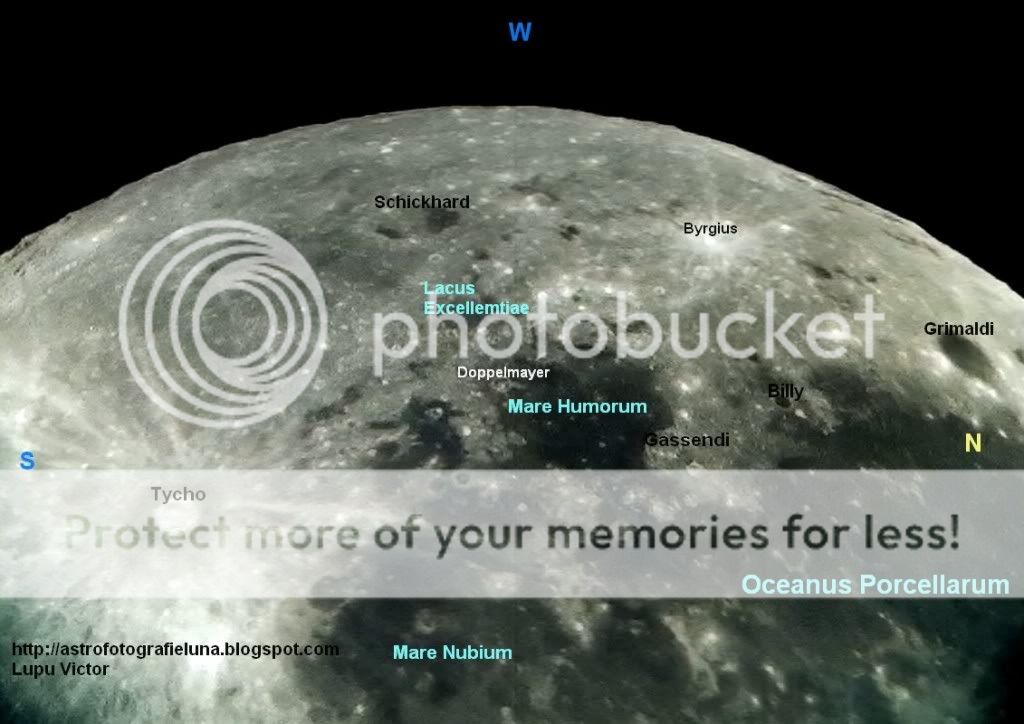
     West of the Moon seen from Earth, we see always the same for the Moon always keeps the same face toward us and never turns his back. It is a large area occupied by Oceanus Procellarum. To the west of the mare, distinct craters are: Grimaldi, who is seen as a dark spot in comparison with the surrounding land, when it is full Moon, Schickard, Gassendi, located on the Mare Humorum, and Byrgius that despite being a relatively small crater, 87 km, shows white rays starting at it, for distances over 400 km.

Oceanus Procellarum is the most extensive and interesting feature of the western part of the Moon. This large area covers almost all the West. On the west, mountains of the Moon are not large.

Results of the links may not have the title features you are looking for, but in the content of those articles, those features are presented.

Craters of the Moon's western area.

Agatharchides
Angstrom
Aristarchus

Aston
Bailly

Bessarion
Bettinus

Billy
Brayley
Briggs
Bullialdus

Byrgius
Campanus
Capuanus

Cardanus
Cavelerius
Cavendish

Cichus
Clausius
Cruger
Damoiseau
Damey
Darwin
De Vico
Diophantus
Doppelmayer
Drebbel
Dunthome
Eddington
Encke
Euclides

Euler
Flamsteed

Fontana
Fourier

Fra Mauro
Freres
Galilaei
Gasparis
Gassendi

Grimaldi
Hainzel
Hansteen
Herigonius
Henry
Hermann
Herodotus

Hevelius
Hippalus
Inghirami
Kepler
Kies
Kircher

Konig
Krafft
Krieger
Kuiper
Kunowsky

Lacroix
Lagrange
Lamarck

Lansberg

Lavoisier
Lee

Lepaute
Letrone
Liebig
Lohrmann
Lubiniezky
Maestlin
Marius
Mee
Mercator

Mersenius
Milichius
Noggerath

Nasmyth
Nielsen
Palmieri
Phocylides
Piazzi
Prinz
Ramsden
Reiner Gamma
Reinhold
Riccioli
Rocca
Russell
Schiaparelli
Schickard
Seleucus
Sirsalis
Struve

T. Mayer
Ulugbek
Vaisala
Vieta
Vitello
Wargentin
Wichmann
Withrop
Wollaston
Zucchius

Zupus

Seas of the Moon's western area.

Mare Cognitum
Mare Humorum
Mare Imbrium
Mare Insularum
Oceanus Procellarum


Mountains of the Moon's western area.

Montes Agricola
Montes Harbinger
Montes Riphaeus

Mons Delisle
Mons Vinogradov


Other forms of relief in the west area of the Moon.

Palus Epidemiarum
Lacus Aestatis
Lacus Excellentiae
Vallis Inghirami
Vallis Schroteri


Space missions on the east side of the Moon.

Luna 7 (1965) Soviet Union- because of loss of control of altitude, crashed on the moon with a high velocity.
Luna 8 (1965) Soviet Union- collapsed on the lunar surface due to a faulty parachute.
Luna 9 (1966) Soviet Union- successfully sent nine images of the lunar surface, including five panoramas.
Luna 13 (1966) Soviet Union- Soviet spacecraft was the second that has successfully reached the lunar surface.

Surveyor 1 (1966) USA- was the first U.S. spacecraft that managed to land safely on the Moon.

Surveyor 2 (1966) USA- during stability maneuver, an engine has not ignited, and crashed on the Moon.

Apollo 12 USA- (EVA). On November 19, 1969, Apollo 12 crew performed a landing on the lunar surface landing a few hundred meters from the crater Surveyor. The main purpose of the mission was to collect pieces of the Surveyor III ship that landed in the crater, 31 months earlier.

SMART-1 (2006) - Europe. After exhaustion of fuel, SMART-1 was deliberately crashed into the lunar surface near the Lacus Excelentiae. The impact was visible from Earth, in North and South America.


Video: Victor Lupu
Optics: CelestronC8 "-Newtonian telescope, plossl20mm, 2x Barlow
Mount: CG5 (EQ5)
Device: SonyCX105 at 7x optical zoom
Total Magnification: 700x
Filter: no
Date: 20/07/2011
Location: Baia Mare, Romania
Processing and editing: Sony Vegas 10


To see the photographic map of the west area of the moon, view: Photographic map of the Moon: West Zone. Lunar Atlas.


Wednesday, 16 October 2013

Visual astronomy Mare Humorum Video.

The first thing that crosses my mind when I think of Mare Humorum, is crater Gassendi (110 km) (minute 1:31), a crater shaped as a diamond ring, north west of this circular basin on thr Moon.

Not much to see on Mare Humorum but only many small craters which are spread on the smooth plateau with the exception of Puiseux (25 km), but on the edges we see features that can not be overlooked.

On the edge of east, west and south of the basin are large craters as Doppelmayer (64 km), Hippalus (58 km) south and east, both having similar shapes because they were partially flooded and a part of their edges disappeared under lava basin, leaving them with a semicircle form.

Age of the Moon: 11 days
Distance: 386 658 km
Phase: 85% (0% = New, 100% = full)


Optical Telescope Celestron C8 "-Newtonian plossl 20mm, 2x Barlow
Mount: CG5 (EQ5)
Device: Sony CX-130
Video Mode: Full HD 1920x1080 progressive
Filter: no
Date: 23/03/2013
Location: Baia Mare, Romania
Processing and editing: Sony Vegas 10


Mare Humorum. Image from 2010.


Sunday, 14 July 2013

HD video Telescope images of lunar crater Fracastorius

We are on the south-east of the Moon, south of Nectaris basin and north of the crater Piccolomini. The area is taken over by a horseshoe-shaped crater named Fracastorius (124 km).

There are many craters on the Moon with this form, as Julius Caesar, Doppelmayer, Meton's satellite craters, or Sinus Iridum.

Fracastorius crater name is given for the poet Girolamo Fracastoro Italian physicist and astronomer who lived in the 14th century and early 15th century. From one of his poems derive the name of syphilis disease.

These superb video of crater Fracastorius in sunlight, is made by my astronomical telescope on which was attached a video camera on the eyepiece. I made some pictures from this video in Registax which optimized multiple frames. You can actually visualize them in the article Fracastorius crater on the Moon through a telescope.

Moon Age: 17 days
Phase: 93% (0% = New, 100% = full)
Distance: 396.848 km


Optics: Celestron C8 "-Newtonian telescope, plossl 20mm, 2x Barlow
Mount: CG5 (EQ5) motorized
Device: Sony CX-130
Video mode: Full HD progressive 1920x1080
Filter: no
Date: 31/12/2012
Location: Baia Mare, Romania
Processing and editing: Sony Vegas 10

 
All images are © Copyright 2010-2015 Lupu Victor. All rights reserved.Images may not be reproduced, published, or copied in any form without written permission of the author. Thank you for respecting the intellectual property rights. ASTROFOTOGRAFIA | Lupu Victor Astronomy - Contact - About
Design by Free WordPress Themes | Bloggerized by Lasantha - Premium Blogger Themes | Online Project management