Visit Worldwide Topsites
Showing posts sorted by relevance for query Miller. Sort by date Show all posts

Monday, 4 March 2013

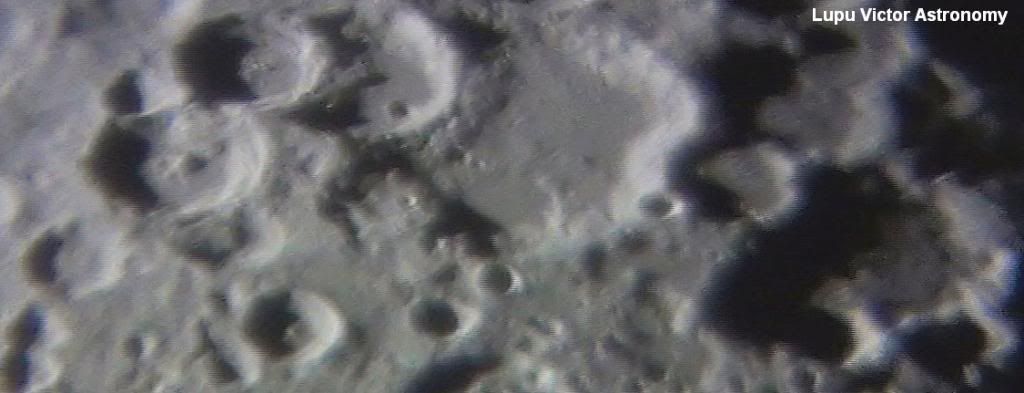
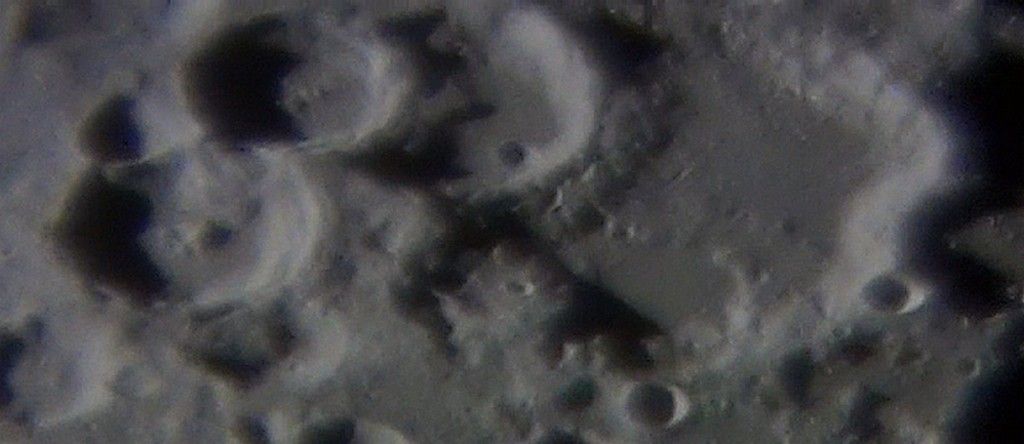
Orontius and the complex of craters forming a scorpion.


Orontius (122 km), is the head of a line of craters that form a "scorpion" with a curved tail. The craters, which are the body and tail of the "scorpion", are Huggins (65 km), Nasireddin (52 km) and Miller (75 km), Miller C (36 km), being the tip of the tail.

I do not know if the successive impacts were shortly one after another, but it is clear that Orontius is the oldest of them, followed by Huggins, after which were Nasireddin and Miller. We can see that, by observing how they overlap each other.


Orontius is very close to the crater Tycho (85 km). The distance between their edges is only of 78 km. Therefore, this area is full of a very high albedo from the impact that caused the formation of Tycho.


Moon age: 7 days
Stage: 51% (0% = New, 100% = Full)
Distance: 384.488 km


Optics: Celestron C8-Newtonian telescope, 20mm Plössl, 2x barlow
Mount: CG5 (EQ5)
Camera: Sony CX130
Filter: no
Date: 29/04/2012
Location: Baia Mare, Romania
Processing: video captures, FastStone Image Viewer

Wednesday, 10 September 2014

"Caterpillar" crater Orontius on the Moon.


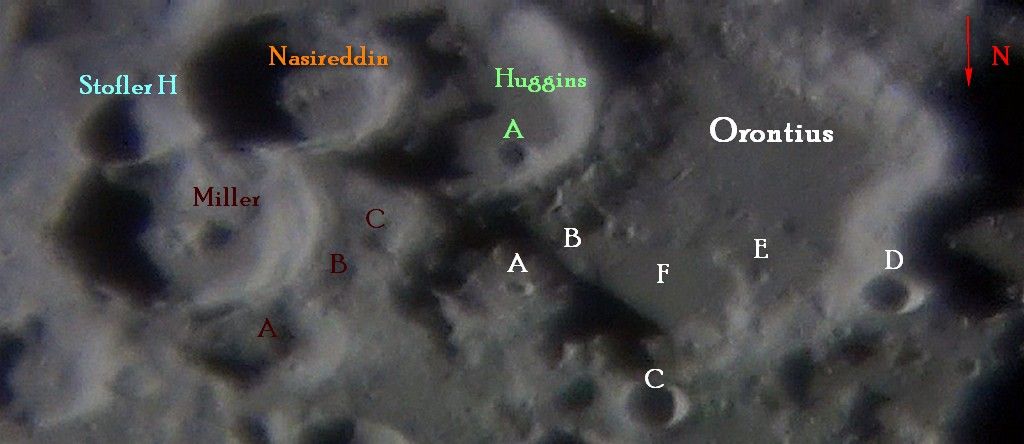
Orontius crater (122 km), would not have been so beautiful and so easy to recognize, unless would not have had attached to it some craters that are arranged in descending order, and its like it forms the body of a caterpillar, its head being Orontius.

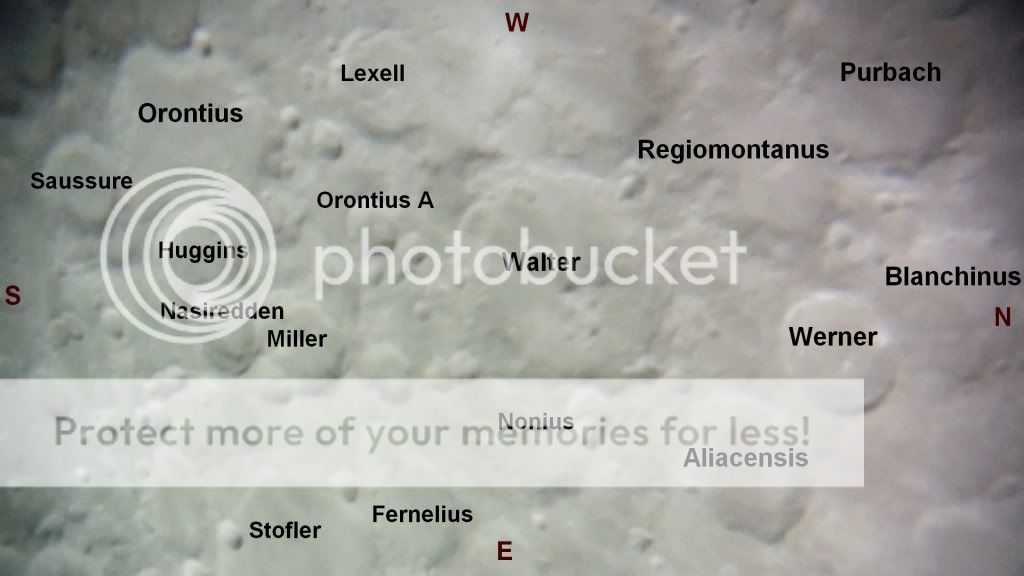
These craters are labeled in the image below for an easier orientation. They are Huggins (65 km), Nasireddin (52 km) and Miller (75 km). All three have two letters side by side as "gg", "dd" and "ll", which I find hard to believe it's a coincidence. Even Stöffler H (27 km), located between Nasireddin and Miller, contains two letters "ff".

Oronţius is the Latin name of Oronce Fine (or Finé), after which was named this crater-Latin: Orontius Finnaeus, Italian: Oronzio Fineo. He was a French mathematician and cartographer.


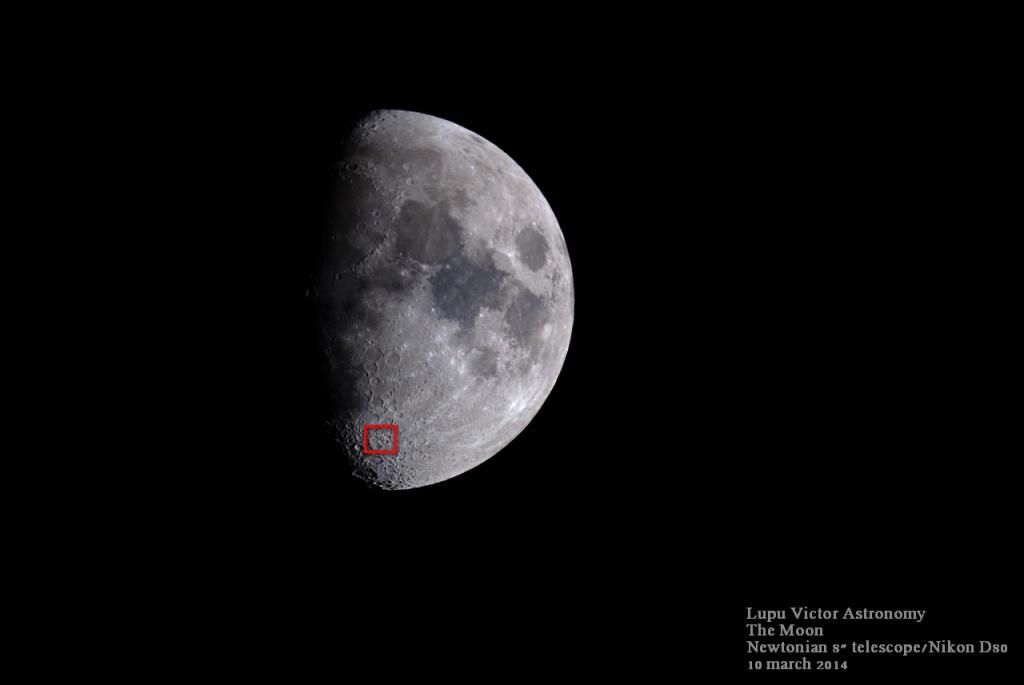
Image for orientation from 29 aprilie 2012.

Moon Age: 9.05 days
Phase: 70.5% (0% = New, 100% = Full)
Distance: 399.221 km


Optics: Celestron C8-Newtonian telescope, 20mm Plossl, 2x barlow
Mount: CG5 (EQ5)
Camera: Sony CX130
Filter: no
Date: 10/03/2014
Location: Baia Mare, Romania
Processing: FastStone Image Viewer


Tuesday, 27 December 2011

List of south features of the Moon-Southern lunar Hemisphere


Southern hemisphere of the Moon is in rough terrain, heavily cratered and with mountainous areas.
At the poles, the sun is always at small angles, so this is creating a unique environment, but also some difficulties in interpreting the geological region.
The southern hemisphere of the Moon craters are very different in size, appearance and how they were formed by impacts in the past.
Personally, the most interesting craters on south, I find Tycho, a crater with rays showing a very high albedo, rays that are left behind from the initial impact, wich can be seen from Earth with the naked eye or binoculars.
Another great crater is Clavius​​, a large crater with other small craters lying inside it in a decreasing order to form a spiral.
Shiller is another crater, interesting to me because of its elongated shape similar to a caterpillar.
 On the southern hemisphere of the Moon seen from Earth, there is only a sea, Mare Nubium that penetrate down to the crater Pitatus.

There are not mountains on the Moon's southern hemisphere. Maybe were probably destroyed by countless impacts were.

Most notable craters of the Moon southern hemisphere, in alphabetical order, are:

Aliacensis
Apianus
Asclepi
Baco
Ball

Barocius
Biela
Blanchinus
Boguslawsky
Bosching
Boussingault
Brown
Buch
Casatus
Cichus
Clairaut
Clavius
Curtius
Cuvier
Cysatus
Deluc
Demonax
Deslandres
Fabricius
Faraday
Fernelius
Frisius
Gauricus
Gemma
Gruemberger
Hagecius
Heinsius
Hell
Helmholtz
Heraclitus
Hommel
Jacobi
Janssen
Kaiser
Kinau
Klaproth
Lexell
Licetus
Lilius
Longomontanus
Maginus
Manzinus
Maurolycus
Metius
Miller
Montanari
Moretus
Mutus
Neander
Nearch
Neumayer
Newton
Nonius
Orontius
Pentland
Picret
Pitatus
Pitiscus
Playfair
Poisson
Pontanus
Pontecoulant
Proctor
Rabbi Levi
Rheita
Riccius
Rosenberger
Sasserides
Saussure
Sempilius
Short
Scheiner
Schiller
Schomberger
Scott
Steinheil
Stofler
Tannerus
Tycho
Vlaq
Watt
Weiss
Werner
Wilhelm
Wurzelbauer
Zach


Seas:
Mare Nubium

Space missions on the south side of the Moon:
Ranger 9 was launched on March 24, 1965 by United States of America and was intentionally crashed on the lunar surface, on crater Alphonsus.
Ranger 9 was designed to achieve an impact trajectory and to transmit pictures of the lunar surface in high-resolution during the flight until the impact.
  Ranger 9 successfully transmitted 5814 images with a resolution of up to 1.5 m.

LCROSS United States launched the LCROSS (Lunar Crater Observation and Sensing Satellite) which was deliberately crashed into the Moon's south pole on crater Cabeus on October 9, 2009
The mission was designed to search for water ice on the lunar surface and examining the resulting cloud, caused by impact. The mission ended with the discovery of significant amounts of water.

Moon Impact Probe was launched by India, and it was deliberately crashed on 14 November 2008 at the lunar south pole.
 It had 35 kg, and was released from Chandrayaan-1 Lunar Orbiter. It was equipped with a video camera, a radar altimeter and a mass spectrometer.


Video: Victor Lupu
Optics: CelestronC8 "-Newtonian telescope, plossl20mm, 2x Barlow
Mount: CG5 (EQ5)
Device: SonyCX105 at 7x optical zoom
Total Magnification: 700x
Filter: no
Date: 16/08/2011
Location: Baia Mare, Romania
Processing and editing: Sony Vegas 10


To see the photographic map of the south area of the Moon, view: Photographic map of the Moon: South Zone. Lunar Atlas.

For those who like my astro pictures or my articles, it woul be great if you could pay attention on advertising that appear in the blog by a click and maybe one day I could buy a better telescope.

Saturday, 2 April 2011

Stöfler Maurolycus and Barocius craters

Stöfler and Maurolycus Registax 80 frames 90% lowest quality.                                                                  -click to enlarge
Stöfler and Maurolycus Registax 32 frames 100% lowest quality.                                                                    -click to enlarge
Stöfler and Maurolycus Registax 14 frames 100% lowest quality.                                                                       -click to enlarge

Stöfler and Maurolycus Registax 78 frames 95% lowest quality.                                                                                                    

Photographer: Victor Lupu
Optics: Celestron C8-Newtonian reflector telescope, plossl 20mm, 2x Barlow
Mount: CG5 (EQ5)
Device: Sony HDR CX105
Filter: No
Date: 09/02/2011
Location: Baia Mare, Romania
Processing: Registax

        Stöfler (126 km) is a large lunar crater located in the mountainous areas south of the Moon.It is named after Johannes Stöffler. It is located west of Maurolycus (east on the photo). A distorted crater, Fernelius is attached to the edge of the south and at east are Nasireddin and Miller (not visible in photos). Faraday (70 km), is a damaged crater located at the northwestern edge of Stöfler.
     Stöfler's edge is eroded, but the outline remains relatively intact except for the region where it overlaps with Faraday crater (75 km). The crater located north of Stöfler is Licetus .
    Craters Maurolycus and Barocius (114-82 km) are located west of Stöfler.


          Barocius (82 km.) is an ancient lunar crater that is located in the southern highlands of the Moon. In north it lies Maurolycus. In the north-east of Barocius is Clairaut.
Barocius's edge has been eroded by many subsequent impacts. The most notable, Barocius B, which is located in west side of Barocius, and mingle with the Barocius C. A remnant of a crater, Barocius W , is inside Barocius .
Crater is the name given by Francesco Barozzi (9 August 1537 - 23 November 1604) who was an italian mathematician, astronomer and humanist.


                 Maurolycus (114 km.) , is one of the most prominent craters in the southern highlands of the Moon. To the north is the crater Barocius.
Crater name is given from Francesco Maurolico (16 September 1494-21 July 1575. He has worked in the fields of mathematics, geometry, optics, mechanics, music, and astronomy.
     

Saturday, 17 September 2011

Maginus and Orontius Craters-telescope images

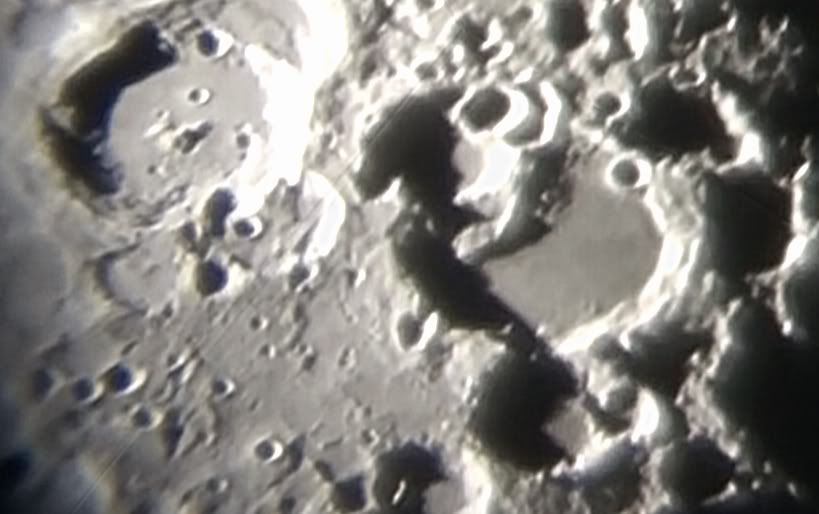
Orontius crater (122 km), is on the bottom of the photos above, along with Huggins (65 km), Nasiredden (52 km) and Miller (75 km). All these are in descending order and are joined to each other.In this area there are some big, big craters, as Maginus (163 km), at the top of the photo, Clavius ​​(225 km), Walther (128 km), and others.
The picture below is older and is for guidance.
Below is Maginus (163 km), located in the center photo. Over all these craters .Tycho crater (85 km) rays, are covering almost the entire southern hemisphere of the Moon.
Photographer: Victor Lupu
Optics: Celestron C8-Newtonian telescope, plossl 20mm, 2x Barlow
Mount: CG5 (EQ5)
Eyepiece Adapter: 1.25 "
Device: Sony CX105 at 7x optical zoom
Total Magnification: 700x
Filter: No
Date: 12/05/2011
Location: Baia Mare, Romania
Processing: video captures, FastStone Image Viewer
Images are upside down, as seen through the telescope.

 
All images are © Copyright 2010-2015 Lupu Victor. All rights reserved.Images may not be reproduced, published, or copied in any form without written permission of the author. Thank you for respecting the intellectual property rights. ASTROFOTOGRAFIA | Lupu Victor Astronomy - Contact - About
Design by Free WordPress Themes | Bloggerized by Lasantha - Premium Blogger Themes | Online Project management