Visit Worldwide Topsites
Showing posts sorted by relevance for query Hell. Sort by date Show all posts

Thursday, 26 July 2012

HD telescope video with heart-shaped Deslandres crater on the Moon.

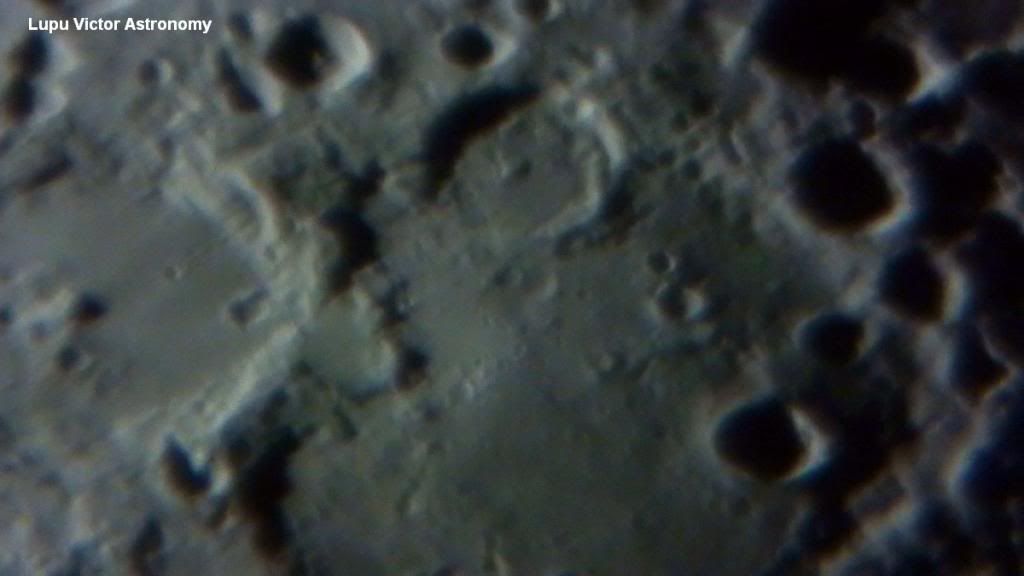
The video images of this article are upside down (north and south are reversed), as seen through the telescope. Images were stabilized in Sony Vegas 10, because the mount wasn't motorized. The quality of our atmosphere was very good and that is why the lunar surface details are clear.

 Deslandres (234 km), is a desintegrated crater of pre-Nectarian era, and is one of the largest craters on the Moon. I like to think it has a heart shape. Also note in the video below, the eroded crater Lexell (63 km) on its southeastern edge and Hell (33 km), a smaller crater, named for astronomer Maximilian Hell, on the west. Hell Crater, shows a central peak in the center, but not visible due to the shadow that covers the crater floor. You may also notice a line of small craters on the eastern crater floor of Deslandres.


Video: Victor Lupu
Optics: CelestronC8 "-Newtonian telescope, plossl20mm, 2x Barlow
Mount: CG5 (EQ5)
Device: Sony CX-130
Video mode: Full HD progressive 1920x1080
Filter: no
Date: 29/04/2012
Location: Baia Mare, Romania
Processing and editing: Sony Vegas 10


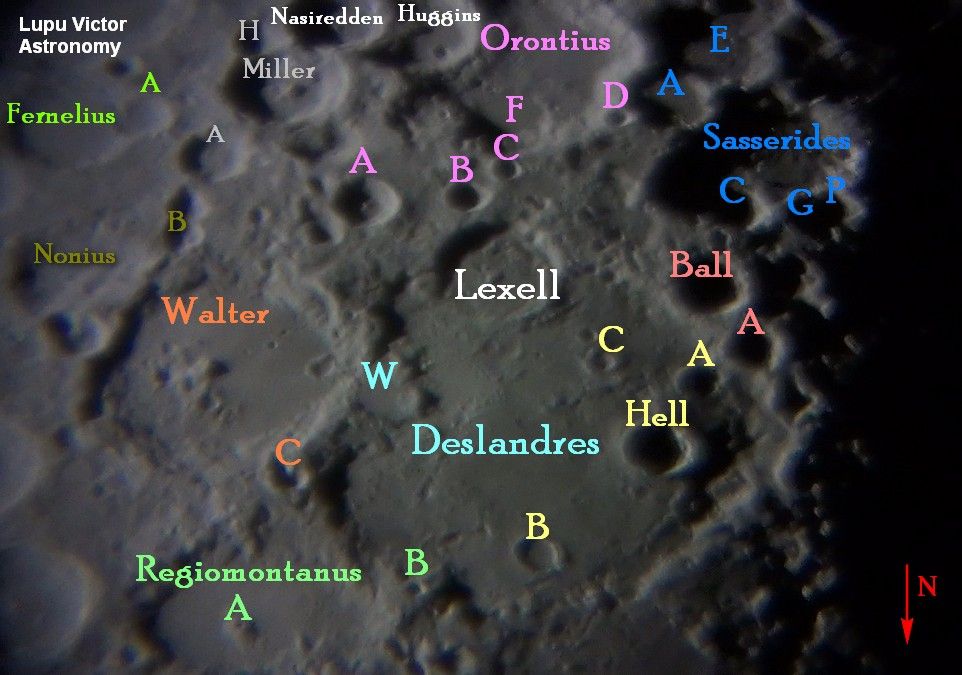
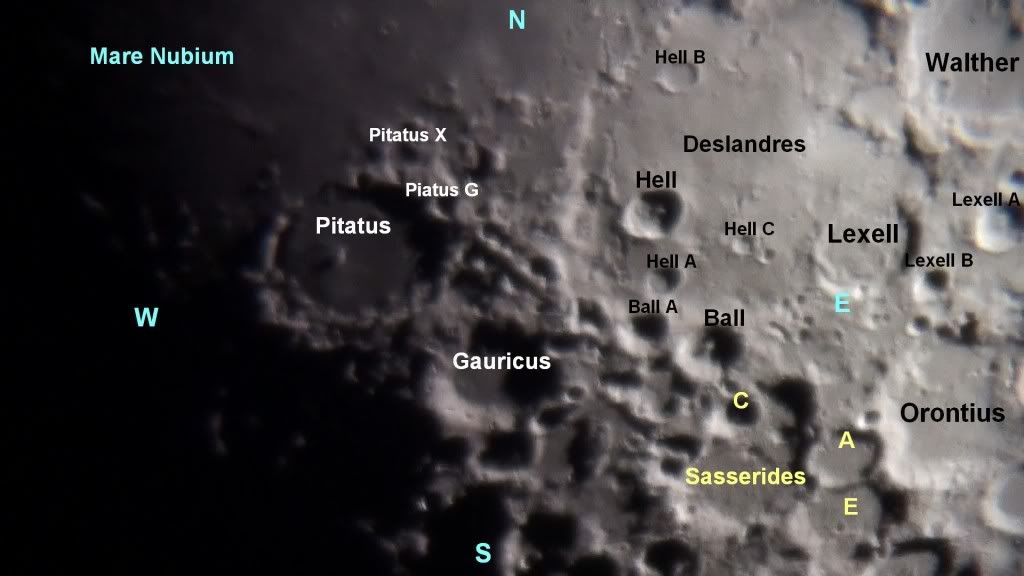
Other large craters in this video, can be identified in the photo below, as Walther, Regiomontanus, Nonius, Sasserides and Orontius.
                                    The picture below was made on May 11, 2011.

Monday, 18 February 2013

Deslandres and the surrounding craters. Astronomical telescope images


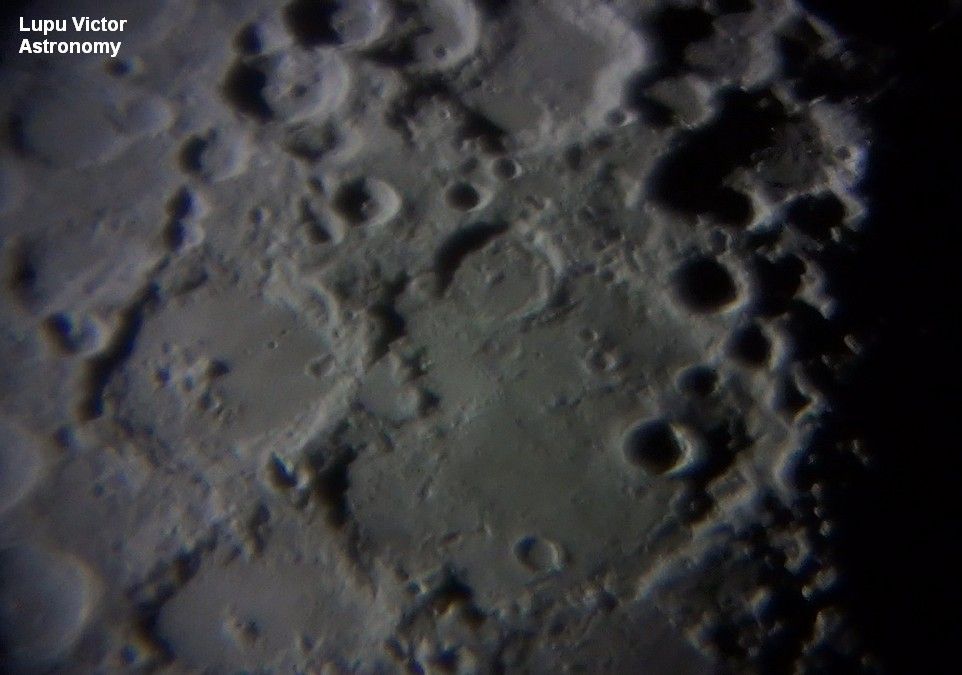
These images are very clear, as the camera focus was best. In the pictures here, we have the huge crater Deslandres (234 km) north of the bright crater Tycho.  To view the telescope video of these photos, go here.

A very bright rays of Tycho with high albedo, are spread on the whole region, but these are not seen in the photos because of the Moon phase at that time, when the Sun was at a low angle.

The picture below explains in great detail all craters located inside of Deslandres, and neighbors, as I labeled them each name with color. Images are inverted as seen through the telescope.

As you can see, this area is very rich in craters of all sizes, feature which is common to the south of the Moon. In these pictures, are craters like: Lexell, Sasserides, Walther, Orontius, Hell, Nonius and others.

Info Deslandres crater.
Coordinates32.5°S 5.2°
Diameter256 km
DepthUnknown
Colongitude5° at sunrise
EponymHenri A. Deslandres


Moon age: 7 days
Stage: 51% (0% = New, 100% = Full)
Distance: 384.488 km

Optics: Celestron C8-Newtonian telescope, 20mm Plössl, 2x barlow
Mount: CG5 (EQ5)
Camera: Sony CX130
Filter: no
Date: 29/04/2012
Location: Baia Mare, Romania
Processing: video captures, FastStone Image Viewer

Tuesday, 27 December 2011

List of south features of the Moon-Southern lunar Hemisphere


Southern hemisphere of the Moon is in rough terrain, heavily cratered and with mountainous areas.
At the poles, the sun is always at small angles, so this is creating a unique environment, but also some difficulties in interpreting the geological region.
The southern hemisphere of the Moon craters are very different in size, appearance and how they were formed by impacts in the past.
Personally, the most interesting craters on south, I find Tycho, a crater with rays showing a very high albedo, rays that are left behind from the initial impact, wich can be seen from Earth with the naked eye or binoculars.
Another great crater is Clavius​​, a large crater with other small craters lying inside it in a decreasing order to form a spiral.
Shiller is another crater, interesting to me because of its elongated shape similar to a caterpillar.
 On the southern hemisphere of the Moon seen from Earth, there is only a sea, Mare Nubium that penetrate down to the crater Pitatus.

There are not mountains on the Moon's southern hemisphere. Maybe were probably destroyed by countless impacts were.

Most notable craters of the Moon southern hemisphere, in alphabetical order, are:

Aliacensis
Apianus
Asclepi
Baco
Ball

Barocius
Biela
Blanchinus
Boguslawsky
Bosching
Boussingault
Brown
Buch
Casatus
Cichus
Clairaut
Clavius
Curtius
Cuvier
Cysatus
Deluc
Demonax
Deslandres
Fabricius
Faraday
Fernelius
Frisius
Gauricus
Gemma
Gruemberger
Hagecius
Heinsius
Hell
Helmholtz
Heraclitus
Hommel
Jacobi
Janssen
Kaiser
Kinau
Klaproth
Lexell
Licetus
Lilius
Longomontanus
Maginus
Manzinus
Maurolycus
Metius
Miller
Montanari
Moretus
Mutus
Neander
Nearch
Neumayer
Newton
Nonius
Orontius
Pentland
Picret
Pitatus
Pitiscus
Playfair
Poisson
Pontanus
Pontecoulant
Proctor
Rabbi Levi
Rheita
Riccius
Rosenberger
Sasserides
Saussure
Sempilius
Short
Scheiner
Schiller
Schomberger
Scott
Steinheil
Stofler
Tannerus
Tycho
Vlaq
Watt
Weiss
Werner
Wilhelm
Wurzelbauer
Zach


Seas:
Mare Nubium

Space missions on the south side of the Moon:
Ranger 9 was launched on March 24, 1965 by United States of America and was intentionally crashed on the lunar surface, on crater Alphonsus.
Ranger 9 was designed to achieve an impact trajectory and to transmit pictures of the lunar surface in high-resolution during the flight until the impact.
  Ranger 9 successfully transmitted 5814 images with a resolution of up to 1.5 m.

LCROSS United States launched the LCROSS (Lunar Crater Observation and Sensing Satellite) which was deliberately crashed into the Moon's south pole on crater Cabeus on October 9, 2009
The mission was designed to search for water ice on the lunar surface and examining the resulting cloud, caused by impact. The mission ended with the discovery of significant amounts of water.

Moon Impact Probe was launched by India, and it was deliberately crashed on 14 November 2008 at the lunar south pole.
 It had 35 kg, and was released from Chandrayaan-1 Lunar Orbiter. It was equipped with a video camera, a radar altimeter and a mass spectrometer.


Video: Victor Lupu
Optics: CelestronC8 "-Newtonian telescope, plossl20mm, 2x Barlow
Mount: CG5 (EQ5)
Device: SonyCX105 at 7x optical zoom
Total Magnification: 700x
Filter: no
Date: 16/08/2011
Location: Baia Mare, Romania
Processing and editing: Sony Vegas 10


To see the photographic map of the south area of the Moon, view: Photographic map of the Moon: South Zone. Lunar Atlas.

For those who like my astro pictures or my articles, it woul be great if you could pay attention on advertising that appear in the blog by a click and maybe one day I could buy a better telescope.

Wednesday, 18 February 2015

Lunar craters. Images by astronomical telescope. Deslandres (Registax).

145 video frames in Registax.
195 video frames in Registax.
1 video frames in Registax.
143 video frames in Registax.

Of course, the most impressive feature that captures your attention in these images is the huge crater Deslandres (256 km). Despite its size, it can not be detected by simple binoculars, but through an astronomical telescope. This is not strange because Deslandres, even if it is very large, is not quite so deep to be distinguished visually observed when using a small power instrument, and thus is easily confused by the surrounding land.

Deslandres is a remnant of a crater, very affected. It is located south-east of the Mare Nubium on the southern part of the Moon.

In size, it is the second-largest crater on the visible Moon after Bailly crater, which is 303 km.

Other neighboring craters of this huge crater, are Oronţius (122 km), Walther (128 km), Sasserides, Regiomontanus (126 km), Pitatus (97 km) and Ball (41 km). . Embedded in Deslandres crater, are small crater Hell (33 km), and Lexell (63 km).

These images processed in Registax are extracted from a video which can be viewed here.
Simple video capture in this article are posted here.

Info Deslandres crater.

Coordinates32.5°S 5.2°
Diameter256 km
DepthUnknown
Colongitude5° at sunrise
EponymHenri A. Deslandres

Moon Age: 9.05 days
Phase: 70.5% (0% = New, 100% = Full)
Distance: 399.221 km


Optics (telescope or lenses): Celestron C8-Newtonian telescope, eyepiece 20mm Plossl, 2x barlow
Mount: CG5 (EQ5)
Camera: Sony CX130
Filter: no
Date: 10/03/2014
Location: Baia Mare, Romania
Processing: Registax,  FastStone Image Viewer


Image for orientation dated April 29 2012.

Astronomy moon craters telescope Deslandres


Saturday, 9 July 2011

Deslandres and Lexell craters

Fotograf: Victor Lupu
Optica: telescop Celestron C8-newtonian, plossl 20mm, Barlow 2x
Montura: CG5 (EQ5)
Aparat: Sony CX105
Filtru: nu
Date: 11.05.2011
Locatie: Baia Mare, România
Procesare: Sony Vegas 10, video captures
        Deslandres (256 km) is a lunar crater affected and distorted. It is located southeast of Mare Nubium on the rugged southern highlands of the Moon. It is the second largest crater on the visible Moon from Earth after crater Bailly (303 km). It is marked by cracks with numerous craters. There is a small area of basalt lava material along the eastern interior floor.
Walther crater is attached to the east, and Ball, on south vest.
The remnant crater Lexell is on south-east edge, forming a "port". Regiomontanus crater is attached to the irregular edge northeast of Deslandres.Crater Hell lies entirely within the crater to the west.

Monday, 14 October 2013

Sony handycam Astrophotography. Deslandres near terminal.

98 frames, 85% best quality in Registax.
520 frames, 90% best quality in Registax.
2 frames, 100% best quality in Registax.


The processed video images above are much clearer than the video captures from another article. We can notice the difference in the still image below, in which I labeled each crater.

In these images that are upside down as seen through the telescope, are craters situated on the southern hemisphere of the Moon, where they are numerous, deep and large.

The large "heart" lying on the right side is a heavily eroded crater which was  formed by a major impact, Deslandres, a crater whose features are well brought out in the light on this Moon phase, and in which the terminal is near the crater, at east.

On the uneven floor of Deslandres
(234 km), we observe the smaller one, Hell (33 km), whose name fits here, being fully submerged in darkness, as Ball crater (41 km), located at the outer edge on the west of Deslandres.

Other craters visible images are Orontius
(122 km), Sasserides (90 km), Walther, Regiomontanus
(128/126 km).  
Video captured images: Deslandres and the surrounding craters. Astronomical telescope images.

Info Deslandres crater.
Coordinates32.5°S 5.2°
Diameter256 km
DepthUnknown
Colongitude5° at sunrise
EponymHenri A. Deslandres

Age of the Moon: 7 days
Phase: 51% (0% = New, 100% = Full)
Distance: 384.488 km


Optics: Celestron C8-Newtonian telescope, 20mm Plossl, 2x Barlow
Mount: CG5 (EQ5)
Camera: Sony CX130
Filter: no
Date: 29.04.2012
Location: Baia Mare, Romania
Processing: Images in Registax, FastStone Image Viewer


Video capture.


Sunday, 9 December 2012

Is NASA America's military elite?


Many of us are familiar with news about new discoveries of planets that revolve around other stars, about comets and asteroids that make their way through our area, but also about building and sending of space probes, telescopes, and rovers simply moving on other planets.

Science of astronomy has evolved greatly from the programs NASA implement, which does not cease to amaze us, fulfilling missions, and expanding their development period double, even triple as they were meant to work.

Truth is, I'm amazed not only at how many staff did NASA in recent years, but also what they want to achieve in the future. In the past I heard less about them. After the last Apollo mission in 1972, NASA had not to many things to show off, but probes that were only photographed the Moon, Saturn and Jupiter in more detail, the space station launched in 1998, and placed rovers on Mars like Opportunity and Phoenix. During this period, however, it has discovered new planets in other solar systems, black holes, and a rover sent to Mars, big as a real car, making its previous rovers look like miniatures.

By what I see at this time, NASA has a very consistent and courageous program, and this is probably due to the government's allocation of necessary funds for these projects which are very expensive.

For example, Spirit and Opportunity rovers mission, have cost $ 820 million, Phoenix $ 386 million and Curiosity $ 2.5 billion, but does not compare to all Apollo missions, which costed $ 202 billion.


After Apollo, which took place between 1961-1972, NASA explained why has not organized human missions to the Moon, by saying it was because they were more concerned about Mars. Honestly, when I saw the pictures of this planet, I came to believe how strikingly resembles with Earth. Although the atmosphere and soil have a reddish color, I saw polar ice caps, mini tornadoes of dust clouds and how the Sun looks from there.

Because we are aliens to the red planet, I wonder if we could seed organic matter fron the Earth there, to see what happens, because this can influence the environment. By studying soil and atmosphere, I think we know with certainty that living organisms can live there. Perhaps in the future will be a mission to create life on this planet.


The conspiracy.
When we talk about NASA, we are not talking about an aerospace club or other kinds of amateur private agencies. Some may not realize that NASA is working not only for the sake of discovering something. It's an American national agency, and even if you do not see it acts as a military force, NASA may be considered America's military elite, it can operate from space on Earth, and vice versa.

It is hard to believe that this agency does not have anything to do with national state security. Think of it as if it were to require help in this regard. NASA would not say no, because they have to deal with the discovery of a black hole. This agency does not need military costumes because they are as the command or leadership of a military unit.


I'm not saying it's wrong, because NASA has proven to be very useful not only for America but for the world, though other countries have not contributed with money to achieve to achieve these goals, but only if there were collaborations for some space missions.

Because NASA has knowledge of space and its fundamental role is the space, rumors appeared that it's hiding something. It is natural, because NASA is not concerned with what is on Earth, but above it. It's like thinking you can not see over the fence for being too small in stature, while the tallest one sees everything with no problems, but does not telling what he sees to the smallest, which is limited only to see his garden.

People need to trust NASA, because even if it lies, as some say, is not stating, nor making anything public which is incriminating and take into account, though:

-on the internet are videos with bright objects seen near the International Space Station

-topographic images of the Moon blurred to hide some buildings built there,

-people who worked inside NASA and now talking about the agency's secret programs,

-evidence that man did not wolked on the Moon, because of errors in filming and photos showing that would be falsified or filming was done in a kind of Hollywood set,

plasma-firing weapons in space, shooting on UFOs filmed by the space station.

-audio transmissions which eventually reached the public, while Apollo astronauts reported that they noticed something strange on the Moon, and even astronaut Edgar Mitchell who said that NASA hides many things from people about extraterrestrial life.

-insiders, who spoke at a coffee about a base on the Moon and have also seen pictures, but can not prove anything now.

These are just some agency charges are brought. About all this and more, no official explanation from NASA, and so people think what they want.


To deny suspicions, and I think for the obligation by the U.S. citizens who pay the contribution to the state budget, NASA looks transparent and transmit live images from the ISS, by NASA TV, and even organizes periodical press conferences to be asked about what they do.

NASA (National Aeronautics and Space Administration), was founded in 1958, and for that, replaced and took over NACA (National Advisory Committee for Aeronautics) with all its staff, during the presidency of Dwight D. Eisenhower. The main reason for setting up this agency it was military, not scientific, and that's because it is felt that national security was at risk.

After launching the world's first artificial satellite, which was the Soviet Sputnik 1, on October 4, 1957, U.S. attention moved to the space race. U.S. Congress, was alarmed by the perceived threat to national security (known as the "Sputnik crisis"), and urged to an immediate and swift action.


LinkdIn coomments for this article:

-Mark Kochte •Linking the military to NASA is a heck of a stretch. Short of providing launch facilities to the military, NASA and the military are two very very separate agencies of the government. NASA is a civilian agency, under a very different jurisdiction than the military.

If NASA *were* to be part of the military, it's budget would be a HELL of a lot larger than it is. rather than the paltry $16 billion it currently gets. (and is going to get cut next year; by contrast, the military's budget is on the order of $684 billion) But instead it is fighting to keep any sort of aliveness to the missions that are currently in place.


Comments on this post on Facebook:

-Ed Rezac Wow. I'm often surprised with impressions people have of NASA, but to suggest that NASA may be considered America's military elite is way off target. Not looking to get into a debate here, particularly with the football game just getting underway. But will suggest folks do their homework before posting something this ill considered on the world wide forum. It does not help one's credibility.

-Ana Maria Hi Wolf. While Passionate Universe appreciates the diversity of its membership and their respective opinions, please be aware we try to ensure that facts are represented as well as opinions.

NASA is part of the Executive Branch of the United States
government. "A crucial function of the executive branch is to ensure that laws are carried out and enforced to facilitate such day-to-day responsibilities of the federal government as collecting taxes, safeguarding the homeland and representing the United States' political and economic interests around the world."* There are many agencies and organizations, including NASA (a civilian organization), within the executive branch which also includes the military; however, the military does not oversee all these agencies and organizations. To be precise: the military does not manage or oversee NASA's operations, therefore, NASA is not part of the military. Military personnel, e.g. pilots, have been selected by NASA because of the superior level of training they have received through the military. However, once selected by NASA, these pilots work and report to NASA management, again a civilian organization. The following link may be helpful to address some misconceptions, and we thank you for your contributions to Passionate Universe.


-Ed Rezac Well said and accurate, Ana. Thank you for taking the time to research and educate...while I spent the afternoon and evening watching football!

 
All images are © Copyright 2010-2015 Lupu Victor. All rights reserved.Images may not be reproduced, published, or copied in any form without written permission of the author. Thank you for respecting the intellectual property rights. ASTROFOTOGRAFIA | Lupu Victor Astronomy - Contact - About
Design by Free WordPress Themes | Bloggerized by Lasantha - Premium Blogger Themes | Online Project management