Visit Worldwide Topsites
Showing posts sorted by relevance for query Plinius. Sort by date Show all posts

Tuesday, 6 March 2012

Registax: Moon Telescope Images: Astronomy Report: crater Plinius.


Figure 1 and 2: 117 frames, 90% Lowest quality.

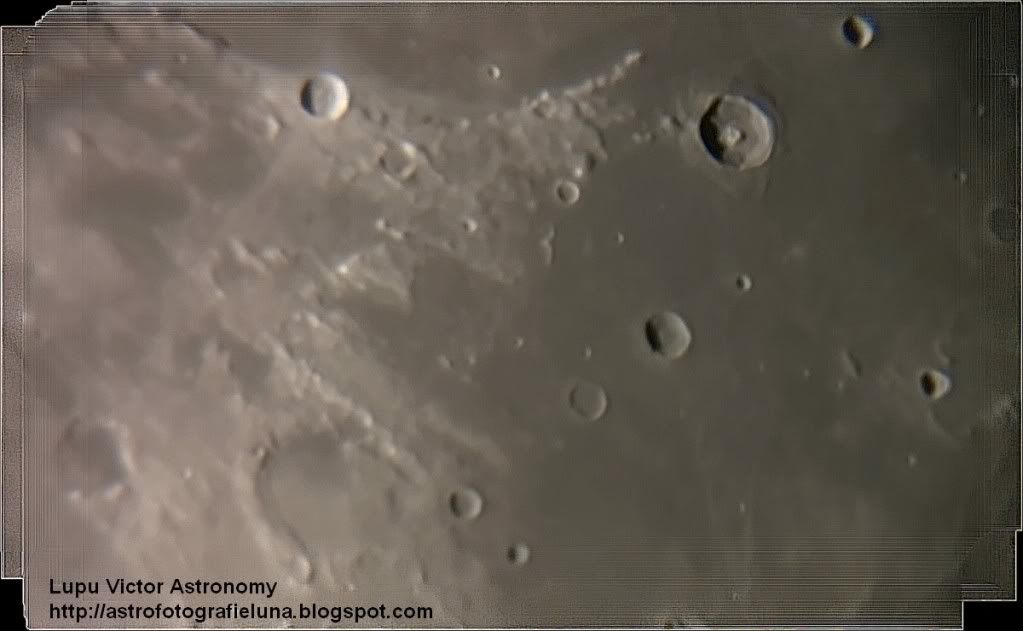
This lunar area is interesting because it presents craters with a lot of space between them and with different features. Take for instance the crater Plinius, the only crater in this area with a prominent central peak.

Plinius (43 km), lies on the border between Mare Serenitatis and Mare Tranquillitatis. At southeast is the crater Ross (26 km) and north-east is Dawes (18 km). To the north, is a system of trenches called Rima Plinius. Northwest of these cracks is Promontorium Archeruia.

Plinius's edge is slightly oval, with a terraced inner wall, and does not have a visible ray system. The floor is hilly, and in the middle is an irregular peak that looks like a double crater under certain angles of illumination. Eastern half of the floor is much smooth than the west.
Plinius has a depth of 4.3 km.

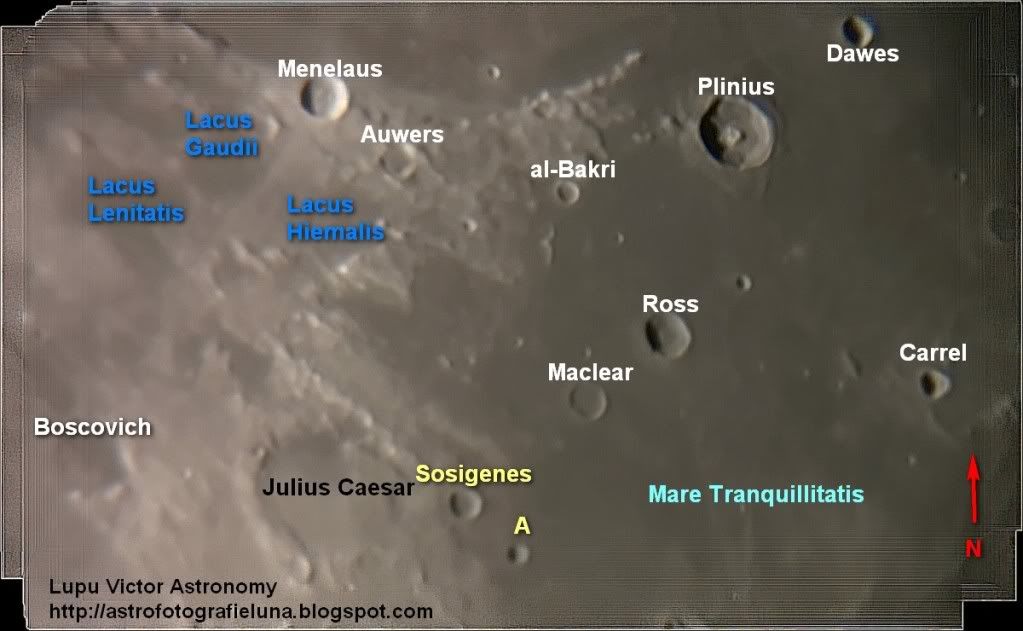
Other craters of these images processed in Registax, are: Menelaus (27 km), al-Bakri (12 km), Dawes (20 km), Maclear (20 km), Sosigenes (18 km), Julius Caesar (90 km) and the 3 lakes: Gaudii, Lenitatis and Hiemalis.
In some links, the results will not have those articles entitled with craters you are looking to see, but  are presented in their content.

The photo above was made ​​on May 11, 2012 and I presented it to see the difference between the Moon photographed with the sun at a low angle, when the shadow craters reveals different features of the lunar area, where everything is gray , and the photo of May 11, 2011, when the sun is at a greater angle, and shows us another face of the Moon, with colours, the soil composition is distinguished , a kind of 'scan' of the Moon .

Photographer: Victor Lupu
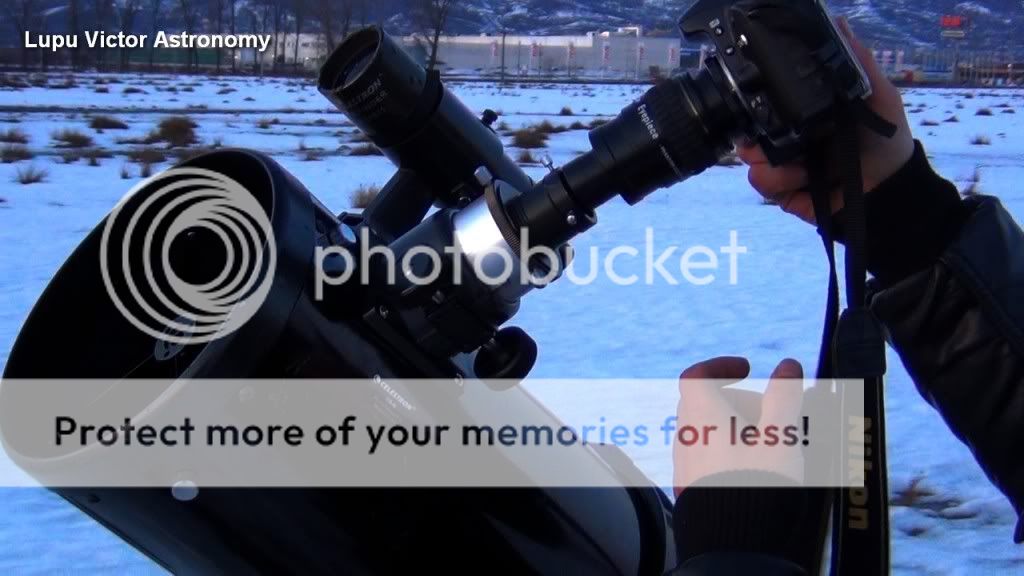
Optics: Celestron C8-inch reflector telescope-Newtonian, plossl 20mm, 2x Barlow
Mount: CG5 (EQ5)
Camera: Sony HDR CX105 to 8x optical zoom
Total Magnification: 800x
Filter: No
Date: 20/07/2011
Location: Baia Mare, Romania
Processing: Registax


Saturday, 21 September 2013

Moon in amazing colors. Plinius and Mare Serenitatis / Tranquillitatis

145 frames at 85% best quality in Registax.
210 frames at 90% best quality in Registax.


Before talking about craters and other features, I want you to fully look at this lunar landscape. I can not take my eyes off from nuances of colors that exist in the east area of the Moon. Note therefore that the Moon is not what you think, gray, but animated by color, which to some people might seem strange.

Most of photographed Moon
on the internet is black / white, as many believe the color images diminishes clarity. In some cases this is true, but only when the camera lens or Multi-coated eyepiece, add some extra color, by their fault. But the Moon itself has interesting colors that should not be overlooked. Take the example of these images which speak for themselves, where we see a little of the two major basins Mare Serenitatis and Mare Tranquillitatis.
 

There was no added colors or worked at their levels. Quite the opposite. In the first picture I just dropped the brightness, and resulted the natural color out of the lunar soil.

Between the two basins, there is a crater named Plinius (43 km), and one that has a high albedo and shows rays, left in picture, at 225 Km from Plinius, named Menelaus (27 km).
Video captures:
Plinius and Menelaus craters on Mare Serenitatis/Tranquillitatis on the Moon.
Plinius and Menelaus craters on Mare Serenitatis/Tranquillitatis on the Moon - See more at: http://lupuvictor.blogspot.ro/2013/02/plinius-and-menelaus-craters-on-mare.html#sthash.09uxj99E.dpuf


Age of the Moon: 7 days
Phase: 51% (0% = New, 100% = Full)
Distance: 384.488 km


Optics: Celestron C8-Newtonian telescope, 20 mm Plossl, 2x Barlow
Mount: CG5 (EQ5)
Camera: Sony CX130
Filter: no
Date: 29.04.2012
Location: Baia Mare, Romania
Processing: Images in Registax, FastStone Image Viewer


Photo made ​​on 11 May 2011, with the same astronomical instruments.


Sunday, 19 August 2012

Plinius between two large seas Pictures by astronomical telescope


The Moon is much less geologically active than Earth. Unlike Earth's crust, whose multiple tectonic plates overlaps and collides and gave rise to mountain areas or destroyed bottom seas, the Moon's crust is a rigid single plate. A series of Moon features results from the deformation of the crust, which include compression (shortening) and tension (extension). Tectonic features are well illustrated around Humorum and Serenitatis basins.

The complex crater Plinius with many mountains, changes it's appearance considerably in different lighting conditions. It is located between Mare Serenitatis and Tranquillitatis.
Around Plinius there is is a lighter blanket caused by the impact and irregular hills on the floor to the north.
Notice some arched rilles, including Rima Plinius, north of Plinius and the darker surrounding. Darker areas show lava flows that prior the bright inner sides of Mare Serenitatis lava sinking. Also note Promontorium Archerusia and Dawes crater.


Photographer: Victor Lupu
Optical Reflector Telescope Celestron C8-Newtonian inch, 20mm Plössl, 2x Barlow
Mount: CG5 (EQ5)
Camera: Sony HDR CX105 to 8x optical zoom
Total Magnification: 800x
Filter: No
Date: 20/07/2011
Location: Baia Mare, Romania
Processing: video captures


              Photo above was made on 20.07.2011.


Sunday, 14 October 2012

Video by telescope. Plinius and the surrounding seas

Images are upside down, as seen through the telescope.
Telescope spins in the area between Mare Serenitatis and Mare Tranquillitatis, and is highlighted especially Plinius crater that lies on the border between the two large Mares. In this film there are craters like Dawes, 18 km, where in the video is located southwest of Plinius, Menelaus of 27 km, and Julius Caesar 90 km, at the top of the screen. Promotorium Archerusia is the white portion forming a "horn" and mountain formations like Montes Haemus.

Plinius, 43 km, located at 5.4 N, 23.7 E, dated from Erathostenian era, is a complex crater with more central mountains, whose appearance changes considerably in different lighting conditions.


Video: Victor Lupu
Optics: CelestronC8 "-Newtonian telescope, plossl20mm, 2x Barlow
Mount: CG5 (EQ5)
Device: Sony CX-130
Video mode: Full HD progressive 1920x1080
Filter: no
Date: 29/04/2012
Location: Baia Mare, Romania
Processing and editing: Sony Vegas 10


Photo above is made ​​in 20.07.2011, the same astronomical instruments.

Sunday, 13 March 2016

Telescope images. Plinius crater on Mare Serenitatis.

We are in an area of the moon with craters small in number on Mare Serenitatis and Mare Tranquillitatis. Most prominent crater, is Plinius (43 km). It is located between the two seas. I've talked many times about it.
 These images may be subject and other visible features such as a few lakes, lakes as Gaudii, Lenitatis and Hiemalis, south-west of Menelaus.

Plinius (43 km) is a polygonal crater, prominent, with a crumpled collar and a beautiful rocky floor. At its northern can be found Rimae Plinius, a set of three linear rilles, each about 100 km long, which looks like the cat's scratch. The crater is complex, with several central mountains. The appearance of this crater is changing considerably in different lighting conditions.

On the 'sharp tooth' as of a predator that comes between the two major seas Serenitatis and Tranquillitatis, there are many features, such as Montes Haemus more to root of the 'tooth', crater Menelaus, and at its left are the three lakes which are arranged in a triangle: Gaudii, Hiemalis and Lenitatis. Auwers crater (20 km), lies south-east of Menelaus. We can't go without mentioning Sinus Honoris, which is on the outside of the 'sharp tooth', nor the crater Julius Caesar (90 km.), which can be seen in the left.


Magnitude: -10.82
Phase: 0.46
Distance: 399.283 km
Illuminated: 45.6% (0% = New, 100% = Full)


Astronomical instrument: Celestron C8-Newtonian telescope,
Eyepiece: Plossl 20mm, 2x Barlow
Mount: CG5 (EQ5)
Camera: Sony CX130
Filter: no
Date: 30.01.2012
Location: Baia Mare, Romania
Processing: FastStone Image Viewer


In the picture below are labeled craters and other lunar features in the region. To better understand this photo, you should note that the label with the name or the letter of larger craters could be found at their center, and on the small craters, you should find them around them, usually above.

Photo made on July 20, 2011.

Sunday, 10 February 2013

Plinius and Menelaus craters on Mare Serenitatis/Tranquillitatis on the Moon


Plinius and Menelaus, located on the eastern Moon, at a distance of 227 km from each other from center to center, have a common characteristic, namely both have peaks in the center. Otherwise, Pliny is larger, more visible even through small telescopes, especially because it's located on the Tranquillitatis basin plateau, close to the mountain region Promotorium Archerusia. But Menelaus has an advantage compared to Plinius: the rays of a very intense albedo spreading in 3 directions: east, south and west, due to the impact of lunar scattered material. We understand that by dropping a stone in the sand ..

These images have areas of intense color, in which in the basin Serenitatis and Tranquillitatis's delimitations are observed. This phenomenon is observed only when the Sun illuminates the Moon at a high angle, otherwise, at a low angle, the colors are practically unnoticed.

Moon age: 7 days
Phase: 51% (0% = New, 100% = Full)
Distance: 384.488 km

Optics: Celestron C8-Newtonian telescope, 20mm Plössl, 2x barlow
Mount: CG5 (EQ5)
Camera: Sony CX130
Filter: no
Date: 29/04/2012
Location: Baia Mare, Romania
Processing: video capture, FastStone Image Viewer


Photo above was made in May 11, 2011, with the same astronomical instruments.

Saturday, 23 June 2012

Wonderful Moon video Serenitatis-Tranquillitatis seas area through the telescope.

Certainly, in this video below are much to see. This is because here are many types of moon features such as seas, lakes, craters and mountains. For example, I never saw Menelaus crater (27 km.) in these shadows. It lies on the southwest edge of Mare Serenitatis and is immersed in a nearly total darkness. Only the imterior western wall is in sunlight.

      On the 'sharp tooth' as of a predator that comes between the two major seas Serenitatis and Tranquillitatis, there are many features, such as Montes Haemus more to root of the 'tooth', crater Menelaus, and at its left are the three lakes which are arranged in a triangle: Gaudii, Hiemalis and Lenitatis. They can be seen closer in the last photo of this article.

      Auwers crater (20 km), lies south-west of Menelaus. We can't go without mentioning Sinus Honoris, which is on the outside of the 'sharp tooth', nor the crater Julius Caesar (90 km.), which can be seen in the lower left corner of the video.
At the end of the 'sharp tooth' is Promotorium Archerusia, named after the promoters of the Black Sea on Earth. The 'tooth' seems to be heading towards to 'smash' the solitary crater Plinius (43 km.), which is located between the two seas, but it misses. In the right of Plinius, is a smaller crater, only 18 km, Dawes, wich is lying on the sea plateau too, and is surrounded by a higher albedo.


Video: Victor Lupu
Optics: CelestronC8 "-Newtonian telescope, plossl20mm, 2x Barlow
Mount: CG5 (EQ5)
Device: Sony CX-130
Video mode: Full HD progressive 1920x1080
Filter: no
Date: 27/04/2012
Location: Baia Mare, Romania
Processing and editing: Sony Vegas 10

         Photo above is made out in May 11, 2011,with  the same astronomical instruments.

         Photo above is made out in February 10, 2011,with the same astronomical instruments.

         Photo above is made out in July 20, 2011,with the same astronomical instruments.

Tuesday, 24 January 2012

List of east features of the Moon. astronomy lecture


East of the Moon is marked by several interesting features. Most notably is Mare Crisium, a "sea" visible from the Earth with the naked eye as an isolated spot by other seas, dark in colour.
 Notable craters on the east side of the Moon are Posidonius, Petavius ​​and Langrenus, which are the largest in size.
 Even if it seems that East of the Moon has not too many huge craters, actually there are many  small craters as we can see in the list below.

Craters of the Moon's eastern area.

Adams
Al Bakri
Ansgarius
Apollonius
Asada
Atwood
Auzout
Balmer
Barkla
Battuta
Beaumont
Behaim
Beketov
Bellot
Berosus
Bessel
Bernoulli
Berzelius
Bilharz
Bohnenberger
Borda
Buckhardt
Cajal
Capella
Carrel
Carmichael
Catharina
Cauchy
Censorinus
Cepheus
Chacornac
Ching-Te
Cleomedes
Clerke
Colombo
Condorcet
Cook
Crozier
Cyrillus
Daniell
Da Vinci
Dawes
Debes
Dubiago
Eimmart
Fabbroni
Fermat
Firmicus
Fracastorius
Franklin
Fredholm
Furnerius
Gardner
Gauss
Geminus
Gilbert
Goclenius
Greaves
Gutenberg
Hase
Hahn
Hall
Holden
Humboldt
Hypatia
Isidorus
Jansen
Kapteyn
Kastner
La Perouse
Lame
Langrenus
Lawrence
Leakey
Legendre
Lick
Lindbergh
Lindenau
Littrow
Lohse
Lucian
Lubbock
Lyell
Maclaurin
Maclear
Macrobius
Magelhaens
Manilius
Manners
Maraldi
Marinus
Maskelyne
McClure
Menelaus
Mercurius
Messier
Messala
Metius
Monge
Monnier
Nansen
Naonobu
Newcomb
Nobili
Plinius
Ross
Palitzsch
Peirce
Petavius
Picard
Piccolomini
Plinius
Proclus
Reichenbach
Rheita
Ritter
Romer
Rothmann
Sabine
Santbech
Secchi
Sinas
Schumacher
Snellius
Stella
Stevinus
Sulpicius Gallus
Swift
Tacitus
Tacquet
Taruntius
Teophrastus
Theophilus
Tisserand
Torricelli
Tralles
Vendelinus
Vitruvius
Webb
Weinek
Wrottesley
Wrottesley
Zagut


Seas of the Moon's eastern area.

Mare Anguis
Mare Crisium
Mare Fecunditatis
Mare Nectaris
Mare Serenitatis
Mare Spumans
Mare Tranquillitatis
Mare Undarum

Mountains of the Moon's eastern area.


Montes Pyrenaeus
Montes Secchi
Montes Taurus
Mons Vitruvius
Mons Argaeus

Other forms of relief in the east area of the Moon.


Sinus Asperitatis
Sinus Amoris
Sinus Concordiae
Sinus Successus
Palus Somni
Lacus Somniorum
Vallis Palitzsch
Rupes Altai


Above: Video of east of the Moon through my telescope.

Space missions on the east side of the Moon.

Apollo 16 (1972) with people on board. Apollo 16 was the tenth mission in the Apollo program with humans. It was launched on 16 April 1972 and ended on 27 April. It was a lunar rover mission and brought back 94.7 kg of lunar soil and rock samples.

Apollo 17 with people on board. EVA activity (EVA). Apollo 17 was the 11th and last  manned mission of the Apollo space program. Launched at 12:33 a.m. on 7 December 1972, with a crew of three members: Eugene Cernan, Ronald Evans and Harrison Schmitt. Apollo 17 landing remains the most recent made ​​beyond Earth's orbit.

 Luna 21 (1973) USSR (Union of Soviet Socialist Republics), has successfully carried on the lunar surface rover Lunakhod 2 on January 15, 1973. It sent back 86 panoramic images and over 80,000 TV pictures.

Ranger 8 (1965) USA - intentionally crashed. Launched on February 20, 1965. Ranger 8 successfully sent 7137 images with a resolution of up to 1.5 m.

Surveyor 5 (1967) successfully landed. It sent more than 19,000 images to Earth, and has conducted more than 100 hours of compositional analysis of the surface.

To see the photographic map of the east area of the moon, view: Photographic map of the Moon: East Zone. Lunar Atlas.

Saturday, 5 March 2011

Moon craters - astronomy pictures through telescope

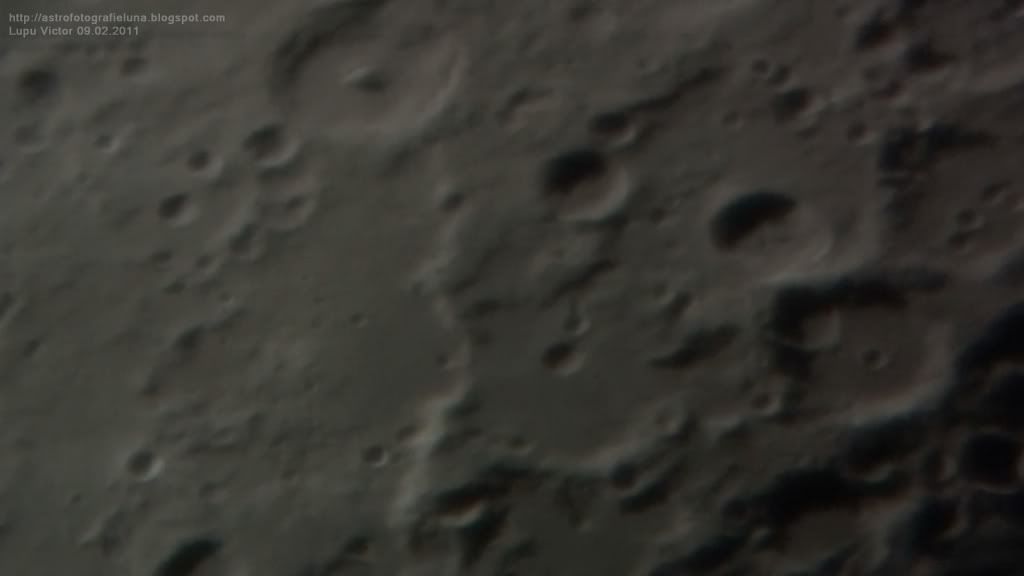
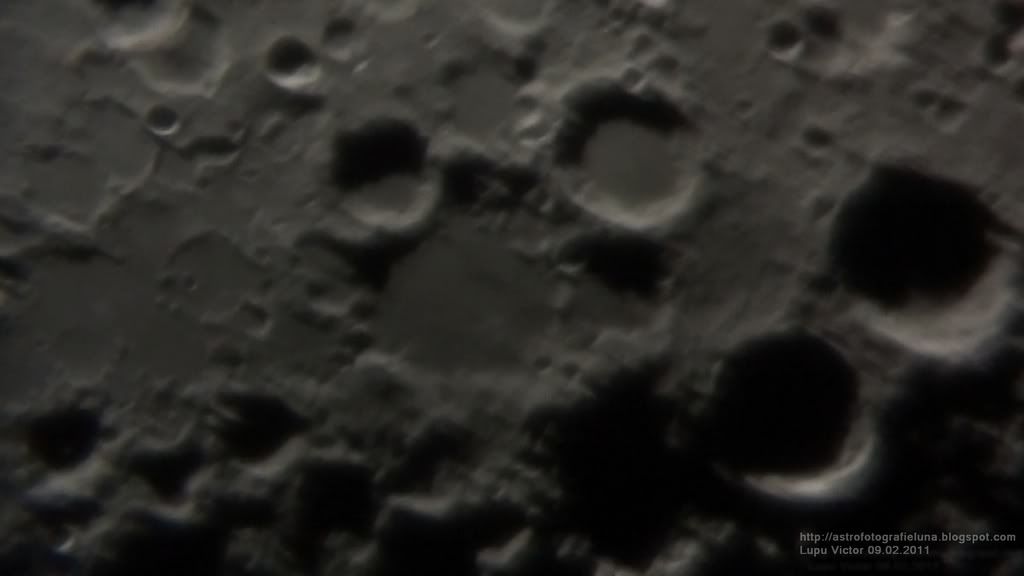
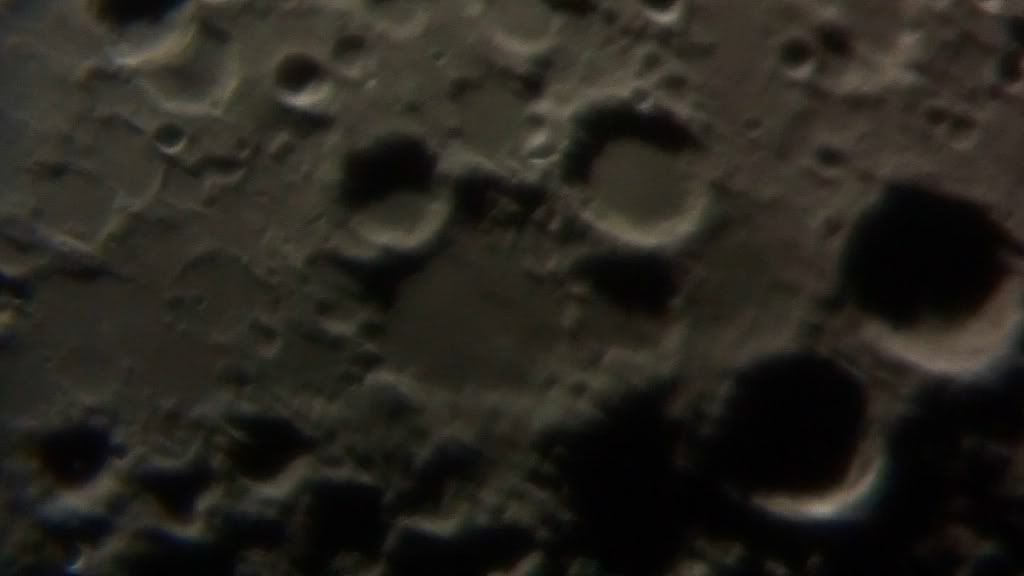
All these pictures are made on 09.02.2011 and I decided to post all of them in a single article
Piccolomini crater (88 km.) in the center pf the photo,and Rupes Altai is the rim that goes down below the crater.(photo above and below)
Apianus G is in the center.Above Apianus G, on right is Apianus (63 km),and on left is Playfair (48 km.)
Aliacensis (80 km.) is on the right of picture,and Werner (70 km.) below it.
Aristoteles (87 km.)-the bigest one, and Euxodus (67 km.)-below.
Hommel and Pitiscus craters-are on center-lower of the photo above
Craters aligned from left to right: Rheita E (the elonged one),Rheita(70 km.),Metius (88 km.) and Fabricius (78 km.)
Crater Janssen (190 km.)-the big one on the left-down,Vlacq (89 km.) and Rosenberger (96 km.) on right
The two craters combined in the center are Watt (66 km.) and Steinheil (67 km.) below it.
Barocius (82 km.) on right-center.Under, is in shadow, Maurolycus (114 km.)
Rupes Altai is the mountain chain-up from left to right.On the right in photo is Zagut (84 km.)
Dalambre Crater (52 km.) which is in the center, beneath is Taylor A and Taylor (41x34 km.)
On the Mare Tranquillitatis are Plinius crater (43 km.) is in left-center, Ross (26 km.) south-east of Plinus, and Arago at the bottom left.

Photographer: Victor Lupu
Optics: Celestron C8-Newtonian reflector telescope, plossl 20mm, 2x Barlow
Mount: CG5 (EQ5)
Device: Sony HDR CX105
Filter: No
Date: 09/02/2011
Location: Baia Mare, Romania
Processing: Sony Vegas 10 Registax

 
All images are © Copyright 2010-2015 Lupu Victor. All rights reserved.Images may not be reproduced, published, or copied in any form without written permission of the author. Thank you for respecting the intellectual property rights. ASTROFOTOGRAFIA | Lupu Victor Astronomy - Contact - About
Design by Free WordPress Themes | Bloggerized by Lasantha - Premium Blogger Themes | Online Project management