Visit Worldwide Topsites
Showing posts sorted by relevance for query Chacornac. Sort by date Show all posts

Wednesday, 2 October 2013

Lunar Photo - Posidonius

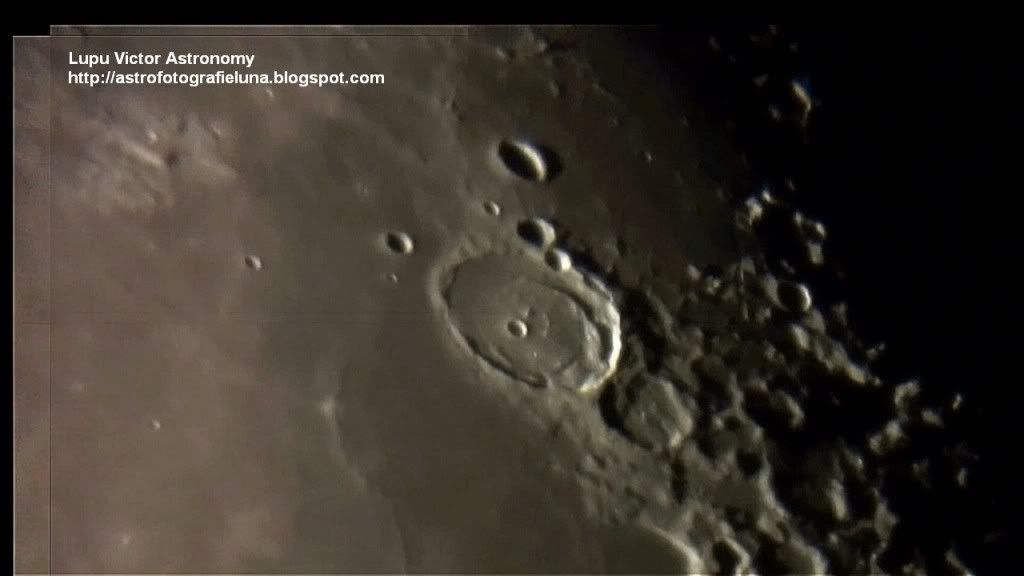
158 frames at 90% best quality in Registax.

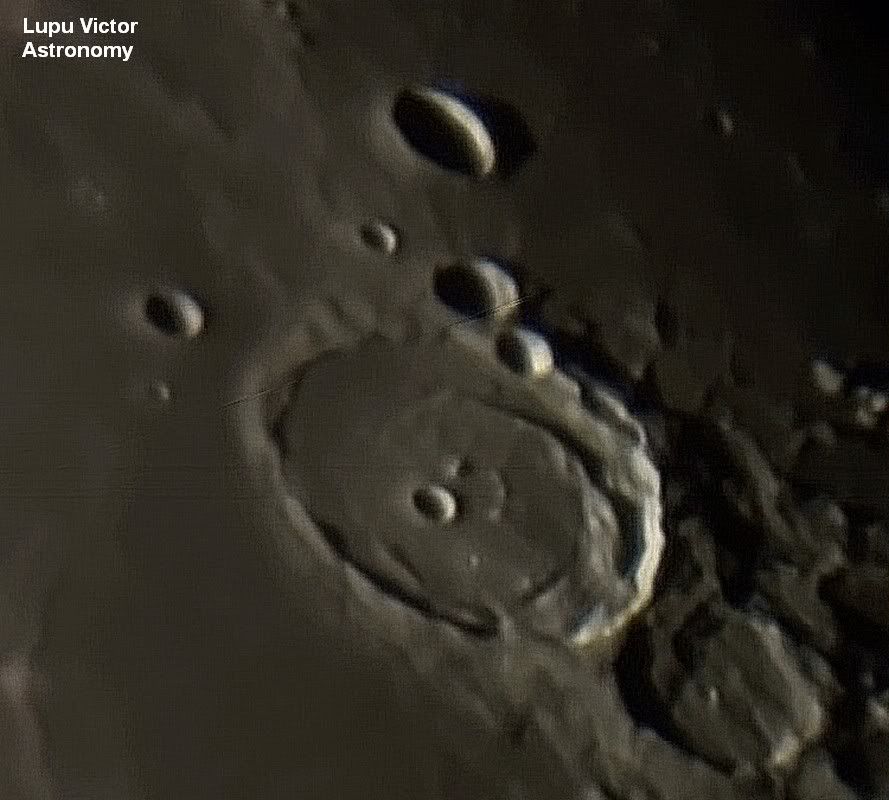
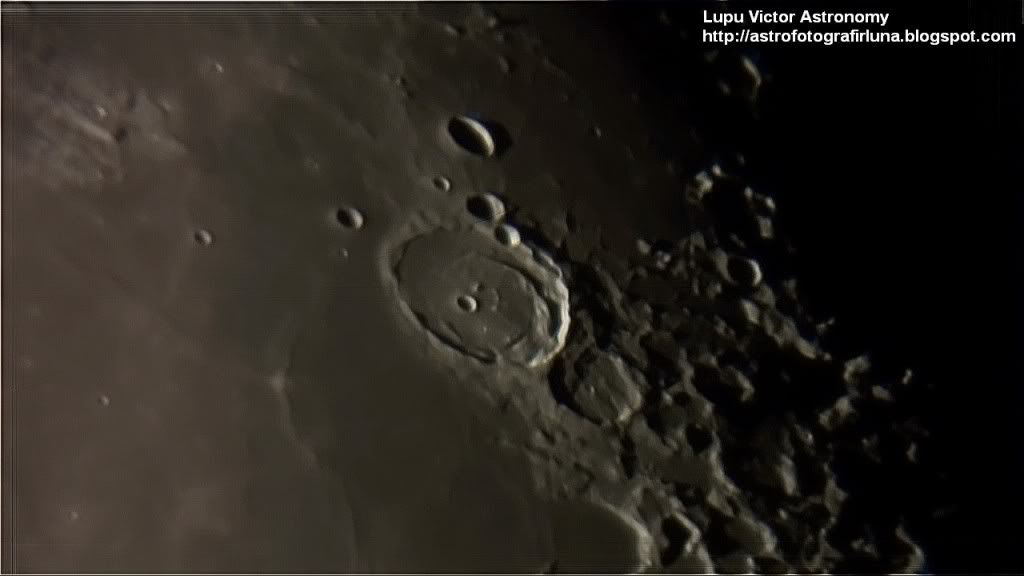
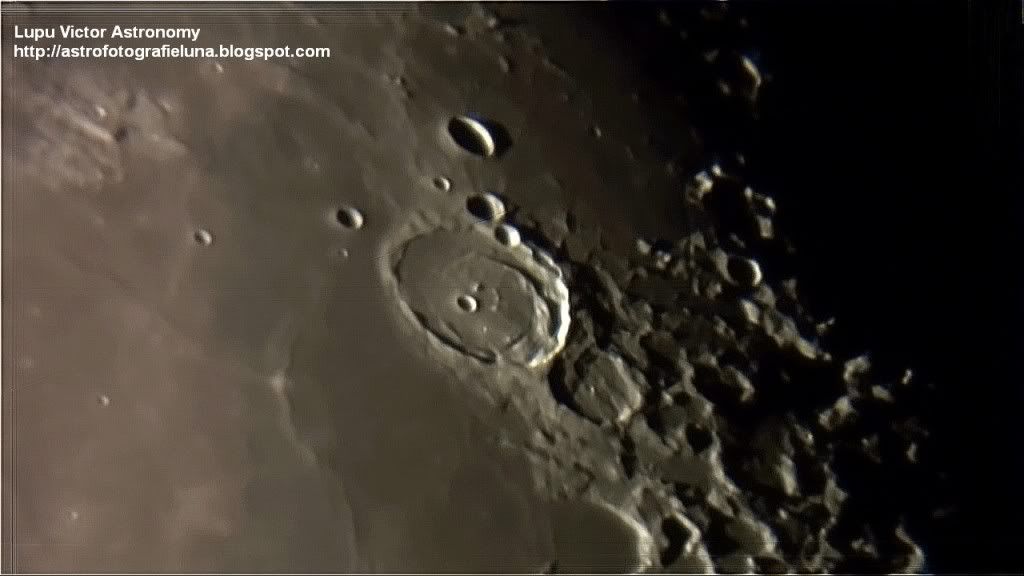
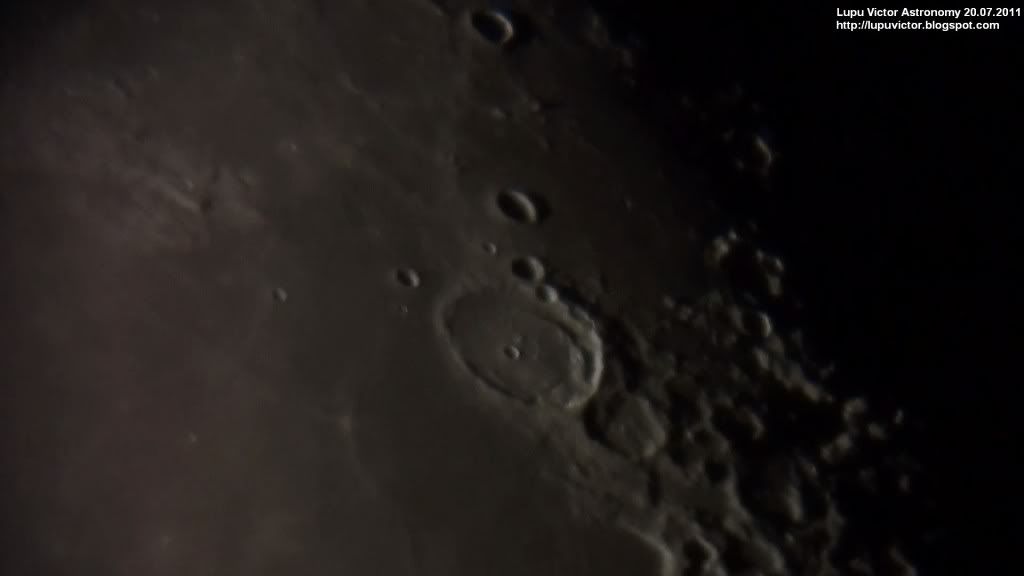
At eastern basin Mare Serenitatis, there is an interesting crater named Posidonius (95 km). This crater is deep compared to its size, but this is because the flooded region has various basins.

As a special feature that this region has, we see that the right is different from the left area of the crater. In  Posidonius's right are landforms which are high, and on the left is a smooth basin called Mare Serenitatis.

Other craters around Posidonius that can be highlighted here, are its satellite craters, A (11 km), B (14 km) and M (10 km), and Chacornac (51 km), Michael Jackson (22 km) and Daniell (30x23 km).

Video captures are here: Pictures by astronomical telescope crater Posidonius in light.


Age of the Moon: 7 days
Phase: 51% (0% = New, 100% = Full)
Distance: 384.488 km


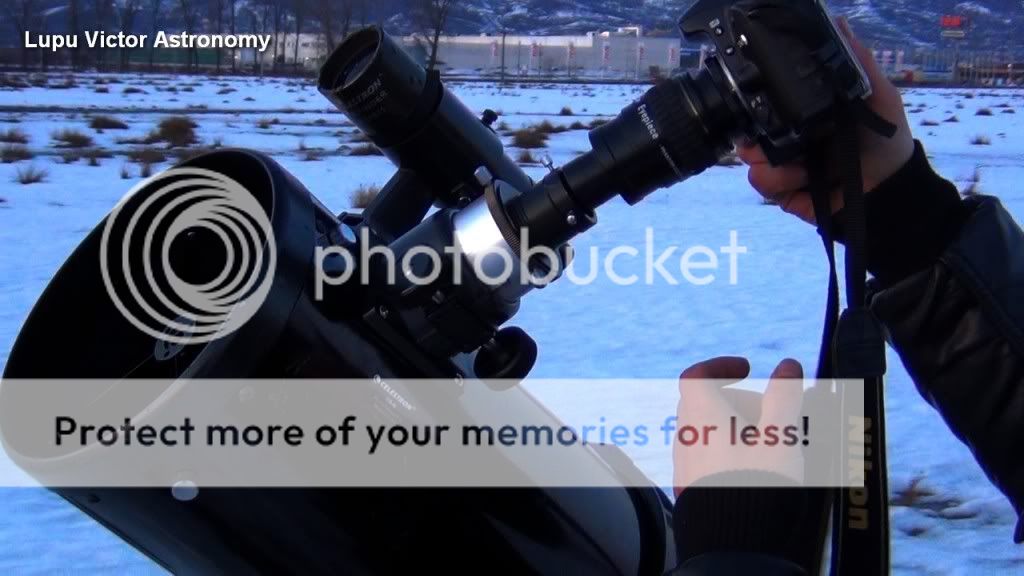
Optics: Celestron C8-Newtonian telescope, 20mm Plossl, 2x Barlow
Mount: CG5 (EQ5)
Camera: Sony CX130
Filter: no
Date: 29.04.2012
Location: Baia Mare, Romania
Processing: Images in Registax, FastStone Image Viewer


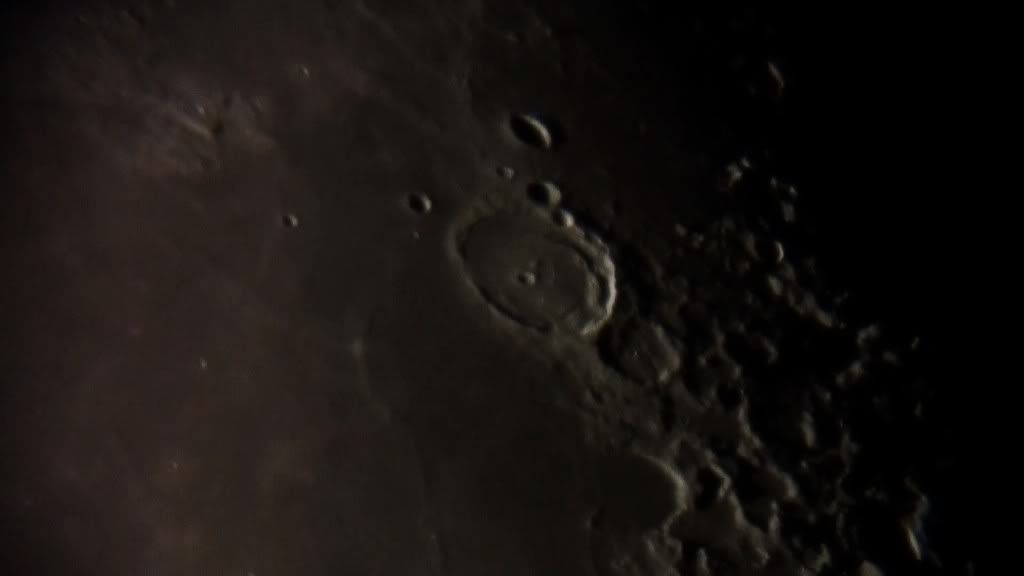
Above is Posidonius under different lighting conditions, photo made ​​in July 19, 2012.


Friday, 4 March 2011

Some Moon craters

Sinus Iridium in Registax 20 frames processed                          
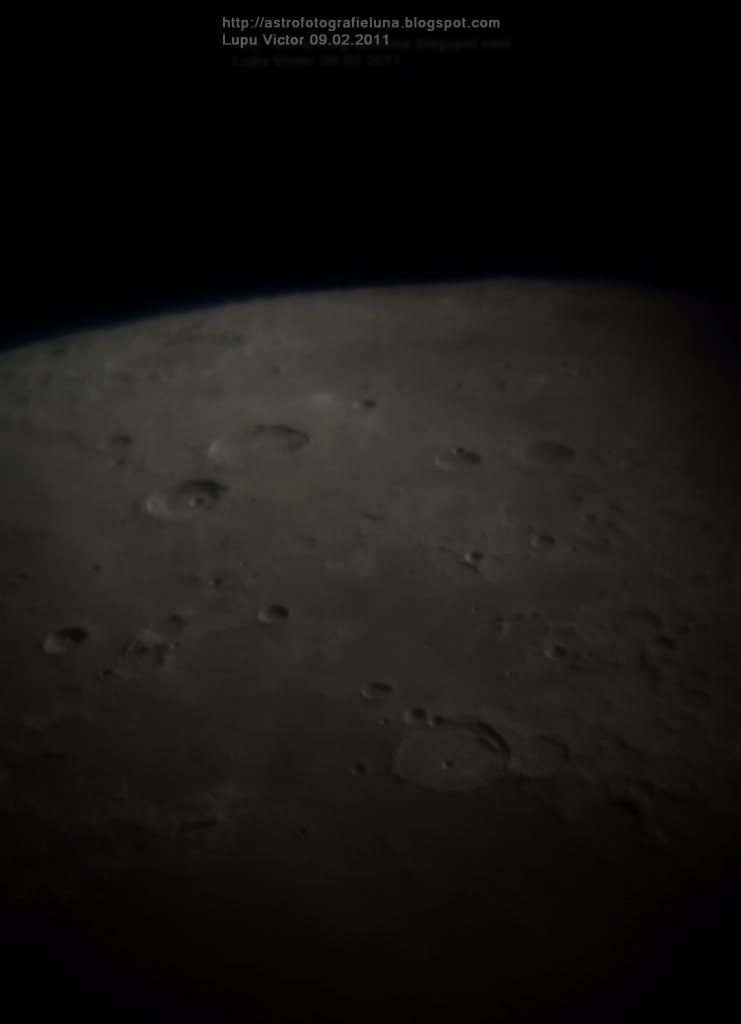
Posidonius crater (95 km.) in the center-lower.Mare Serenitatis plateau is below.Crater Hercules si Atlas (69-87 km.) are on the left corner up.
Mare Crisium is the round plateau.

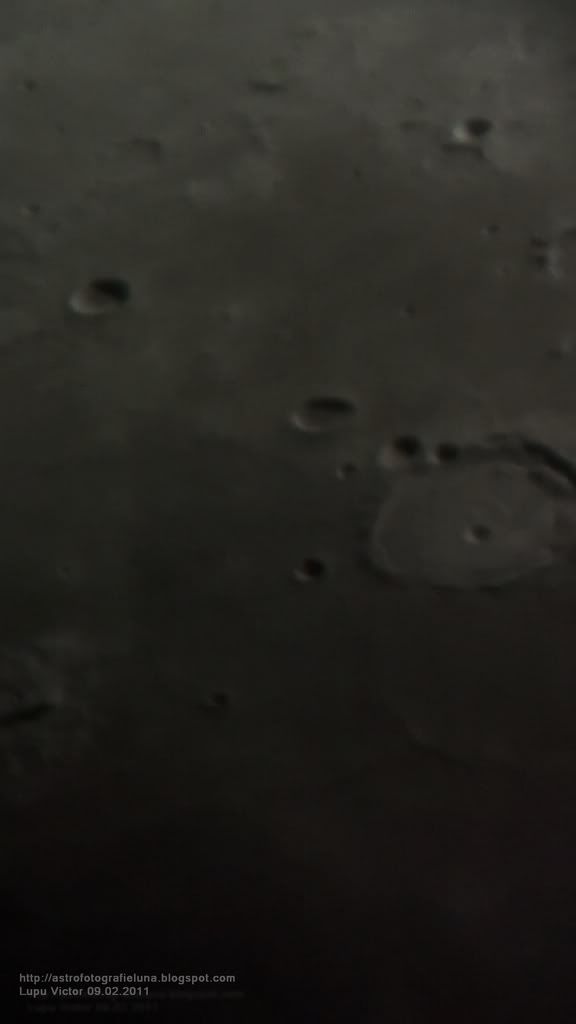
Posidonius crater (95 km.) largest left, Chacornac (51 km.) is attached to it. Monnier (61 km)is the incomplete one.. Maraldi (40 km.) sits in the center of the photo. At the bottom of the picture are two plates: Mare Serenitatis left and right Mare Tranqillitatis .
A portion of the south pole of the Moon.Crater Janssen (190 km.) is the largest in the picture in the center-left.
Photographer: Victor Lupu
Optics: Celestron C8-Newtonian reflector telescope, plossl 20mm, 2x Barlow
Mount: CG5 (EQ5)
Device: Sony HDR CX105
Filter: No
Date: 09/02/2011
Location: Baia Mare, Romania
Processing: Sony Vegas 10 Registax

Wednesday, 12 October 2011

North craters of the Moon-Lunar Features

            16 july 2011 picture of north's Moon through my telescope


           North of the Moon is less affected by craters, which are dispersed, leaving place to the large lava seas that covered them long time ago. I think that should be more craters on the north of the Moon, but they are covered by lava,and we will never have the opportunity to see them. Geological and cosmic chain of events occurred in its formation, made it look like we see it today.

          The Moon craters are named after great personalities of the branch of science such as astronomers, mathematicians, inventors, but not only (eg crater Michael Jackson, just north of the crater Posidonius).

          Notable craters on the north side of the Moon are Plato 101 km, Aristoteles/ Euxodus-67 and 87 km in diameter, Archimedes of 83 km, and Sinus Iridium (which would have to be a crater, but it was flooded with lava).

List of features on the North side of the Moon:
>Craters:

Alexander
Anaxagoras- young crater with ray system
Anaximander - crater without central peak
Archytas - almost circular crater with sharp edges
Archimedes-large crater without central peak
Aristoteles -presents  uneven crater floor
Aristillus-crater with ray system
Arnold - ancient crater rounded by other impacts
Atlas
Autolycus-have a ray system of 400 km.
Babbage-in this crater there is Babbage A, which is younger.
Baillaud - close to the Moon terminal.
Barrow
Bianchini
Bouguer
Burg - on the center of Lacus Mortis
Barrow-remodeled by other craters and lava flows.
C. Mayer - young crater with sharp edges.
Carpenter
Cassini - contains many craters on its floor.
Calippus - crater surrounded by Caucasus mountains.
Chacornac - distorted crater, irregular.
Challis - eroded crater and hit by older impacts.
Daniell - oval crater.
Delisle
Democritus
Epigenes - eroded crater.
Euctemon - renewed lava crater floor.
Euxodus-crater central peak not present.
Endymion - lunar crater located at the terminal with a low albedo.
Egede-a lava flooded remnant crater.
Fontenelle
Foucault
G. Bond
Galle - crater with sharp edges.
Gartner
Goldschmidt - crater eroded and incised by other impacts.
Grove
Gruithuisen
Hall
Harding
Harpalus
Heis
Hercules - crater with terraced inner walls.
J. Herschel - heavily eroded crater.
Keldish
La Condamine
Lichtenberg
Luther
Main - crater near the north pole.
Mairan - eroded crater.
Markov
Maupertuis
Meton - clover-shaped crater (three combined craters)
Michael Jackson - small crater, former Posidonius J.
Mason
Mitchell - crater attached to the edge of the crater Aristotle.
Mouchez - a remnant of a lunar crater.
Neison
Oenopides - old eroded crater.
Philolaus - crater with a pair of central peaks.
Plana
Plato - large crater filled with lava.
Poncelet
Posidonius - fractured crater floor.
Protagoras - circular crater.
Scoresby - crater with sharp edges.
Sharp - crater surrounded by mountains.
Sheepsharks
Sitter - forms a trio with other two craters.
 South
 Strabo
Timaeus - pentagonal crater with rounded edges.
Theaetetus - polygonal shaped crater.
W. Bond - irregular shaped crater.
 Williams
>Other formations:

Lacus Mortis - strange crater.
Sinus Iridium- a large crater with missing edge.
Vallis Alpes - valley that divides Montes Alpes the two.

Mountains:

Montes Alpes - named after the Alps of Earth.
Montes Apenninus - a wide range of mountain (Mons Huygens is the largest peak).
Montes Caucasus - the highest peaks reach 6000 m.
Mons Pico - isolated mountain on Mare Imbrium.
Mons Piton - isolated mountain on Mare Imbrium.
Montes Recti-mountain with a length of 90 km and width of 20 km).
Montes Spitzbergen - the edge of a crater.
Montes Teneriffe - mountain rises to 2.4 km.

>Seas:

Mare Frigoris - dates from the Imbrian era.
Mare Imbrium - formed when a massive object hit the Moon, and the lava flooded the crater.

>Missions on the north side of the Moon:

Luna 17 & Lunokhod 1 in 1970, was the first of two unmanned rovers that landed on the Moon sent by the Soviet Union, as part of Lunokhod program.
Video below shows the location of features on the Moon's northern hemisphere.


Video: Victor Lupu
Optics: Celestron C8 "-Newtonian telescope, plossl 20mm, 2x Barlow
Mount: CG5 (EQ5)
Device: Sony CX105
Total Magnification: 100x
Resolution: 1920x1080
Bitrate: 16000, FPS: 50
Filter: No
Date: 09/09/2011
Location: Baia Mare, Romania
Edit: Video stabilized in Sony Vegas


To see the photographic map of the north area of the Moon, view:
Photographic map of the Moon: North Zone. Lunar Atlas.

For those who like the pictures of my articles, would be nice to pay attention on advertising that appear in the blog by a click, because it is the only way I could buy one day a better telescope.

Saturday, 12 March 2011

Posidonius crater and Lacus Somniorum Photos by telescope

Posidonius crater (95 km.) in the center-lower.Mare Serenitatis plateau is below.Crater Hercules si Atlas (69-87 km.) are on the left corner up.
        Posidonius is an impact crater , which is located on the western edge of Mare Serenitatis, south of Lacus Somniorum.Crater Chacornac (51 km.) is attached to the eastern edge in photo, Daniell (30 km.) is on northwest .Also at the north-west close to the edge of Posidonius,is the crater Michael Jackson (former Posidonius J). Crater Burg (40 km.)-on the left of photo ,who is sitting on Lacus Mortis.
The rim of Posidonius is superficial and hidden, especially on the southern edge and the interior was covered by a lava flow in the past.
The name of the crater is from Posidonius that
was a Greek philosopher, politician, astronomer, geographer, historian and professor at Apamea, Syria.


Lacus Somniorum. Latin name is Lake of Dreams, a name that was given by Riccioli. This lake has an irregular shape with undefined boundaries.The surface has the same low albedo as the surrounding terrain, and its surface was formed by basaltic lava flooding. The area is 334 km, and joins Mare Serenitatis at the Southwest.


Photographer: Victor Lupu
Optics: Celestron C8-Newtonian reflector telescope, plossl 20mm, 2x Barlow
Mount: CG5 (EQ5)
Device: Sony HDR CX105
Filter: No
Date: 09/02/2011
Location: Baia Mare, Romania

Wednesday, 6 March 2013

Pictures by astronomical telescope crater Posidonius in light


Posidonius crater (95 km) from the photo above is a video capture. Together with Chacornac crater, (51 km), Posidonius is forming a gorgeous duo on this relatively flat area, surrounded by Mare Serenitatis basin and Lacus Somniorum. To the south, however, is a higher region, called Montes Taurus.

Another crater, famous for its name but not for its size, is Michael Jackson crater (22 km), probably named so because the "moonwalk" dance invented by the famous pop artist. It was called before Posidonius J, and can be located in the photo below, in which I labeled all the craters in the vicinity of Posidonius.

Posidonius is a relative small crater, but creates the illusion that it is larger as it is in a smooth region and in the absence of other craters with which to compare it, it seems to be a big one.

With a 6-inch telescope, the crater can be seen easily, and with 8-inch telescope and a video camera or photo attached, this crater can be seen in detail, when the sun is at a perfect angle.

Moon age: 7 days
Stage: 51% (0% = New, 100% = Full)
Distance: 384.488 km


Optics: Celestron C8-Newtonian telescope, 20mm Plössl, 2x barlow
Mount: CG5 (EQ5)
Camera: Sony CX130
Filter: no
Date: 29/04/2012
Location: Baia Mare, Romania
Processing: video captures, FastStone Image Viewer


Above, Posidonius under a different lighting conditions, made ​​in July 19, 2012.

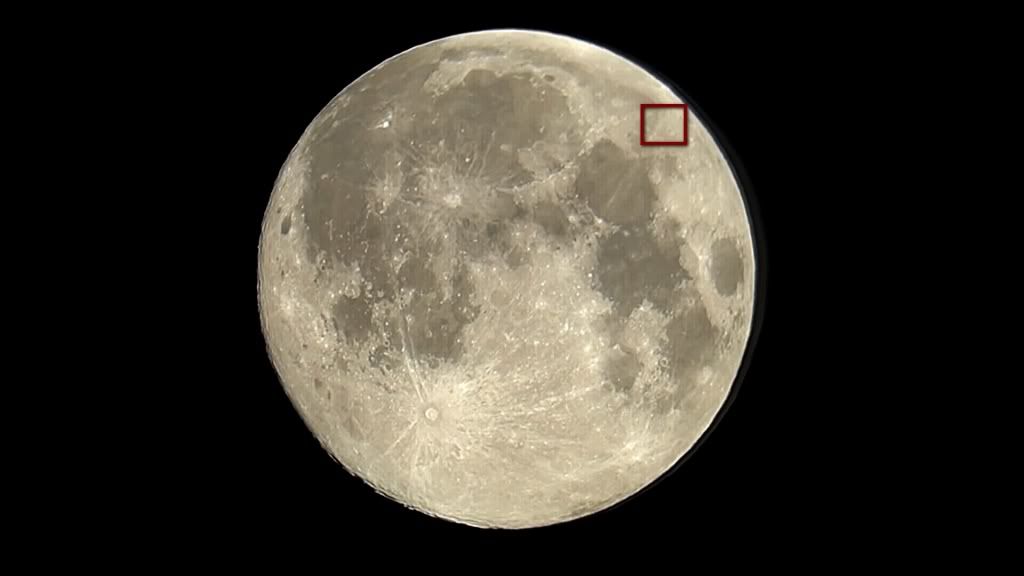
Location of Posidonius crater on the eastern Moon.

Thursday, 9 August 2012

In Posidonius crater on the Moon people began a civil war


Posidonius, is a flooded crater located on Mare Serenitatis, dating from Imbrian era. Inner ring is higher than the Moon's average surface height, in the east, and has a very uneven terrain. In this crater, exists hills that may be of volcanic origin. Note that there are more than five separate rilles on its floor. Probably, the impact that formed Posidonius, which occurred on the basin, was already affected.
  Posidonius A is located slightly west of the center on the floor of Posidonius and Chacornac is located south-east.

As an imaginative guy, I can not help wondering what would happen if the Moon were suddenly populated by people. I wonder, because now the world is not interested in Moon craters, the names, location, their size, but if suddenly they would start to travel to the Moon, people would begin to be curious about these things instantly. Why? To buy land, to do business (helium-3, or who knows what other resources they would find there). For example the subject of this article is the crater Posidonius. Is a what? It is a crater, a hole in the Moon, that people are not interested to know at least for example where it is . In future this ctater of 95 km, can turn into a city full of lights, which would be seen even from Earth when is New Moon.

The Moon, is even now in the second millennium not an important goal for the world's population, not just for science. We see it in the sky as people of the past saw it, with the same foreign feeling to us. Some of us do not even know is there anymore. Only if it were some rumors that there would be some aliens, people would be curious.

If you put the title of this article "Presidential election takes place in Crater Posidonius", or "In Posidonius crater on the Moon people began a civil war", you'll see what the difference is in the interest of people, curious how crazy is who wrote that article, unless I write "Posidonius crater on the Moon. Description and location." when people would not even bother to read the title to the end. And because I am very curious by nature, I will do it.


Photographer: Victor Lupu 
Optics: Celestron C8-inch reflector telescope-Newtonian, plossl 20mm, 2x Barlow 
Mount: CG5 (EQ5) 
Camera: Sony HDR CX105 to 8x optical zoom
Total Magnification: 800x
Filter: No
Date: 20/07/2011
Location: Baia Mare, Romania
Processing: video captures

Sunday, 4 March 2012

Registax: crater Posidonius astronomical images.


Posidonius crater is beautiful. These images presents many interesting features. The most interesting of these is a semi-circular wall of the inside floor of the east. Posidonius A, with a diameter of 11 km, is located near the center of the floor. Notice that the eastern edge is higher than the west, which suggests that in this crater when was first flooded, the lava entered in the northwest.

Inside the crater, at west, there is another wall that doubles the main wall. This is called Rima Posidonius.

Other interesting craters near Posidonius, are:
Chacornac, 51 km north whose wall, stuck to Posidonius was not visible as much as in these pictures. That wall is thicker than the rest of it, and has a height of about 1.5 km.
Posidonius B, 6 km, and J, which are located at north, over the first wall of Posidonius, and the second is north of B. Also, Posidonius J, is now called Michael Jackson, after the artist with the same name, who sang and composed pop music.
Lacus Somniorum plateau in the dim light located north of Posidonius.
On the right in the pictures, there are some mountains that are lit partly by the Sun. They belong to the larger mountains, which stretch more than the photos, called Montes Taurus.
The pictures above are images processed in registax.

Picture 1-4: 95 frames to 90% Lowest quality
Figure 5: 2 frames 100% Lowest quality


Below are video captures. The difference between video captures and images processed in Registax is very obvious.


Photographer: Victor Lupu
Optics: Celestron C8-Newtonian telescope, plossl 20mm, 2x Barlow
Mount: CG5 (EQ5)
Device: Sony CX105 to 7x optical zoom
Total Magnification: 700x
Filter: no
Date: 19/07/2011
Location: Baia Mare, Romania
Processing: Registax , video captures, FastStone Image Viewer


The video from wich I processed these images, is here: Video astro Saturn planet in my Newtonian telescope .
Below the picture was made ​​on February 9, 2011, and presents Posidonius crater in the distance.


Wednesday, 29 February 2012

Video lunar crater Posidonius by astronomical telescope.

In this stabilized video of crater Posidonius on the north-east of the Moon, has many moments of clarity.
In the first half of the film, the Moon is filmed from far away, at 500x, and vignetting is present. In the next half are images I like it most, because it shows crater Posidonius with mote details. For example, the western edge of the crater is clearly visible as a double edge which extends over the entire eastern side of the inner crater.
Near the southern edge of the crater is another crater, Chacornac, and above, to the north, is the crater Daniell.


Video: Victor Lupu
Optics: CelestronC8 "-Newtonian telescope, plossl20mm, 2x Barlow
Mount: CG5 (EQ5)
Device: SonyCX105 at 7x optical zoom
Total Magnification: 700x
Filter: no
Date: 20/07/2011
Location: Baia Mare, Romania
Processing and editing: Sony Vegas 10

Tuesday, 24 January 2012

List of east features of the Moon. astronomy lecture


East of the Moon is marked by several interesting features. Most notably is Mare Crisium, a "sea" visible from the Earth with the naked eye as an isolated spot by other seas, dark in colour.
 Notable craters on the east side of the Moon are Posidonius, Petavius ​​and Langrenus, which are the largest in size.
 Even if it seems that East of the Moon has not too many huge craters, actually there are many  small craters as we can see in the list below.

Craters of the Moon's eastern area.

Adams
Al Bakri
Ansgarius
Apollonius
Asada
Atwood
Auzout
Balmer
Barkla
Battuta
Beaumont
Behaim
Beketov
Bellot
Berosus
Bessel
Bernoulli
Berzelius
Bilharz
Bohnenberger
Borda
Buckhardt
Cajal
Capella
Carrel
Carmichael
Catharina
Cauchy
Censorinus
Cepheus
Chacornac
Ching-Te
Cleomedes
Clerke
Colombo
Condorcet
Cook
Crozier
Cyrillus
Daniell
Da Vinci
Dawes
Debes
Dubiago
Eimmart
Fabbroni
Fermat
Firmicus
Fracastorius
Franklin
Fredholm
Furnerius
Gardner
Gauss
Geminus
Gilbert
Goclenius
Greaves
Gutenberg
Hase
Hahn
Hall
Holden
Humboldt
Hypatia
Isidorus
Jansen
Kapteyn
Kastner
La Perouse
Lame
Langrenus
Lawrence
Leakey
Legendre
Lick
Lindbergh
Lindenau
Littrow
Lohse
Lucian
Lubbock
Lyell
Maclaurin
Maclear
Macrobius
Magelhaens
Manilius
Manners
Maraldi
Marinus
Maskelyne
McClure
Menelaus
Mercurius
Messier
Messala
Metius
Monge
Monnier
Nansen
Naonobu
Newcomb
Nobili
Plinius
Ross
Palitzsch
Peirce
Petavius
Picard
Piccolomini
Plinius
Proclus
Reichenbach
Rheita
Ritter
Romer
Rothmann
Sabine
Santbech
Secchi
Sinas
Schumacher
Snellius
Stella
Stevinus
Sulpicius Gallus
Swift
Tacitus
Tacquet
Taruntius
Teophrastus
Theophilus
Tisserand
Torricelli
Tralles
Vendelinus
Vitruvius
Webb
Weinek
Wrottesley
Wrottesley
Zagut


Seas of the Moon's eastern area.

Mare Anguis
Mare Crisium
Mare Fecunditatis
Mare Nectaris
Mare Serenitatis
Mare Spumans
Mare Tranquillitatis
Mare Undarum

Mountains of the Moon's eastern area.


Montes Pyrenaeus
Montes Secchi
Montes Taurus
Mons Vitruvius
Mons Argaeus

Other forms of relief in the east area of the Moon.


Sinus Asperitatis
Sinus Amoris
Sinus Concordiae
Sinus Successus
Palus Somni
Lacus Somniorum
Vallis Palitzsch
Rupes Altai


Above: Video of east of the Moon through my telescope.

Space missions on the east side of the Moon.

Apollo 16 (1972) with people on board. Apollo 16 was the tenth mission in the Apollo program with humans. It was launched on 16 April 1972 and ended on 27 April. It was a lunar rover mission and brought back 94.7 kg of lunar soil and rock samples.

Apollo 17 with people on board. EVA activity (EVA). Apollo 17 was the 11th and last  manned mission of the Apollo space program. Launched at 12:33 a.m. on 7 December 1972, with a crew of three members: Eugene Cernan, Ronald Evans and Harrison Schmitt. Apollo 17 landing remains the most recent made ​​beyond Earth's orbit.

 Luna 21 (1973) USSR (Union of Soviet Socialist Republics), has successfully carried on the lunar surface rover Lunakhod 2 on January 15, 1973. It sent back 86 panoramic images and over 80,000 TV pictures.

Ranger 8 (1965) USA - intentionally crashed. Launched on February 20, 1965. Ranger 8 successfully sent 7137 images with a resolution of up to 1.5 m.

Surveyor 5 (1967) successfully landed. It sent more than 19,000 images to Earth, and has conducted more than 100 hours of compositional analysis of the surface.

To see the photographic map of the east area of the moon, view: Photographic map of the Moon: East Zone. Lunar Atlas.

 
All images are © Copyright 2010-2015 Lupu Victor. All rights reserved.Images may not be reproduced, published, or copied in any form without written permission of the author. Thank you for respecting the intellectual property rights. ASTROFOTOGRAFIA | Lupu Victor Astronomy - Contact - About
Design by Free WordPress Themes | Bloggerized by Lasantha - Premium Blogger Themes | Online Project management