Visit Worldwide Topsites
Showing posts sorted by relevance for query Humboldt. Sort by date Show all posts

Tuesday, 9 August 2011

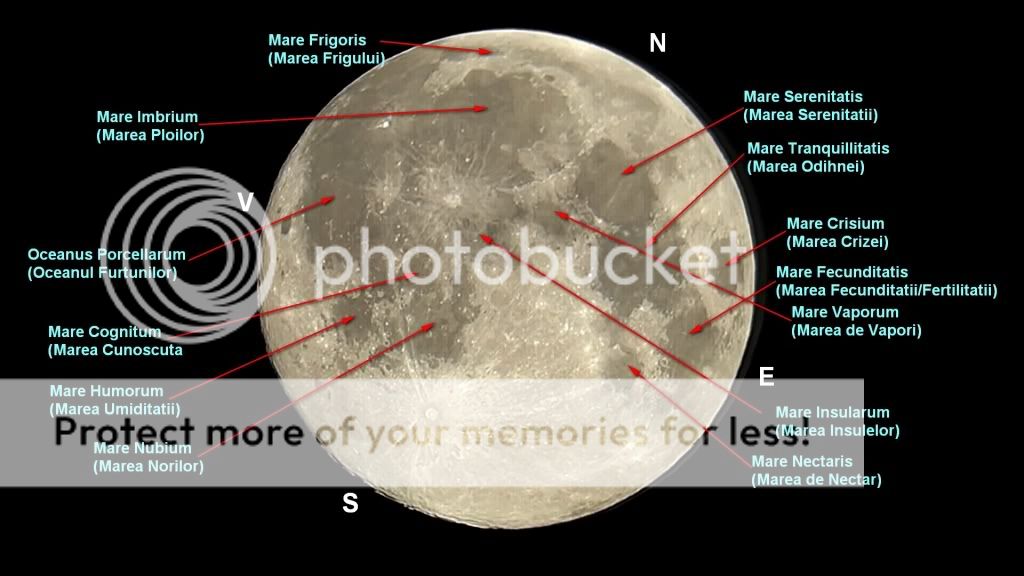
The seas of the Moon-Lunar Mare description and location


           These are the seas oof the near side of the Moon. I made ​​this photo above to make it easier to locate them. Perhaps the term "mare" (or sea), is a bit strange to someone who have just discovered the Moon.
What are the lunar seas:
          Lunar seas are dark basalt surfaces, which were formed by very old volcanic eruptions. These large areas have been dubbed "Maria" (in Latin "mare") by ancient astronomers to have mistaken for the real seas.
These are less luminous than higher heights because of iron-rich composition, and therefore seen by the naked eye appear dark.
         The seas cover about 16% of the Moon surface, and are especially visible on the side that is seen on Earth. Other big names for these include "oceanus" or ocean, "lacus" or lake, "palus" or swamp, and "sinus" or golf.

-Mare Frigoris- or Sea of cold- stretches 1.446 km and is located above the Alpes mountains

-Mare Imbrium- or Sea of rains-  has a large surface of 1.145 km, and is bordered to the south of Sinus Iridium and Alpes mountains to the north, the mountains Apenninus at east, Mare Insularum and Copernicus crater at south and west of Oceanus Procellarum.

-Mare Serenitatis- Sea of serenity is 674 km and is located east of the Apenninus mountains. Mare Imbrium and Mare Serenitatis are separated by these mountains.

-Mare Tranquillitatis or Sea of rest, is joined to the north with Mare Serenitatis and stretches 873 km

-Mare Crisium -or Sea of depression, is located on the east side of the Moon and is isolated from other mare.It has 555 km.

-Mare Fecundatis-or Sea of fertility, is a continuation of Mare Tranquillitatis on south.

-Mare Vaporum or great vapours, is in south of Apenninus mountains and has a surface quite small, 245 km.

-Mare Insularum or Sea of Islands is near the crater Copernicus in southwest.It is 513 km wide.

-Mare Nectaris or Sea of ​​Nectar is located southwest of Mare Fecunditatis and has a relatively small stretch of 333 km.

-Mare Cognitum or the known sea, it's in the intersection of several seas, and has a quite small area of 376 km.

-Mare Humorum or Sea of Humidity it's located on the west of the Moon, and on it is the famous crater Gassendi.it is ​​389 km in diameter.

-Mare Nubium or Sea of Clouds it is located in the center-south of the Moon with a surface of 715 km.

-Oceanus Procellarum or sea storms is on the east side of the Moon and is 2.592 km in diameter. On it are Aristarcus with Herodotus and Kepler craters.

- Mare Undarum or "Sea of Waves", located on the east side of the Moon with an area of ​​273 km
.
-Mare Spumans or "Foaming Sea" of 139 km.

-Mare Anguis official name is translated as "Serpent Sea", but could also mean "Dragon Sea". It is located on the east side of the Moon.

-Mare Australe or "Southern Sea", is situated in south-eastern hemisphere of the Moon. It is 603 km in diameter, and overlaps the visible (near) and invisible (far) sides of the Moon from Earth.

- Mare Humboldtianum is located east of Mare Frigoris. It is named after Alexander von Humboldt.

-Mare Ingenii or "Sea of intelligence" is one of the few seas on the far side of the Moon.

- Mare Marginis or "Sea of the Edge", is very on the distant edge of visible Moon with a diameter of 420 km.

-Mare Moscoviense or "Sea of Moscow" is a on the Moscoviense basin. It is one of very few seas on the far side of the Moon.

-Mare Orientale or "Eastern Sea" in Italian, is one of the largest lunar seas of 900 km in diameter, a ring like in a bull's eye target. Is located near the western extreme of the Moon, and this impact basin is difficult to see from Earth.

-Mare Smythii Latin for "Sea of Smyth" is located along the equator on the eastern slopes of the near side. It was named after William Henry Smyth, an English astronomer.


Wednesday, 8 April 2015

Astronomy through the telescope. Lunar twin craters Sabine and Ritter.

Sabine (30 km and 1.3 km deep) is a lunar crater that forms a pair with Ritter crater (29 km) north-west, and are located on Mare Tranquillitatis basin, on south-west. The edges of these craters are separated by a distance of only 3 kilometers. To the west is crater Schmidt (11 km), bowl-shaped and further north are Manners (15 km) and Arago (26 km)

Ritter (29 km and 1.3 km deep) is a crater like Sabine, both in size, depth and shape, which makes me think that they were created by successive impacts during the same period.
To the north of it, are three smaller craters called Ritter C (14 km), B (14 km), D (7 km), written by their distance from Ritter.

In the picture we see a good part of Mare Tranquillitatis basin, the darker area.

Name of crater Sabine is given from General Sir Edward Sabine (October 14, 1788 - June 26, 1883), which was an Irish astronomer, geophysicist, explorer, soldier and President of the Royal Society.

His works are notable determining the second's length of a pendulum (two seconds means one second in each direction of the pendulum), and his research on the Earth's magnetic field.

The name crater Ritter is given from Karl Ritter (August 7, 1779 - September 28, 1859), which was a German geographer. Along with Alexander von Humboldt, he is considered one of the founders of geography. From 1825 until his death he held the first chair in geography at the University of Berlin.

Astronomy through the telescope. Lunar twin craters Sabine and Ritter.
 220 video frames, in Registax.
153 video frames, in Registax.
220 video frames, in Registax.

Moon Age: 9.05 days
Phase: 70.5% (0% = New, 100% = Full)
Distance: 399.221 km


Optics (telescope or lenses): Celestron C8-Newtonian telescope, eyepiece 20mm Plossl, 2x barlow
Mount: CG5 (EQ5)
Camera: Sony CX130
Filter: no
Date: 10/03/2014
Location: Baia Mare, Romania
Processing: Registax,  FastStone Image Viewer


Tuesday, 24 January 2012

List of east features of the Moon. astronomy lecture


East of the Moon is marked by several interesting features. Most notably is Mare Crisium, a "sea" visible from the Earth with the naked eye as an isolated spot by other seas, dark in colour.
 Notable craters on the east side of the Moon are Posidonius, Petavius ​​and Langrenus, which are the largest in size.
 Even if it seems that East of the Moon has not too many huge craters, actually there are many  small craters as we can see in the list below.

Craters of the Moon's eastern area.

Adams
Al Bakri
Ansgarius
Apollonius
Asada
Atwood
Auzout
Balmer
Barkla
Battuta
Beaumont
Behaim
Beketov
Bellot
Berosus
Bessel
Bernoulli
Berzelius
Bilharz
Bohnenberger
Borda
Buckhardt
Cajal
Capella
Carrel
Carmichael
Catharina
Cauchy
Censorinus
Cepheus
Chacornac
Ching-Te
Cleomedes
Clerke
Colombo
Condorcet
Cook
Crozier
Cyrillus
Daniell
Da Vinci
Dawes
Debes
Dubiago
Eimmart
Fabbroni
Fermat
Firmicus
Fracastorius
Franklin
Fredholm
Furnerius
Gardner
Gauss
Geminus
Gilbert
Goclenius
Greaves
Gutenberg
Hase
Hahn
Hall
Holden
Humboldt
Hypatia
Isidorus
Jansen
Kapteyn
Kastner
La Perouse
Lame
Langrenus
Lawrence
Leakey
Legendre
Lick
Lindbergh
Lindenau
Littrow
Lohse
Lucian
Lubbock
Lyell
Maclaurin
Maclear
Macrobius
Magelhaens
Manilius
Manners
Maraldi
Marinus
Maskelyne
McClure
Menelaus
Mercurius
Messier
Messala
Metius
Monge
Monnier
Nansen
Naonobu
Newcomb
Nobili
Plinius
Ross
Palitzsch
Peirce
Petavius
Picard
Piccolomini
Plinius
Proclus
Reichenbach
Rheita
Ritter
Romer
Rothmann
Sabine
Santbech
Secchi
Sinas
Schumacher
Snellius
Stella
Stevinus
Sulpicius Gallus
Swift
Tacitus
Tacquet
Taruntius
Teophrastus
Theophilus
Tisserand
Torricelli
Tralles
Vendelinus
Vitruvius
Webb
Weinek
Wrottesley
Wrottesley
Zagut


Seas of the Moon's eastern area.

Mare Anguis
Mare Crisium
Mare Fecunditatis
Mare Nectaris
Mare Serenitatis
Mare Spumans
Mare Tranquillitatis
Mare Undarum

Mountains of the Moon's eastern area.


Montes Pyrenaeus
Montes Secchi
Montes Taurus
Mons Vitruvius
Mons Argaeus

Other forms of relief in the east area of the Moon.


Sinus Asperitatis
Sinus Amoris
Sinus Concordiae
Sinus Successus
Palus Somni
Lacus Somniorum
Vallis Palitzsch
Rupes Altai


Above: Video of east of the Moon through my telescope.

Space missions on the east side of the Moon.

Apollo 16 (1972) with people on board. Apollo 16 was the tenth mission in the Apollo program with humans. It was launched on 16 April 1972 and ended on 27 April. It was a lunar rover mission and brought back 94.7 kg of lunar soil and rock samples.

Apollo 17 with people on board. EVA activity (EVA). Apollo 17 was the 11th and last  manned mission of the Apollo space program. Launched at 12:33 a.m. on 7 December 1972, with a crew of three members: Eugene Cernan, Ronald Evans and Harrison Schmitt. Apollo 17 landing remains the most recent made ​​beyond Earth's orbit.

 Luna 21 (1973) USSR (Union of Soviet Socialist Republics), has successfully carried on the lunar surface rover Lunakhod 2 on January 15, 1973. It sent back 86 panoramic images and over 80,000 TV pictures.

Ranger 8 (1965) USA - intentionally crashed. Launched on February 20, 1965. Ranger 8 successfully sent 7137 images with a resolution of up to 1.5 m.

Surveyor 5 (1967) successfully landed. It sent more than 19,000 images to Earth, and has conducted more than 100 hours of compositional analysis of the surface.

To see the photographic map of the east area of the moon, view: Photographic map of the Moon: East Zone. Lunar Atlas.

 
All images are © Copyright 2010-2015 Lupu Victor. All rights reserved.Images may not be reproduced, published, or copied in any form without written permission of the author. Thank you for respecting the intellectual property rights. ASTROFOTOGRAFIA | Lupu Victor Astronomy - Contact - About
Design by Free WordPress Themes | Bloggerized by Lasantha - Premium Blogger Themes | Online Project management