Visit Worldwide Topsites
Showing posts sorted by relevance for query Tacitus. Sort by date Show all posts

Friday, 25 March 2011

Abulfeda and Almanon craters


Abulfeda and Almanon in Registax 17 frames ,95% lowest quality                                                                  -click to enlarge
Photographer: Victor Lupu
Optics: Celestron C8-Newtonian reflector telescope, plossl 20mm, 2x Barlow
Mount: CG5 (EQ5)
Device: Sony HDR CX105
Filter: No
Date: 09/02/2011
Location: Baia Mare, Romania
Processing: Registax


        Abulfeda (62 km.) bottom-largest, is a Moon impact crater located in the central highlands of the Moon. To the north ic crater Almanon (49 km.). A chain of craters named Catena Abulfeda runs between the northern edge of Abulfeda and Almanon's southern edge, then continues with a length of 210 km in Rupes Altai.The chain crater in the photo is as a long crack.
The crater was named after Ismael Abul-Fida Kurdish,an historian who lived in the 14th century.
       Almanon (49 km.) Abulfeda-over's, is named after the calif Abbasid Al Ma'mun. Above it are two craters, a smaller one called Almanon A and B is the largest At the west of Almanon is Tacitus (40 km .). Almanon C is attached to the southwestern edge of Almanon.


The images below are snapshots of the same video I processed the one above in Registax 5.
The first photo is with the names of thecraters around Abulfeda.

Thursday, 11 August 2011

Catharina and Geber lunar craters-images

Photographer: Victor Lupu
Optics: Celestron C8-Newtonian telescope, plossl 20mm, 2x Barlow
Mount: CG5 (EQ5)
Device: Sony CX105
Filter: No
Date: 11/05/2011
Location: Baia Mare, Romania
Processing: Sony Vegas 10 video captures

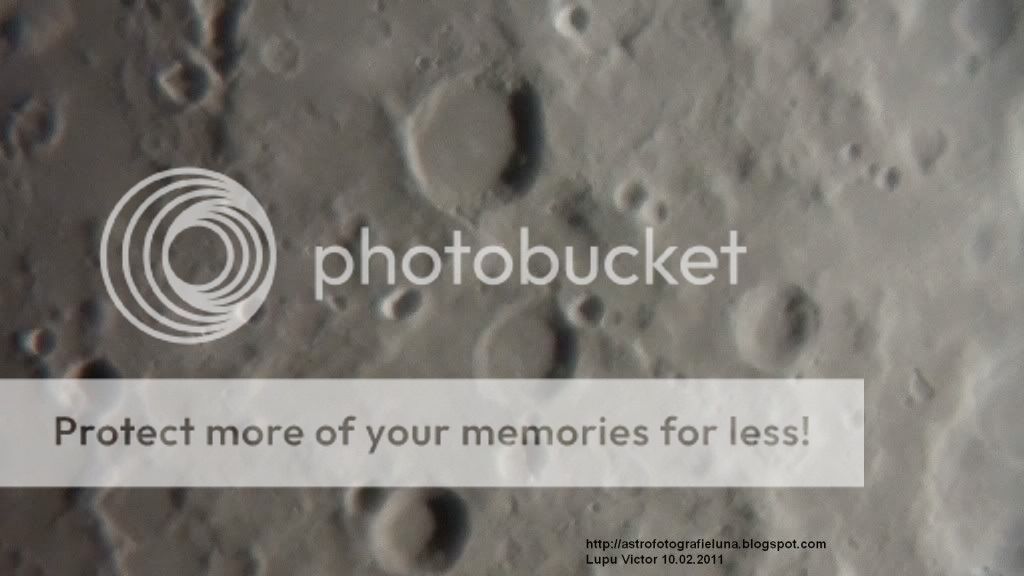
          Catharina (100 km), is a Moon impact crater located in the mountainous south, and is located west between Rupes Altai wich is a steep slope,and Mare Nectaris at east. To the northwest is the Tacitus crater. In the north it borders Cyrillus and Teophillus. Catharina form a prominent group along with the two craters, which are framed by Rupes Altai. There is a difference between the ages of the three craters, their age increasing from north to south.
Catharina's edge is very worn and irregular, especially in the north wall where is Catharina P crater (46 km). Northeast wall is deeply affected by several small craters. The floor is relatively flat with a curved ridge formed by Catharina P.
            Eponymous of this crater is Saint Catherine of Alexandria, also known Holy Great Martyr Catherine, who is a Christian saint and martyr, and is believed to have lived in the early fourth century.
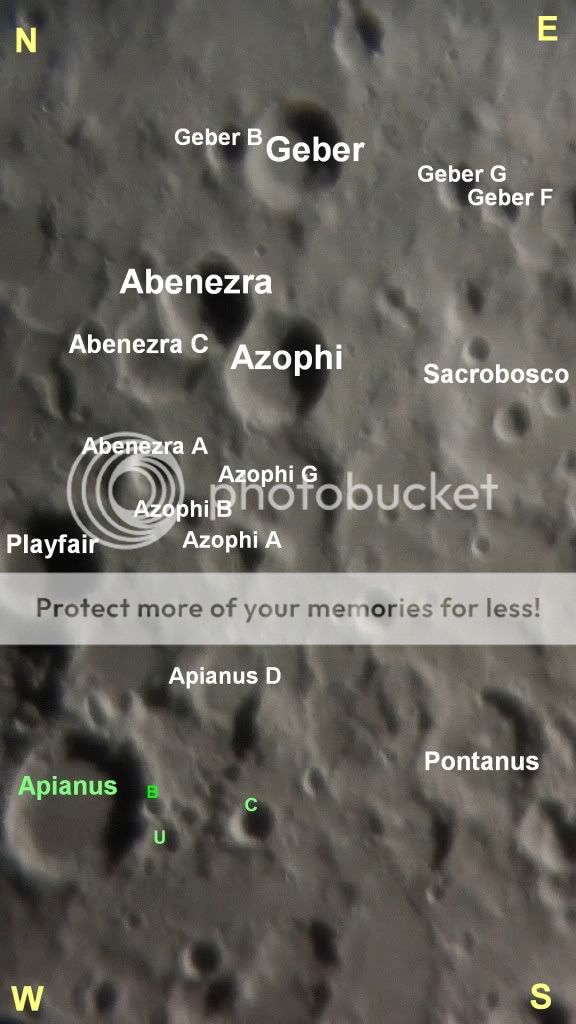
          Geber crater is located halfway between Almanon crater at northeast  and the pair craters Abenezra and Azophi on southwest. Further to the southeast is Sacrobosco. Geber is 45 kilometers in diameter and 3510 meters deep.
The name of the crater comes from Abu Muhammad Jabir ibn Aflaḥ or Geber / Gebir (1100-1150), the Muslim astronomer and mathematician of Seville.

Tuesday, 24 January 2012

List of east features of the Moon. astronomy lecture


East of the Moon is marked by several interesting features. Most notably is Mare Crisium, a "sea" visible from the Earth with the naked eye as an isolated spot by other seas, dark in colour.
 Notable craters on the east side of the Moon are Posidonius, Petavius ​​and Langrenus, which are the largest in size.
 Even if it seems that East of the Moon has not too many huge craters, actually there are many  small craters as we can see in the list below.

Craters of the Moon's eastern area.

Adams
Al Bakri
Ansgarius
Apollonius
Asada
Atwood
Auzout
Balmer
Barkla
Battuta
Beaumont
Behaim
Beketov
Bellot
Berosus
Bessel
Bernoulli
Berzelius
Bilharz
Bohnenberger
Borda
Buckhardt
Cajal
Capella
Carrel
Carmichael
Catharina
Cauchy
Censorinus
Cepheus
Chacornac
Ching-Te
Cleomedes
Clerke
Colombo
Condorcet
Cook
Crozier
Cyrillus
Daniell
Da Vinci
Dawes
Debes
Dubiago
Eimmart
Fabbroni
Fermat
Firmicus
Fracastorius
Franklin
Fredholm
Furnerius
Gardner
Gauss
Geminus
Gilbert
Goclenius
Greaves
Gutenberg
Hase
Hahn
Hall
Holden
Humboldt
Hypatia
Isidorus
Jansen
Kapteyn
Kastner
La Perouse
Lame
Langrenus
Lawrence
Leakey
Legendre
Lick
Lindbergh
Lindenau
Littrow
Lohse
Lucian
Lubbock
Lyell
Maclaurin
Maclear
Macrobius
Magelhaens
Manilius
Manners
Maraldi
Marinus
Maskelyne
McClure
Menelaus
Mercurius
Messier
Messala
Metius
Monge
Monnier
Nansen
Naonobu
Newcomb
Nobili
Plinius
Ross
Palitzsch
Peirce
Petavius
Picard
Piccolomini
Plinius
Proclus
Reichenbach
Rheita
Ritter
Romer
Rothmann
Sabine
Santbech
Secchi
Sinas
Schumacher
Snellius
Stella
Stevinus
Sulpicius Gallus
Swift
Tacitus
Tacquet
Taruntius
Teophrastus
Theophilus
Tisserand
Torricelli
Tralles
Vendelinus
Vitruvius
Webb
Weinek
Wrottesley
Wrottesley
Zagut


Seas of the Moon's eastern area.

Mare Anguis
Mare Crisium
Mare Fecunditatis
Mare Nectaris
Mare Serenitatis
Mare Spumans
Mare Tranquillitatis
Mare Undarum

Mountains of the Moon's eastern area.


Montes Pyrenaeus
Montes Secchi
Montes Taurus
Mons Vitruvius
Mons Argaeus

Other forms of relief in the east area of the Moon.


Sinus Asperitatis
Sinus Amoris
Sinus Concordiae
Sinus Successus
Palus Somni
Lacus Somniorum
Vallis Palitzsch
Rupes Altai


Above: Video of east of the Moon through my telescope.

Space missions on the east side of the Moon.

Apollo 16 (1972) with people on board. Apollo 16 was the tenth mission in the Apollo program with humans. It was launched on 16 April 1972 and ended on 27 April. It was a lunar rover mission and brought back 94.7 kg of lunar soil and rock samples.

Apollo 17 with people on board. EVA activity (EVA). Apollo 17 was the 11th and last  manned mission of the Apollo space program. Launched at 12:33 a.m. on 7 December 1972, with a crew of three members: Eugene Cernan, Ronald Evans and Harrison Schmitt. Apollo 17 landing remains the most recent made ​​beyond Earth's orbit.

 Luna 21 (1973) USSR (Union of Soviet Socialist Republics), has successfully carried on the lunar surface rover Lunakhod 2 on January 15, 1973. It sent back 86 panoramic images and over 80,000 TV pictures.

Ranger 8 (1965) USA - intentionally crashed. Launched on February 20, 1965. Ranger 8 successfully sent 7137 images with a resolution of up to 1.5 m.

Surveyor 5 (1967) successfully landed. It sent more than 19,000 images to Earth, and has conducted more than 100 hours of compositional analysis of the surface.

To see the photographic map of the east area of the moon, view: Photographic map of the Moon: East Zone. Lunar Atlas.

 
All images are © Copyright 2010-2015 Lupu Victor. All rights reserved.Images may not be reproduced, published, or copied in any form without written permission of the author. Thank you for respecting the intellectual property rights. ASTROFOTOGRAFIA | Lupu Victor Astronomy - Contact - About
Design by Free WordPress Themes | Bloggerized by Lasantha - Premium Blogger Themes | Online Project management