Visit Worldwide Topsites
Showing posts sorted by relevance for query hagecius. Sort by date Show all posts

Saturday, 31 August 2013

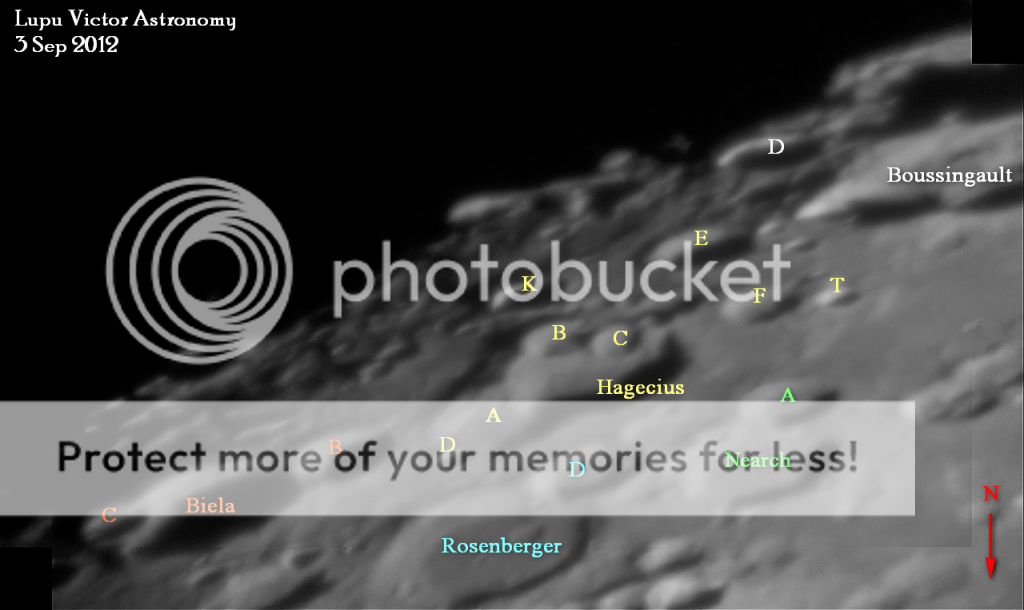
Craters on the Moon Hagecius and Biela images.


243 frames in Registax.


In these images processed in Registax, we see many craters located near the southern end of our natural satellite, the Moon, as we see it from Earth.

Observe crater with Hagecius (76km) with Hagecius A (61 km) which seems like a spoon under these lighting conditions.

Hagecius has many small satellite craters that are found on the floor and around it. Their names can be seen labeled in the picture above.

Another interesting crater is Biela (76 km), which has a shadowed floor at this phase of the Moon and that is why it appears to be deeper than it actually is. It is the same size like Hagecius.

Other craters that are neighbors of the above ones, are Nearch and Rosenberger.

Age of the Moon: 17 days
Phase: 90% (0% = New, 100% = Full)
Distance: 399,796 km


Optics: Celestron C8-Newtonian telescope, 20mm Plossl, 2x Barlow
Mount: CG5 (EQ5)
Camera: Sony CX130
Filter: no
Date: 03/09/2012
Location: Baia Mare, Romania
Processing: Registax, FastStone Image Viewer


Monday, 23 May 2011

Nearch Jacobi and Boguslawsky-South Moon craters

A
B
C

Photographer: Victor Lupu
Optics: Celestron C8-Newtonian telescope, plossl 20mm, 2x Barlow
Mount: CG5 (EQ5)
Device: Sony CX105
Filter: No
Date: 10/02/2011
Location: Baia Mare, Romania
Processing: Sony Vegas 10, video captures

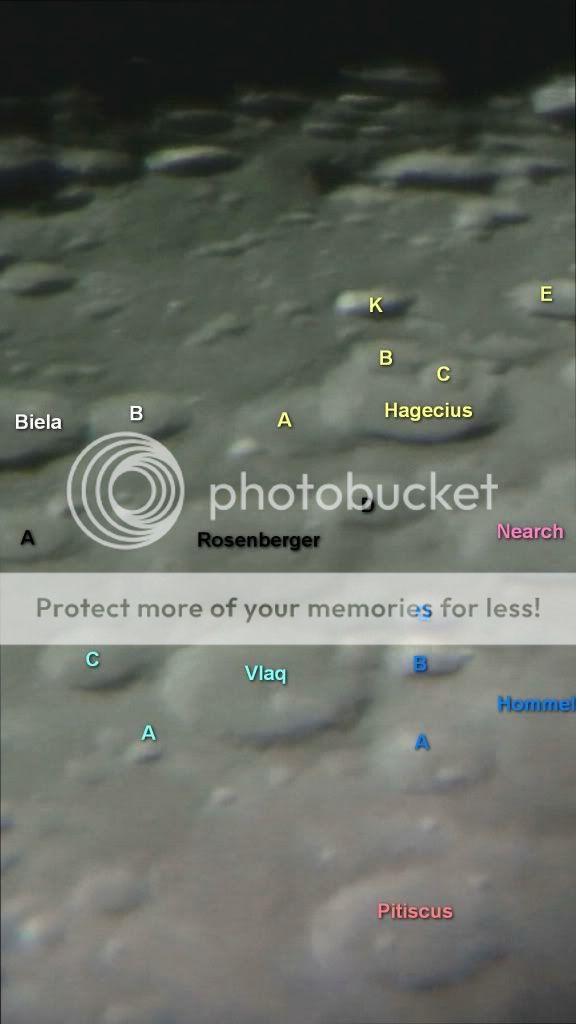
In photo A: craters Hommel, Vlaq, Pitiscus, Rosenberger, Nearch (76 km) and Hagecius (76 km).

         Nearch (76 km) is an impact crater, situated on the south-east region of the Moon, south-east of the crater Hommel. North of Nearch is Vlacq, and north-east lies Rosenberger. Nearch is 76 kilometers in diameter and 2.9 km deep and dates from pre-nectarian era, now 4.55 - 3.92 billion years ago.
The outer edge of the crater has been affected by small craters, which overlap along the eastern edge. The most important of these is Nearch A (43 km) on south-east edge. Small craters are found on the north and west. The rest of the interior walls are relatively intact, and retains its circular shape.


          Hagecius (76 km), this crater forms a triangle with crater Rosenberger on north-west and Nearch on west-north-west. Like other craters, Hagecius was undergone further erosion of the impacts. South-eastern edge is overlaped by three smaller craters called Hagecius C (24 km), B (34 km) and G (30 km).


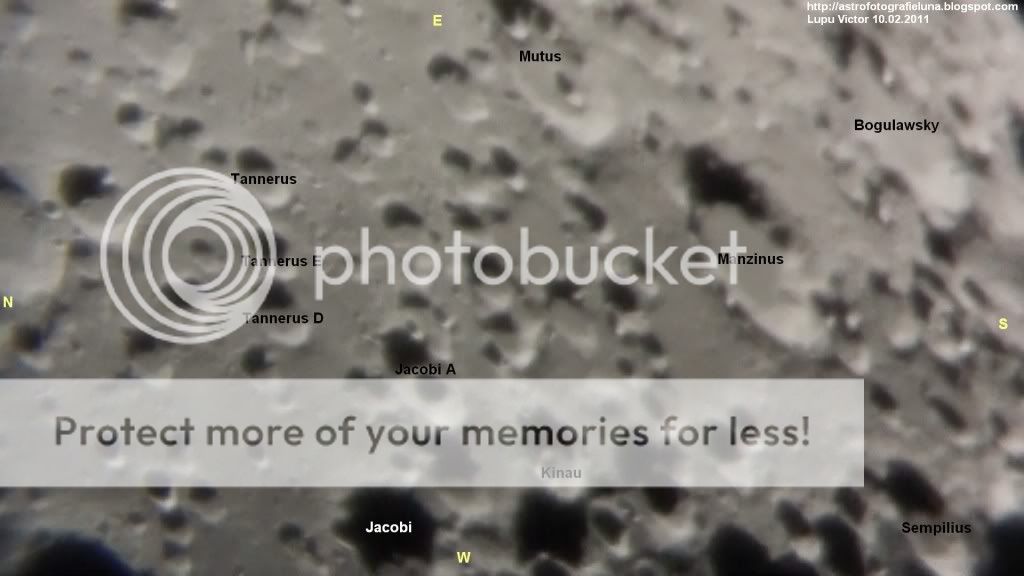
In photo C: crater Mutus, Manzinus, Jacobi (68 km), Boguslawsky (97 km), Tannerus (29 km), Kinau (42 km) and Sempilius (70 km).

      Jacobi (68 km), has a margin of several overlapping craters along the southern edge, including Jacobi J (19 km), and a pair on the north side. The result is that the outer edges are flat along the north and south sides. On the north side, Jacobi A, forms a member of a chain of craters, forming a line on the floor inside, from north-east to south-west.

        Boguslawsky (97 km) is located near the southern edge of the Moon. It lies northwest of the crater Demonax, and south-west of Boussingault (131 km). Due to its location Boguslawsky appears elongated.
 Crater floor is flooded and with no many features. The edge is low. Crater Boguslawsky D is on the east side.
The name comes from the Palm (or Palon) Heinrich Ludwig (Pruß) von Boguslawski (7 September 1789-5 Iun 1851) who was a German professor of astronomy.

         Tannerus (29 km). The edge of this crater is almost circular, with only a slight inward bulge along the northern edge where it is joined with Tannerus P (20 km). Edge is clear and well defined, although there are small craters along the border in the west and south. Crater floor is without marks or features.
Crater name is given from Adam Tanner (in Latin, Tannerus) (14 April 1572 - May 25, 1632) which was an Austrian Jesuit professor of mathematics and philosophy.

         Kinau (42 km), is a mile deep. Kinau may date from the pre-nectarian era, 4.55 - 3.85 billion years ago. North-western edge of the crater walls was strongly affected by the impacts, and is overlaid by a pair of small craters, bowl-shaped. The remaining edge is distorted into a hexagonal shape, with the small craters along its rim. The interior walls are relatively low and the interior floor is with almost no characteristics. There is a small rise near the middle of the crater.
The crater is named after 19th century German priest, teacher and amateur astronomer Adolph Gottfried Kinau.

          Sempilius (70 km).  The crater may also date back to pre-nectariana, 4.55 - 3.85 billion years ago.Sempilius was affected by impacts and is relatively circular.The crater is named after Hugh Sempill (or Semple ) (Latin Sempilius) (between 1589 or 1596, and 1654) which was a Scottish Jesuit mathematician and linguist.

To locate craters above, I've described crater names in the picture below, taken on 14/11/2010.

Wednesday, 19 February 2014

Have some popcorn to see this. Biela and Hagecius craters on the Moon.

Biela (76 km), is a crater located on the south- west of the Moon , and that's why on Earth can be seen only in oval shape due to his position , although it is circular , but not perfectly round , with a mountain peak located in center .

In the video , the crater looks tidy, perfect edge , but this is due to the Moon phase at that time, many of the " ugly " features of the crater being filled by dark.

Stuck to the south- west edge, is a satellite crater of Biela, Biela B (43 km). Biela A (26 km) and C (26 km) are found in the north- east of Biela , the latter being superimposed over the rim of Biela . The same situation is with the crater Biela W (16 km), on the western rim .

Finishing analysis of the region , I believe that video is quite successful , though many craters are hidden by the terminal ( top image) , which would amplify the beauty of the moonscape .

Images are processed in Registax in the video can be viewed here: Lunar craters Images Hagecius and Biela .
Here you can learn about the other craters visible in the video , Nearch (76 km) , Rosenberger (96 km) and Hagecius (76 km) ( center in picture ) .

You have to remember, the images are inverted , and the cardinal points must be seen as such, with the north at the bottom.

Age of the Moon: 17 days
Phase: 90% (0% = New, 100% = Full)
Distance: 399796 km


Optics: Celestron C8-Newtonian telescope, 20mm Plossl, 2x barlow
Mount: CG5 (EQ5)
Camera: Sony CX130
Filter: no
Date: 03/09/2012
Location: Baia Mare, Romania
Processing: FastStone Image Viewer


Saturday, 10 December 2011

Nearch and Hagecius craters-amateur telescope images

Photographer: Victor Lupu
Optics: Celestron C8-Newtonian telescope, plossl 20mm, 2x Barlow
Mount: CG5 (EQ5)
Device: Sony CX105 to 8x optical zoom
Total Magnification: 800x
Filter: no
Date: 08/16/2011
Location: Baia Mare, Romania
Processing: video captures, FastStone Image Viewer


Picture above is for guidance and I made ​​it on November 4, 2010, which is now a year and a month.
Nearch and Hagecius are craters situated on the south side of the Moon.

Tuesday, 27 December 2011

List of south features of the Moon-Southern lunar Hemisphere


Southern hemisphere of the Moon is in rough terrain, heavily cratered and with mountainous areas.
At the poles, the sun is always at small angles, so this is creating a unique environment, but also some difficulties in interpreting the geological region.
The southern hemisphere of the Moon craters are very different in size, appearance and how they were formed by impacts in the past.
Personally, the most interesting craters on south, I find Tycho, a crater with rays showing a very high albedo, rays that are left behind from the initial impact, wich can be seen from Earth with the naked eye or binoculars.
Another great crater is Clavius​​, a large crater with other small craters lying inside it in a decreasing order to form a spiral.
Shiller is another crater, interesting to me because of its elongated shape similar to a caterpillar.
 On the southern hemisphere of the Moon seen from Earth, there is only a sea, Mare Nubium that penetrate down to the crater Pitatus.

There are not mountains on the Moon's southern hemisphere. Maybe were probably destroyed by countless impacts were.

Most notable craters of the Moon southern hemisphere, in alphabetical order, are:

Aliacensis
Apianus
Asclepi
Baco
Ball

Barocius
Biela
Blanchinus
Boguslawsky
Bosching
Boussingault
Brown
Buch
Casatus
Cichus
Clairaut
Clavius
Curtius
Cuvier
Cysatus
Deluc
Demonax
Deslandres
Fabricius
Faraday
Fernelius
Frisius
Gauricus
Gemma
Gruemberger
Hagecius
Heinsius
Hell
Helmholtz
Heraclitus
Hommel
Jacobi
Janssen
Kaiser
Kinau
Klaproth
Lexell
Licetus
Lilius
Longomontanus
Maginus
Manzinus
Maurolycus
Metius
Miller
Montanari
Moretus
Mutus
Neander
Nearch
Neumayer
Newton
Nonius
Orontius
Pentland
Picret
Pitatus
Pitiscus
Playfair
Poisson
Pontanus
Pontecoulant
Proctor
Rabbi Levi
Rheita
Riccius
Rosenberger
Sasserides
Saussure
Sempilius
Short
Scheiner
Schiller
Schomberger
Scott
Steinheil
Stofler
Tannerus
Tycho
Vlaq
Watt
Weiss
Werner
Wilhelm
Wurzelbauer
Zach


Seas:
Mare Nubium

Space missions on the south side of the Moon:
Ranger 9 was launched on March 24, 1965 by United States of America and was intentionally crashed on the lunar surfaceon crater Alphonsus.
Ranger 9 was designed to achieve an impact trajectory and to transmit pictures of the lunar surface in high-resolution during the flight until the impact.
  Ranger 9 successfully transmitted 5814 images with a resolution of up to 1.5 m.

LCROSS United States launched the LCROSS (Lunar Crater Observation and Sensing Satellite) which was deliberately crashed into the Moon's south pole on crater Cabeus on October 9, 2009
The mission was designed to search for water ice on the lunar surface and examining the resulting cloud, caused by impact. The mission ended with the discovery of significant amounts of water.

Moon Impact Probe was launched by India, and it was deliberately crashed on 14 November 2008 at the lunar south pole.
 It had 35 kg, and was released from Chandrayaan-1 Lunar Orbiter. It was equipped with a video camera, a radar altimeter and a mass spectrometer.


Video: Victor Lupu
Optics: CelestronC8 "-Newtonian telescope, plossl20mm, 2x Barlow
Mount: CG5 (EQ5)
Device: SonyCX105 at 7x optical zoom
Total Magnification: 700x
Filter: no
Date: 16/08/2011
Location: Baia Mare, Romania
Processing and editing: Sony Vegas 10


To see the photographic map of the south area of the Moon, view: Photographic map of the Moon: South Zone. Lunar Atlas.

For those who like my astro pictures or my articles, it woul be great if you could pay attention on advertising that appear in the blog by a click and maybe one day I could buy a better telescope.

Monday, 16 January 2012

Astro Info: Rosenberger and Vlacq lunar craters. Telescope images.


Vlacq (89 km.), Is located on the south-east of the Moon. This crater is adjacent to the southeast edge of Hommel (125 km.), and north to Rosenberger (96 km.). Vlacq is more contoured than his neighbor Rosenberger, with a depth of 3 km. The other has a smaller depth of 2.2 km.

Rosenberger (96 km.) Appears oval when viewed from Earth, however, is almost circular .
This crater has been heavily eroded by numerous impacts so that the outer edge has become rounded and somewhat indistinct Satellite crater Rosenberger D, which is about 50 kilometers in diameter, is located in the northeastern edge of Rosenberger.

Crater name comes from Otto August Rosenberger (10 August, 1800 - 23 January, 1890) who was a German astronomer at the Baltic Sea in Tukums.
Rosenberger graduated from the University of Königsberg, and was noted for his study of comets. He won the Gold Medal of the Royal Astronomical Society in 1837.

Towards the south of Rosenberger (image is inverted), is the crater Biela and Hagecius with satellite craters.

Photographer: Victor Lupu
Optics: Celestron C8-Newtonian telescope, plossl 20mm, 2x Barlow
Mount: CG5 (EQ5)
Device: Sony CX105 to 8x optical zoom
Total Magnification: 800x
Filter: no
Date: 08/16/2011
Location: Baia Mare, Romania
Processing: video capture, FastStone Image Viewer


All images are © Copyright 2010-2015 Lupu Victor. All rights reserved.Images may not be reproduced, published, or copied in any form without written permission of the author. Thank you for respecting the intellectual property rights. ASTROFOTOGRAFIA | Lupu Victor Astronomy - Contact - About
Design by Free WordPress Themes | Bloggerized by Lasantha - Premium Blogger Themes | Online Project management