Visit Worldwide Topsites
Showing posts sorted by relevance for query picard. Sort by date Show all posts

Monday, 10 June 2013

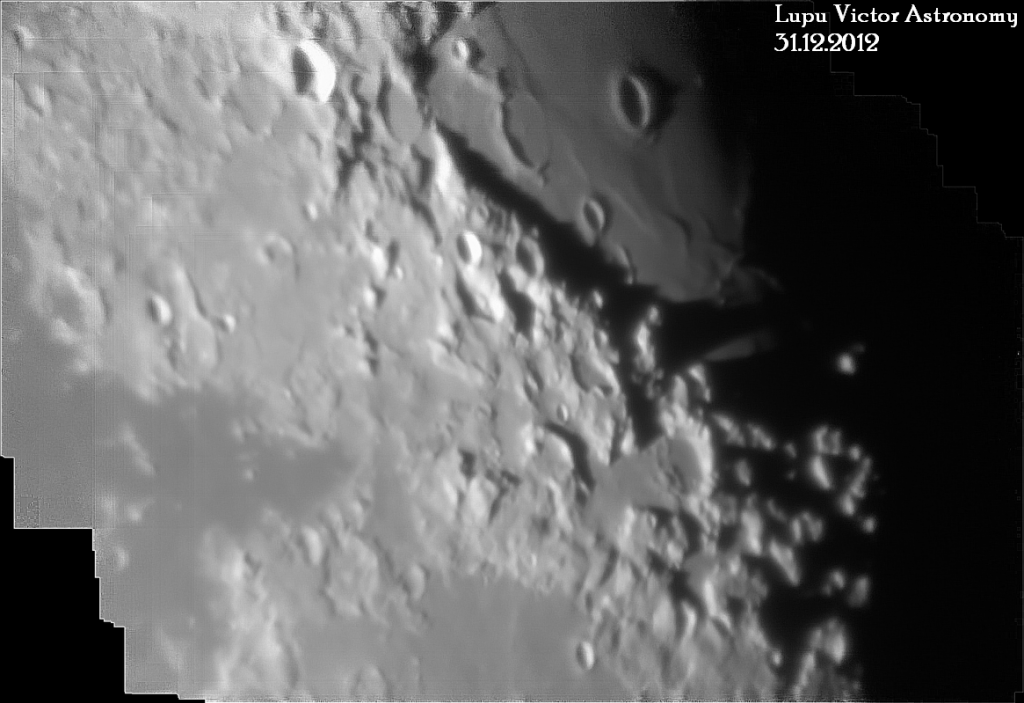
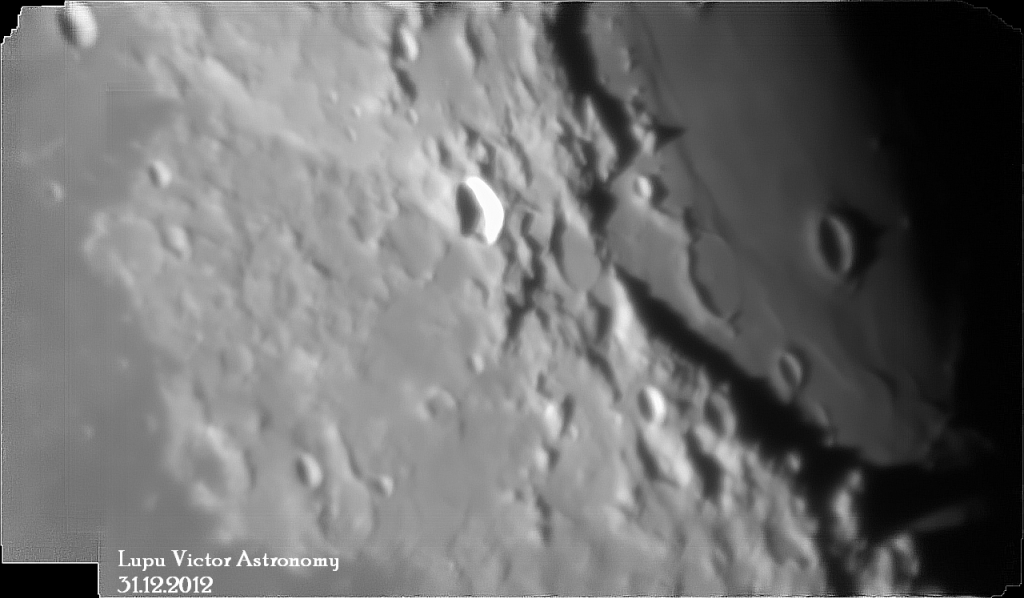
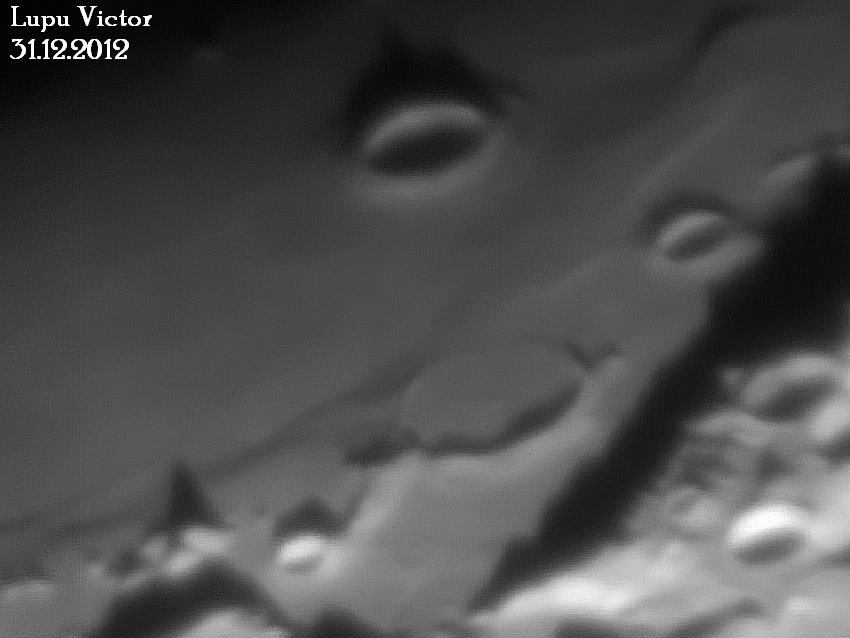
Wonderful pictures of western Mare Crisium and crater Picard on the Moon

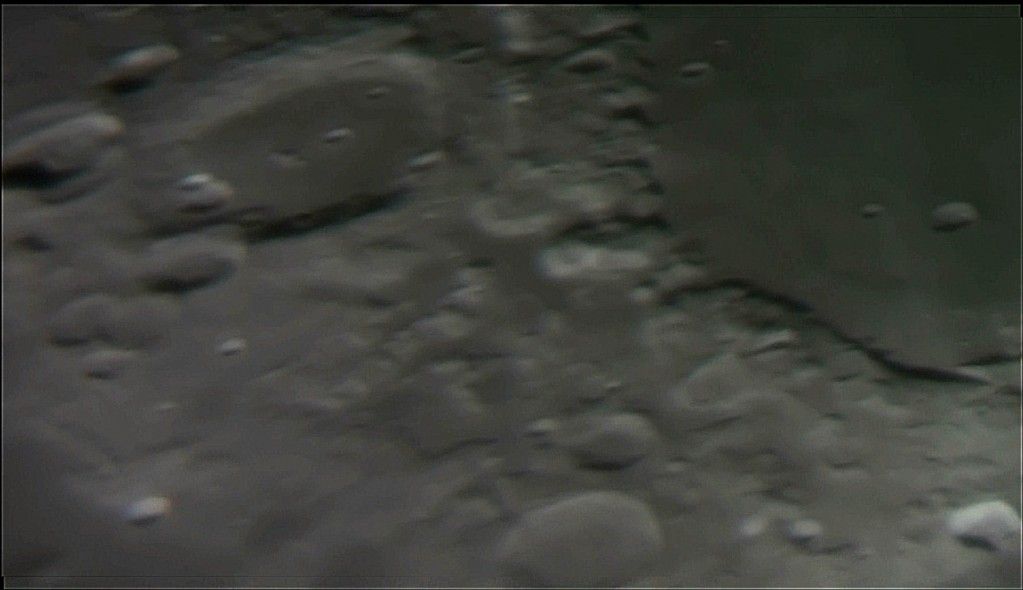
West of Mare Crisium 101 frames at 90% best quality in Registax.


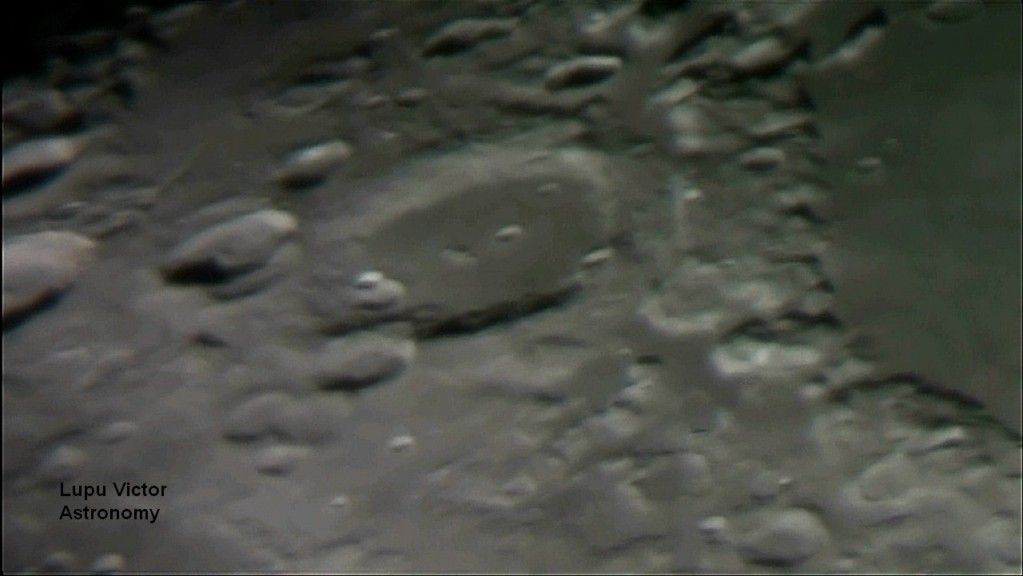
West of Mare Crisium 252 frames at 75% best quality in Registax.


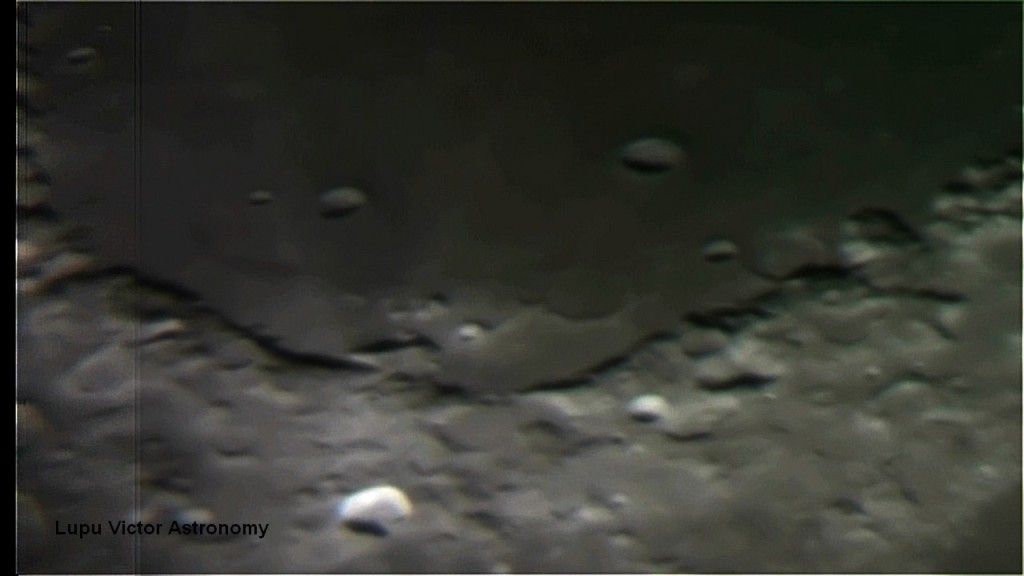
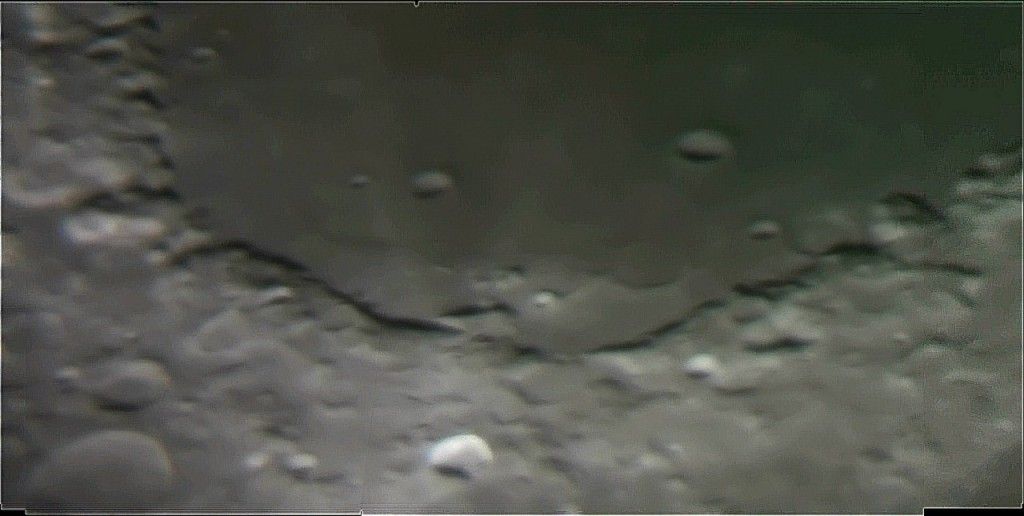
Picard crater 356 frames at 80% best quality in Registax.


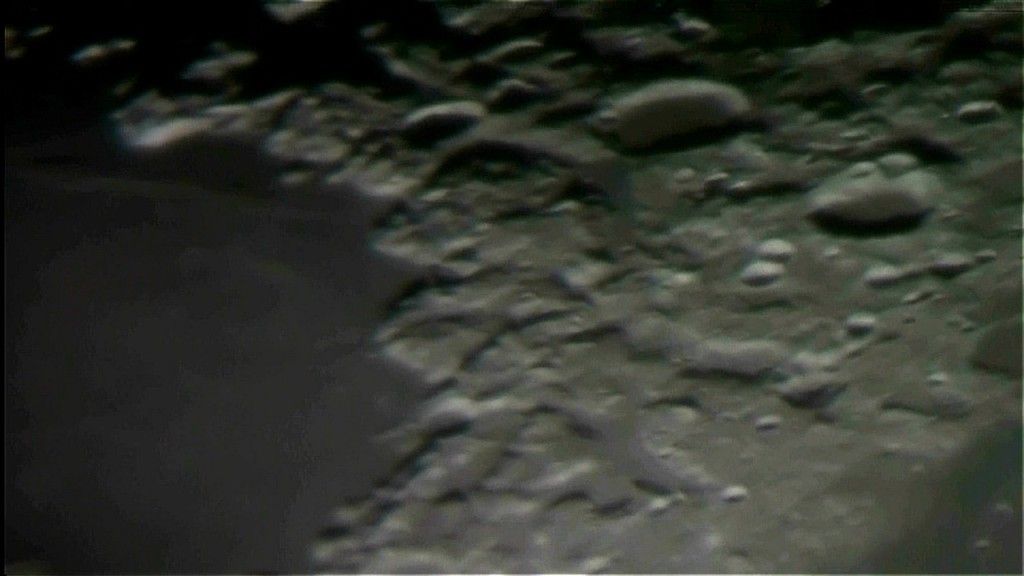
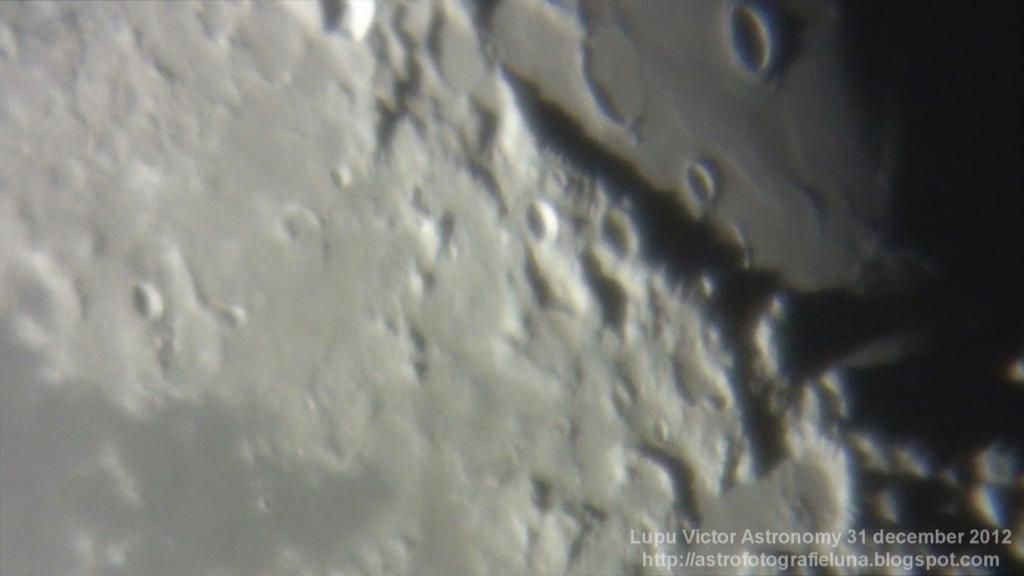
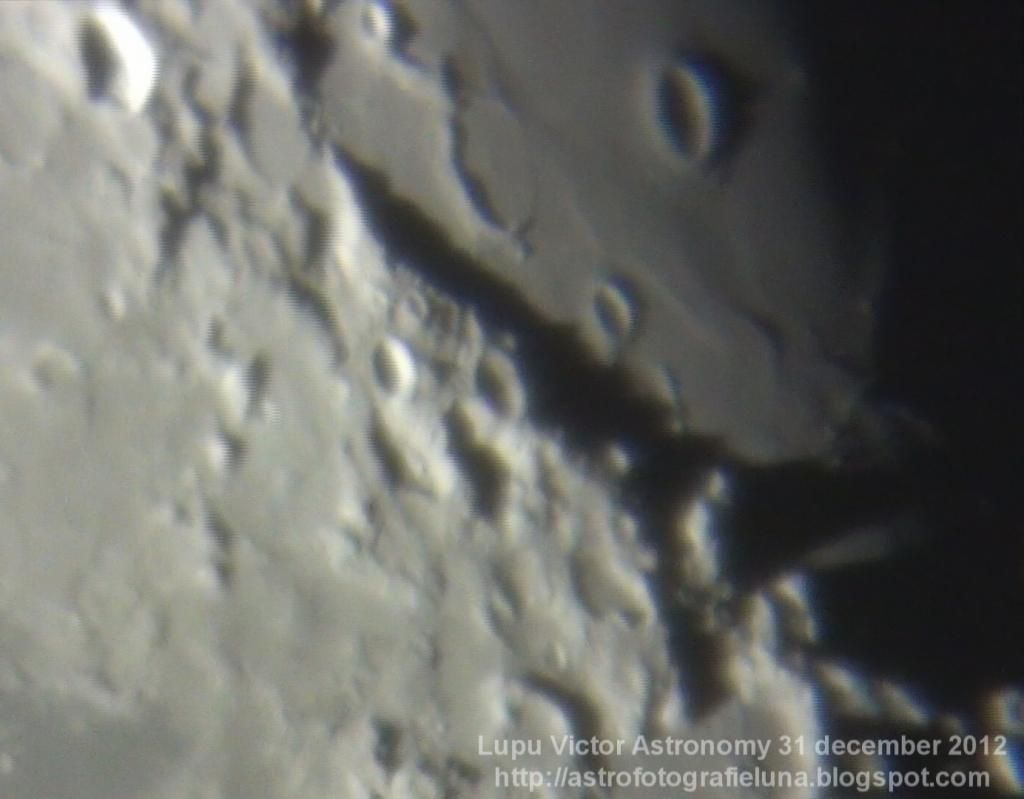
In these images, we see Mare Crisium basin with several craters and the mountainous region that forms the southwestern edge of the basin.


Under this illumination angle of the Sun, we see more standout wrinkles on Mare Crisium. These are called Dorsum Oppel (west), and Dorsum Termier, south. These wrinkles are not the only ones on this basin.


Crater Picard (23 km) in these images (better seen in picture 3), seems perfectly round (but oval because of its position on the east Moon), and it's not like that, because it has some edge loops, the highest being on the east. I never saw this crater so prominent like in these images.


Note the flooded crater Yerkes (36 km) located west of Picard, more to the edge of the Crisium basin. Its west wall is high, but as we look to the east, the wall becomes smaller, becoming almost nonexistent.


On the Crisium basin, also observe a crater located south of Yerkes, called Greaves (14 km), which looks like Picard, but smaller in size. Climbing up the edge of the basin, we see its shadow projected onto the plateau, becoming an adorable beauty view. On the western edge of the Crisium basin, are sprinkled more satellite craters of Glaisher (16 km) and Proclus (28 km).


  Continuing to the south of the basin, we see that the collar that surrounds the Mare Crisium is increasingly taller and lace. Here, we see the Thebbutt (32 km) crater, and also satellite craters of some which are on the basin, as Picard and Lick (31 km). The latter is not visible in the picture because is in shadow, south of Greaves.

Image are processed in Registax of a video from which were taken between 101 and 356 frames, merged to form a single image.

Age of the Moon: 17 days
Phase: 93% (0% = New, 100% = full)
Distance: 394.960 km


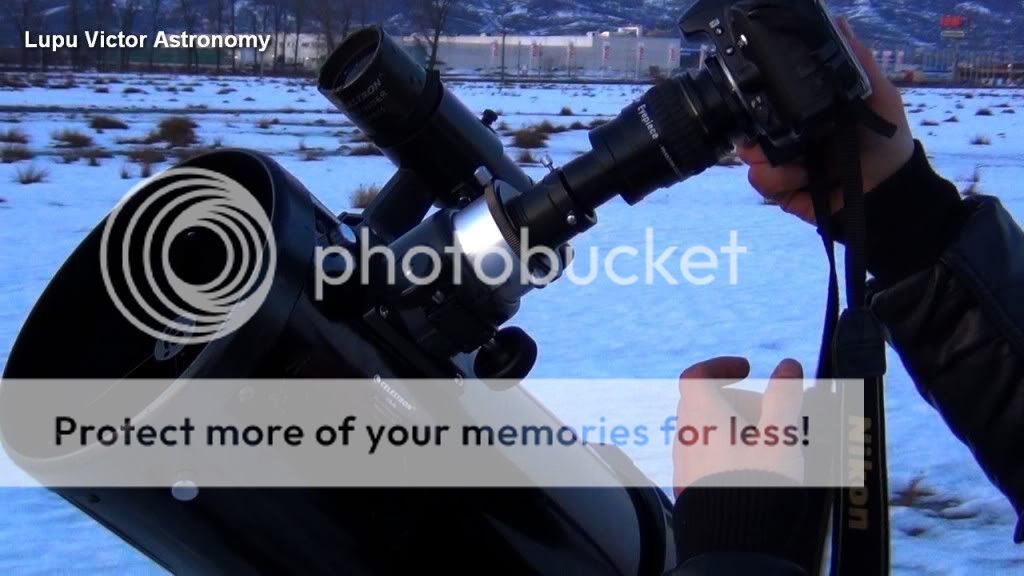
Optics: Celestron C8-Newtonian telescope, 20mm Plossl, 2x Barlow
Mount: CG5 (EQ5) motorized
Camera: Sony CX130
Filter: no
Date: 31/12/2012
Location: Baia Mare, Romania
Processing: Registax, FastStone Image Viewer


Tuesday, 27 May 2014

Observational astronomy: Picard crater.


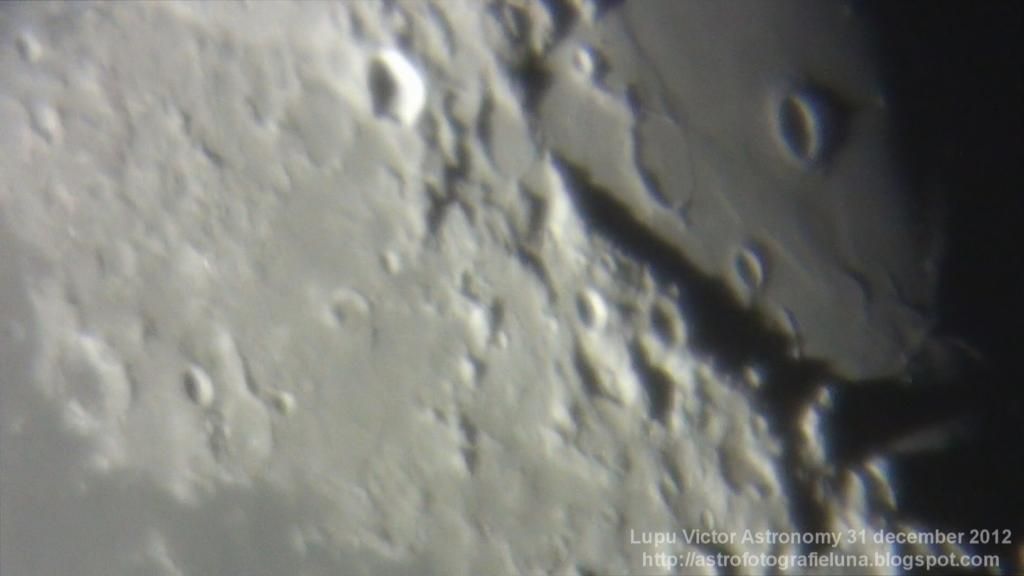
Beautiful Crisium basin region can not be denied by anyone who observes these images. Notice here the south-western edge of the Mare, with the beautiful lace in sunlight.

Picard (23 km) is easily located on the basin, with an oval shape in semi-darkness.

Images processed in Registax here.


Age of the Moon: 17 days
Phase: 93% (0% = New, 100% = full)

Distance: 394.960 km

Optics: Celestron C8-Newtonian telescope, 20mm Plossl, 2x Barlow
Mount: CG5 (EQ5) motorized
Camera: Sony CX130
Filter: no
Date: 31/12/2012
Location: Baia Mare, Romania
Processing: FastStone Image Viewer


Friday, 6 January 2012

Astronomy lecture.Western Mare Crisium.Pictures by telescope


These captures of western Crisium sea through the telescope, are presented in another article: Video by astronomical telescope-near Western Mare Crisium.
There are many present craters on this large area, and I will only talk about features that were not discussed before.

We start with Burkhardt crater (57 km), which is located between craters Geminus (86 km), on north, and Cleomedes on south.
Burckhardt is located on two slightly smaller-sized craters on the opposite sides, producing a triple crater formation. Burckhardt E (39 km), is covered by the southwest quadrant of Burckhardt's, while Burckhardt F (43 km), is covered by the northwest quadrant. Crater rim is circular, but somewhat irregular in shape. There is a central peak near the midpoint of the crater floor.

Stucked in the western edge of the crater Cleomedes, is Tralles, and to the east of Cleomedes is the crater Delmotte (32 km), a small crater, whose characteristics are difficult to see because of its position.

Continue to the next photo description below, are craters Macrobius and Tisserand, 64 and 37 km, crater ray Proclus (28 km), and west of Proclus is Palus Somni , an area of 143 km,.

In the third picture below, there are many small craters on the surface of the sea, but also on its edge.
Peirce crater (19 km) with Picard (23 km), are those who are most "into the sea" of Crisium.
Picard's interior has a series of terraces, which seismologists have attributed to a collapse of the crater floor. The lowest point of the crater floor is about 2000 meters below its rim, and has a small hill in the center.

Other craters located further to the edge of the sea are Yerkes (36 km), Lick (31 km), Greaves (14 km), and Glaisher crater (16 km).

Yerkes crater (36 km), it seems interesting, because its inside was almost completely flooded by lava, leaving only a shallow remnant edge above the seaand the edge is the most visible in west. The floor has a similar albedo with the large Crisium sea, so Yerkes's features are not distinct by surroundings.

About craters Firmicus (56 km) and Apollonius (53 km), I will speak in another article dedicated to them.


Photographer: Victor Lupu
Optics: Celestron C8-Newtonian telescope, plossl 20mm, 2x Barlow
Mount: CG5 (EQ5)
Device: Sony CX105 to 8x optical zoom
Total Magnification: 800x
Filter: no
Date: 08/16/2011
Location: Baia Mare, Romania

Processing: video capture, FastStone Image Viewer


Above are images processed in Registax.

Sunday, 16 June 2013

HD Video by astronomical telescope. Taruntius crater and western Crisium basin

These are astronomical telescope HD video images with Taruntius crater (56 km) and west of Crisium basin on the eastern Moon, as seen from Earth.


  The night of 30 to 31 January 2012 was one with an atmosphere quite clean, but very frosty. Images consequently come up to be satisfying with video camera mounted on the telescope.


In this video, I have extracted several frames in Registax program, to form some clear pictures that can be seen in the article: Taruntius crater and on the border of area Mare Fecunditatis-Tranquillitatis. Telescope Images .


  Also at 3:00 minute, the telescope moves it's attention to craters north of Taruntius, at Proclus (28 km), the bigger one Macrobius (64 km) on the west of the Crisium basin, and the beautiful crater called Picard (23 km)  located on Mare Crisium. Images in Registax of these cratersyou can see in the article: Wonderful pictures of western Mare Crisium and crater Picard on the Moon .

I've talked more about these regions, in the articles specified above.


Optics: CelestronC8 "-Newtonian telescope, plossl20mm, 2x Barlow
Mount: CG5 (EQ5) motorized
Device: Sony CX-130
Video mode: Full HD progressive 1920x1080
Filter: no
Date: 31/12/2012
Location: Baia Mare, Romania
Processing and editing: Sony Vegas 10

Wednesday, 4 January 2012

Video by astronomical telescope-near Western Mare Crisium

This stabilized video presents west of Crisium Sea. The clip starts with the large crater Cleomedes (126 km) in the north of the sea. Images goes along the west of the sea, to south, when Macrobius and Tisserand craters appear, then the bright ray crater Proclus (28 km).

  We go forward and climb the Mare Crisium plateau, where we see two isolated craters: the smaller left is Peirce (19 km), and the bigger on right is Picard (23 km).

In the bottom-right corner begins to see a bit of Mare Fecunditatis.
We visually keep on eye the Mare Crisium, and we reach its southern edge, where Firmicus (56 km) and Apollonius (53 km) craters takes shape, and then there are two large plates: Mare Spumans, on the top, and Sinus Succesus on the bottom of the screen.


Video: Victor Lupu
Optics: CelestronC8" -Newtonian telescope, plossl20mm, 2x Barlow
Mount: CG5 (EQ5)
Device: Sony CX105 at 7x optical zoom
Total Magnification: 700x
Filter: no
Date: 16/08/2011
Location: Baia Mare, Romania
Processing and editing: Sony Vegas 10

Saturday, 11 May 2013

East lunar basins Astronomical images

48 frames at 90% best quality
2 frames at 100% best quality

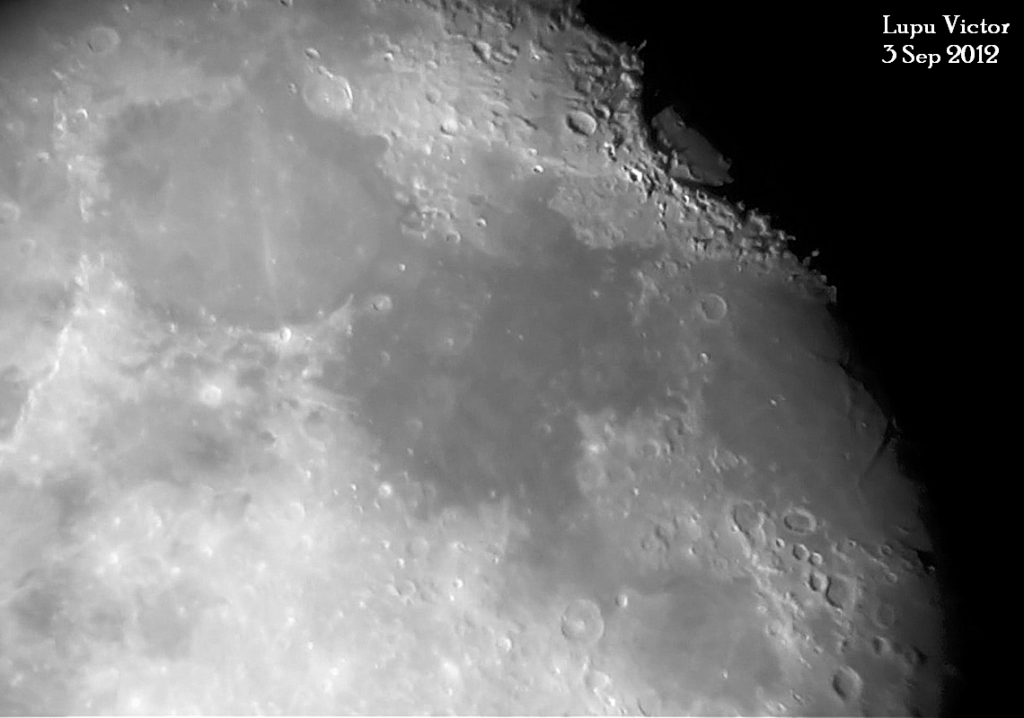
In these photos made in Registax program, we see more lava basins, larger and smaller (second photo), such as Mare Serenitatis, Mare Tranquillitatis, half of Mare Fecunditatis, Mare Nectaris, and about a quarter of Mare Crisium, the rest being sunk in shadow.

   Note the claw-shaped mountain that separates the two basins Serenitatis and Tranquillitatis, of which termination is Promotorium Archerusia. Note also Taruntius crater, situated between Mare Tranquillitatis and Mare Fecunditatis, and Posidonius crater on the northeast edge of Mare Serenitatis.

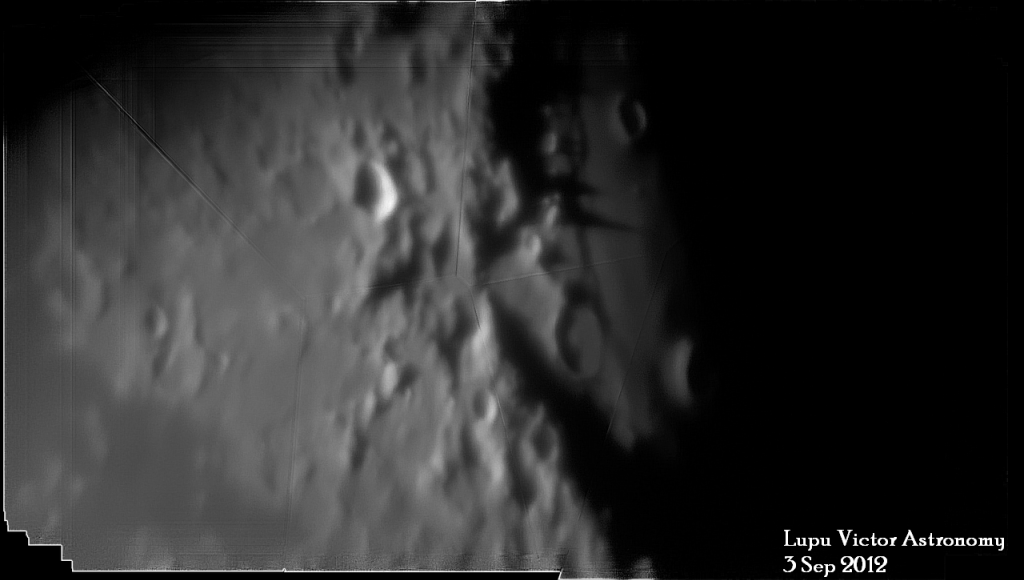
In the first photo in the article, we see the western edge of Mare Crisium. Three quarters of this plateau is in shadow, and at the terminal are still observed two craters, one below, called Picard, and one to the north, called Peirce.

  Proclus, the the crater of which is most lit in the first photo because it shows a very high albedo. In this picture, the Sun shines in the eastern inner wall. Proclus, is located on Palus Somni, and in other lighting conditions, it can be seen the rays scattered from north-west, north-east and south, these being the ejection from the impact that produced the crater.

  Images are processed in Registax of a video that were taken a few shots, merged to form a single image.

Moon Age: 17 days
Phase: 90% (0% = New, 100% = Full)
Distance: 399,796 km


Optics: Celestron C8-Newtonian telescope, 20mm Plossl, 2x Barlow
Mount: CG5 (EQ5)
Camera: Sony CX130
Filter: no
Date: 03/09/2012
Location: Baia Mare, Romania
Processing: Registax, FastStone Image Viewer


Tuesday, 8 January 2013

Mare Crisium half in darkness video

These clips have reversed images as seen through the telescope. Moon at that time was lit 58%. What is interesting in these images, is Mare Crisium, which if you do not know it's there, you think that is a huge crater because the Crisium basin is half covered in darkness.


In the first video, the Moon is seen from the distance. Half of Mare Crisium, along with the surrounding Mares: Serenitatis, Tranquillitatis and Fecunditatis.

Video 2, is closer to the Mare Crisium. In this basin you can see the crater Picard (higher, 23 km), and below Peirce (lower, 19 km). Yerkes crater (36 km) is more difficult to see because it is almost flooded by lava.


Optics: CelestronC8 "-Newtonian telescope, plossl20mm, 2x Barlow
Mount: CG5 (EQ5)
Device: Sony CX-130
Video mode: Full HD progressive 1920x1080
Filter: no
Date: 30/04/2012
Location: Baia Mare, Romania
Processing and editing: Sony Vegas 10

Tuesday, 24 January 2012

List of east features of the Moon. astronomy lecture


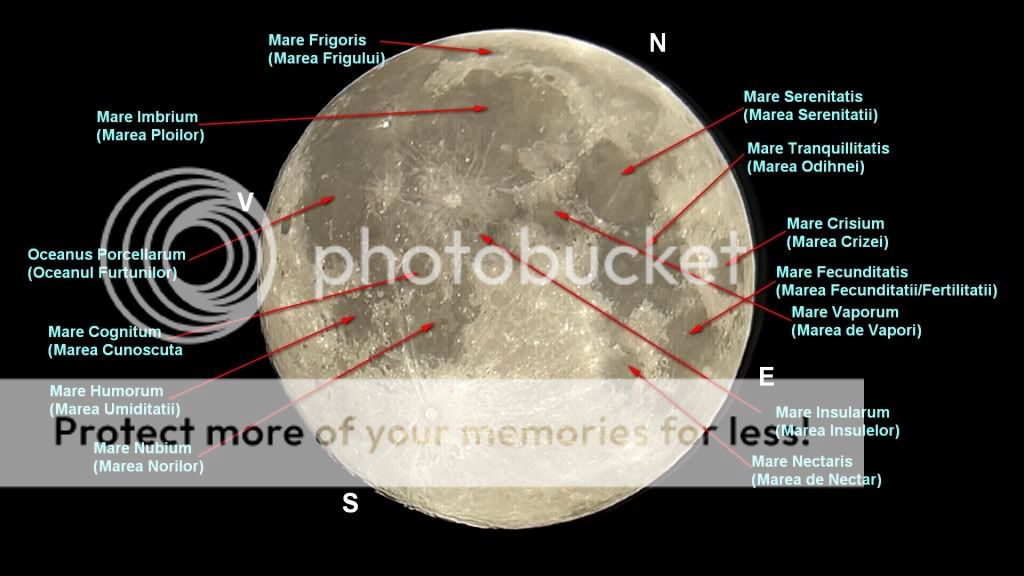
East of the Moon is marked by several interesting features. Most notably is Mare Crisium, a "sea" visible from the Earth with the naked eye as an isolated spot by other seas, dark in colour.
 Notable craters on the east side of the Moon are Posidonius, Petavius ​​and Langrenus, which are the largest in size.
 Even if it seems that East of the Moon has not too many huge craters, actually there are many  small craters as we can see in the list below.

Craters of the Moon's eastern area.

Adams
Al Bakri
Ansgarius
Apollonius
Asada
Atwood
Auzout
Balmer
Barkla
Battuta
Beaumont
Behaim
Beketov
Bellot
Berosus
Bessel
Bernoulli
Berzelius
Bilharz
Bohnenberger
Borda
Buckhardt
Cajal
Capella
Carrel
Carmichael
Catharina
Cauchy
Censorinus
Cepheus
Chacornac
Ching-Te
Cleomedes
Clerke
Colombo
Condorcet
Cook
Crozier
Cyrillus
Daniell
Da Vinci
Dawes
Debes
Dubiago
Eimmart
Fabbroni
Fermat
Firmicus
Fracastorius
Franklin
Fredholm
Furnerius
Gardner
Gauss
Geminus
Gilbert
Goclenius
Greaves
Gutenberg
Hase
Hahn
Hall
Holden
Humboldt
Hypatia
Isidorus
Jansen
Kapteyn
Kastner
La Perouse
Lame
Langrenus
Lawrence
Leakey
Legendre
Lick
Lindbergh
Lindenau
Littrow
Lohse
Lucian
Lubbock
Lyell
Maclaurin
Maclear
Macrobius
Magelhaens
Manilius
Manners
Maraldi
Marinus
Maskelyne
McClure
Menelaus
Mercurius
Messier
Messala
Metius
Monge
Monnier
Nansen
Naonobu
Newcomb
Nobili
Plinius
Ross
Palitzsch
Peirce
Petavius
Picard
Piccolomini
Plinius
Proclus
Reichenbach
Rheita
Ritter
Romer
Rothmann
Sabine
Santbech
Secchi
Sinas
Schumacher
Snellius
Stella
Stevinus
Sulpicius Gallus
Swift
Tacitus
Tacquet
Taruntius
Teophrastus
Theophilus
Tisserand
Torricelli
Tralles
Vendelinus
Vitruvius
Webb
Weinek
Wrottesley
Wrottesley
Zagut


Seas of the Moon's eastern area.

Mare Anguis
Mare Crisium
Mare Fecunditatis
Mare Nectaris
Mare Serenitatis
Mare Spumans
Mare Tranquillitatis
Mare Undarum

Mountains of the Moon's eastern area.


Montes Pyrenaeus
Montes Secchi
Montes Taurus
Mons Vitruvius
Mons Argaeus

Other forms of relief in the east area of the Moon.


Sinus Asperitatis
Sinus Amoris
Sinus Concordiae
Sinus Successus
Palus Somni
Lacus Somniorum
Vallis Palitzsch
Rupes Altai


Above: Video of east of the Moon through my telescope.

Space missions on the east side of the Moon.

Apollo 16 (1972) with people on board. Apollo 16 was the tenth mission in the Apollo program with humans. It was launched on 16 April 1972 and ended on 27 April. It was a lunar rover mission and brought back 94.7 kg of lunar soil and rock samples.

Apollo 17 with people on board. EVA activity (EVA). Apollo 17 was the 11th and last  manned mission of the Apollo space program. Launched at 12:33 a.m. on 7 December 1972, with a crew of three members: Eugene Cernan, Ronald Evans and Harrison Schmitt. Apollo 17 landing remains the most recent made ​​beyond Earth's orbit.

 Luna 21 (1973) USSR (Union of Soviet Socialist Republics), has successfully carried on the lunar surface rover Lunakhod 2 on January 15, 1973. It sent back 86 panoramic images and over 80,000 TV pictures.

Ranger 8 (1965) USA - intentionally crashed. Launched on February 20, 1965. Ranger 8 successfully sent 7137 images with a resolution of up to 1.5 m.

Surveyor 5 (1967) successfully landedIt sent more than 19,000 images to Earth, and has conducted more than 100 hours of compositional analysis of the surface.

To see the photographic map of the east area of the moon, view: Photographic map of the Moon: East Zone. Lunar Atlas.

 
All images are © Copyright 2010-2015 Lupu Victor. All rights reserved.Images may not be reproduced, published, or copied in any form without written permission of the author. Thank you for respecting the intellectual property rights. ASTROFOTOGRAFIA | Lupu Victor Astronomy - Contact - About
Design by Free WordPress Themes | Bloggerized by Lasantha - Premium Blogger Themes | Online Project management